

Sophia Duleep Singh: The Princess Who Stood Outside a Palace and Demanded the Vote
Updated: Mar 13

On certain mornings in the early twentieth century, visitors wandering through Hampton Court Palace might have encountered a scene that felt oddly out of place. Outside one of the royal residences stood a woman dressed with unmistakable elegance, selling a newspaper that openly promoted rebellion. A simple board leaned beside her with a single word written boldly across it: Revolution. She was not a hired demonstrator or a passing agitator. She lived there. And she was a princess.
Sophia Duleep Singh’s life unfolded at a fault line where empire, class, race, and gender all pressed against one another. She was raised within the heart of the British establishment, surrounded by royal favour and imperial ceremony, yet she became one of the most conspicuous and persistent supporters of militant women’s suffrage in Britain. Her story is not neat, and it does not fit comfortably into heroic templates. She was protected when others were punished, celebrated when others were dismissed, and watched constantly by a state that never quite trusted her. But she was also relentless. And she never stopped insisting that women’s political rights mattered.

A child born from conquest
Sophia Alexandra Duleep Singh was born on 8th of August, 1876, in Belgravia, London. From the beginning, her life was shaped by loss disguised as privilege. Her father, Maharaja Sir Duleep Singh, was the last ruler of the Sikh Empire in Punjab. As a child, he had been forced to abdicate his kingdom following the British annexation of Punjab in 1849. As part of that settlement, the Koh i Noor diamond was handed over to the British under a treaty that left no room for refusal.
Duleep Singh was removed from India as a teenager and brought to Britain, where he was remade into a model imperial subject. Queen Victoria took a personal interest in him, treating him with a mixture of fascination and pity. In her private writings, she described him as extremely handsome, refined, and dignified, adding that she felt great sympathy for “these poor deposed Indian princes”. The language is revealing. Affection and domination coexisted easily.
Sophia’s mother, Bamba Müller, added further layers to the family’s identity. She was the daughter of a German merchant banker and a woman of Ethiopian descent who had once been enslaved. Sophia was named after that grandmother, and also given the name Alexandrovna in tribute to Queen Victoria, whose own first name was Alexandrina. Some sources suggest she also carried the name Jindan, after her paternal grandmother Maharani Jind Kaur. Even her name reflected the convergence of African, Indian, European, and British royal histories.
Sophia was one of six surviving children. Her siblings included Catherine Hilda Duleep Singh, who would also become involved in suffrage activism, her sister Bamba, and her brother Frederick. The family lived at Elveden Hall in Suffolk, surrounded by the outward trappings of aristocratic comfort. Yet behind the scenes, the British state kept a close watch. Officials at the India Office monitored the family carefully, worried that the descendants of a deposed ruler might one day become politically inconvenient.

Illness, death, and abandonment
Sophia’s childhood was punctuated by trauma. At the age of ten she contracted typhoid. Her mother, who cared for her during the illness, also fell sick and died on 17th of September, 1887. The loss left a lasting mark. Not long afterwards, her father’s behaviour grew more erratic. His earlier closeness to Queen Victoria faded as his resentment towards Britain deepened.
Duleep Singh attempted to return to India in 1886 with his family, defying the wishes of the British government. The attempt failed. The family was turned back at Aden, stopped by arrest warrants issued to prevent his return. From that point on, his life unravelled. He moved between countries, accumulated debts, and took up relationships in Paris. At one stage he openly disavowed responsibility for the financial ruin he had caused his family.
When Sophia’s father died in a run down Paris hotel on 22nd of October, 1893, he was fifty five years old. His children inherited money, but not stability. They were placed under guardianship until they reached adulthood. Accounts from the period describe the siblings living in a house stripped of its former security, surrounded by packing crates, while polite society whispered about their misfortune.
It was an education in how fragile imperial favour could be.
Hampton Court and the performance of respectability
In 1898, Queen Victoria granted Sophia and her sisters Catherine and Bamba grace and favour apartments at Faraday House within Hampton Court Palace, along with an annual allowance of two hundred pounds. It was a generous gesture, but it also came with expectations. Living at Hampton Court meant visibility, gratitude, and restraint.

For a time, Sophia embraced the role. She attended debutante balls, wore Parisian fashion, bred championship dogs, cycled, experimented with photography, and moved comfortably through upper class social life. On one voyage to India aboard the SS Barbarossa, she paid careful attention to dining etiquette and seating arrangements. She refused outright to allow her dogs to travel anywhere but near her, feeding them fine cuts of meat and even, occasionally, brandy. Suggestions that the animals be sent to steerage with her maid were rejected without hesitation.
This period is often portrayed as frivolous, but it mattered. Sophia learned how attention worked, how image could be managed, and how public performance could be used deliberately. These skills would later be turned towards political ends.
India and political awakening
Sophia made several visits to India over her lifetime, all of them monitored by British officials. The state feared that the presence of Duleep Singh’s daughters might stir dissent. In that fear, they were not entirely wrong.

Her visit to the Delhi Durbar in 1903 left her disillusioned. She found herself largely ignored by imperial ceremony, a reminder that royal lineage meant little under colonial rule. It was during her longer stay between 1906 and 1907 that her outlook shifted decisively.
In Punjab, she witnessed widespread poverty and rising political unrest. She met Indian nationalist leaders such as Gopal Krishna Gokhale and Lala Lajpat Rai and was deeply moved by their speeches and conviction. By April 1907, after six months in India, she had seen enough to feel drawn towards the cause of Indian self determination. When Lala Lajpat Rai was later imprisoned on charges of sedition, her sympathy hardened into anger at the British administration.
She returned to Britain changed, with a growing sense that injustice was not abstract, and that silence was a form of complicity.
Turning towards suffrage
Within a year of her return, Sophia joined the Women’s Social and Political Union, led by Emmeline Pankhurst. She also became an active member of the Women’s Tax Resistance League, whose slogan was simple and uncompromising: No Vote No Tax.
At first, she resisted public speaking. She described herself as useless at chairing meetings and claimed she could manage only a few words at a time. But she compensated through other means. She funded suffrage groups, loaned equipment, organised fundraising weeks, and used her title to attract attention.
Her position within the movement was complicated. Suffrage organisations were happy to capitalise on her status as a princess, even while leaving wider class hierarchies largely unexamined. Historians later pointed out that her presence highlighted the contradictions within the movement itself.
Sophia seemed aware of this tension and chose to use it rather than deny it.
Black Friday and the limits of protection
On 18th of November, 1910, around three hundred women marched to Parliament seeking a meeting with Prime Minister Herbert Henry Asquith. The government had stalled on the Conciliation Bill, which would have extended voting rights to some women. Asquith refused to meet them.
The demonstration turned violent. Police were ordered to clear the protest. Women were shoved, beaten, and assaulted by officers and members of the crowd. Many were seriously injured. Two later died from their injuries. Calls for an inquiry were dismissed by the Home Secretary, Winston Churchill.
Sophia was among the women arrested that day. Her presence attracted immediate press attention. She was, as her biographer later noted, about as close to a celebrity as a suffragette could be.
Yet class intervened. Charges against her were quietly dropped. She was never imprisoned. Despite repeatedly placing herself in harm’s way, she was denied the chance to become a martyr. As one account dryly observed, not even throwing herself at the prime minister’s car was enough to earn her the same punishment as women of lower rank.
Protest at the palace gates
After Black Friday, Sophia’s activism intensified. In 1911, she refused to complete the national census, scrawling across the form that women would not be counted because they did not count politically. She refused to pay taxes and licence fees. When bailiffs arrived, her jewellery was seized and auctioned. Friends often bought items back and returned them to her.
She attempted to throw herself in front of Asquith’s car outside Downing Street holding a banner that read “Give women the vote”.
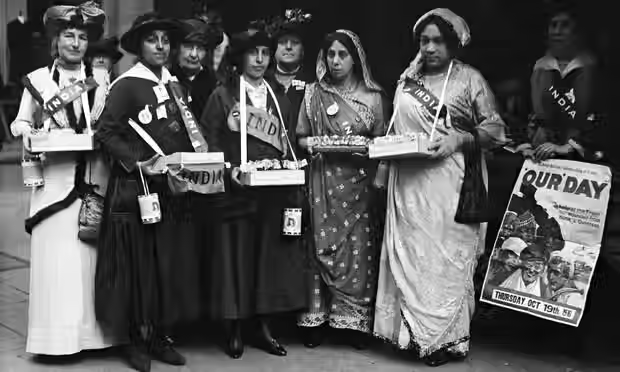
In 1913, she stood outside Hampton Court Palace selling copies of The Suffragette newspaper beside a board reading “Revolution”. The photograph circulated widely and became emblematic of the movement’s attempt to recruit and provoke.
Behind the scenes, the India Office collected press clippings about her, tracked her finances, and exchanged memoranda about her behaviour. King George V reportedly asked in frustration whether there was any way to restrain her. Parliament, not the monarchy, controlled her finances, and the answer was effectively no.
War, service, and shifting priorities
When the First World War broke out, the suffrage movement fractured. Like many others, Sophia redirected her energies towards wartime service.
She volunteered as a nurse with the British Red Cross and served at an auxiliary military hospital in Isleworth between October 1915 and January 1917. There she cared for wounded Indian soldiers evacuated from the Western Front. Many struggled to believe that the granddaughter of Maharaja Ranjit Singh was tending them in uniform.
She also raised funds for Indian troops and supported Indian sailors working in British fleets.
Votes won and a quieter persistence
In 1918, Parliament passed legislation allowing women over thirty to vote if they met certain property qualifications. Full equality followed in 1928.
Sophia remained involved with suffrage organisations for the rest of her life. In 1934, she described her life’s purpose simply as “the advancement of women”.
She returned to India in 1924 with her sister Bamba, travelling through Punjab. Crowds gathered wherever they went, calling out, “Our princesses are here.” At Jallianwala Bagh, the site of the 1919 massacre, her family’s history collided once again with the violence of empire.
During the Second World War, she evacuated from London to Buckinghamshire with her sister Catherine and three children from the city. Her final years were spent with her companion and housekeeper Janet Ivy Bowden and Bowden’s daughter Drovna, whom Sophia made her goddaughter.
Sophia often spoke to Drovna about voting. She would say that once you had the right, you must never fail to use it, because it had been won at great cost.
Death and recognition
Sophia Duleep Singh died in her sleep on 22nd of August, 1948, aged seventy one. She was cremated according to Sikh rites, and her ashes were taken to Punjab by her sister Bamba and scattered there, though the precise location is not known.
In death, recognition came slowly. She now appears on the plinth of the Millicent Fawcett statue in Parliament Square. She was featured on a commemorative Votes for Women stamp issued in 2018. A blue plaque was unveiled near Hampton Court in May 2023. Films, documentaries, and theatre productions have since revisited her life.
Yet her story still resists easy classification. She was not a martyr. She was not punished in the way many of her comrades were. But she was persistent, visible, and impossible to ignore. From the gates of a palace, she insisted that women deserved political power. And she never stopped insisting that the right to vote mattered.


