

Ecstasy (1933): The Film That Changed What Cinema Could Show
Updated: Jul 6

In the early 1930s, at a moment when cinema was still deciding how bold it could afford to be, a small Czechoslovakian film quietly unsettled almost every assumption audiences held about what could be shown, suggested and felt on screen. Ecstasy, released in 1933, did not arrive with the fanfare of a Hollywood epic, nor with the swagger of a studio-backed provocation. Instead, it drifted in from Central Europe, visually delicate, emotionally restless, and carrying with it a performance that would follow its star for the rest of her life.
To reduce Ecstasy to its most famous scenes would be to miss what makes it linger. Yes, it contains one of the earliest nude scenes in a film intended for general audiences, and yes, it became notorious for the way it framed female sexual pleasure at a time when such things were rarely admitted to exist in polite cinema. But it is also a thoughtful, visually poetic, quietly radical meditation on marriage, frustration, desire and the uneasy space between social respectability and private longing.

A story that begins after the dream
The film opens not with romance, but with its collapse. As one critic neatly observed, “The film starts just when the dream dies.” Eva, played by the then Hedy Kiesler, later known to the world as Hedy Lamarr, has just married Emil, a wealthy older man, portrayed by Zvonimir Rogoz. It is not the beginning of happiness, but its swift unravelling.
Their wedding night establishes the emotional grammar of the entire film. Instead of the warmth or excitement one might expect, Eva spends it alone and confused. Emil refuses to come to bed, distracted by a small cut on his finger while unclasping her necklace. Rather than laugh it off or return to her side, he withdraws entirely, preferring to sulk alone rather than endure even the smallest discomfort for his wife.
This pattern becomes his defining trait. As the source text describes it, “A minor inconvenience will move him to retreat so far into himself that he might as well be irretrievably lost as far as Eva is concerned.” Emil is not merely emotionally distant, he is controlling. He tells callers that Eva is not home even when she is sitting next to the telephone, looking him in the eye. He insists this is for his peace of mind.
What Machatý constructs here is not simply a cold husband, but a suffocating domestic environment in which Eva exists more as a possession than a partner. There is no cruelty in the conventional sense, no raised fists or shouted threats, only a persistent narrowing of space around her life.

Watching happiness elsewhere
The film lingers on Eva’s growing isolation with a quiet observational patience. She becomes, in the words of the source, “the woman distracted at social events by the obvious love between some of the couples in attendance.” These moments are subtle but devastating. Machatý lets the camera drift away from polite conversation and formal gestures to settle on glances between other couples, casual touches, shared smiles. These are things Eva does not have, and increasingly cannot tolerate being reminded of.
Eventually, she files for divorce, noting in the proceedings that she knew from the night she said “I do” that they were fundamentally wrong for each other. This is a striking narrative move for a film made in 1933. Divorce is not framed as scandalous or immoral, but as an act of emotional honesty.
Ecstasy, as the source puts it, becomes “about the sexual and romantic bliss she will soon find with a handsome young engineer, Adam, and how it is sullied by a husband who may give her the divorce she wants but will never really leave her alone.”
A naked swim and a new beginning
It is after Eva returns to her family home that the film’s most famous sequence unfolds. One morning, uplifted by the bright sun, she rides out on horseback and arrives near a pond. She undresses and swims naked, in a scene that has been endlessly analysed, censored, restored and debated.
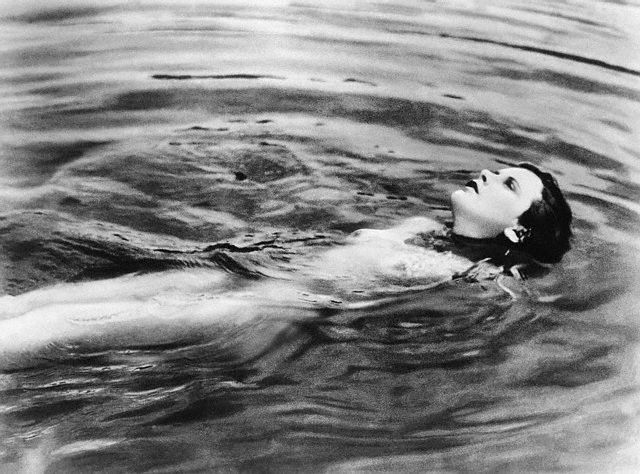
Here, nudity is not presented as spectacle for its own sake, but as a visual expression of freedom. Eva is alone, unobserved, moving through water and light with a physical ease absent from her marriage. It is interrupted when her horse wanders off with her clothes. Enter Adam, played by Aribert Mog, an engineer working on a nearby railway line. He retrieves the horse and brings it back to her, marking the beginning of a connection built not on ownership or control, but on empathy.
His “empathic availability impresses Eva, the two fall in love.” That phrase captures something rare for cinema of the period: a male love interest defined less by dominance or charm than by attentiveness.
That night, Eva joins Adam in his home and, as the source simply states, “can finally get to know the passion of love.”
Eroticism through suggestion, not display
Despite its notoriety, Ecstasy is remarkably restrained in what it shows explicitly. Machatý’s approach to eroticism relies less on bodies than on tension, texture and rhythm. As the first source notes, “This is a film that understands that the erotic, in cinema, is better generated not by showing acts explicitly but by valuing tension and suggestion.”

It is “less interested in a kiss than the way Lamarr’s wet lips look as they wait to be touched by another’s.” It dwells on “the way the light beams off a pearl necklace caressing Lamarr’s unclothed neck,” making it vibrate with anticipation. And perhaps most poetically, it finds sexual metaphor in nature and objects: “shots of some dew dripping off a leaf and into a flower’s pistil” and “excess champagne spilling into another glass.”
These images are not merely decorative. They align Eva’s emotional awakening with the physical world around her, suggesting that desire is not a moral aberration but part of a larger, organic rhythm.
A narrative that refuses punishment
For a film of its time, Ecstasy is strikingly unwilling to punish its female protagonist. Many films of the era demanded moral retribution for women who sought pleasure outside marriage. Machatý’s film is different. As the source observes, “Ecstasy is nonetheless apt not just in how it depicts lust, but also how much circa-1933 society’s acceptance of a woman’s sexual expression depended on its proximity to marriage.”
Yet the film itself does not rush to condemn Eva. Instead, it is “quicker to empathize with her, lend small, ‘taboo’ moments the momentousness with which she experiences them.” This empathy is perhaps the film’s most quietly radical gesture.
Josephone Baker, who was performing in Paris in the same period and pushing at similar boundaries around female sexuality and the gaze, was doing so with an audience that was both fascinated and deeply uncomfortable."

A tragic convergence
The narrative takes a darker turn when Emil attempts to reconcile. He drives to see Eva, unaware that Adam is now her lover. Fate, or perhaps Machatý’s taste for symbolic convergence, brings the two men together when Emil’s car breaks down near the railway construction site managed by Adam. Adam asks Emil for a lift, and during the journey Emil notices Eva’s necklace in Adam’s possession, the one left behind after their night together.
In this moment, the emotional geometry of the film collapses into a single realisation. Emil understands he has lost Eva, not merely emotionally but irreversibly.
That evening, while Eva and Adam dance, Emil writes a note to his mother and shoots himself. The film treats his suicide with restraint rather than melodrama. Adam later reflects that he might have helped the man had he known who he was. Eva realises she is, in part, the cause, but says nothing.
Their planned escape to Berlin dissolves under the weight of guilt. Eva leaves alone while Adam sleeps, and he returns to his work, never forgetting her.
A troubled production
The creation of Ecstasy was as complex as its reception. Produced by Slavia-Film in Prague, the film was initially conceived without dialogue. A German language script of only five pages was written partway through production, with much of the film shaped through improvisation and visual storytelling.
Filming took place across Czechoslovakia, Slovakia and Austria, including Barrandov Studios in Prague, a pond in Jevany, and locations in Dobšiná, Topoľčianky, Khust and the Carpathians. Interior scenes were shot in Vienna. Sound dialogue in German was produced later in Prague between September and October, 1932.
The role of Eva was initially offered to Lupita Tovar, who declined due to the nude scenes, and later to Adina Mandlová, who also withdrew. Hedy Kiesler accepted, a decision that would define her early career.

Lamarr’s account
Lamarr later offered a vivid, deeply conflicted account of making the film in her autobiography Ecstasy and Me. She recalled,
“... I had no reason to have fears about the film. I had no idea of the humiliation it would cause me... When I agreed to make the film, there were no scenes in which I had to appear naked, nor close-ups of intercourse.”
She described how Machatý pressured her into the nude scenes:
“The director yelled: if you don’t do this scene, the movie will be ruined, and we’ll make up for the losses on you!”
She recounted undressing behind a tree, running naked into the lake, and discovering later that the camera had been far closer than promised. “They had used the telephoto lens,” she wrote. “I would sit there and I wanted to kill the director.”
Her description of the love scene is even more unsettling, involving a safety pin used to provoke physical reactions:
“When Aribert slipped out of the lens on one side, the director on the other side pricked my buttock with a pin and I reacted.”
Lamarr insisted that what appeared as sexual ecstasy on screen was in reality exhaustion and pain:
“If you have ever seen Ecstasy I can only tell you that in the close-up scenes you could see me agonizing from pinpricks!”

Not everyone accepted her account. Cinematographer Jan Stallich later said that “the protagonist of the film knew that she would have to appear naked in some scenes, and she didn’t make any fuss during production.”
Censorship and condemnation
Unsurprisingly, Ecstasy faced severe censorship. It was condemned by the Catholic Legion of Decency, and Pope Pius XI spoke negatively of it after a Vatican journalist attended its Venice screening. In the United States, Joseph Breen of the Production Code Administration called it “highly – even dangerously – indecent.”
The film was banned outright in Pennsylvania, heavily cut elsewhere, and denied general release due to the Hays Code. It circulated instead through independent theatres, often under alternative titles such as My Ecstasy and Rhapsody of Love.
Yet audiences found it. According to Variety, by 1945 it had grossed $1,500,000 in North America alone.
Fritz Mandl and the Attempt to Destroy the Film
Eva Kiesler's performance in Ecstasy made her famous across Europe. It also made her extremely difficult to marry off. In 1933, she married Fritz Mandl, an Austrian arms dealer and one of the wealthiest industrialists in Central Europe. Mandl was a controlling, jealous man who viewed the film as a personal humiliation and set about trying to eliminate it from existence. He spent years buying up prints wherever he could find them, paying whatever the owners asked, and had them destroyed. He was unable to buy them all. The film was too widely distributed, too profitable for independent exhibitors, and too interesting to audiences to disappear completely. Mandl's obsession with controlling Eva's image would ultimately fail on that front too: in 1937, she escaped the marriage by drugging her maid, borrowing the maid's uniform, and walking out of their Vienna home. She made her way to London, changed her name to Hedy Lamarr at the suggestion of MGM head Louis B. Mayer, and the rest followed.
A legacy beyond scandal
In 1934, Machatý won Best Director at the Venice Film Festival. In 2019, a restored Czech version was screened again at Venice, nearly nine decades after its creation, its images no longer scandalous but still quietly powerful.
Today, Ecstasy stands not merely as a provocative relic, but as a reminder of how early cinema could, even under intense social pressure, imagine women as desiring subjects rather than moral objects.
It remains a film that does not shout its radicalism, but whispers it through light on skin, water on leaves, and the quiet, determined gaze of a young woman refusing to remain confined by someone else’s peace of mind.
The most remarkable footnote to Lamarr's story has nothing to do with cinema. During the Second World War, working with composer George Antheil, she co-invented a radio guidance system for torpedoes that used frequency-hopping spread spectrum technology to prevent jamming. The patent, filed in 1942 and granted in 1942, was not used by the US military during the war, and lapsed before the technology found commercial application. It was only decades later that the underlying principle was recognised as foundational to modern WiFi, Bluetooth, and GPS systems. In 1997, Lamarr and Antheil were awarded the Electronic Frontier Foundation Pioneer Award. She was 82. She had spent most of her life being known primarily for a nude swim in a 1933 Czechoslovakian film. The technology in your pocket owes something to the same woman.
You can watch the 1933 film Ecstasy in full here


