

When Bettie Page Demonstrated America’s Striptease Laws in 1953
Updated: Mar 31

In the early 1950s, America had a peculiar problem. Striptease performers were not entirely sure how much of themselves they were legally allowed to reveal. The answer depended entirely on which state they happened to be performing in, and the rules could change dramatically from one place to the next.
For dancers travelling from city to city, this created a rather practical dilemma. Could you remove your gloves? Your bra? Could you turn your back to the audience while removing something questionable? And what exactly counted as indecent exposure anyway?
One Chicago magazine decided the easiest way to answer these questions was with a demonstration. And if you were going to demonstrate the legal limits of American striptease in 1953, there was arguably no better model to ask than Bettie Page.
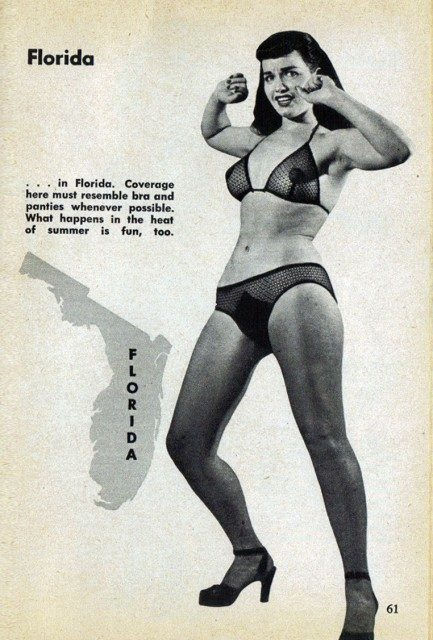
So in December 1953, the second issue of Carnival magazine published what might politely be described as a public service announcement for burlesque performers. The article was titled “Guide for Strip Teasers”, and it featured a young Bettie Page modelling the legal restrictions of stripping across various US states.
It was educational. Of a sort.

A Magazine With an Eye for Curiosity
Carnival was a digest sized magazine produced by Hillman Publications, a Chicago based publishing company founded by Alex Hillman. Hillman had built his business on an eclectic mixture of pulp genres that reflected the American reading public of the mid twentieth century.
True crime magazines were a major part of the company’s output. So were confession magazines, celebrity features, and a steady flow of sensational illustrated content. Hillman also produced comic books during the 1940s and early 1950s, many of which mirrored the same lurid storytelling style found in his adult magazines.
The publishing house was nothing if not adaptable. If the public wanted scandal, Hillman printed scandal. If they wanted celebrity coverage, he printed that as well. At various points the company also produced right wing political material alongside mainstream entertainment titles.
Carnival was one of the smaller publications in Hillman’s portfolio. It appeared in digest format and combined humour, novelty features, and the sort of light curiosity pieces that could easily be read during a train journey or lunch break.
The “Guide for Strip Teasers” article fit comfortably within that spirit. It was cheeky, mildly educational, and just daring enough to catch the attention of readers browsing the magazine rack.
Bettie Page Before the Fame
By the time the article appeared in December 1953, Bettie Page was still in the early stages of her modelling career.
Although she would later become one of the most recognisable pin up models in American history, her rise to fame had not yet fully taken shape. At this stage she was appearing regularly in the publications of Robert Harrison, whose magazines such as Eyeful and Beauty Parade specialised in pin up photography.
Interestingly, Page was often not identified by name in these early appearances. Models in pin up magazines frequently went uncredited, and readers tended to recognise them visually rather than by biography. The iconic jet black bangs that later became synonymous with Bettie Page were already present, but the cult status that would surround her decades later had not yet arrived.

The more widely known phase of her career would soon begin when photographer and film producer Irving Klaw started working with her. Klaw’s studio would produce the photographs and short films that eventually cemented Page’s reputation as the most famous pin up model of the 1950s.
The Carnival feature therefore captures an interesting moment just before that transition.
The Photographer: Nick de Morgoli
The photographs were taken by Nick de Morgoli, a photographer who was far better known for photographing Hollywood celebrities than pin up models.
De Morgoli had an impressive career in magazine photography. His portraits of Marilyn Monroe appeared on magazine covers around the world and were published in titles such as Photoplay, Motion Picture Magazine, and Screen Life. For several years he also worked as a staff photographer for Vogue.

Earlier in his career he had worked with the PIX news agency, producing images that occasionally appeared in Life magazine. His portfolio ranged widely from celebrity portraits to automotive photography for publications like Argosy.
In short, de Morgoli was not primarily a glamour photographer. He was a working magazine photographer who moved comfortably between assignments.
Which perhaps explains why the Bettie Page photographs in Carnival have a slightly utilitarian quality to them. As some collectors have noted over the years, they are not the most polished images of Page’s career. De Morgoli tended to work quickly and directly rather than staging elaborate pin up compositions.
A Small Typographical Mishap
There is also a small historical curiosity attached to the photographs.
In the printed issue of Carnival, the photographer’s name was credited incorrectly. Instead of “Nick de Morgoli”, the magazine listed him as Nick de Margoli.
Whether this was a typographical error or a hurried editorial oversight is unclear. Given that the article itself does not credit the writer at all, it seems likely that the editorial process for the magazine was not overly concerned with precision.
Demonstrating the Legal Limits of Striptease
The central idea of the article was straightforward.
Different American states had different laws governing burlesque performances and striptease routines. Some jurisdictions allowed dancers to remove most of their clothing as long as they remained technically covered. Others imposed stricter limitations about what could be shown or how performers could move on stage.

For travelling performers the rules could become confusing very quickly. A routine that was perfectly acceptable in New York might attract police attention in another state.
The article therefore presented a visual guide to these restrictions. Bettie Page posed in a sequence of photographs demonstrating the various stages of undressing that might or might not be permitted depending on local law.
One state might allow a dancer to remove gloves and outer garments but require that a bra remain in place. Another might permit the removal of stockings but forbid complete toplessness. In some locations performers could turn away from the audience while removing certain items, creating the illusion of nudity without technically revealing anything illegal.
It was a peculiar mixture of legal interpretation and burlesque choreography.
In effect the article functioned as a slightly mischievous handbook for navigating America’s patchwork morality laws.

The Culture of Burlesque in the 1950s
To understand why such a guide might have seemed useful, it helps to remember how popular burlesque and striptease were during the mid twentieth century.
Burlesque theatres existed in many major American cities and were part of a long tradition of stage entertainment that blended comedy sketches, variety acts, and striptease performances. Famous performers such as Gypsy Rose Lee had already turned the art of teasing rather than revealing into a sophisticated stage craft.
However, the legal boundaries surrounding these performances were rarely consistent. Local authorities could interpret obscenity laws differently, and police raids on burlesque theatres were not uncommon.

This created a somewhat uncertain environment for performers. Dancers had to balance audience expectations with the risk of running afoul of local regulations.
In that context, a magazine article explaining what could be removed, when, and how, may have seemed almost practical.
Bettie Page’s Unexpected Educational Role
Looking back today, there is something quietly amusing about the idea of Bettie Page serving as a legal demonstration model.
Yet the photographs also reflect a broader moment in American cultural history. The early 1950s were a time when attitudes toward sexuality were beginning to shift, but public discussion of those changes often took place through humour or coded language rather than direct debate.
A digest magazine like Carnival could explore these subjects lightly, presenting them as curiosities rather than serious social commentary.
Bettie Page, with her distinctive appearance and relaxed on camera presence, was well suited to that tone. She could deliver a playful wink at the camera without appearing confrontational.
Within a few years she would become one of the defining pin up figures of the decade. Her photographs would circulate widely in magazines, calendars, and eventually underground film loops produced by Irving Klaw.
But in December 1953 she was simply modelling the legal limits of American striptease.

A Curious Footnote in Pin Up History
The Carnival magazine feature remains a small but intriguing episode in the history of Bettie Page photography.
It captures a moment before her fame fully arrived, photographed by a magazine photographer who was better known for shooting Hollywood stars, published in a digest magazine that happily mixed humour, curiosity, and a touch of scandal.
The article also offers a glimpse into a strangely bureaucratic side of burlesque culture. Behind the glamour and stage lights were performers carefully navigating a patchwork of state regulations that could determine how many buttons, stockings, or gloves could legally be removed.
In the end, Bettie Page provided a helpful visual guide.
History does not record whether any travelling dancers actually used the article as a reference manual.
But for one issue of a small Chicago magazine in December 1953, American striptease law was explained with admirable clarity.
And, perhaps more importantly, with excellent bangs.
Sources
Bettie Page The Life of a Pin Up Legend by Karen Essex and James L Swanson
The Bettie Page Collection by Irving Klaw
Vintage Men’s Adventure Magazines by Robert Deis
Hillman Periodicals history https://www.pulpartists.com/Hillman.html
Nick de Morgoli photography archive https://www.gettyimages.com/photos/nick-de-morgoli
Pin Up History Project https://www.pinuphistory.com


