

The 1998 Vatican Murders: Three Bodies, One Night, and Questions That Won't Die
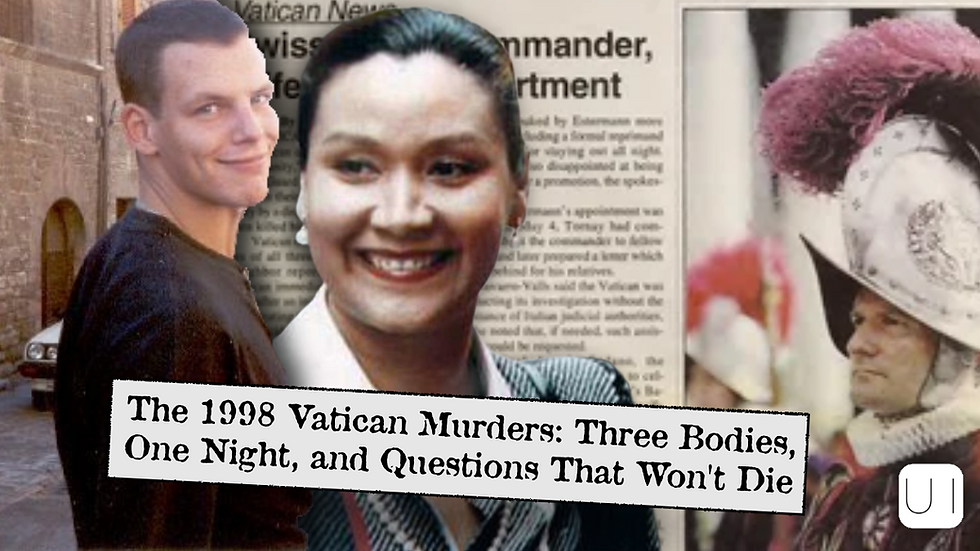
The most shocking crime in Vatican City's modern history happened in seconds — but the controversy has lasted decades.
At 9 p.m. on 4 May 1998, five gunshots rang out inside an apartment tucked within the fortified walls of Vatican City. By the time anyone came to investigate, three people were dead: the newly appointed commander of the elite Pontifical Swiss Guard, his wife, and a 23-year-old lance corporal.
The Vatican announced its verdict within hours. It was, officials said, a murder-suicide triggered by a young soldier's bitter resentment over a denied medal. The world was stunned — and many were deeply unconvinced.
More than 25 years later, the case remains one of the most debated mysteries in the modern history of the Catholic Church.
The Victims: Who Were They?
Alois Estermann — The Commander
Alois Estermann was born on 29 October 1954 in Gunzwil, in the Canton of Lucerne, Switzerland, and grew up on a farming family estate near Beromünster. He was not born into power — he earned it meticulously. After graduating from a business school in Lucerne in 1975 and completing officer training at the Swiss Army school in Thun, he began his Vatican career in 1977 with a brief early stint in the Pontifical Swiss Guard. He formally joined the Guard in 1980 and spent nearly two decades climbing its ranks.

His most dramatic moment came on 13 May 1981, when Pope John Paul II was shot by Turkish gunman Mehmet Ali Ağca in St. Peter's Square. Estermann was one of the bodyguards assigned to the popemobile that day, and photographs captured him reacting in the chaos. That connection to one of the most infamous assassination attempts of the 20th century would later fuel conspiracy theories about his death.
By 1998, with the previous commander Roland Buchs having retired, the Holy See spent an unusually long five months deliberating before selecting Estermann — initially as acting commandant — to lead an institution that has protected popes since 1506. He officially became the 31st Commander of the Pontifical Swiss Guard on the afternoon of 4 May 1998. He was 43 years old. He did not survive the night.
Gladys Meza Romero — The Ambassador's World
Estermann's wife, Gladys Meza Romero, was born in Venezuela in 1949 and arrived in Italy in the late 1970s as a fashion model. Few people in this story are as overlooked as Gladys, who was in many ways the most cosmopolitan figure of the three. She studied hard after arriving in Rome, earning degrees in both civil and canon law from the Pontifical Lateran University — a prestigious papal institution. She met Alois Estermann in an Italian language class in Rome, and the two married in 1983.
By 1998 she was 49 years old and working as an archivist at the Venezuelan Embassy to the Holy See — a job she had held for approximately five years. To those in Rome's diplomatic circles, the Estermanns were a beloved couple: elegant, devout, and sociable, regularly attending diplomatic receptions and Sunday Mass. Cristina di Vollmer, wife of the Venezuelan ambassador, described Gladys as "a person of extraordinary human qualities, very beautiful, very elegant and always with a smile on her lips."
She was on the phone with a friend at 8:46 p.m. that night when Cédric Tornay knocked at the door. She answered it herself.
Cédric Tornay — The Man With a Grievance
Cédric Tornay was born on 24 July 1974 in Saint-Maurice, in the canton of Valais, Switzerland — a town known for its ancient abbey and relative quiet. Before joining the Swiss Guard, he had worked as a garage mechanic. He arrived in Rome in 1994 to join the Guard, motivated at least in part by the famous Benemerenti Medal, which is routinely awarded to Swiss Guards who complete three years of service. Former commander Roland Buchs, who knew Tornay personally, described him as an idealist — someone who was acutely "sensitive to the way other people treated him."
The Vatican's own final report painted a complicated portrait: "uninhibited and disrespectful" on one hand, "polite and kind" on the other. He regularly used marijuana, and an autopsy later revealed a brain cyst "the size of a pigeon egg" — a discovery the Vatican would lean on heavily to explain his actions.

His relationship with Estermann soured dramatically in February 1998, when Tornay spent a night outside Vatican City without permission — a clear regulatory violation. Estermann disciplined him for the infraction and, crucially, used it to deny Tornay the Benemerenti Medal. The timing was particularly cruel: the denial came just two days before Tornay would have received it, after three years and six months of service. It is believed by some observers that the medal was the primary reason Tornay had stayed in the Guard as long as he had.
The Night of the Murders
The evening of 4 May 1998 should have been a celebration. Just hours earlier, Estermann had been officially confirmed as commander in a formal Vatican ceremony. Forty new Swiss Guard recruits were preparing to take their oath of loyalty just two days later — families had already arrived in Rome.
Instead, at approximately 9 p.m., Tornay arrived at Estermann's apartment in the Swiss Guard barracks near the Porta Sant'Anna — the entrance closest to Vatican City's boundary with Rome. The investigation report reconstructs what followed in forensic detail:
At 8:46 p.m., Gladys and Alois had been on the phone with a friend. Alois was still speaking when Gladys opened the apartment door to Tornay. Tornay rushed past her toward Estermann and fired twice with his SIG Sauer P220 9mm service pistol — the standard-issue sidearm of the Swiss Guard — striking Estermann in the shoulder and the left cheek. Estermann died from those wounds. Tornay then turned on Gladys. His first shot missed, the bullet punching through the apartment door and embedding itself in the lift door on the landing outside. His fourth shot killed her. He then knelt on the floor and shot himself through the roof of his mouth. The pistol was found beneath his body.
A nun named Anna-Lina Meier, who worked periodically in the Swiss Guard barracks, heard noise from the apartment and went to investigate. Finding the door ajar and Gladys's body visible, she was too shaken to go further alone. She found lance corporal Marcel Riedi, who entered the apartment and discovered all three bodies. Shortly after, the Guard's chaplain, Alois Jehle, informed Pope John Paul II's private secretary, Stanisław Dziwisz, who delivered the news to the Pope.
John Paul II, by all accounts, was visibly distressed.

The Suicide Note
Before going to the apartment, Tornay had written a letter to his mother, Muguette Baudat. In it, he described years of what he called "injustices" at the hands of Estermann, calling him unfair and harsh. He also referenced tensions between the French-speaking and German-speaking factions within the Guard — a long-simmering cultural friction in the institution.
Most pointedly, he wrote: "After three years, six months and three days of enduring all the injustices here, they denied me the one thing I wanted."
The note, while bitter, was not narrowly focused on Estermann alone. His resentment was broader — directed at the institution, at its hierarchies, at what he experienced as systemic unfairness. Whether his grievances accurately reflected reality remains, as the official report acknowledged, unclear.
The Vatican's Response: Swift, Certain, Controversial
The Vatican announced its conclusion within hours of the bodies being discovered. Spokesman Joaquín Navarro-Valls told the world that Tornay had suffered a "sudden fit of madness," brought on by his resentment over the medal denial and what was described as a "peculiar" psychology.
Nine months later, on 5 February 1999, the official investigation was closed. Three days after that, on 8 February, examining magistrate Gianluigi Marrone released a 10-page final report confirming the original verdict: Tornay acted alone, driven by personal resentment, and his judgement had likely been impaired by marijuana use and the brain cyst discovered during autopsy. The names of all witnesses in the report were redacted, making it effectively impossible for journalists to conduct independent verification.
Critics found the report deeply unsatisfying. The Vatican had refused technical assistance from Italian police. The investigation was led by a judge who simultaneously held a position as a personnel manager for the Italian parliament — raising eyebrows over his experience with criminal inquiries. The report was widely described as "very thin." One Italian newspaper called the official explanation "too smooth, too complete."
Swiss President Flavio Cotti expressed the Swiss government's condolences. Cardinal Secretary of State Angelo Sodano offered a poetic statement that simultaneously acknowledged the tragedy and drew a firm line under it: "Dear officers of the Holy See, the pope renews his trust and his gratitude. The black cloud of one day cannot obscure more than five hundred years of service."
A memorial Mass was held for Alois and Gladys Estermann in St. Peter's Basilica — the first time this honour had ever been extended to non-clergy. Tornay's funeral was held quietly in his home town of Saint-Maurice.
The Conspiracy Theories: What Others Believe
The Italian press, in particular, erupted with alternative theories. A Swiss correspondent for the Neue Zürcher Zeitung compared the media frenzy to the coverage of the death of Princess Diana. Multiple books were written, each arguing a different version of events. None has ever produced definitive proof of anything beyond the official narrative — but that hasn't silenced the questions.
Theory 1: The Stasi Connection
Just days after the murders, the German tabloid Berliner Kurier reported that Estermann had been recruited by the East German Stasi secret police in 1979, operating under the codename "Werder." According to the paper's unnamed source, Estermann allegedly filed at least seven detailed intelligence reports on Vatican affairs between 1979 and 1984, with documents passed via a dead-drop system on the Rome-to-Innsbruck night train, where they were collected by Stasi operatives in Austria. The motive attributed to him was financial.
The Vatican forcefully denied the allegation. Spokesman Navarro-Valls stated: "Here in the Vatican we're not even considering such a hypothesis. Unfortunately, this is not the first time that lies have been written about an honest man." The theory nevertheless persists, partly because Estermann had been present at the 1981 papal assassination attempt — an event itself tangled in Cold War intelligence disputes, with some evidence suggesting Soviet and Bulgarian involvement in the plot against John Paul II.
Theory 2: A Gay Affair Gone Wrong
This was among the most explosive theories to emerge. Multiple sources, including investigative journalist John Follain in his book City of Secrets, suggested that Estermann and Tornay had been in a sexual relationship — and that the murders occurred after Estermann ended the affair, possibly to pursue another younger recruit. In the book Verbum Dei et Verbum Gay, author Massimo Lacchei claimed to have observed Estermann and Tornay together socially in the days before the murders and described Tornay as clearly emotionally attached to his superior.
There is no forensic evidence to support this theory.
Theory 3: Power Struggle — Opus Dei vs. Internal Factions
Some writers argued Estermann was connected to the conservative Catholic movement Opus Dei, while others claimed he was sympathetic to a rival internal faction. In this reading, Tornay discovered Estermann's true allegiances and killed him to protect the church before he could take command. The 2002 book Assassinati in Vaticano (Murdered in the Vatican), by Vergès and Luc Brossollet, went further still, arguing that all three people were murdered, the scene was staged, and Tornay's body was placed in the apartment after the real perpetrators fled — hence, supposedly, why no neighbours reported hearing gunshots.
Theory 4: A Mother's Fight
Perhaps the most persistent challenge to the official narrative has come not from journalists or conspiracy theorists, but from Tornay's own mother. Muguette Baudat has never accepted the verdict that her son was a murderer. She hired the late Jacques Vergès — a notoriously flamboyant French lawyer who had defended international terrorists, former Nazi officers, and Serbian president Slobodan Milošević — as her family's legal representative.

Vergès and Baudat's lawyer Luc Brossollet spent years attempting to reopen the case. A 2009 attempt to pursue the matter in Swiss courts failed, as the crime had not occurred on Swiss soil. The Vatican also rejected re-examination, citing a lack of new evidence. A 2019 request to access the case files was denied.
The 2021 Breakthrough — and the Book That Followed
In 2021, something changed. Cardinal Pietro Parolin, the Vatican's Secretary of State, personally intervened and instructed the Vatican City tribunal to pay "particular attention" to Baudat's long-standing request to access the confidential court file. His intervention was announced on the 23rd anniversary of the murders — 4 May 2021.
Baudat's lawyer, Laura Sgro, was granted access and spent the following year reviewing the material. In 2022, she published Sangue in Vaticano (Blood in the Vatican), a book drawing on those court files. Her conclusion was damning — not necessarily that Tornay was innocent, but that the investigation itself was so superficial and poorly conducted that the truth could never be definitively established. She criticised investigators for settling on Tornay as the perpetrator almost immediately, without adequately analysing the crime scene.
Sgro sent copies of the book to Pope Francis and filed a complaint with the United Nations Human Rights Council.
A Statistical Footnote Stranger Than Fiction
Because of Vatican City's extraordinarily small population — fewer than 1,000 residents at any given time — the double homicide of 4 May 1998 gave the tiny state the highest murder rate in the world for that year: over 200 homicides per 100,000 people. In 1999, the rate returned to zero. No country on Earth has ever experienced such a dramatic statistical swing from one year to the next.
The Legacy
The official verdict has never been overturned. Historian Yvonnick Denoël noted that while Tornay had the motive and the psychological preconditions to commit the act, the way the Vatican conducted its investigation "ensured the truth would never be discovered." Politics professor David Alvarez concluded that the various conspiracy theories "either remain unsubstantiated or have been thoroughly discredited."
Author Robert Royal offered perhaps the most deflating summary: Tornay had simply "snapped."
Former commander Roland Buchs, speaking at Tornay's funeral, captured the unresolved nature of the case with unexpected grace: "His act remains mysterious. Who can understand his last gesture? At this tragic time, many 'whys' and 'wherefores' remain in suspense. Only God knows the answers to our questions."
Pope John Paul II, for his part, said of Tornay that he was to be judged by God, "to whose mercy I entrust him."
Three people died inside the walls of the world's smallest nation on one night in May. An institution more than five centuries old was shaken to its foundations. And 26 years later, the questions keep coming.


