

The Goebbels Children: Childhood, Propaganda, and Murder in Hitler’s Bunker
Updated: Jul 9

On the evening of the 1st of May 1945, while Berlin burned above ground and Soviet troops closed in on the Reich Chancellery, six children were being prepared for bed in an underground bunker. Their hair was brushed, ribbons tied, nightdresses straightened. It was meant to feel ordinary. It was anything but.
By the next morning, all six children would be dead, killed not by bombs or advancing soldiers, but by their own parents. They were the children of Joseph Goebbels, the chief architect of Nazi propaganda, and his wife Magda Goebbels. Their deaths remain one of the most unsettling episodes of the Second World War, not because of physical violence, but because they reveal how ideology can reach into family life and erase it completely.

This is not simply a story about the end of the Third Reich. It is a story about childhood shaped by power, performance, and belief, and about what happens when those beliefs leave no room for survival.
A Family That Lived in Public
Joseph and Magda Goebbels had six children together between 1932 and 1940. From the moment they were born, those children were never private individuals. They were photographed, filmed, and displayed as proof that National Socialism was wholesome, orderly, and future focused. Their family life was political by design.
Magda also had an older son from her first marriage, Harald Quandt, who survived the war and later became one of West Germany’s most successful industrialists. His survival throws the fate of his six younger half siblings into stark relief.
The six children were:
Helga Susanne, born 1st of September, 1932
Hildegard Traudel, born 13th of April, 1934
Helmut Christian, born 2nd of October, 1935
Holdine Kathrin, born 19th of February, 1937
Hedwig Johanna, born 5th of May, 1938
Heidrun Elisabeth, born 29th of October, 1940
All were murdered in Berlin on the 1st of May, 1945, the same day their parents took their own lives.
Names, Symbols, and Later Myths
It is often claimed that all the Goebbels children were given names beginning with the letter “H” as a tribute to Adolf Hitler, who was fond of the children and visited the family frequently. The idea is neat and symbolic, but it does not withstand closer scrutiny.

The naming pattern existed before Magda married Joseph Goebbels. Her first husband, Günther Quandt, had already chosen “H” names for his children, and Magda’s mother later described it as a harmless family habit. The persistence of the Hitler theory reflects the way later generations search for symbolic meaning in retrospect, even where none was intended at the time.
Harald Quandt and the Life That Continued
Harald Quandt was born on the 1st of November, 1921, more than a decade before Magda married Goebbels. He attended their wedding in December 1931, with Hitler acting as a witness, and lived for a time in the Goebbels household.
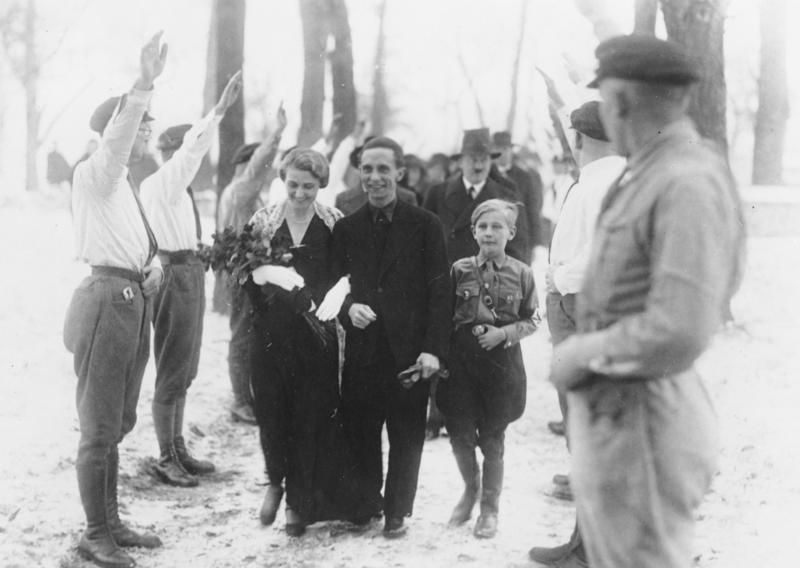
He appeared to admire his stepfather and often accompanied him to public events in Hitler Youth uniform. By 1934, following pressure from Goebbels, Harald’s biological father relinquished custody and Harald became fully integrated into the household.
During the war, Harald served as a Luftwaffe officer. He was captured by Allied forces and was a prisoner of war when his six half siblings were murdered in Berlin. After 1945, he rebuilt his life in West Germany, becoming a prominent industrialist. He rarely spoke publicly about the deaths of the children. He died on the 22nd of September, 1967 when his private aircraft crashed in Italy.
The Children Themselves
Although they are often discussed as a single tragic group, those who encountered the Goebbels children remembered them as individuals.
Helga, the eldest, was intelligent and observant. She was especially close to her father and frequently waited up late so she could sit with him when he returned home. In the bunker, she appears to have sensed that something was wrong. Bruising later found on her face has led many historians to believe she resisted being poisoned.
Hilde, born in 1934, was quieter and more reserved. Joseph Goebbels once referred to her affectionately in his diary as “a little mouse”.
Helmut, the only boy, was sensitive and imaginative. Teachers worried about his academic progress, though intense tutoring helped him advance. In the bunker, when he heard the sound of Hitler’s suicide, he mistook it for an artillery impact and shouted, “That was a bullseye”.
Holdine, usually called Holde, was shy and often described as the least lively of the children. Goebbels is said to have compensated by giving her particular attention.

Hedwig, known as Hedda, was lively and outspoken. She once announced she intended to marry an SS officer because she was fascinated by his artificial eye.
Heidrun, the youngest, was four years old. She was playful and talkative, remembered fondly by bunker staff. She shared a birthday with her father and was described as a reconciliation child, conceived after a period of marital strain.
Privilege Behind Closed Doors
Throughout the 1930s, the Goebbels family lived in considerable comfort. Their estate on Schwanenwerder, an island in the River Havel, offered gardens, ponies, servants, and privacy. A second residence at Bogensee served as a weekend retreat.
This carefully managed domestic image concealed a volatile marriage. In 1938, Goebbels’ affair with Czech actress Lída Baarová nearly ended the relationship. Hitler intervened personally, forcing a public reconciliation to avoid scandal. For the children, little appears to have changed. Domestic harmony, like everything else in the household, was something to be performed.
Growing Up as Propaganda
No senior Nazi exposed his children to propaganda as thoroughly as Joseph Goebbels. They appeared repeatedly in newsreels, photographs, and public events, shown playing in gardens, singing patriotic songs, and attending major political occasions.
In 1939, Goebbels secretly filmed his own children to contrast them with disabled children in propaganda supporting the Action T4 euthanasia programme. Between 1942 and 1944, the children appeared dozens of times in weekly newsreels. They were not background decoration. They were central to the image of Nazism as healthy, moral, and family centred.

The older children were not entirely unaware of the ideology surrounding them. Helga and Helmut, in particular, were reported to repeat speeches, slogans, and political language, often mimicking their father. Indoctrination took place not only in schools and rallies, but at home.
Paula Hitler, Adolf's only sister, had a completely different experience -- she spent the war working in a military hospital and the peace living quietly in a two-room flat, deliberately distancing herself from everything her brother represented.
Belief Without an Exit
By the final months of the war, Magda Goebbels had become increasingly rigid in her thinking. She told others she could not imagine her children growing up in a defeated Germany where their father would be remembered as a criminal. In a letter sent from the bunker to Harald, she wrote that the world to come was not worth living in.
Joseph Goebbels shared this fatalism. In a postscript to Hitler’s will, he wrote that he would not leave Berlin “for reasons of humanity and personal loyalty”. He added that his wife and children supported this decision. He later claimed the children would agree with their fate if they were old enough to understand.
This was not a moment of panic. It was a conclusion reached well before the Red Army arrived.
Life Underground
In April 1945, the family moved into the Vorbunker beneath the Reich Chancellery. Despite the circumstances, witnesses remembered the children as polite, cheerful, and largely unaware of the danger.
They played games, sang songs, and interacted warmly with nurses and secretaries. They slept together in one room and played with Hitler’s dog Blondi. On the afternoon of the 30th of April, 1945, they were with staff members when the sound of Hitler’s suicide echoed through the bunker.

The Murders in the Vorbunker
By the final days of April 1945, there was no doubt among those remaining in the bunker that Berlin would fall. What remained undecided was how the last members of the Nazi leadership would meet that end. For Joseph and Magda Goebbels, the decision had already been made. They would not leave Berlin. And their children, they believed, would not outlive the regime.
Magda Goebbels rejected multiple offers to have the children removed from the city. Albert Speer later recalled trying to persuade her to let them escape, but she refused. Others made similar suggestions. Each was dismissed. Magda had spoken weeks earlier about her belief that her children could not grow up in a world without National Socialism.

On the evening of the 1st of May, 1945, the practical arrangements were put in place.
An SS dentist, Helmut Kunz, was summoned to the family quarters. According to his later testimony, he was instructed to administer morphine injections to all six children in order to sedate them. He stated that he injected each child in turn and that his involvement ended there.
What followed remains one of the most debated aspects of the event. The most widely accepted account is that, once the children were unconscious, cyanide capsules were crushed in their mouths. Kunz later stated that this was done by Magda Goebbels herself and by Ludwig Stumpfegger, Hitler’s personal physician, who did not survive to give testimony.
Nurse Erna Flegel later recalled that Magda reassured the children earlier in the evening, telling them they needed injections because they would be staying in the bunker for some time. The explanation was calm and maternal. There was no sense of urgency or alarm.

Bunker operator Rochus Misch was among the last to see the children alive. He described them sitting together around a table in his work area, dressed in their nightclothes, as their mother combed their hair and kissed them. It was close to bedtime.
Misch recalled that Helga, the eldest, was sobbing quietly. She appeared to understand, at least in part, what was about to happen. Four year old Heidrun, suffering from tonsillitis and wearing a scarf around her neck, behaved very differently. She climbed onto the table, giggled, and teased Misch as she was led away, unaware of what awaited her.
The children were taken upstairs to the Vorbunker, where the injections and poison were administered. Postmortem examinations later revealed bruising around Helga’s mouth and face, suggesting she may have resisted the cyanide capsule. No such marks were found on the other children.
It is unclear whether the children were killed one by one or in quick succession. What is clear is that the process was deliberate and controlled, carried out quietly while the sounds of artillery continued above ground.
Once the children were dead, their bodies were left in their beds, hair still neatly arranged, ribbons still tied.
Later that same day, Joseph and Magda Goebbels went into the Reich Chancellery garden and took their own lives.
Discovery and Disappearance
On the 3rd of May, 1945, Soviet troops discovered the children’s bodies in the Vorbunker, still dressed in their nightclothes. Their remains were buried, exhumed, and reburied several times as Soviet authorities sought to control information surrounding the fate of Nazi leaders.
In 1970, KGB director Yuri Andropov authorised the final destruction of the remains. They were burned and scattered into the Biederitz River. Magda’s mother never learned what became of her grandchildren.
Memory and Unease
In post war Germany, the story of the Goebbels children sat uneasily between innocence and inherited guilt. Harald Quandt remained silent. School curricula largely avoided the subject.
In 2005, Rochus Misch proposed a memorial plaque for the children, arguing that they were innocent victims of ideology. Critics feared such a memorial would risk obscuring the far greater number of children murdered by the Nazi state. The debate remains unresolved.
A Story That Refuses Closure
The Goebbels children did not choose their parents, their beliefs, or their fate. They lived lives shaped by privilege, performance, and propaganda, and died because the adults around them could not imagine a future without power.
Their story remains deeply uncomfortable precisely because it resists easy moral framing. It reminds us that totalitarian belief systems do not end at borders or battlefields. They enter homes, shape childhoods, and, when they collapse, often destroy the very people they claimed to protect.
Sources


