

Alfred Cheney Johnston and the Artistry Behind the Ziegfeld Follies' Golden Era
Updated: Aug 2
I'm often blown away when I see work by an artist I'd never heard of before, I'm pleased to say it's a pretty much a daily occurance. But when I first set eyes on Alfred Cheney Johnston's work I couldn't believe the sheer quality and beauty of what I was looking at. They're the perfect mixture of a classical sculpture with touch of a renaissance pose, aided by the fact they were captured on large glass plates which gives them a flawless detailed look.
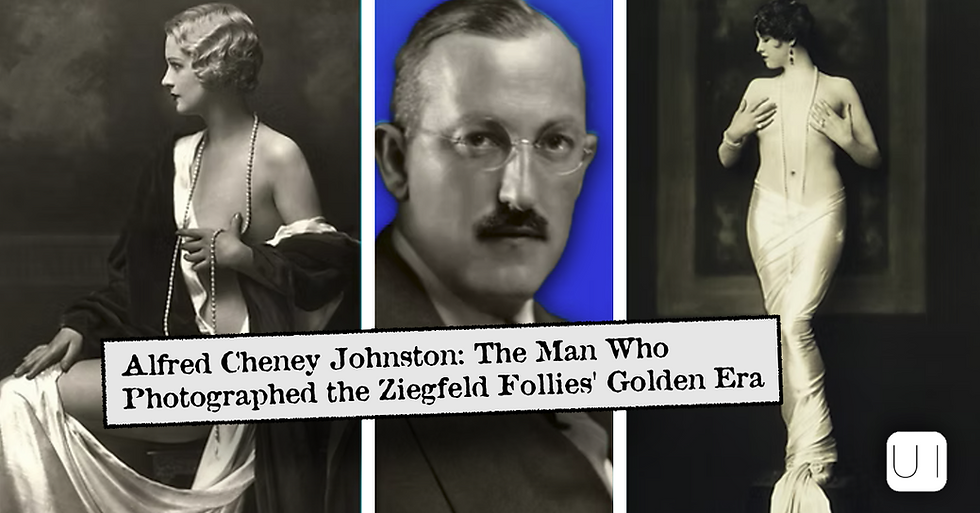
There was a time when beauty wasn't filtered through a phone, but through the platinum shimmer of a glass negative. In the early decades of the twentieth century, photographer Alfred Cheney Johnston became the visual chronicler of an era obsessed with elegance, excess, and female glamour. Best known for his portraits of the Ziegfeld Follies showgirls, Johnston didn't just take pictures, he sculpted beauty. His studio, tucked away in New York City, was a revolving door of dancers, actresses, and ingénues, all hoping to be captured in his distinctive, softly lit style that blended stage fantasy with classical portraiture.
Ziegfeld showgirl holding a mirror, draped in fur and pearls. Performer in sheer costume posed against a velvet backdrop. Seated showgirl in a velvet robe and long strand of pearls
Who Was Alfred Cheney Johnston?
Alfred Cheney Johnston was born on 8th April, 1885, in Westchester County, New York, the son of a bank clerk. Raised in a household that valued refinement and culture, he enrolled at the Art Students League of New York at eighteen before transferring to the National Academy of Design, where he studied painting and illustration. There, he became lifelong friends with a fellow student who would go on to become rather better known: Norman Rockwell.
Johnston graduated from the Academy in 1908 and married a classmate, painter Doris Gernon, the following year. Doris would go on to do much of the darkroom retouching work on his prints and glass plates throughout his career, an uncredited but essential part of his process.
His early efforts to earn a living as a portrait painter went nowhere. It was a family friend, the illustrator Charles Dana Gibson, creator of the iconic "Gibson Girl," who suggested Johnston pick up the camera he'd been using to document his own paintings and make that his medium instead. Johnston took the advice. He first found work as a retoucher at the Sarony photographic studios in New York before striking out on his own, opening his first studio at 57th Street and Sixth Avenue.
By 1917, he had become the official photographer for Florenz Ziegfeld's theatrical revue, the Ziegfeld Follies. Ziegfeld, ever the connoisseur of glamour and spectacle, entrusted Johnston to immortalise the carefully curated beauty of his performers, something he was clearly more than capable of achieving. In 1921, a fire forced Johnston to relocate his studio to the Hotel des Artistes, where he would work for much of the rest of his Follies years. By the end of the 1920s, he was charging as much as $1,200 for a single sitting, a substantial sum for the period.
Ziegfeld showgirl posed with a hoop and silk drapery Performer seated in a shawl and heeled boots, mid-pose. Model draped in fabric before an ornate tapestry backdrop.
The Rise of the Ziegfeld Follies
The Ziegfeld Follies, running from 1907 to 1931, were more than just musical theatre, they were a visual feast. Inspired by the Folies Bergère in Paris, Ziegfeld's productions celebrated American femininity in all its stylised, corseted glory. The Follies showgirls were not just dancers; they were fashion models, icons, and symbols of an opulent, pre-Depression culture.
Johnston played a pivotal role in creating their visual mythology. His photographs were often the first (and sometimes only) record of these performers' brief but brilliant careers. The images featured elaborate costumes, sculptural poses, and a dreamlike aura that turned performers into semi-mythic figures.
Showgirl seated in heels and fur, framed in soft spotlight. Performer reclining on a settee, wrapped in fringe and satin. Close-up of lace-gloved hands holding a cigarette.
Photography as Spectacle: Johnston’s Technical Craft
Johnston was a meticulous technician. He worked primarily with large-format view cameras and glass plate negatives, which allowed for incredible clarity and detail. That clarity is actually the foundation of his look: the negatives themselves are sharp, and the softness people associate with his work comes from his platinum printing process and his careful, directional studio lighting rather than any blur in the lens. It's a subtle but important distinction, and it's part of why his images have aged so well; a genuinely soft-focus negative degrades badly when reproduced at scale, while Johnston's sharp glass plates still hold remarkable detail today.
Importantly, Johnston's images blurred the line between high art and commercial portraiture. Some were overtly sensual, even nude, but always with a veneer of respectability. In an era of strict moral codes, he presented the female form not as scandalous but as something sculptural and idealised, a throwback to classical beauty.
Showgirl wrapped in satin, posed with elegance and a bit like a mermaid! Art deco–style photo of a woman in a long satin wrap, standing against a framed backdrop with her ha Ziegfeld model in sheer fabric and fur, turned in profile.
The Women in Focus
Johnston photographed some of the most recognisable women of the early 20th century. Billie Burke, Ziegfeld's wife and later Glinda the Good Witch in The Wizard of Oz, was one of his early muses. Other sitters included actresses like Barbara Stanwyck, Helen Henderson, and Marion Davies.
While many of his subjects are now lost to time, Johnston's images preserve their likenesses in a moment of poised confidence. These women, often in their teens or twenties, were projected into fame not just by performance but through image, Johnston's image.
In some portraits, the showgirls are clothed in feathered headpieces and crystal-beaded bodices; in others, they pose nude, draped in shadows or sheer fabrics. His approach never seemed lecherous. Instead, it was reverent, almost classical. He framed these women not as objects, but as embodiments of an aesthetic ideal.
Performer in lace dress seated with a doll, mid-gesture. Profile portrait with pearls and downward gaze. Ziegfeld girl in sequins, holding an open fan.
Decline, the Depression, and a Move to Connecticut
As tastes shifted and the Great Depression tightened its grip, the Ziegfeld Follies faded from public interest. Johnston's star dimmed accordingly. The stock market crash of 1929 and the ensuing Depression devastated Ziegfeld's empire, and the producer's financial ruin and subsequent death in 1932 marked the end of an era for Johnston, who found himself struggling to adapt to a changing world.
By the late 1930s, Johnston had relocated to a farm in Oxford, Connecticut, where he continued his photographic work on a smaller scale, converting a barn into a studio. Though he briefly operated commercial studios in Connecticut in the 1940s and 1950s, Johnston never recaptured the prominence he had enjoyed during the Follies' heyday. Nevertheless, he remained dedicated to his craft, continuing to use his beloved 11x14 camera to photograph a new generation of models.
Showgirl seated in profile, wrapped in fringe and sequins. Full nude against a forest tapestry backdrop. Studio portrait of a woman with curled hair and deep neckline.
Legacy and Rediscovery
In 1960, Johnston donated 245 prints to the Library of Congress, ensuring that his work would be preserved for future generations. This collection includes portraits of Follies showgirls, Broadway stars, and Hollywood legends, along with product advertisements showcasing Johnston's versatility.
Johnston died on 17th April, 1971, at Griffin Hospital in Ansonia, Connecticut, aged 86. Following his death, a cache of nude and semi-nude portraits was discovered at his Connecticut farm. Many of these featured Ziegfeld showgirls in poses far more daring than what the public saw at the time.
Speculation abounds as to whether these were private commissions for Ziegfeld himself or simply Johnston's personal exploration of artistic freedom. Regardless of their origin, these images are now celebrated as bold works of art, challenging the boundaries of acceptable photography in their era.
Some of that same appetite for artistic nude work found a more deliberate outlet during his lifetime too. In 1937, Johnston published his own book of nude studies, and his place in the wider story of early 20th-century nude photography is a story in itself. For that, read our companion piece, Alfred Cheney Johnston: The Man Who Made the Ziegfeld Girls Immortal.
Showgirl in pearls and embroidered robe, posed in profile. Standing nude wrapped in satin, softly lit against a plain backdrop. Model seated with mirror, posed in heels and sheer sleeves.
For decades, his work sat largely forgotten, filed under the dusty categories of 'vaudeville' and 'stage photography.' Only in the late 20th and early 21st centuries did historians and collectors begin to re-evaluate his legacy. Books like Jazz Age Beauties by Robert Hudovernik and exhibitions at photography museums brought Johnston's work back into the spotlight, highlighting the artistic merit and cultural significance of his oeuvre. Today, his images fetch high prices at auctions and are displayed in galleries, serving as a reminder of an era when beauty, glamour, and artistry converged on the stage and in front of Johnston's lens.
Sources:
1. Hudovernik, Robert. Jazz Age Beauties: The Lost Collection of Ziegfeld Photographer Alfred Cheney Johnston. Universe Publishing, 2006.
2. Library of Congress Prints and Photographs Division. https://www.loc.gov/pictures
3. New York Public Library Digital Collections. https://digitalcollections.nypl.org
4. Smithsonian Institution Archives. https://siarchives.si.edu
5. The Ziegfeld Club: Legacy of the Ziegfeld Follies. https://theziegfeldclubinc.com
6. American Experience, PBS: The Ziegfeld Touch. https://www.pbs.org/wgbh/americanexperience/features/ziegfeld-glamour/
7. V&A Museum Collections, Early 20th-Century Photography. https://www.vam.ac.uk/collections/photography
8. Northlight Gallery Research: Alfred Cheney Johnston. https://northlightgalleryresearch.com/alfred-cheney-johnston/
9. MutualArt: Alfred Cheney Johnston, Life, Art & Legacy. https://www.mutualart.com/Artist/Alfred-Cheney-Johnston/78DA554EECFBD4C4/Biography


