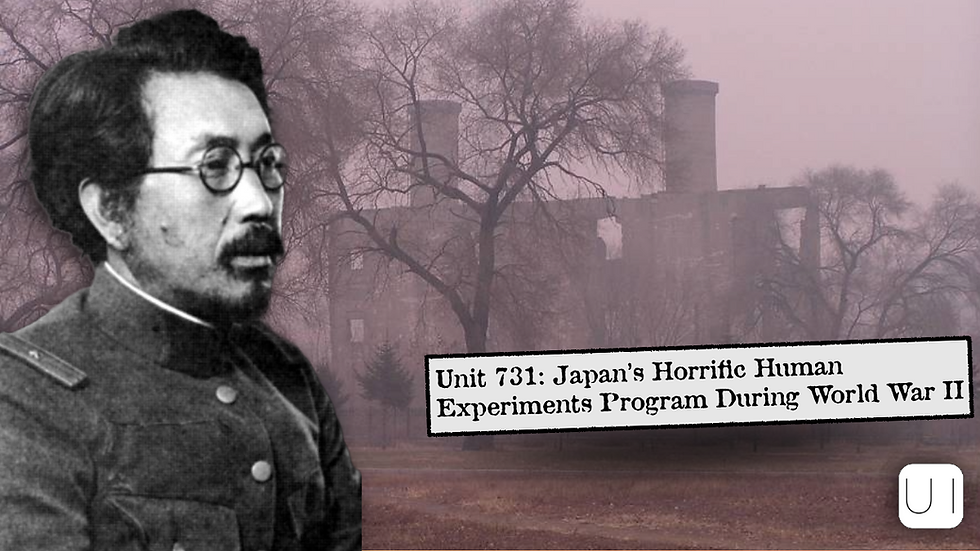
Hideki Tojo: Started a War, Survived His Own Bullet, and Went to the Gallows with "Remember Pearl Harbor" in His Mouth
Updated: Oct 16

Hideki Tojo was the Japanese general and politician who served as Prime Minister of Japan from October 1941 to July 1944, and in that capacity presided over some of the most catastrophic events of the Second World War. He was the man whose cabinet authorised the attack on Pearl Harbor. He was the man who enforced brutal military expansion across Asia and the Pacific. He was the man who, when American soldiers finally came to arrest him in 1945, pressed a pistol to his own chest and pulled the trigger.
He missed his heart.
What followed was one of history's most extraordinary sequences of events: the enemy he had tried to destroy saved his life, put American blood in his veins, repaired his teeth, and then one of those dentists secretly drilled "Remember Pearl Harbor" in Morse code into his dentures. He wore them every day, unwittingly, all the way to the gallows.
This is that story.
Born to Serve the Emperor
Hideki Tojo was born on 30 December 1884 in the Kojimachi district of Tokyo, the third son of Hidenori Tojo, a lieutenant general in the Imperial Japanese Army. The Tojo family were of samurai descent, and in the rigid caste structure of Meiji-era Japan, that lineage meant everything. Military service was not a career choice for young Hideki; it was inheritance.

He graduated from the Imperial Japanese Army Academy in March 1905, ranking tenth out of 363 cadets, and was commissioned as a second lieutenant in the infantry. His early career was steady and disciplined. He served briefly in Siberia during the Japanese intervention in the Russian Civil War between 1918 and 1919, then spent three years as a military attaché in Germany between 1919 and 1922. The German Army left a lasting impression on him: its concept of the "Defence State," in which every element of a nation is subordinated to military preparation, became a template he would spend the rest of his career trying to replicate in Japan.
On his return journey from Germany, he crossed the United States by train. It was his only visit to North America, and it left him contemptuous. He wrote at the time that Americans were a "materialistic, soft people" interested only in money and pleasure. Two years later, the US Congress passed the Immigration Control Act of 1924, which banned Asian immigration outright, with many legislators openly arguing that Asians worked harder than white Americans and therefore represented a threat. Tojo was furious. He wrote bitterly that white Americans would never accept Asians as equals, and concluded that Japan had to become powerful simply to survive.
That resentment never left him.
The Rise of "Razor" Tojo
By 1928 Tojo had risen to bureau chief of the Japanese Army, and shortly thereafter was promoted to colonel. His reputation for sharp, quick decision-making and his uncompromising personality earned him the nickname "Razor" (Kamisori in Japanese). He was a deeply serious man who boasted that his only hobby was his work, customarily bringing paperwork home and staying up late into the night. He was brusque, demanding, and obsessively attentive to etiquette.
He was also politically astute. Through the 1930s, the Imperial Japanese Army was riven between two major factions: the Kodoha, or "Imperial Way" faction, which wanted an immediate coup and an invasion of the Soviet Union; and the Toseiha, or "Control Faction," which preferred to work within the system, modernise the military, and build a full war economy before engaging the West. Tojo aligned himself firmly with the Toseiha.
In September 1935, he was appointed to command the Kempeitai, the military secret police, attached to the Kwantung Army in Manchuria. It was a position that suited him. When junior officers from the rival Kodoha faction launched the February 26 Incident of 1936, an attempted coup in Tokyo, Tojo immediately ordered the arrest of all officers in Manchuria suspected of sympathising with the rebels. The coup failed. The Kodoha was purged. The Control Faction, with Tojo as one of its leaders, consolidated its grip on the Army.
By 1937, Tojo was chief of staff of the Kwantung Army and a lieutenant general. In July of that year, following the Marco Polo Bridge Incident that ignited the Second Sino-Japanese War, he personally led units of the 1st Independent Mixed Brigade in Operation Chahar. It was his only real combat experience. Shortly after, he ordered his forces to attack Hebei Province and northern China more broadly, committing to what Tokyo called the "China Incident" and what millions of Chinese civilians experienced as systematic brutality.
Road to Pearl Harbor
By 1940, Tojo was Army Minister in Prince Fumimaro Konoe's government. He was now one of the most powerful men in Japan, and he was steering his country toward catastrophe.
In July 1941, after Japan moved troops into southern French Indochina, the United States responded with an oil embargo that cut off 80 percent of Japan's petroleum supply. Japan's war machine ran on oil. Without it, the military would be paralysed within two years. At the Imperial Conference in September 1941, a deadline of early October was fixed for resolving the crisis diplomatically. That deadline passed without result.
When Prime Minister Konoe convened his final cabinet meeting and sought a path to negotiation, it was Tojo who dominated the room. He argued that any withdrawal from China or Indochina would destroy the fruits of years of sacrifice, embolden the Americans, and threaten Japan's hold on Korea and Manchukuo. Peace through compromise, he said, would simply invite more extreme demands. He did not want war, he insisted, but he would not countenance humiliation.

On 16 October 1941, Konoe resigned. Emperor Hirohito, following the advice of his Lord Keeper of the Privy Seal, Koichi Kido, chose Tojo as his replacement. On 18 October 1941, Hideki Tojo became Prime Minister of Japan.
He simultaneously retained the post of Army Minister and held others concurrently throughout his tenure, including Home Minister and briefly Foreign Minister. He now effectively controlled both the government and the military command structure. He was not, however, an unchecked dictator: the Imperial Navy remained a rival power centre with which he had to negotiate, and the Emperor retained ultimate authority. But within those constraints, Tojo drove Japan toward war.
On 27 November 1941, US Secretary of State Cordell Hull handed the Japanese ambassador a proposal requiring Japan to withdraw all military forces from China and Indochina in exchange for lifting the oil embargo. Tojo chose to present the offer to his cabinet as an ultimatum, which it was not: the document was explicitly marked "tentative" and carried no deadline. The misrepresentation was deliberate, and it served its purpose. On 1 December 1941, the Imperial Conference formally sanctioned war against the United States, Britain, and the Netherlands.
Tojo only learned of the Navy's plan to attack Pearl Harbor after that decision had been made.
World War II: From Triumph to Collapse
On 8 December 1941 (7 December in the Americas), Tojo was woken at five in the morning with news that the attack on Pearl Harbor had succeeded. The strike killed 2,403 Americans, including 68 civilians, destroyed or damaged 19 US Navy ships, and drew the United States fully into the Second World War. Tojo went on Japanese radio to announce that Japan was now at war with the United States, the British Empire, and the Netherlands.
The opening months of the Pacific War went Japan's way. Japanese forces swept through Malaya, Singapore, the Philippines, the Dutch East Indies, and Burma. But the tide turned with brutal finality at the Battle of Midway in June 1942, where Japan lost four fleet aircraft carriers and the core of its naval air power in a single engagement. From that point, the weight of American industrial and military capacity began to grind Japan down.
Tojo responded to setbacks by concentrating more power in his own hands. In February 1944, he assumed the post of Chief of the Imperial Japanese Army General Staff on top of his existing roles, making himself simultaneously head of government and supreme army commander. He planned three decisive operations for 1944: Operation Ichi-Go in China, Operation U-Go in India, and a naval battle in the Marianas that he hoped would destroy the US Pacific Fleet and shock America into seeking peace.
All three failed. The invasion of India through Burma ended in the catastrophic defeats at Imphal and Kohima. Of roughly 150,000 Japanese soldiers who crossed into India, most were dead by July 1944, killed by Allied forces, starvation, and disease. In the Pacific, the Battle of the Philippine Sea in June 1944 destroyed what remained of Japanese naval aviation: American pilots shot down over 350 Japanese aircraft while losing fewer than 30 of their own, an engagement US airmen would simply call "The Great Marianas Turkey Shoot." When Saipan fell shortly after, Japan's elder statesmen told the Emperor that Tojo had to go.
On 18 July 1944, Tojo was forced to resign. The Emperor, who had once backed him absolutely, refused to accept a cabinet reorganisation as sufficient. Tojo's entire government was dismissed.
He spent the following year in private life as Japan was firebombed, blockaded, and ultimately struck by atomic bombs at Hiroshima and Nagasaki. On 2 September 1945, Japan surrendered unconditionally aboard the USS Missouri.
The Arrest: A Pistol, a Missed Heartbeat, and American Blood
General Douglas MacArthur moved quickly. He ordered the arrest of dozens of suspected war criminals. Tojo was at the top of the list.
The day before soldiers arrived, Tojo had already sent his wife to friends in Fukuoka. He was living in his modest home in Setagaya, Tokyo, with one elderly servant and a policeman for company. He had also, anticipating what was coming, quietly consulted a local doctor to find out exactly where his heart was.

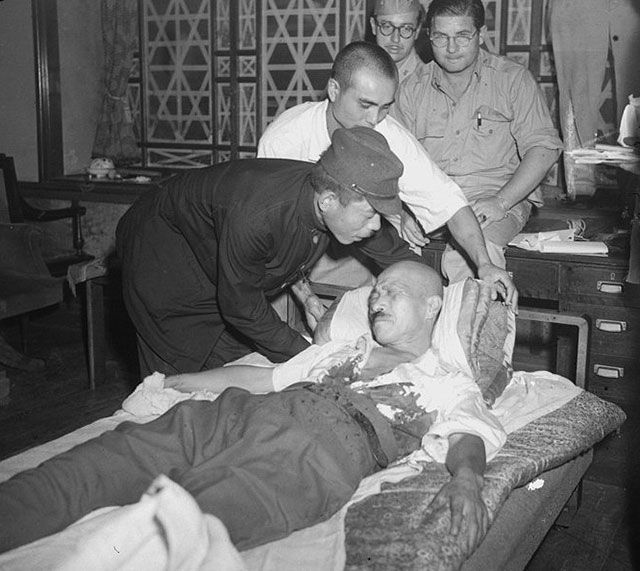
On 11 September 1945, Major Paul Kraus of Army Counter-Intelligence arrived at the house with arrest orders. When Tojo appeared at the window and stalled, Kraus told his interpreter to tell the general to stop "this damn fooling around" and open the door. Tojo disappeared from the window. When he reappeared, he fired a pistol into his own chest.
He had used an 8mm Nambu pistol, the standard Japanese service handgun of the era. The round passed through the left side of his chest below the heart, leaving what witnesses described as a six-inch wound. Tojo slumped into a chair with the gun falling from his fingers.

American soldiers and reporters burst through the door. As he bled, Tojo spoke in Japanese. Two Japanese reporters present translated and recorded his words: "I am very sorry it is taking me so long to die. The Greater East Asia War was justified and righteous. I am very sorry for the nation and all the races of the Greater Asiatic powers. I wait for the righteous judgment of history. I wished to commit suicide but sometimes that fails."
He had sat in the ceremonial hara-kiri position, legs crossed, but he had not chosen the traditional samurai method of ritual disembowelment with a sword. He had used a pistol, and it had not been enough.

American medics administered plasma on the spot, then rushed him to the 98th Evacuation Hospital in Yokohama. He received multiple transfusions of American blood to keep him alive. The man who had sent hundreds of thousands of Americans to their deaths now had American blood flowing through his veins.
Once stabilised, he was transferred to Sugamo Prison near Tokyo to await trial.

"Remember Pearl Harbor": The Denture Story
Inside Sugamo, Tojo's teeth were in a wretched state. The prison authorities sent two US Navy dentists to assess him: Lieutenant (junior grade) Dr. George Foster, an oral surgeon, and Lieutenant (junior grade) Dr. Jack Mallory, a dental prosthetics officer.
Foster examined the former prime minister and extracted all but seven of his remaining teeth. Mallory recommended complete upper and lower dentures, but Tojo initially refused a lower plate on the grounds that it seemed a waste of effort for a man about to be executed. He accepted a full upper denture so that he could speak clearly at his trial.
Mallory was 22 years old, a draftee, and an amateur ham radio operator who knew Morse code well. As the dentures were being prepared, a colleague suggested it would be fitting to engrave "Remember Pearl Harbor" on the back of the man's teeth. Standard military dental procedure at the time was to engrave the patient's name, rank, and service number into any dentures made by the hospital. Mallory knew that writing the phrase out in plain letters would get him court-martialled.
So he drilled it in Morse code instead: a series of dots and dashes along the inside of the peripheral border of the upper plate, where acrylic met the roof of Tojo's mouth. You could see it clearly when the denture was dry, but 99 percent of the time it was invisible. Tojo accepted the finished plate without any suspicion.

For roughly three months in 1946 and into 1947, the man who had overseen the attack on Pearl Harbor walked around Sugamo Prison, ate his meals, prepared his legal defence, and stood in court with the words "Remember Pearl Harbor" hidden in his mouth.
He never knew they were there.
The secret was too good to keep. Mallory told his dental colleagues, who were sworn to secrecy. Then one of them wrote home about it in a letter to his parents in Texas. The parents passed the story to a brother, who broadcast it on a local radio station. It went around the world.
A furious colonel summoned Mallory and Foster. "Is there any truth in this report that 'Remember Pearl Harbor' is inscribed in the dentures?" he demanded. "No, sir!" both men answered.
That night, Mallory and Foster drove to the prison and woke Tojo in the middle of the night, telling him they needed the dentures for emergency adjustments. Using a crude grinding stone in the dark, Mallory removed every dot and dash. The next morning, reporters and investigators examined the dentures. There was nothing to find. Neither man received any formal reprimand, though Mallory was stripped of a commendation he had recently received. Tojo noticed only that his dentures seemed to fit slightly more loosely after that night.

In 1969, Mallory returned to Japan for a dental reunion. Over dinner, he told the story to his Japanese colleagues. "They thought it was the funniest thing," he recalled. "They all said, 'Why didn't you tell us this?' I said, 'Well, the timing just didn't seem right.'"
E.J. "Jack" Mallory died in 2013. His obituary mentioned a distinguished dental career and, briefly, a "dental prank" performed on the man behind the attack on Pearl Harbor.
Trial, Conviction, and the Gallows
Tojo was tried before the International Military Tribunal for the Far East, commonly known as the Tokyo Trials, beginning in 1946. The charges against him were sweeping: waging wars of aggression, war in violation of international law, unprovoked attacks against various nations, and ordering, authorising, and permitting inhumane treatment of prisoners of war.
The crimes committed under his authority were not abstract. Historian R.J. Rummel estimated that the Empire of Japan was responsible for the deaths of approximately three million civilians and prisoners of war through massacre, human experimentation, starvation, and forced labour, a significant portion of which occurred during Tojo's time in power.
At the trial, Tojo did not attempt to deny his centrality to the war. He accepted full responsibility. He told the court: "It is natural that I should bear entire responsibility for the war in general, and, needless to say, I am prepared to do so. Consequently, now that the war has been lost, it is presumably necessary that I be judged... I mean to pay considerable attention to this in my actions, and say to the end that what is true is true and what is false is false."
At one point during testimony on 31 December 1947, Tojo momentarily deviated from the agreed line about Emperor Hirohito's innocence, referring to the Emperor's ultimate authority in ways that implicated the throne. The American-led prosecution immediately arranged for him to be coached privately to revise his statement. A former Japanese general with close ties to the prosecution was used as an intermediary. Tojo duly recanted. Historians Herbert Bix and John Dower have since argued that General MacArthur and his staff worked deliberately to shift ultimate responsibility away from Hirohito and onto Tojo, making the former prime minister the singular face of Japanese war guilt.

Whether Tojo knew he was being used as a shield for the Emperor, or whether he accepted the role out of his lifelong loyalty to the imperial institution, remains a subject of historical debate.
On 12 November 1948, the tribunal sentenced Tojo to death.
On 23 December 1948, forty-one days later and one week before what would have been his 64th birthday, Hideki Tojo was led to the gallows at Sugamo Prison. His final statement apologised for the atrocities committed by the Japanese military and urged the American occupation to show compassion toward the Japanese people, who had already suffered devastating firebombing raids and the two atomic bombings.
He was hanged alongside six other convicted war criminals. His body was removed, cremated, and the ashes were scattered over the Pacific Ocean approximately 30 miles east of Yokohama from a US Army aircraft on the afternoon of 23 December 1948. The decision to scatter the ashes at sea was deliberate: the Americans wanted no burial site that could serve as a shrine or focal point for future Japanese nationalism. Two years earlier at Nuremberg, the US Army's executions had been handled by Master Sergeant John C. Woods, and the questions over how well he did that job have never gone away.
The Final Irony
When Hideki Tojo's lifeless body was taken down from the gallows and prepared for cremation, the mathematics of his last years were extraordinary.
He had tried to die by his own hand and failed. He had been kept alive by American plasma and American medical expertise. He had eaten, slept, spoken, and defended himself in court for three months with "Remember Pearl Harbor" hidden in his mouth. He had American blood in his veins. He had American-made dentures in his jaw.
History rarely delivers a conclusion so perfectly formed.
Legacy
Tojo's ashes are gone, but not all of them. Some were reportedly taken from the crematorium and are today enshrined at Mount Sangane and the Koa Kannon temple. His name also appears at Yasukuni Shrine in Tokyo, a site that continues to generate significant diplomatic tension between Japan, China, and South Korea whenever Japanese politicians visit.
His granddaughter, Yuko Tojo, became a political figure who argued that Japan's wartime conduct was one of self-defence and that her grandfather was treated unjustly as a war criminal. His second son, Teruo Tojo, who designed fighter and passenger aircraft during and after the war, eventually rose to become an executive at Mitsubishi Heavy Industries.
In China, where the scars of Japanese wartime occupation remain deep, a 1997 survey of university students asked who came to mind when they thought of Japanese people. The most common answer was Hideki Tojo.
In Japan in 1998, a film called "Pride" portrayed him as a national hero railroaded by a victor's justice. In the rest of the world, he is remembered as one of the principal architects of a war that killed tens of millions of people.
The man who ordered the attack on Pearl Harbor is gone. So are his ashes, scattered somewhere in the Pacific. But for three months in 1946, he sat in a prison cell planning his defence, completely unaware that the ocean he had tried to rule was being silently referenced in Morse code every time he opened his mouth.