Meet The Forty Elephants, The All-Girl Gang From London

For roughly seventy years, an all-female gang ran a sophisticated shoplifting operation out of South London, stripping out the contents of Selfridges and other department stores in under an hour using coats with secret pockets sewn into the lining and fake pregnant bellies stuffed with stolen fur. Their leader wore diamond rings as makeshift knuckledusters and was known to police as Diamond Annie. When one of her members broke the gang's rules in 1925, she led an army of women armed with bricks and broken bottles into the street and started a riot. This is the story of the Forty Elephants, one of British crime history's strangest and least-known success stories.
When we conjure up images of crime gangs, our minds often drift to Italian mobsters or Japanese Yakuza members, maybe Mexican or Colombian Cartels. However, there have been numerous gangs throughout history that haven't received the same level of recognition. Consider, for instance, the Forty Elephants. Named after their territory in Southwark, the Elephant and Castle area in London.

From the Forty Thieves to the Forty Elephants
The gang's roots go back further than the famous 1920s heyday most people associate with it. Records trace an organised female shoplifting network in the area as far back as the 1870s, originally known as the Forty Thieves under a leader named Mary Carr. Carr was an expert "hoister", the period slang for a shoplifter, and she laid the groundwork that later generations would build on, training her thieves not only to steal but to seduce and blackmail wealthy men and worm their way into respectable household jobs to loot from the inside.
The gang took its better-known name from the Elephant and Castle district of Southwark where most of its members lived and operated, and it maintained a close, semi-formal alliance with the all-male Elephant and Castle Mob, who handled the rougher end of the business while the women specialised in theft, fraud, and blackmail.
Operating from at least the 1880s and possibly as far back as the 18th century, the Forty Elephants gang thrived in London until the 1950s. During the 1920s and 1930s, the gang enjoyed a robust partnership with the Elephant and Castle Mob, marking the peak of both groups. However, unlike the mob, the Forty Elephants gang consisted entirely of women.
The members would often dress as housemaids in order to gain entry to wealthy homes, relieving the inhabitants of their jewels and other valuable objects. However, the gang's specialty was covertly stealing from department stores with extreme efficiency.
Legend had it that a mere hour was all it took for a group of Forty Elephants members to clear out a store, skilfully concealing valuables in their numerous pockets. However, the gang had a particular fondness for fur coats, which became their signature style. Interestingly, rather than donning their stolen loot, the women opted for high fashion purchased outright with the proceeds from their illicit activities. Wearing the stolen goods was actually against the rules, known as the "Hoister's Code" which also prohibited going out drinking the night before a big job or working with the police, among other things.
During that era, women in department stores were granted a degree of privacy, recognising that shopping for clothing or other items could potentially compromise a woman's modesty if certain protocols weren't upheld. However, this autonomy also provided an opportunity for the gang members to pilfer vast quantities of merchandise without detection.

Diamond Annie's Rise
Alice Diamond, the woman who would lead the gang through its most famous and successful era, was born illegitimately in Lambeth workhouse in 1896, the eldest of seven children. Her father Thomas was a violent career criminal, once notorious for shoving the Lord Mayor's son's head through a plate-glass window during a riot. Growing up in poverty in Walworth, Alice was raised in an environment where crime was simply how families got by. She was first cautioned for theft at sixteen, and within a few years had become one of the most prolific shoplifters in South London.
She was also unusually tall for the period, standing around 5'9" at a time when the average man stood barely an inch taller. Combined with her physical presence and a reputation for genuine toughness, she was marked out for leadership by the male Elephant and Castle gang, who recognised her as the perfect candidate to run their female counterpart. In 1915 or 1916, depending on the source, Alice Diamond became Queen of the Forty Elephants. She was twenty years old.
The most infamous figure at the helm of the Forty Elephants was Alice Diamond, better known as Diamond Annie due to her dazzling rings that lent her punches considerable force. Taking charge in 1916, Diamond Annie steered the gang to unprecedented success, consistently outmaneuvering law enforcement with remarkable efficiency. Despite numerous members being apprehended and prosecuted for minor thefts, often without any direct association with larger gang operations, many of the girls resumed their affiliation with the gang upon completing their sentences.

The Forty Elephants employed blackmail as a lucrative tactic, enticing affluent men only to later extort them for financial gain. This method was occasionally leveraged to call in favors and evade legal repercussions. Renowned for their resilience, many of these women were as formidable as any man when faced with threats. Conversely, the gang was also famed for throwing extravagant parties, indulging in the opulent nightlife of the 1920s and embracing the glamorous sophistication and champagne-soaked revelry depicted in 1930s cinema.
The alternative for nearly all of the members of the Forty Thieves would have been extreme poverty and/or a life of prostitution. This would have been particularly true for the 19th century members of the gang as class divisions in London during the 1800s meant there was almost no chance of rising from poverty without considerable help.
In the period between the World Wars, Diamond Annie served as the Queen of the Forty Elephants.
In the 1920s, the gang reached the pinnacle of their success and notoriety. Diamond instituted numerous clever tricks into the gang's arsenal, ensuring that all thieves were equipped with secret pockets and flaps in their gowns to facilitate shoplifting. They were also early adopters of automobiles, making their getaways in the most glamorous models. They confounded police by handing off stolen goods to an unseen accomplice on foot before dashing off in a high-speed car chase; police were left befuddled when they caught up with the car and found it devoid of any stolen goods. Cars also allowed the members to expand their operation outside of London to nearby towns, all the better once Diamond's and other faces became too well-known to local law enforcement to go incognito.

Notoriety on Both Sides of the Atlantic
By the mid-1920s, the gang had become genuinely famous, not just in Britain. Their exploits were covered extensively by American newspapers including the San Jose Evening News and the Lancashire Evening Post, which ran breathless headlines describing the gang as "two of the most expert shoplifters in the world" and dwelling, with no small amount of sensationalism, on the gang's reputed use of razor blades hidden in their corsages to threaten witnesses into silence. The coverage, accurate or not, only added to the gang's mythology.
The Lambeth Riot
Ultimately, Diamond was undone by her increasing fixation on controlling the gang. The Hoister's Code forbade members from doing anything against Diamond's wishes, including marrying men she did not approve of.
In late 1925, a member of the gang named Marie Britten broke that rule, marrying a man Alice hadn't sanctioned after falling pregnant by him. On the night of 20 December 1925, Alice and her deputy Maggie Hill, sister of the notorious gangster Billy Hill, gathered at the Canterbury Social Club near Lambeth's New Cut market and drank themselves into a fury. Armed with bottles, stones, and lumps of concrete, the gang marched to Britten's lodgings, smashed their way inside, held Marie at gunpoint, and beat her husband senseless in front of her. Police arrived and a brawl broke out in the street, which became known as the Lambeth Riot.
When a member defied her in 1925, Diamond led the gang in a brutal attack against the newlyweds so disruptive that it became known as the Lambeth Riot. For her role as instigator, Diamond was sentenced to 18 months in prison. Maggie Hill received 21 months. Nine other members of the gang received prison sentences too. By the time she was freed, a new queen had taken over.
Diamond's Decline and Shirley Pitts
Diamond turned to a career managing a brothel, while still offering tutelage to aspiring young thieves. She refused to leave London during the Blitz evacuations of the Second World War and continued to mentor younger thieves from her Lambeth brothel until her death from complications of multiple sclerosis in 1952, aged 55.
One of her protégées, Shirley Pitts, was the acknowledged queen of the gang in the 1960s. According to Pitts's biographer Lorraine Gamman, Alice Diamond first took a twelve-year-old Shirley shoplifting in 1947, after Shirley's father came home from prison and bought her clothes she hated. Inside a shop, Alice asked Shirley whether a particular top would fit her brother. When Shirley said yes, Alice stuffed the item down the front of Shirley's own clothes. By the end of that single outing, Alice had clothed the entire Pitts family for free, and Shirley was hooked for life. Pitts went on to lead the Forty Elephants into the 1960s, though her operation was smaller and the gang's methods were increasingly defeated by modern store security and changing fashion that made it harder to conceal stolen goods in clothing. When Shirley Pitts died in 1992, she was buried, fittingly, in a stolen Gucci dress.
Following her departure, the leadership of the gang fell into the hands of Lillian Rose Kendall, a true embodiment of the flapper era, nicknamed the "Bobbed-Haired Bandit" for her short, fashionable haircut and her specialism in smash-and-grab raids, sometimes using her car to physically smash through jewellers' shop windows. However, by the 1950s, increased store security and the advent of sleeker clothing made shoplifting considerably more challenging, marking the eventual decline of the Forty Elephants' activities.

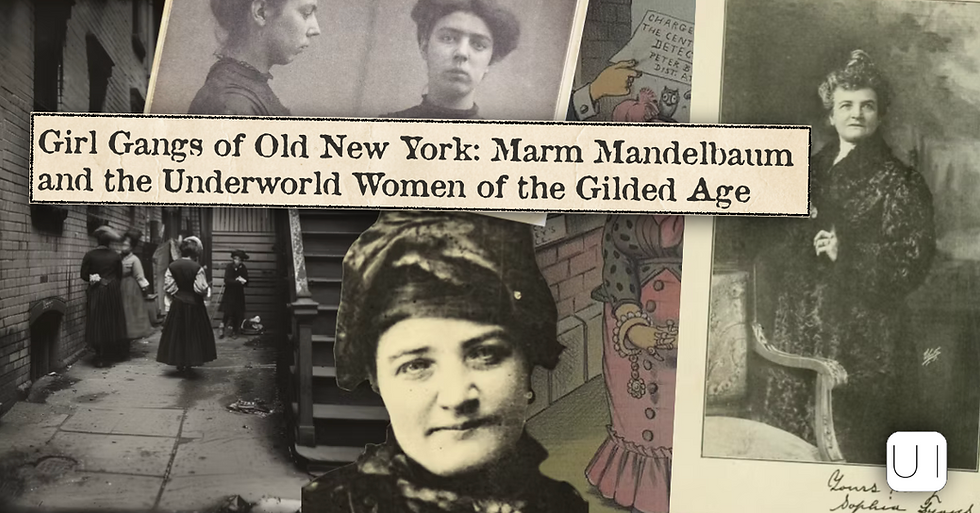
The gang faded out sometime in the 1950s, never formally dismantled by police, simply outpaced by changing technology and changing fashion. They were not the only women-led criminal network of their kind. Across the Atlantic, Fredericka "Marm" Mandelbaum ran a comparable network of female thieves and fences out of Gilded Age New York. But few matched the Forty Elephants for sheer longevity. Across roughly eight decades and at least three generations of leadership, from Mary Carr to Diamond Annie to Shirley Pitts, they ran one of the longest-surviving organised crime operations in British history, and they did it by being underestimated. Store detectives were watching for men. Police were looking for men. For seventy years, nobody thought to look twice at well-dressed women trying on coats.
Sources:
1. Southwark News: Alice Diamond and the Forty Elephants. https://www.southwarknews.co.uk/history/alice-diamond-and-the-forty-elephants-the-all-female-criminal-gang-which-caused-waves-on-both-sides-of-the-atlantic/
2. Historic Mysteries: London's Notorious Female Gangsters, the 40 Elephants. https://www.historicmysteries.com/history/40-elephants/28301/
3. Biographics: The Forty Elephants — The All-Women Gang That Robbed London Blind. https://biographics.org/the-forty-elephants-the-all-women-gang-that-robbed-london-blind/
4. Crime+Investigation UK: The Key Figures. https://www.crimeandinvestigation.co.uk/crime-files/london-gangs/key-figures
5. Herstorical Tours: Alice Diamond and the Forty Elephants. https://www.herstoricaltours.co.uk/post/herstory-of-the-month-alice-diamond-and-the-forty-elephants
6. Taylor & Francis: 'Alice Diamond, giant—queen of the terrors': female gangsterism in the London underworld. https://www.tandfonline.com/doi/full/10.1080/09612025.2025.2462879