

Girl Gangs of Old New York: Marm Mandelbaum and the Underworld Women of the Gilded Age
Updated: Aug 30
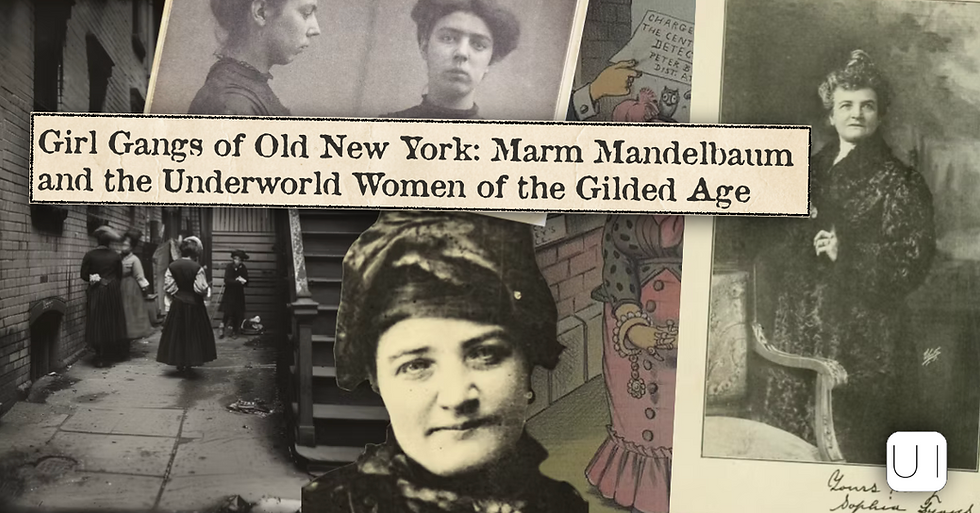
In mid-19th century Manhattan, the Five Points neighbourhood had gained international infamy as a crowded, disease-ridden, crime-infested slum. Here and in other desperate quarters of a rapidly growing New York, gangs ruled the streets, and not all of their most fearsome members were men. Amid the bustling markets and back-alley saloons, a new breed of criminal emerged: women who could pick pockets as deftly as any man, con the gullible with a disarming smile, or brawl in the street with the best of them. They formed the girl gangs of old New York, networks of female pickpockets, burglars and swindlers whose exploits became the stuff of legend, all of it eventually orbiting one woman who ran the whole operation from behind a modest haberdashery counter.
Quick Answers
Who was Marm Mandelbaum? Fredericka Mandelbaum, a German-Jewish immigrant who built and ran America's first large-scale organised crime syndicate in New York from the 1860s to 1884.
What did she actually do? She fenced stolen goods, financed and planned thefts, trained young pickpockets, and bankrolled bail and legal defence for a loyal network of mostly female criminals.
How was she caught? New York's district attorney bypassed the city's compromised police force and hired Pinkerton detectives, who spent months infiltrating her circle before catching her handling marked stolen silk.
What happened to her? She fled to Canada the night before her trial in December 1884 and lived there, safe from extradition, until her death a decade later.

A City of Immigrants and Outlaws
The explosive expansion of New York City after 1820 created the perfect breeding ground for gang culture. In 1800, Manhattan was a modest port city; by 1890 it had swelled to more than 1.7 million residents amid relentless immigration and industrialisation. Awash with impoverished Irish, German, Italian and Jewish immigrants, the city's neighbourhoods split along ethnic lines and overflowed with overcrowding and poverty. By the 1880s, roughly 40 per cent of New York's population was foreign-born, many crammed into squalid tenements a short walk from genuine wealth. Honest work was scarce and paid poorly, particularly for young women, whose respectable options amounted to seamstress work, domestic service or factory labour, often for wages that barely covered rent. It's little wonder some turned instead to shoplifting from upscale stores, picking pockets in crowded markets, or running confidence scams on the unwary.
Nowhere was this more evident than the Five Points slum of Lower Manhattan, centred on a former pond turned landfill and often described at the time as the world's most notorious slum. By the 1850s it was awash with violent crime, unemployment, prostitution, gambling and disease, and became the cradle of the city's earliest organised gang culture. Famous gangs like the Bowery Boys and the Dead Rabbits fought in its streets, and its folklore includes fearsome women too. One of the best known is Hell-Cat Maggie, said to have filed her teeth to points and fought with brass claws fitted to her fingers, tearing into brawls twice her size; her actual existence is disputed, since most of what survives about her comes from a sensationalist 1920s crime writer rather than contemporary record.
Better documented, if only slightly, is Gallus Mag, a towering Bowery saloon bouncer reputed to bite off the ears of unruly drunks and keep the trophies pickled in a jar behind the bar, and her contemporary Sadie the Goat, said to have worked as a river pirate who head-butted victims in the stomach so her crew could rob them while they were doubled over. Whether myth, exaggeration or fact, these stories reflected a startling truth polite Victorian society preferred to ignore: women were just as capable of running the underworld as men, and by the 1860s, the centre of gravity for organised female crime in New York had shifted decisively to the empire of one particular woman.
Marm Mandelbaum: The Mother of Crooks
In an era dominated by male crime bosses, Fredericka Mandelbaum rose to become New York's original mother of crooks. German-born and stout in build, she cut an unlikely figure on the Lower East Side, often dressed in fine silks and a plumed hat, every inch the respectable shopkeeper she pretended to be. Chronicler Herbert Asbury described her sharply curved mouth, heavy black brows and tightly rolled black hair, usually topped with a small bonnet trimmed in drooping feathers, a look that made her instantly recognisable on Clinton Street even to people who had no idea what she really did for a living. Her dry goods store at Clinton and Rivington Streets served as a legitimate front for what she really did: for more than three decades, she was the city's most successful fence, buying stolen goods and reselling them at a healthy margin.
Her operation was a sprawling criminal network of pickpockets, burglars, shoplifters and confidence artists. Detective Robert Pinkerton later said Mandelbaum's name was known to virtually every thief and detective in the country, and that stolen goods reached her from across the United States, Canada and Mexico. Chief of Police George Walling put it more plainly still, noting that if a silk robbery happened as far away as St Louis and the thieves were known to belong to Marm's network, she'd always get first choice of the loot. Her success rested partly on genuine loyalty: she paid bail and legal fees for anyone caught, never betrayed a client, and hosted lavish dinners for her most trusted thieves. Contemporaries compared her to Dickens's Fagin, an underworld mother who transformed street children into skilled pickpockets rather than letting them starve. She reputedly even ran an informal school for the trade, later remembered as Marm's Grand Street School. For a very different, London-based version of the same pattern decades later, our piece on the Forty Elephants covers an entire all-female gang built along strikingly similar lines.

Crime and Camaraderie
Part of Mandelbaum's success lay in the tight-knit, almost familial loyalty she cultivated among her circle. She was shrewd, but remarkably devoted to her thieves once they were hers, and her followers repaid that loyalty in kind. Her network was a microcosm of the polyglot city itself, made up of Irish pickpockets, Jewish confidence men, German burglars, Italian sneak thieves and, when useful, a corrupt politician or two kept firmly in her pocket. She regularly threw extravagant dinner parties at which her most trusted thieves, women and men alike, socialised and strategised over fine food and drink; one surviving illustration from the period shows Marm seated at the head of a long table, presiding over a banquet of fashionably dressed rogues. Around that table, conversation no doubt turned to recent professional successes, a jewel theft pulled off cleanly, a profitable confidence trick, a narrow escape from the police, as her extended criminal family bonded over their shared, illicit craft.
The Female Felons in Marm's Network
Mandelbaum paid particular attention to training and empowering female criminals, in an era when women had few other paths to real financial independence. Her circle of protégées reads like a rogues' gallery of Gilded Age crime.
Sophie Lyons
Sophie Lyons was perhaps Marm's most famous pupil. Born Sophie Levy in New York in 1848, she was taught to steal by her own mother almost as soon as she could walk, and was first arrested at the age of three. By 12 she'd been caught shoplifting. She married the pickpocket Maury Harris at 16, left him for the celebrated bank robber Ned Lyons, and the pair robbed their way from New York to Detroit and Montreal. Sophie's real gift was performance: contemporaries said she could counterfeit every shade of emotion convincingly enough to talk her own victims into letting her go, even after being caught red-handed. After a stint in Sing Sing, she and Ned staged a dramatic 1872 escape together and fled with their children to Canada, buying themselves a few more years of freedom on the strength of Ned's reputation as the so-called King of Bank Robbers.
Lyons eventually turned her fortune towards reform work, funding rehabilitation for juvenile delinquents and publishing an autobiography, Why Crime Does Not Pay, in 1913. Her ending was as violent as her early career: in May 1924, three men she'd been trying to help came to her Detroit home, apparently convinced she had money hidden somewhere in the house, and beat her so badly her skull was fractured. She died in hospital that night, aged 76. Her roughly one million dollar estate went mostly to her children, with one notable exception: her daughter Esther received only 100 dollars and a purse to keep it in.
'Little Annie' Reilly
Little Annie Reilly, an Irish immigrant, was celebrated in her day as the cleverest woman in her line in America. Petite, multilingual and thoroughly charming, she'd take work as a maid or nanny in a wealthy household, spend weeks doting on the children to win the family's trust, then vanish one night with a fortune in jewellery, on at least one occasion worth an estimated 5,000 dollars, an enormous sum at the time. Arrested and imprisoned repeatedly through the 1870s, she simply resumed her cons on release each time. By 1886, police inspector Thomas Byrnes credited her with stealing more property over the previous 15 years than any other female thief in the country.

'Black' Lena Kleinschmidt and Kid Glove Rosey
Lena Kleinschmidt, a German-born shoplifter and confidence woman, often worked with an accomplice nicknamed Kid Glove Rosey for the elegant gloves she wore while stealing. The pair were arrested together attempting to steal a large quantity of silk from a Manhattan store, a favourite target given how easily bolts of fine fabric could be resold. Rosey was sentenced to five years. Lena talked her way free and later reinvented herself in New Jersey, hosting lavish dinner parties in imitation of her old mentor while posing as the wealthy widow of a South American mining tycoon, all while quietly continuing to fence stolen jewels and fabric on the side.
Eliza 'Big Mary' Wallace
Eliza Wallace, who operated under at least half a dozen aliases including Big Mary and Boston Mary, specialised in stealing high-value silk and was wanted in multiple cities simultaneously. She served time in Sing Sing, jumped bail, and spent over a year as a fugitive before finally being tracked down in Philadelphia in 1869, by which point she was facing charges in two states at once.
Cops, Courts and Crackdowns
The rise of female-led criminal rings posed genuinely new challenges for 19th-century law enforcement. Victorian attitudes cast women as the gentler sex, and police and courts were often simply reluctant to believe a woman capable of masterminding felonies or carrying out violent acts. Some of these criminals exploited that bias directly: Sophie Lyons' celebrated kleptomania ploy in 1880, convincing a store detective her shoplifting was an uncontrollable medical affliction rather than a calculated theft, worked precisely because it played to what a male law officer already wanted to believe about women. Judges, too, sometimes handed down lighter sentences to women, assuming they'd been coerced by men or were simply too feminine and frail for real culpability. But as repeat offenders like Little Annie Reilly and Black Lena Kleinschmidt kept resurfacing under new aliases, the authorities grew wiser. By the 1870s and 1880s, the NYPD was tracking its most notorious female criminals nearly as doggedly as the men.
Inspector Thomas Byrnes, who led NYPD detectives through the 1880s, pioneered the department's Rogues' Gallery, a photographic archive used to identify repeat offenders regardless of what new name they were using, and instituted the Mulberry Street Morning Parade, where newly arrested criminals, women included, were marched past veteran detectives for recognition. Mandelbaum's own crew appeared regularly among the mugshots pinned to his office wall, including a shoplifter named Mary Hollbrook, whose dour portrait survives in Byrnes's 1886 book Professional Criminals of America, sitting alongside profiles of her male counterparts as though thievery had become, in the eyes of the police at least, a fully professional trade deserving equally professional policing.

The Godmother in Exile
For most of her career, Mandelbaum was untouchable. She'd been born Friederike Henriette Auguste Wiesener in Kassel in 1825, the daughter of a Jewish merchant, and had arrived in New York with her husband Wolfe around 1848, working first as a street peddler before opening the Clinton Street shop that became her front. Wolfe died in 1875, leaving her a widow with four children and sole control of the business. By the 1880s, rumour held that half the city's police force was on her payroll and the other half simply outmatched, and it took a fellow criminal, a fence and appraiser known as General Abe Greenthal, to teach her how to properly value the luxury goods that would make her fortune. Greenthal, born Abraham Greenthal in Prussia in 1822, was himself one of the most accomplished pickpockets in the country and led a nationwide ring of thieves for more than four decades.
Her ambitions eventually outgrew shoplifted silk and jewellery. She's been linked to two of the era's most audacious bank robberies, the 1869 Ocean National Bank job and the 1878 raid on the Manhattan Savings Institution, both masterminded by the celebrated burglar George Leonidas Leslie, a man police at the time believed had planned or personally carried out as much as 80 per cent of America's bank robberies. Marm financed the operations and fenced the proceeds. Property looted during the Great Chicago Fire of 1871 reportedly passed through her hands too, one more illustration of just how far her reach extended beyond New York's Lower East Side.
It ultimately took an outside operation to bring her down. In 1884, angry silk merchants, who estimated they were losing five to six thousand dollars a year to organised theft, pushed New York's newly appointed district attorney, Peter Olney, into action. Olney knew better than to trust the city's own police force with the case, so he hired the Pinkerton Detective Agency instead. Pinkerton agent Gustave Frank spent four months building a convincing cover as a silk merchant, taking lessons from a legitimate dealer on quality and pricing, before working his way into Mandelbaum's confidence. On 22 July 1884, Frank finally confronted her outside her shop, waving an arrest warrant and telling her she'd been caught, and that her best option now was to come clean. Her response wasn't a confession. She punched him in the face. It didn't save her; she, her 24-year-old son Julius, and her trusted associate Herman Stoude were all arrested on the spot, and police searching her properties reportedly found enough stolen merchandise to supply an army.
Out on an extraordinary 10,000 dollar bail, an enormous sum for the time, and represented by the notorious defence lawyers Howe and Hummel, Mandelbaum simply vanished the night before her December 1884 trial date, fleeing to Hamilton, Ontario, where no extradition treaty could reach her. Her arrest had already caused enough friction that it sparked a public feud between the NYPD and the district attorney's office over the use of private Pinkerton detectives on the department's own turf, a bitter argument over who deserved credit for finally bringing her down. What she did once she was safely across the border might be the strangest part of her story: rather than start a new criminal empire, she lived quietly as a model citizen, remaining a devoted and generous member of Congregation Rodeph Sholom, the same Lower East Side synagogue she'd belonged to for years, and running an unremarkable hat shop. She reportedly told acquaintances she missed New York enough that she should have simply faced the music rather than run. A political cartoon published in Puck magazine in 1885 captured the absurdity of the situation for American readers, depicting the whole of Canada itself as Mother Mandelbaum, sheltering wanted criminals behind its northern border.

She died in Hamilton in February 1894, reportedly after a long illness, still a fugitive a decade after fleeing. Even her local obituary in the Hamilton Spectator, while noting her criminal past, described her as a woman of kindly disposition, broad sympathies and large intelligence. Her body was returned to New York and buried in her family's plot at Rodeph Sholom's Union Field Cemetery in the Cypress Hills section of Queens. In a detail almost too fitting to be true, several mourners at her own funeral had their pockets picked. Persistent rumours held that she'd never really died at all, that her coffin had been quietly loaded with stones to end the search for good. No credible evidence has ever supported that theory, but its very existence says something about the legend she'd built.

Legacy: Infamous Women and the Making of Urban Myth
For the women who didn't run, the outcomes varied. Some, like Kid Glove Rosey and Little Annie Reilly, served their prison terms and simply faded from notoriety once released. Others, Sophie Lyons chief among them, turned their ill-gotten fame and fortune into second careers as reformers and advisers to at-risk youth. The high-profile exploits of Mandelbaum's circle also fed directly into policy debates of the era: New York founded the Society for the Prevention of Cruelty to Children in 1875, partly in response to stories of child pickpockets being trained up by fences exactly like Marm, and mission houses and charities sprang up specifically to intercept wayward girls before they fell under the sway of a criminal patron. The women's prison movement gained real momentum too: the Women's Prison Association opened a rehabilitation home in New York in 1874, the city opened a dedicated women's workhouse in 1887, and police departments began hiring female matrons to search and guard female prisoners, a role that eventually led to the appointment of the city's first women detectives, including Isabella Goodwin in 1910, brought in specifically to catch the era's remaining lady swindlers.

By the turn of the twentieth century, the era of Marm Mandelbaum and her girl gangs was closing, but the legend only grew from there. Herbert Asbury's 1928 book Gangs of New York, embellishments and all, cemented figures like Hell-Cat Maggie and Gallus Mag in the city's folklore, while historians increasingly recognised Mandelbaum herself as America's first female organised crime boss, a woman who prefigured the crime matriarchs of later decades by half a century.

These women operated in a world that offered them almost no legitimate path to power or wealth, and found one anyway, however illegally. Their notoriety forced the legal system to grapple, often clumsily, with women who refused to fit the era's expectations, and it inadvertently pushed early reformers towards real, lasting change in how the city treated female offenders. It's a history that's part cautionary tale and part outright legend, one of masked ladies and midnight thieves, of a mother to the motherless who taught street children how to steal rather than starve, and of lawmen slowly learning that the fairer sex could be every bit as felonious as any Bowery Boy. The woman at its centre was entirely real, and she beat the system that finally came for her right up to the very end.

You Might Also Like
Sources
10. Thomas F. Byrnes, Professional Criminals of America (1886)


