

Alfred Packer and the Colorado Cannibal Case: Murder, Survival, and One of the West’s Darkest Mysteries
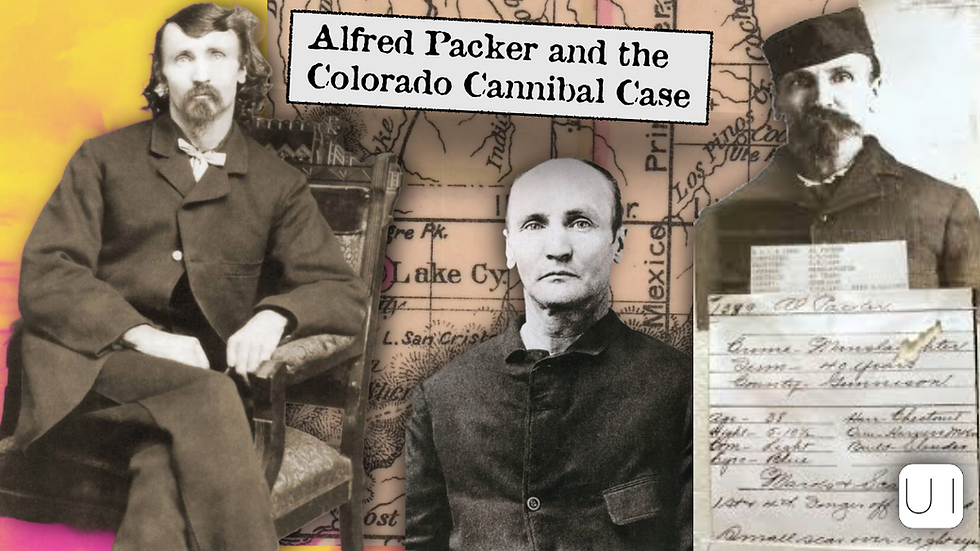
On the 16th of April, 1874, a man walked out of the Colorado mountains alone. His name was Alfred Packer. He'd gone into the wilderness with five other men and returned carrying their belongings, spending their money, and offering stories that changed every time he told them. Before long, people were asking the obvious question. Had Alfred Packer merely survived one of the worst winter ordeals in the Rocky Mountains, or had he led five men to their deaths and fed on them afterwards?
It is one of those frontier stories that has never quite settled into a neat conclusion. Packer admitted to cannibalism. That much is not really in dispute. What remains uncertain, even after trials, exhumations, and later forensic work, is how the five other men actually died. That uncertainty is the reason the case has endured for so long. It is not simply a story of starvation in the mountains. It is a story about the American frontier, about reputation, greed, mythmaking, and the very thin line between necessity and murder.

Who was Alfred Packer?
Alfred Griner Packer was born on the 21st of January, 1842, near Pittsburgh, Pennsylvania, though even that simple detail has been the subject of confusion over the years. He was known at times as Alfred Packer and at others as Alferd Packer. Like much else in his life, his personal story often came wrapped in uncertainty.
By the early 1850s, his family had moved to Indiana, where his father worked as a cabinetmaker. Accounts of Packer’s early life suggest a difficult relationship with his parents, and by his late teens he had left home and drifted westward. He worked as a shoemaker in Minnesota and later served in the Union Army during the American Civil War. His military career was brief and broken. He enlisted twice and was discharged twice, both times because of epilepsy and the seizures it caused.
That condition shaped much of his adult life. Packer moved from job to job and place to place, working as a hunter, teamster, ranch hand, labourer and miner. He also claimed experience as a wilderness guide, though many who later knew him insisted he was poorly suited to that role. The portrait that emerges from witness accounts is not flattering. He was often described as quarrelsome, unreliable, and prone to lying. Preston Nutter, one of the men who later helped expose him, remembered him as “sulky, obstinate and quarrelsome” and “a petty thief willing to take things that did not belong to him”.
That reputation matters, because when the time came to decide whether Packer had killed five men or merely outlived them, many people were already inclined to think the worst.
The journey into the San Juan Mountains
In late 1873, excitement over gold discoveries in Colorado drew prospectors westward. One such group formed in Utah, intending to travel through the San Juan Mountains toward the Breckenridge gold fields. Robert McGrue gathered a party of around twenty men. They were not a close-knit band of friends. Most were strangers brought together by the usual frontier promise of quick wealth.
At some point near Provo, Alfred Packer joined them. He offered to come along as a prospector and guide, claiming he knew the Colorado territory well. He had no provisions of his own, so he paid for the chance to join the party. The men accepted, partly because they wanted someone who appeared to know the route.
That decision would haunt them.
Almost from the beginning, Packer’s conduct raised doubts. He was said to be greedy with rations, lazy on the trail, argumentative with the others, and strangely interested in how much money his companions were carrying. His lack of proper equipment did not help confidence either. He reportedly began the expedition with a revolver but no rifle.

Winter quickly closed in. Snow covered the trail and made progress painfully slow. Wagons and horses became burdens. Food dwindled. The party became lost, and the idea that Packer actually knew the country began to look doubtful at best and invented at worst.
By 21st January, 1874, the miners reached the camp of Chief Ouray in the Uncompahgre Valley. Ouray, known as the White Man’s Friend, offered them food and shelter and urged them to remain there until spring. He warned them plainly that no sensible Ute would attempt the crossing in such conditions. He was not being dramatic. He was describing reality.
His warning was ignored.
The split at Chief Ouray’s camp
At Ouray’s camp, the larger party divided. Some men accepted the obvious wisdom of waiting out the winter or taking the safer river route. Others pressed on. Alfred Packer argued in favour of crossing through the mountains, claiming it was the more direct path to the Los Piños Indian Agency and beyond. Six men eventually left together on 9th February, 1874: Packer, George “California” Noon, Israel Swan, James Humphrey, Frank Miller, and Shannon Wilson Bell.
It was an astonishingly risky decision.
The group had barely enough food for two weeks, no snowshoes, very few matches, no flint, inadequate clothing for the cold, and only a tiny collection of weapons and tools. Chief Ouray had already shown them a safer route. Packer chose otherwise. That choice later became central to the prosecution’s case. Was it incompetence, recklessness, or planning?
At the time, nobody could say for certain. In hindsight, it looked like the beginning of disaster.
Alfred Packer returns alone
Sixty five days later, on 16th April, 1874, Packer staggered into the Los Piños Indian Agency alone. The scene made an impression. The men there were eating breakfast when he appeared, hungry, exhausted, and asking for food and shelter.
He carried a rifle, a knife, a coffee pot, and a satchel. He told the officials that his five companions had abandoned him after he became snow blind and slowed them down. He said that one of the men, Israel Swan, had left him a rifle, and that he had survived alone by eating roots, rosebuds, rabbits, and even his moccasins.
The story was possible in the abstract, but something about Packer himself bothered people. He was weak enough to vomit after eating, yet he did not look like a man starved to the edge of death. His face appeared bloated rather than gaunt. He did not seem skeletal. He also seemed unexpectedly keen on whisky.
These details immediately made people suspicious. Men who had seen genuine starvation in the mountains thought Packer looked too well.
He claimed to be broke, yet soon after reaching nearby Saguache he began spending freely. He bought a horse, paid for a room, drank heavily, and made purchases in local stores. He also had in his possession items known to belong to the missing men, including Swan’s rifle and Miller’s knife. Witnesses said he had several wallets.
For a man who had entered the mountains with almost nothing, Packer suddenly looked surprisingly flush.

The first confession
Suspicion hardened when surviving members of the original larger party reached the agency and dismissed Packer’s story at once. Oliver Loutsenhizer and Preston Nutter did not believe for a moment that the missing men would have abandoned their guide in the snow. They also knew that Packer’s claims to mountain expertise were deeply doubtful.
When pressed by General Charles Adams at Los Piños, Packer changed his story.
At first he begged for mercy and said, “It would not be the first time that people had been obliged to eat each other when they were hungry.” That sentence opened the door to one of the strangest and most notorious confession histories in American criminal history.
In his first official statement, Packer claimed the party had run out of food and gradually turned to cannibalism after Israel Swan died. He said Swan was killed first, then Frank Miller, then Humphrey, then Noon. In this version, the men had not merely eaten the dead. They had decided who should die next. Packer presented himself as part of the group, trapped inside a terrible sequence of choices. Finally, according to him, only he and Shannon Bell remained, and Bell tried to kill him. Packer said he struck Bell with a hatchet in self defence, then butchered him and carried flesh with him on the final leg of his journey to the agency.
This was already horrific, but it was also suspiciously convenient. It spread guilt around the camp. It made Packer look compromised rather than uniquely guilty. It gave him company in savagery.
Few believed it.

The bodies are found
In August 1874, the story changed again, not because Packer altered it but because the mountains gave up the dead.
John A. Randolph, an illustrator for Harper’s Weekly, located the site where the five men had died near what became known as Dead Man’s Gulch, south east of Lake City, Colorado. What authorities found there badly undermined Packer’s account.
The bodies were not scattered across the landscape as one might expect if the men had died at different times and in different places. They were all together at a single campsite in a pine shaded gulch. Several showed signs of blunt force trauma to the skull. Flesh had been cut from the bodies in meaty areas, but some substantial flesh and organs remained, which cast doubt on Packer’s descriptions of desperate, prolonged starvation and incremental consumption. Bell appeared to have died last, but the arrangement of the bodies and the injuries suggested concentrated violence, not simply a drifting collapse into death over weeks.
There was also evidence that provisions may not have been completely exhausted when the killings occurred. This fed a grim theory that spread quickly through Colorado: Packer may have murdered the men before starvation made such acts “necessary”, then survived by feeding off their bodies while snowbound.
When searchers returned to confront him, Packer had escaped.

Escape, capture, and a second version
Packer vanished for nine years. He was eventually found in 1883 in Cheyenne, Wyoming, living under the alias John Schwartze. Once arrested and brought back to Colorado, he offered yet another confession.
This second major version shifted almost all responsibility onto Shannon Bell.
Now Packer said that he had gone off scouting for food or a route forward and returned to camp to find Bell roasting human flesh by the fire. According to this account, Bell had gone mad and murdered the other four men with a hatchet. When Bell then came at him, Packer shot him in the belly, grabbed the hatchet, and struck him on the head. Trapped by snow and unable to escape, he then survived by eating the flesh of the dead men.
It was a much more focused defence. Instead of sharing guilt with the others as in the first confession, Packer now set himself up as the only innocent man in a camp of corpses, cornered by the madness of Bell and the cruelty of winter.
The problem was obvious. He had already told a different story. In fact, he had told several.
The trials and conviction
Packer’s first trial began on 6th April, 1883. The prosecution argued that the whole mountain crossing had been a deadly fraud from the start. Their case was that Packer, never a real guide, had lured the men into the wilderness with minimal supplies, killed them, robbed them, and later used cannibalism to survive.
He was convicted of the premeditated murder of Israel Swan and sentenced to death.
The trial also produced the famous line often attributed to Judge M. B. Gerry, who supposedly declared: “Stand up yah voracious man eatin’ sonofabitch and receive yir sintince.” That colourful speech has lived on in retellings of the case, though the official court record shows a far more conventional sentencing statement. Even so, the folklore stuck because it suited the mood of the case. Packer had already become less a defendant than a frontier legend.

The death sentence did not stand. In 1885, the Colorado Supreme Court reversed it on technical grounds because the law applied at trial had not been in force when the crime occurred in territorial Colorado. A second trial followed in 1886. This time Packer was convicted on five counts of voluntary manslaughter and sentenced to 40 years in prison, a term regarded at the time as extraordinarily long.
Packer continued to insist that he had killed only Bell and only in self defence.
Polly Pry and the remaking of Alfred Packer
By the late 1890s, public feeling about Packer had softened in some quarters. Much of that change can be credited to Polly Pry, the sharp and enterprising reporter at The Denver Post. Pry saw what others had long recognised: Packer’s story had power. But where many had treated him as a monster, she recast him as a rough, unlucky veteran destroyed by circumstance and public hysteria.
Her campaign was effective. Packer was paroled on 8th February, 1901, after serving 18 years. He was not pardoned, but he was released under the understanding that he would not profit from his story. Afterwards he worked as a guard for The Denver Post and later as a ranch hand. He referred to Polly Pry as his “Liberator”.
It is one of the strangest turns in the whole saga. A man once denounced as the Colorado Cannibal ended his life as a figure of almost local curiosity, even sympathy.
Packer died on 23rd April, 1907, aged 65. Accounts of his final years often describe him as modest, charitable, fond of children, and possibly even vegetarian. Whether that last detail is true or not, it has the feel of legend attaching itself to a life that had already become inseparable from myth.
What later investigations found
The story did not end with Packer’s death.
In 1989, the remains of the five victims were exhumed for forensic examination under the direction of James E. Starrs. The goal was not to prove cannibalism, which Packer himself had never denied, but to learn more about how the men died. Starrs concluded that Packer had probably murdered the men and then resorted to cannibalism to survive.

The skeletal evidence suggested blunt force trauma to the skulls, defensive wounds on some forearms, and butchering patterns inconsistent with Packer’s claims of limited consumption. Fibres found within some skull fractures even suggested that some victims may have had blankets over their heads when struck. That detail is chilling because it points toward surprise attacks, perhaps while the men were asleep.
Later work added further complexity. In the 1990s and early 2000s, curator David P. Bailey investigated a revolver associated with the case. Microscopic lead fragments found beneath Shannon Bell’s remains were matched to bullets from Packer’s pistol. That finding strongly suggests Bell was indeed shot, which gives some support to Packer’s repeated claim that Bell was the last man he killed.
But support is not proof of innocence. Bell may have been shot in self defence. He may also have been shot in a final confrontation after Packer had already attacked the others. The evidence cannot settle that question.
And that is why the case still fascinates. The broad outline is known, but the order of violence is not.
Murder or desperate survival?
The central question has never really changed. Did Alfred Packer lead five men to their deaths through incompetence and then survive by consuming them? Or did he plan from the beginning to rob and murder them?
There are arguments for both, but the balance of evidence has long tilted toward murder. His shifting confessions, possession of the victims’ valuables, suspicious spending, poor reputation, choice of the more dangerous route, and the forensic signs of concentrated violence all point away from a simple starvation narrative.
At the same time, the mountains were genuinely lethal, and once the killings had happened, whether by panic, greed, or self defence, cannibalism may well have been the only reason Packer got out alive.
That combination is what makes the case so grim. It does not fit neatly into one moral category. There was almost certainly violence before the eating began. But survival and crime were tangled together in a way that has resisted clean judgement for more than 150 years.
Alfred Packer’s strange afterlife in popular culture
Packer never disappeared from public memory. His story inspired books, films, songs, and endless retellings. A largely fictional biopic, The Legend of Alfred Packer, appeared in 1980. Trey Parker and Matt Stone later turned the case into Cannibal! The Musical in 1993, pushing it into black comedy and cult cinema. At the University of Colorado Boulder, his name was even attached to a dining hall, the Alferd Packer Restaurant and Grill, proof that frontier horror can become campus humour with enough time.
That odd afterlife says something about how the American West is remembered. Packer sits at the meeting point of fact and folklore. He is a criminal defendant, a mountain ghost story, a newspaper sensation, a forensic puzzle, and a morbid joke all at once.
Yet underneath all of that are five dead men: George Noon, Israel Swan, James Humphrey, Frank Miller, and Shannon Wilson Bell. Their deaths were once turned into lurid headlines and courtroom theatre. Modern retellings often do the same. But stripped of the legend, their end was bleak and brutal. They set out chasing gold and were swallowed by winter, hunger, fear, and one of the most disputed men in frontier history.
Final thoughts
Alfred Packer liked to insist that he had been condemned not for murder but for cannibalism, as though civilised society could not distinguish between the two. In a narrow sense, he had a point. Cannibalism horrified people and made the case unforgettable. But the real issue was never simply that human flesh had been eaten in the mountains. Frontier America had already seen that with the Donner Party. The deeper question was whether Alfred Packer created the conditions of survival by killing the men he later consumed.
That question remains open in the smallest sense and closed in the broadest one. Absolute certainty is probably impossible now. But the physical evidence, the contradictions in his story, and the trail of money and possessions he carried out of the mountains make it difficult to see him as merely unlucky.
What walked out of the Colorado wilderness in April 1874 was not just a starving man. It was a mystery with blood on it, and the West has been telling the story ever since.


