

Lawn Chair Larry: The Truck Driver Who Flew 16,000 Feet on a Garden Chair and 42 Balloons

The Man Who Had to Fly
On the morning of 2 July 1982, a 33-year-old Los Angeles truck driver named Larry Walters strapped himself into an aluminium garden chair, attached 42 helium-filled weather balloons to it, packed a pellet gun, two litres of Coca-Cola, a six-pack of Miller Lite, some sandwiches, a CB radio, and a parachute, and floated off into the sky above California.
He had planned to drift gently about 100 feet above his neighbourhood, enjoy the view, pop a few balloons with his gun, and come back down.
Instead, he shot up to 16,000 feet (roughly the cruising altitude of a turboprop aircraft) drifted into the controlled airspace of one of the busiest airports in the United States, was spotted by commercial airline pilots, and triggered a federal investigation before his chair became tangled in power lines and blacked out an entire neighbourhood.
Larry Walters did not have a pilot's licence. He had never received any flight training. He had, however, spent the better part of twenty years dreaming about exactly this moment.

A Dream That Started in a Surplus Store
Lawrence Richard Walters was born in Los Angeles on 19 April 1949 and grew up with one consuming passion: he wanted to fly. He attended Hollywood High School and, when he graduated, joined the military hoping to train as a pilot. The Air Force turned him down because of poor eyesight. He was devastated, but the dream never left him.
He served as a cook during the Vietnam War and returned home to work as a truck driver. The sky above the LA freeways was always there, full of aircraft he would never officially be allowed to operate.
The seed of his eventual solution had been planted when he was thirteen years old, browsing a military surplus store and noticing large weather balloons hanging from the ceiling. Something clicked. If enough of those could be filled with helium, he reasoned, they would lift a person. The idea sat with him for two decades.
By 1982, he had decided he was actually going to do it.
Planning "Inspiration I"
Walters spent considerable time preparing for what he called "Inspiration I" — the name he gave to his garden chair aircraft. The planning, it turns out, was more thorough than the resulting chaos might suggest.
Together with his girlfriend, Carol Van Deusen, he purchased 45 large eight-foot weather balloons from a military surplus store. Obtaining the helium presented its own problem. He and Carol obtained the helium tanks from a company called California Toy Time Balloons, using a fake letter from his employer, FilmFair Studios, claiming the balloons were for a television commercial.
His equipment list for the flight was methodical. He assembled a two-way radio, an altimeter, a hand compass, a flashlight with spare batteries, a medical kit, a pocketknife, eight plastic bottles of water to act as ballast, a package of beef jerky, a road map of California, a camera, two litres of Coca-Cola, and a BB gun for popping the balloons when the time came to descend. He also brought a six-pack of Miller Lite beer and wore both a parachute and a life jacket.
The chair itself was a Sears lawn chair. He attached the water jugs to the sides for stability, then connected 42 of the 45 balloons in four grouped clusters. Three balloons were kept as spares. The plan was to ascend gradually while still tethered to his Jeep via a rope, check the conditions, and only then release himself fully for a short, controlled flight.
The night before the launch, when curious police officers spotted the ground crew inflating a suspicious number of giant helium balloons, Walters waved them off, telling them they were shooting a commercial.

Launch Day: Things Go Immediately Wrong
On the morning of 2 July 1982, in the backyard of a home at 1633 West 7th Street in San Pedro owned by Carol's mother, Walters strapped himself in and the inflation began.
The plan was to ascend slowly while tethered, hover at a few hundred feet, and assess the situation before committing to a longer drift. The Inspiration I rose at around 800 feet per minute almost immediately, snapping the tether to the ground before Walters had a chance to properly notify the relevant authorities.
What followed was not the serene float above the Mojave Desert he had imagined for twenty years.
Within minutes, Walters was above the clouds. As he crossed into the primary approach corridor for Long Beach Airport, commercial pilots flying out of LAX spotted him in his chair. One reportedly radioed to air traffic control: "This is TWA 231, level at 16,000 feet. We have a man in a chair attached to balloons, in our ten o'clock position, range five miles."
He was in radio contact with REACT, a citizens band radio monitoring organisation, which recorded part of the exchange:
REACT: What information do you wish me to tell the airport at this time as to your location and your difficulty? Larry: The difficulty is this was an unauthorised balloon launch, and I know I'm in federal airspace, and I'm sure my ground crew has alerted the proper authority. Just call them and tell them I'm okay.
At 15,000 feet, the temperature dropped sharply. Walters was now facing freezing temperatures and dangerously reduced oxygen levels. He tried to use his pellet gun to pop several balloons and begin a controlled descent. He managed to shoot down a handful before a gust of wind caught the balloons and rocked the chair forward. The gun tumbled out of his lap and fell three miles toward the houses below.
Without his gun, Walters had no reliable way to descend. He drifted upward to a peak of around 16,000 feet, now entirely at the mercy of the wind.

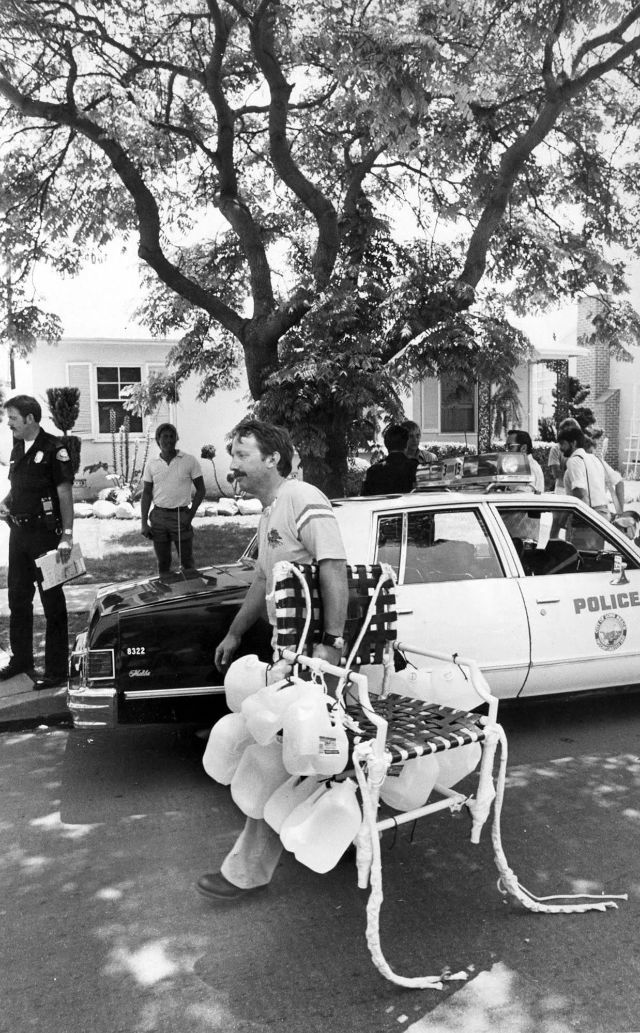
Realising he was eventually descending too quickly, Walters dumped water from the plastic jugs strapped to the chair to reduce weight and slow his fall. He finally came down over Long Beach, where the dangling cables beneath the chair became caught in a power line. The power line broke, causing a 20-minute electricity blackout in the surrounding neighbourhood. He climbed down a stepladder to the ground, unharmed, and was immediately arrested by waiting members of the Long Beach Police Department.
The whole flight had lasted around 45 minutes.
The Aftermath: Fines, Fame, and the Funny Farm
The FAA was not amused, though it was briefly stumped. Regional safety inspector Neal Savoy told reporters: "We know he broke some part of the Federal Aviation Act, and as soon as we decide which part it is, some type of charge will be filed. If he had a pilot's licence, we'd suspend that, but he doesn't."
Walters was initially fined $4,000 (equivalent to roughly $13,000 today) for operating an aircraft in controlled airspace without maintaining two-way communication with the control tower. He appealed, and the fine was reduced to $1,500. A separate charge of operating a "civil aircraft for which there is not currently in effect an airworthiness certificate" was dropped on the grounds that it did not apply to his class of aircraft.
Walters also received an award from the Bonehead Club of Dallas, a distinction that had previously been given with more contempt than affection.
Just after landing, Walters spoke to the press. His comments have since become some of the most quietly iconic words ever uttered on a Los Angeles pavement:
"It was something I had to do. I had this dream for twenty years, and if I hadn't done it, I think I would have ended up in the funny farm. A man can't just sit around."
Ten days after the flight, he appeared on Late Night with David Letterman. He also appeared with Johnny Carson on The Tonight Show and hosted at a New York bar filled with lawn chairs in celebration of his feat. He quit his job as a truck driver and attempted a career as a motivational speaker, but the bookings were never as plentiful as the column inches. He was featured in a Timex print advertisement in the early 1990s but, by most accounts, never made much money from any of it.

The Chair That Ended Up in the Smithsonian
After landing, Walters gave the chair away on the spot to a young neighbourhood boy named Jerry Fleck, who had been watching the whole extraordinary spectacle. He later deeply regretted the decision when the Smithsonian Institution came knocking and asked him to donate it for their collection.
The story did not end there. Twenty years after the flight, Fleck contacted Mark Barry, a pilot who had dedicated a website to documenting Walters' story. Fleck still had the chair, along with some of the original tethers and water jugs used as ballast, sitting in his garage.
The chair was eventually loaned to the San Diego Air and Space Museum, where it was exhibited in 2014, before being donated to the Smithsonian. It now sits on permanent display in the "Thomas W. Haas We All Fly" gallery at the National Air and Space Museum in Washington DC. The aluminium garden chair, measuring roughly 90cm by 70cm and still attached to its original tethers and water jug ballast, occupies a place among some of the most significant aircraft in history.
The Legacy: Cluster Ballooning and Imitators
Walters inspired a genuinely unexpected sporting legacy. His flight gave rise to the extreme sport of cluster ballooning, in which participants are attached by harness to large numbers of rubber helium-filled balloons.
The most dedicated imitator was Kent Couch, a gas station owner from Bend, Oregon, who in 2007 flew 240 miles across Oregon in his own lawn chair, attached to 105 helium balloons, travelling at an average of 22 miles per hour before landing near the Idaho border. Unlike Walters, Couch made multiple attempts and eventually managed the journey to another state in 2008.

The story also attracted less fortunate imitators. In April 2008, a Brazilian Catholic priest named Adelir Antonio de Carli attempted a similar flight using 1,000 helium balloons. He did not check the weather forecast, was caught in a storm, and his body was later found near an offshore oil platform. He was posthumously awarded a Darwin Award.
Walters' story also inspired the 2003 Australian comedy film Danny Deckchair, a stage musical, and a MythBusters episode in which the team replicated a version of the flight with a tethered chair and a willing presenter.

Later Life and Death
Despite the brief blaze of fame, the years after the flight were not kind to Walters. He broke up with Carol, his girlfriend of fifteen years, and found it increasingly difficult to sustain a living through speaking engagements. He worked sporadically as a security guard. He found some solace hiking the San Gabriel Mountains and volunteering for the United States Forest Service.
On 6 October 1993, at the age of 44, Larry Walters died by shooting himself in the heart in Angeles National Forest.
His death received relatively little coverage at the time. People magazine ran a brief piece under the headline "A Daredevil's Despair Ends in His Suicide." For many people who heard about it, the end felt like a profound mismatch with the brightness of what he had done eleven years earlier.
Why the Story Still Matters
There is something about Larry Walters that refuses to be filed away as a historical oddity. He was not a daredevil in the traditional sense. He was not chasing records or sponsorship. He was a truck driver who had carried a dream around for twenty years and one morning decided, with meticulous practicality and no small amount of naivety, to actually do it.
He bought a sturdy chair. He gathered his provisions. He made his list.
The fact that it went catastrophically and brilliantly sideways seems almost beside the point. When asked, simply, why he had done it, he said: "A man can't just sit around."
The lawn chair is in the Smithsonian now. Which, if you think about it, is exactly where it belongs.
If you or someone you know is struggling, the Samaritans are available 24 hours a day on 116 123 (UK and Ireland). In the US, call or text 988 to reach the Suicide and Crisis Lifeline.


