

Wet Noses in No Man’s Land: The Bravery of Mercy Dogs, Battlefield Rescuers of World War I and Beyond
Updated: Mar 13

There are many sounds described in accounts of trench warfare. Shellfire tearing through the air. The dull concussion of artillery. The splash of boots in mud thick enough to swallow a man whole. And then there was another sensation altogether. A cold nose brushing against a soldier’s face in the darkness of no man’s land.
More often than not, that sensation meant a rat. But sometimes, it meant rescue.
Mercy dogs, also known as ambulance dogs, Red Cross dogs or casualty dogs, were among the most remarkable yet understated participants in modern warfare. Moving silently across shattered landscapes, they searched for wounded soldiers, carried first aid supplies, guided medics to those who still had a chance of survival, and in some cases remained beside the dying so that no one faced their final moments alone.
Their history stretches from the late nineteenth century into the Korean War, and their legacy still echoes in modern military working dogs and civilian search and rescue teams today.

The Origins of the Sanitätshunde
The formal idea of training dogs specifically for medical battlefield roles began in Germany. In 1890, the painter and animal advocate Jean Bungartz founded the Deutschen Verein für Sanitätshunde, or German Association for Medical Dogs.
By 1895, what contemporary observers described as a “novel experiment” was under way. Bungartz and his colleagues believed dogs could do more than guard or carry messages. They could locate wounded men in terrain too dangerous for stretcher bearers. They could carry supplies. They could lead rescuers to survivors.
By 1908, Italy, Austria, France and Germany had developed structured programmes. These were not sentimental ventures. They were practical responses to the changing nature of warfare. Firepower was increasing. Battlefields were becoming larger and more chaotic. Casualty retrieval was falling behind the pace of injury.
Dogs offered mobility, stealth and instinct in environments where human movement drew gunfire.
World War I: No Man’s Land and the Work of Rescue
When the First World War began in 1914, Germany already had approximately 6,000 trained dogs, many of them ambulance dogs known as Sanitätshunde. Over the course of the war, Germany is estimated to have used roughly 30,000 dogs in total military roles, including messengers and medical auxiliaries. Of these, around 7,000 were killed.
Across all combatant nations, upwards of 50,000 dogs were deployed during the war. Estimates suggest that around 10,000 served specifically as mercy dogs. They were credited with saving thousands of lives, including at least 2,000 in France and approximately 4,000 wounded German soldiers.
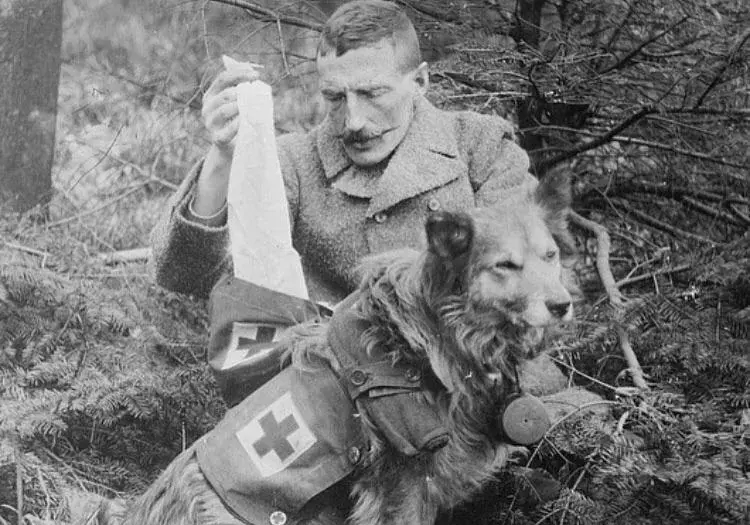
Equipment and Training
A typical mercy dog wore a specially designed saddlebag containing water, bandages, rations and sometimes small quantities of liquor used to steady men in shock. The dogs were trained by national Red Cross societies or military schools associated with each army.
They worked primarily at night or after heavy fighting had subsided. Silence was essential. Barking could attract enemy fire. Instead, once a wounded soldier was found, the dog would approach close enough for him to access the medical supplies.
If the soldier was too badly injured to treat himself, the dog would take a piece of uniform or a personal item and return to its handler. It would then guide the medic back across the battlefield.
If the dog found no one, it would lie down in front of its handler rather than attempt to lead him somewhere unnecessarily.
Some dogs were even fitted with gas masks during periods of chemical warfare, a stark reminder of the conditions in which they worked.

Triage by Instinct
Accounts from military surgeons repeatedly emphasised the dogs’ ability to identify those with a chance of survival.
One British surgeon wrote:
“They sometimes lead us to bodies we think have no life in them, but when we bring them back to the doctors they always find a spark. It is purely a matter of their instinct, which is far more effective than man’s reasoning powers.”
Handlers reported that dogs appeared to distinguish between the dead, the mortally wounded and those who could be saved. Whether this was true triage or an acute sensitivity to scent and movement is still debated. What is clear is that they frequently located men overlooked in darkness, mud and cratered terrain.
In cases where a soldier was beyond help, some dogs were trained to remain beside him. In the isolation of no man’s land, that companionship mattered.
Edwin Richardson and the British War Dog School
At the outbreak of war, Britain had no organised military dog programme. That changed largely due to the persistence of Edwin Hautenville Richardson.
Richardson had been advocating for a British military dog unit since 1910. After his proposals were initially rejected, he trained dogs himself and offered them to the Army. When they declined, he supplied them to the British Red Cross.
He and his wife established the British War Dog School in 1914, the first of its kind in Britain. More than 200 dogs were eventually trained there.

Richardson favoured Airedales for their intelligence and steadiness under fire. Training was conducted under simulated battle conditions. Shells from practice batteries screamed overhead while motor lorries roared past. Dogs were conditioned to ignore the chaos.
In 1915, British soldier Oliver Hyde wrote in The Work of the Red Cross Dog on the Battlefield:
“To the forlorn and despairing wounded soldier, the coming of the Red Cross dog is that of a messenger of hope. Here at last is help, here is first aid.”
Hyde described the dog as part of the “army of mercy”, a phrase that captured both the practical and symbolic value of their work.
Breed Selection and Temperament
Different nations favoured different breeds based on temperament and physical capacity.
German Shepherds were valued for intelligence, stamina and trainability.
Airedales were considered steady and robust.
Collies were used early for their scenting ability and obedience.
Pointers and setters were employed by the United States Army Medical Corps during World War II for their tracking instincts.
Mercy dogs required unusual balance. They had to work independently yet remain responsive to handlers. They needed courage without recklessness. Most importantly, they needed to move calmly through noise, smoke and gunfire.
Individual Dogs and Battlefield Accounts
Certain dogs became known for extraordinary efforts.
A French dog named Captain reportedly located 30 wounded soldiers in a single day. Another, Prusco, was credited with finding 100 men during one engagement. Accounts state that Prusco dragged injured soldiers into shell holes for temporary shelter before returning with rescuers.

These stories illustrate not just training but improvisation. While dogs were conditioned to locate and signal, dragging a man to cover suggests adaptive behaviour under extreme stress.
Yet many mercy dogs did not survive. Heavy losses, particularly in France, led to the eventual discontinuation of some national programmes.
Animals in the Wider War Effort
Mercy dogs were part of a much larger animal workforce. During the First World War alone, over 16 million animals served in various capacities.
Horses and mules hauled artillery. Pigeons carried coded messages. Cats controlled rats aboard ships and in trenches. Dogs pulled carts, guarded depots and delivered supplies.
The war was industrial, but it still depended heavily on living muscle and instinct. Mercy dogs occupied a unique place within that system. They were not simply transport or communication tools. They functioned as medical auxiliaries.
Psychological Impact on Soldiers
Beyond physical rescue, mercy dogs had psychological significance.
Letters and memoirs describe the relief felt when a dog appeared. In a landscape of mud, wire and artillery, the sight of a calm animal evoked home and normality.
The dogs’ presence reduced isolation. Even when medical rescue was impossible, companionship mattered. In environments defined by mechanised destruction, the simple act of being found by another living creature carried emotional weight.
Some contemporary commentators noted that dogs themselves showed signs of strain after prolonged exposure to shellfire. The emotional cost of war did not fall exclusively on human participants.

Recognition and Decoration
Formal recognition for animal bravery evolved later.
During World War II, the Dickin Medal was established in 1943 by the People’s Dispensary for Sick Animals in Britain, becoming known as the animal equivalent of the Victoria Cross. Many war dogs received this honour in later conflicts.
However, most First World War mercy dogs predated structured animal gallantry awards. Some individual animals, such as Sergeant Stubby, gained public attention, but the majority worked anonymously.
Their contributions were documented primarily in surgeons’ reports, Red Cross publications and recruitment posters.

World War II and the Korean War
In the lead up to World War II, Germany again conscripted dogs for messenger, guard and medical roles.
The United States Army Medical Corps began a formal casualty dog training programme in August 1942. Some ambulances were equipped with teams of six trained dogs. Pointers and setters were commonly used.
During the Korean War, German Shepherds trained at Fort Riley, Kansas, were deployed as casualty dogs. Their task remained familiar: search for wounded soldiers and lead handlers to them.
However, technological developments were changing warfare. Improved radio communication and helicopter medical evacuation began to reduce reliance on roaming casualty dogs.
Decline and Transition
By the mid twentieth century, battlefield conditions were shifting. Mechanised warfare moved faster. Front lines became more fluid. Helicopter evacuation in Korea and later conflicts allowed rapid retrieval of wounded personnel.
The window in which a dog could independently search a static battlefield narrowed. Mercy dog programmes gradually declined.
Yet the concept did not disappear entirely. Modern military working dogs continue to serve in explosive detection, patrol and search roles. Civilian search and rescue dogs in earthquake zones perform a function strikingly similar to their First World War predecessors: locating the living among the collapsed and presumed dead.
From War to Therapy
After the Second World War, the American Red Cross initiated a therapy dog programme. Though distinct from battlefield rescue, it reflected recognition of the calming influence of dogs in medical environments.
The programme continued into the twenty first century. The role had shifted from locating wounded soldiers to comforting patients in hospitals and care facilities. The underlying principle remained consistent: dogs could support human resilience in moments of vulnerability.

Numbers and Legacy
By the end of the First World War in November 1918, approximately 7,000 German dogs had died in service. Across both World Wars, as many as 20,000 dogs are estimated to have served specifically as mercy dogs.
Their contribution can be measured in thousands of lives saved, but also in quieter moments. A wounded man in darkness feeling a steady presence beside him. A surgeon guided to a patient others had overlooked.
Mercy dogs did not volunteer. They were trained and deployed within human conflicts. Yet their work demonstrates how deeply intertwined animal and human histories have been, even in industrial warfare.
In the cratered mud of no man’s land, they moved without ceremony. They did not carry weapons. They carried bandages. And sometimes, that was enough.
Sources
Red Cross historical archives
Oliver Hyde, The Work of the Red Cross Dog on the Battlefield, 1915
US Army Medical Corps training records, 1942
Fort Riley military working dog archives
Zita Ballinger Fletcher, MHQ Military History Quarterly
People’s Dispensary for Sick Animals, Dickin Medal history


