The Electric Egg: A Glimpse into the Future of Urban Mobility
Updated: Mar 11
Electric cars feel like a thoroughly modern development, quietly gliding through city streets with an efficiency that would have seemed improbable not long ago. Yet, more than eighty years before today’s EV boom, one French designer was already imagining a compact electric future. His solution did not resemble anything on the road. It looked like an egg.
The L’Oeuf Electrique was created in the early 1940s by industrial designer Paul Arzens, and it remains one of the most unusual and forward-thinking vehicles ever built. It was not a prototype commissioned by a major manufacturer, nor a speculative design study. It was Arzens’s personal car, constructed largely by hand during wartime fuel shortages. Only one was ever made, and it survives today as a rare example of mid-twentieth-century experimental thinking.
What makes the story compelling is not simply the car’s eccentric shape, but the context in which it was conceived. The Electric Egg emerged from wartime necessity, artistic curiosity, and one designer’s persistent interest in alternative propulsion.
Paul Arzens: The Man Behind the Electric Egg
Paul Arzens was born in France in 1903 and built a reputation as a highly original industrial designer. He is best remembered today for his work on French railway locomotives, particularly the distinctive streamlined electric engines of the SNCF. His design philosophy consistently blended engineering practicality with sculptural form.
Before turning fully to vehicle design, Arzens experimented widely with mechanical systems. One of his earliest automotive projects was a six-speed automatic transmission developed for an older Chrysler platform. The system attracted the attention of Robert Peugeot, though it ultimately did not enter production in the Peugeot 402. Even at this early stage, Arzens showed a willingness to challenge established automotive conventions.
His first complete car, however, revealed the full extent of his visual imagination.
La Baleine: The Precursor
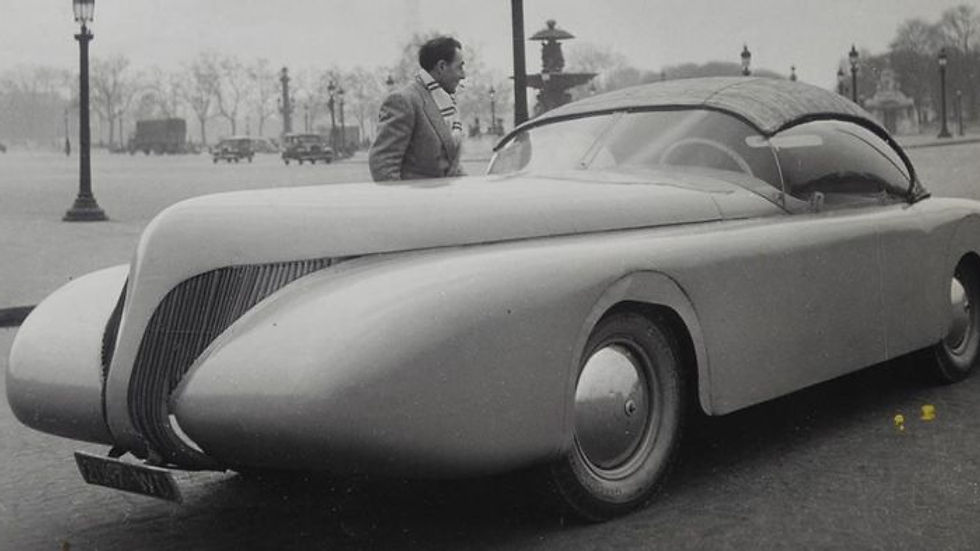
In 1937, Arzens constructed a striking vehicle known as La Baleine, meaning The Whale. Built on a Buick chassis, it featured a bulbous streamlined body that already hinted at his fascination with organic forms. The car was unconventional but still powered by petrol.
The outbreak of the Second World War soon changed the practical realities of motoring across occupied Europe. Petrol became scarce, heavily rationed, or simply unavailable for civilian use. Like many engineers of the period, Arzens began to consider electric propulsion as a necessity rather than a curiosity.
He produced an electric version of La Baleine using a Fiat chassis and a large accumulator battery pack weighing over 2,400 pounds. The vehicle reportedly produced around 10 horsepower and could travel roughly 125 miles on a charge. While technically impressive, the weight penalty made the design inefficient and unwieldy.
Arzens drew an important lesson. If electric motoring were to succeed under wartime constraints, weight reduction would be essential. The next project would take the opposite approach.

Wartime Shortages and the Birth of L’Oeuf Electrique
The German occupation and the severe petrol shortage provided the immediate motivation for the Electric Egg. Arzens set out to design an ultra-light personal electric vehicle that could function efficiently in constrained urban conditions.
The result was L’Oeuf Electrique, literally The Electric Egg, completed in the early 1940s. Unlike La Baleine, this machine was conceived from the ground up as a lightweight electric runabout rather than a converted petrol car.
It was a radical departure in both engineering and appearance.
The vehicle was powered by a small electric motor and battery pack capable of delivering approximately 63 miles of range. Top speed was around 44 mph when lightly loaded, dropping to roughly 37 mph with two occupants. By modern standards, the figures appear modest, but within the context of wartime Europe, they represented a practical urban solution.
A Radical Lightweight Structure
Perhaps the most technically impressive aspect of L’Oeuf Electrique was its weight discipline.
The bare body shell weighed only about 66 pounds. Even after the electric motor was installed, the vehicle remained exceptionally light at under 200 pounds. With the battery pack fitted, total weight reached roughly 771 pounds, making it one of the lightest road-going electric vehicles ever constructed.
This was achieved through a combination of hand-beaten aluminium panels and extensive use of Plexiglass. The transparent canopy covered much of the upper body, reducing mass while creating the car’s distinctive bubble appearance.
Arzens had effectively built a rolling greenhouse.
The three-wheel layout also contributed to the low weight and tight manoeuvrability. The single rear wheel housed the drive system, while the front axle handled steering duties. For crowded European streets, the configuration made practical sense.

A Bubble Cabin With Panoramic Vision
Inside, the Electric Egg was remarkably simple but thoughtfully arranged. The cabin accommodated two occupants in close quarters, with seating that was reportedly comfortable given the vehicle’s minimal footprint.
Dominating the interior was an oversized steering wheel positioned prominently in front of the driver. Instrumentation was minimal, reflecting both wartime austerity and Arzens’s functional priorities.
The real innovation was visibility. Thanks to the expansive Plexiglass canopy, occupants enjoyed roughly 270 degrees of outward vision. There were virtually no structural pillars to obstruct the view, creating a driving experience closer to sitting in a glass dome than a conventional car.
In an era when most vehicles had relatively poor sightlines, this was quietly revolutionary.

Hand Built Craftsmanship
Unlike mass-produced vehicles of the period, L’Oeuf Electrique was essentially coachbuilt by a single designer. Arzens personally shaped the aluminium panels by hand, giving the body its distinctive organic contours.
The surface was never perfectly smooth, and even when new it displayed subtle irregularities typical of hand-beaten metal. Today, the surviving example shows additional wear and patina, but these imperfections only emphasise its handmade origin.
At the rear, the otherwise smooth egg profile is interrupted by the housing for the motor and rear wheel assembly. Small integrated lights completed the minimalist exterior.
The result sits somewhere between sculpture and transport device, which was entirely consistent with Arzens’s broader design philosophy.

A Vehicle Ahead of Its Time
Contemporary observers did not widely embrace the Electric Egg. Wartime Europe had little appetite for experimental personal vehicles, and after the war, the automotive industry returned firmly to petrol power. Electric cars would remain marginal for decades.
Yet viewed from a modern perspective, Arzens’s thinking appears strikingly prescient.
He anticipated several themes that define current urban mobility discussions:
Ultra-compact city vehicles
Lightweight construction
Electric propulsion for short-range urban use
Panoramic driver visibility
Personal mobility pods rather than traditional cars
Some commentators have even suggested that the philosophy behind L’Oeuf Electrique foreshadows later microcars and possibly the Smart ForTwo, particularly in its focus on dense city manoeuvrability. While there is no direct design lineage, the conceptual overlap is difficult to ignore.
Survival and Legacy
Remarkably, the sole Electric Egg has survived. It has not undergone heavy modern restoration, which preserves much of its original character. The vehicle stands today as both a historical curiosity and a serious early experiment in electric mobility.
Paul Arzens would go on to achieve greater fame through his railway locomotive designs, but L’Oeuf Electrique remains one of his most distinctive creations. It represents a moment when wartime necessity, artistic ambition, and engineering ingenuity briefly aligned.
At a time when electric vehicles were largely dismissed as impractical, Arzens demonstrated that thoughtful design could make them viable, at least for specific uses.
Final Thoughts
The L’Oeuf Electrique is easy to treat as an eccentric footnote in automotive history. Its egg-shaped body and Plexiglass bubble invite amusement at first glance. Yet beneath the unusual styling lies a serious piece of design thinking born from real constraints.
Paul Arzens was not trying to predict the twenty-first century. He was trying to solve a wartime transport problem with the tools available to him. In doing so, he produced a vehicle that now feels unexpectedly contemporary.
As electric cars finally move into the mainstream, the Electric Egg serves as a quiet reminder that many of today’s supposed innovations were already being explored in workshops and garages more than eight decades ago.
The Future of Electric Vehicles
As we look ahead, the future of electric vehicles seems bright. Innovations continue to emerge, and the industry is evolving rapidly. The Electric Egg stands as a testament to the creativity and determination of designers like Paul Arzens. His vision paved the way for the electric vehicles we see today.
The journey of electric cars has just begun. With advancements in battery technology, charging infrastructure, and sustainable practices, we are on the brink of a transportation revolution. The Electric Egg may have been a product of its time, but its spirit lives on in the modern electric vehicles that are transforming how we think about mobility.
In conclusion, the legacy of L’Oeuf Electrique is not just about a quirky design. It’s about the enduring pursuit of innovation in the face of challenges. As we embrace the future of electric mobility, let us remember the pioneers who dared to dream of a different kind of vehicle.