

The Gruesome Death Of Captain James Cook
Updated: Mar 14

On 14th February, 1779, Captain James Cook, one of Britain’s most celebrated navigators, was killed at Kealakekua Bay in the Hawaiian Kingdom. He was fifty years old. By the time of his death, Cook had already transformed European understanding of the Pacific Ocean, charting vast stretches of coastline and producing maps of remarkable accuracy. Yet his final encounter in Hawaii exposed the fragile and often volatile nature of first contact between Europeans and Indigenous societies.
From Yorkshire Farm to the Pacific
James Cook was born in 1728 in Marton, Yorkshire, the son of a Scottish farm labourer. His early life was modest. He worked on the land alongside his father until the age of eighteen, when a Quaker shipowner offered him an apprenticeship. That decision altered the course of his life.
Cook proved to be a disciplined and mathematically gifted seaman. After joining the Royal Navy, he rose steadily through the ranks and became a ship’s master by the age of twenty nine. His reputation for precision and calm command brought him to the attention of the Admiralty.
In 1768 he was given command of the barque Endeavour and sent on what was officially a scientific expedition to observe the transit of Venus. The voyage expanded far beyond astronomy. Cook circumnavigated New Zealand, mapped the eastern coast of Australia, and charted the Great Barrier Reef. His surveys were so accurate that many remained in use for generations.

The Third Voyage and the Hawaiian Encounter
Cook’s third major voyage, beginning in 1776, aimed to locate the long sought Northwest Passage. During this journey he became the first recorded European to reach the Hawaiian Islands, which he initially named the Sandwich Islands.
Cook’s ships arrived at Kealakekua Bay during the makahiki season, an annual festival honouring the Hawaiian god Lono. Some historians suggest that the timing of Cook’s arrival, combined with the appearance of his ships, may have encouraged certain Hawaiians to associate him with the deity. While modern scholarship treats the idea that Cook was universally believed to be Lono with caution, it is clear that his reception was initially warm. Cook and his crew were provisioned generously and treated with formal ceremony.
The atmosphere, however, did not remain harmonious for long.
Growing Tensions
Relations began to deteriorate during Cook’s extended stay. Cultural misunderstandings, competition over resources, and the increasingly assertive behaviour of the British sailors strained local goodwill. Matters worsened when one of Cook’s crew died, probably from a stroke brought on by illness and excess. The death was a visible reminder that the visitors were mortal.
Cook eventually sailed away, but severe weather damaged the foremast of his ship Resolution, forcing an unwelcome return to Kealakekua Bay in early 1779. By this point the political and social climate had shifted. The Hawaiians were less accommodating, and minor disputes became more frequent.
The immediate crisis arose when one of Cook’s cutter boats was stolen. Boat theft was a common form of leverage in Pacific encounters, but Cook responded with a tactic he had used elsewhere: he decided to detain a high ranking chief in order to compel the return of the property.
The Fatal Confrontation
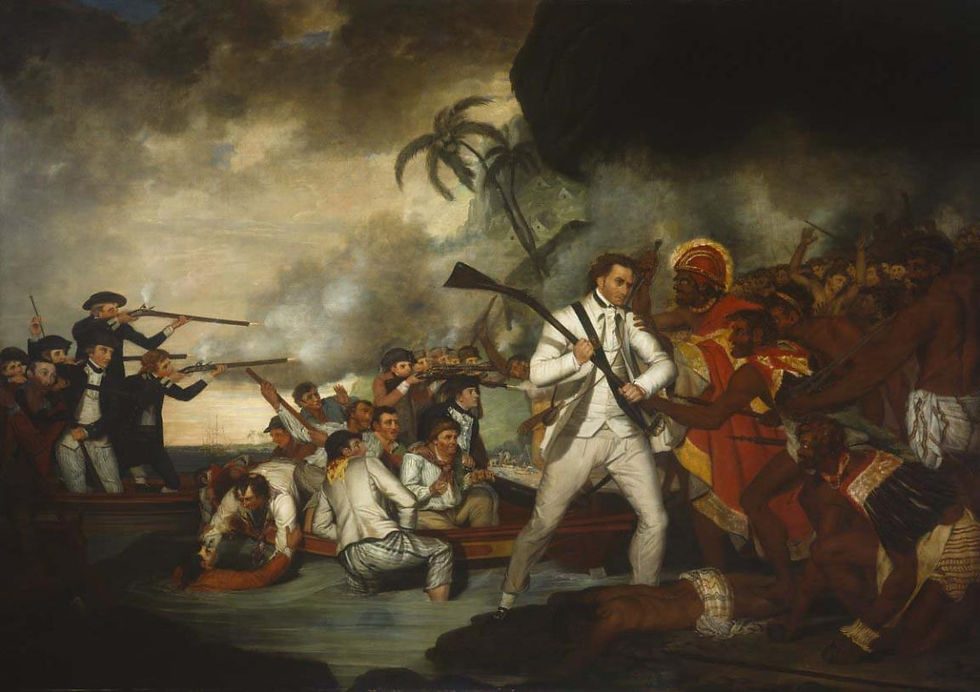
On the morning of 14th February, 1779, Cook went ashore with a detachment of Royal Marines. His intention remains debated. Some accounts state that he planned to kidnap the ruling chief Kalaniōpuʻu as a hostage. Others suggest he initially hoped to negotiate but was prepared to use coercion if necessary.
What is clear is that the situation quickly escalated.
A large crowd gathered on the shoreline as Cook attempted to escort the chief towards the boats. Tension rose. Stones were thrown. At some point a Hawaiian chief of lower rank was shot by Cook’s party. The firing triggered panic and anger among the assembled Hawaiians.
Cook ordered his men to withdraw towards the boats through the surf. In the confusion he was struck on the head and then stabbed. He fell forward into the water and died face down in the shallows. Four marines were killed alongside him.
The surviving British forces retreated to their ships, where they later launched retaliatory bombardments and skirmishes along the coast over several days.
Treatment of the Body
After the clash, Hawaiian priests and chiefs took possession of Cook’s body. British observers later described the remains as mutilated, noting that the body had been dismembered and the bones preserved.
However, many Hawaiian scholars and historians have emphasised that this treatment was consistent with high status funerary rites traditionally reserved for important individuals. In Hawaiian practice, the removal and careful preservation of bones could signify honour rather than desecration. Eventually, portions of Cook’s remains were returned to the British and buried at sea.

The Monument at Kealakekua Bay
Today, a 27 foot white obelisk stands near the shoreline at Kealakekua Bay marking the site of Cook’s death. The monument was erected in 1878 by British interests. The small plot of land on which it stands is technically British territory, despite being surrounded by the United States.
A plaque in the surf indicates the approximate location where Cook fell. Behind the monument lie the ruins of the ancient Hawaiian village of Kaʻawaloa, once an important religious and political centre.
The memorial remains controversial. Many Hawaiians view it not as a neutral historical marker but as a symbol of colonial intrusion. Cook’s arrival marked the beginning of profound and often damaging changes to Hawaiian society, including the introduction of foreign diseases, shifting power structures, and eventual political upheaval.

Historical Assessment
Captain James Cook remains one of the most significant maritime explorers in British history. His surveys of the Pacific were meticulous, and his voyages expanded European geographic knowledge on an unprecedented scale. Few navigators of the eighteenth century matched his technical skill or endurance.
Yet his death at Kealakekua Bay illustrates the limits of even the most accomplished explorer. Cook’s earlier success in managing encounters across the Pacific may have contributed to a degree of overconfidence during his final months. By 1779 he was operating in a far more volatile environment, and the decision to use coercion over negotiation proved fatal.
Modern historians tend to view the event not as an isolated tragedy but as a moment shaped by mutual misunderstanding, cultural friction, and the increasingly forceful behaviour of European expeditions in the late eighteenth century.
Cook helped fill in the blank spaces on European maps. His death, however, serves as a reminder that exploration was never simply a story of 'discovery.' It was also a story of encounter, imbalance, and consequence.


