

Martin Adolf Bormann: A Life Shaped by Ideology, Belief, Flight and Reckoning
Updated: Mar 14

On 14th April, 1930, a boy was born into one of the most powerful households in Nazi Germany. His birthplace was the affluent Munich suburb of Grünwald, a place of quiet streets and large villas that concealed the extraordinary authority exercised by his father. The child was Martin Adolf Bormann, the eldest son of Martin Bormann, the head of the Nazi Party Chancellery and private secretary to Adolf Hitler.
Martin Adolf Bormann’s life would unfold as a long and uneasy journey through the wreckage of twentieth century Europe. It moved from total ideological immersion to religious conversion, from missionary work in a collapsing post colonial state to public engagement with the crimes of the Third Reich, and finally into unresolved allegations that complicated any simple narrative of redemption. His biography offers a rare and uncomfortable lens into how the children of power navigated the aftermath of catastrophe.
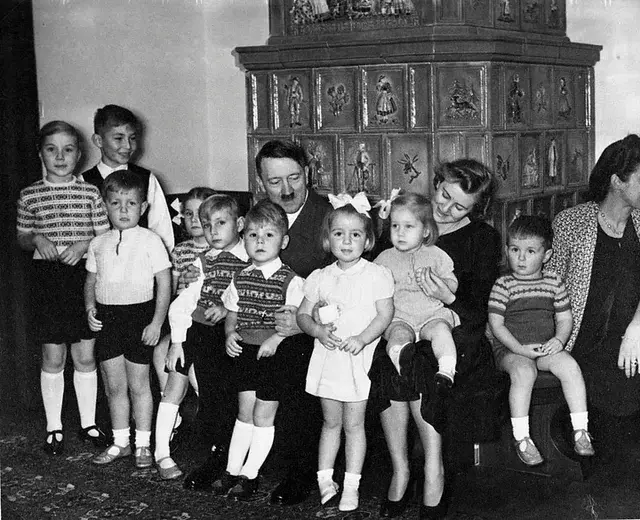
Childhood inside the Nazi inner circle
Although born into privilege, Martin Adolf’s childhood was marked less by warmth than by ideology. His father was rarely present. Martin Bormann senior spent much of the war years at Hitler’s headquarters, first at the Berghof and later at the Wolf’s Lair, acting as gatekeeper to the Führer and exercising immense influence behind the scenes. Family life was shaped primarily by his mother Gerda, a committed National Socialist who believed deeply in racial doctrine and authoritarian discipline.
The household rejected Christianity as a moral framework. Martin Adolf was baptised into the German Evangelical Church largely as a symbolic act, with Hitler named as his godfather. There is no evidence of personal contact between godfather and child beyond formalities. Subsequent children were not baptised at all, reflecting their parents’ hostility to organised religion. Emotional intimacy was discouraged. Letters written by Gerda to her husband reveal a worldview in which compassion was dismissed as weakness and obedience was treated as the highest virtue.
Within the family, Martin Adolf was known as Krönzi, short for Kronprinz. The nickname captured both his position as eldest son and the expectations placed upon him. He was raised to see himself as part of a ruling elite whose authority was biological and inevitable.
Education and indoctrination
In 1940, at the age of ten, Martin Adolf was sent to the Nazi Party Academy at Matrei am Brenner in the Tyrol. These academies formed part of a wider system that included Napola schools and Ordensburg training centres, institutions designed to create a future leadership class loyal to National Socialism.

Life at Matrei followed a rigid structure. Days were filled with physical endurance training, military drill, racial theory, and constant reinforcement of loyalty to the Führer. Christianity was marginalised and often mocked. Pupils were taught to see themselves not as moral individuals but as biological vanguards of the Reich.
Martin Adolf absorbed this worldview enthusiastically. Later accounts describe him as an ardent young Nazi during these years, committed to the ideals he had never been encouraged to question.
Collapse and flight
By April 1945, the certainties of his childhood were dissolving. On 15th April, 1945, as Allied forces advanced, the academy at Matrei am Brenner closed. A party official in Munich advised the fifteen year old to attempt to reach his mother, who was then in the German occupied hamlet of Val Gardena near Selva in Italian South Tyrol.
The journey proved impossible. Transport networks were shattered, borders were unstable, and authority was collapsing. Martin Adolf found himself stranded in Salzburg. There, the Gauleiter provided him with false identity papers, an act that likely saved his life as the name Bormann was already becoming dangerous.
He eventually found refuge with a Catholic farmer, Nikolaus Hohenwarter, at the Querleitnerhof, a remote farm halfway up a mountain in the Salzburg Alps. The contrast with his earlier life was stark. The rhythms of farm work, the absence of ideology, and the quiet presence of Catholic faith introduced him to a world utterly unlike the one he had known.
Loss revelation and silence
After Germany’s surrender, Martin Adolf remained in hiding. His mother Gerda was arrested by Allied authorities and subjected to prolonged interrogation by officers of the Combined Intelligence Committee. She was imprisoned in Italy and died of abdominal cancer in the prison hospital at Merano on 23rd March, 1946.
Martin Adolf learned of her death only in 1947, through an article in the Salzburger Nachrichten. The delay underscored how completely his former life had disintegrated. It was only then that he confessed his true identity to Hohenwarter.
The farmer reported this information to the local priest in Weißbach bei Lofer. Rather than denouncing the boy, the priest sought guidance from church authorities. The rector of the pilgrimage church of Maria Kirchtal agreed to take Martin Adolf into his care, offering structure and protection at a moment of profound vulnerability.
This period was marked by psychological dislocation. Like many former Hitler Youth members, Martin Adolf experienced a collapse of meaning when the regime fell. Authority symbols vanished overnight, leaving shame confusion and silence in their wake.

Conversion and confrontation
At Maria Kirchtal, Martin Adolf converted to Catholicism. His conversion was not dramatic. It emerged slowly through routine ritual and the experience of being treated with dignity rather than suspicion. In post war Austria, Catholic institutions often functioned as places of refuge for displaced or compromised youth, offering food shelter and a new social identity.
While serving as an altar boy, Martin Adolf was arrested by American intelligence officers and taken to Zell am See for several days of interrogation. His father’s role still cast a long shadow. After questioning, he was returned to his parish. No charges were brought.
He remained at Maria Kirchtal until joining the Missionaries of the Sacred Heart in Ingolstadt. During this time he resumed contact with his siblings. With the exception of one sister, all were eventually received into the Catholic Church, marking a collective break from their parents’ ideology.

Ordination and uncertainty
On 26th July, 1958, Martin Adolf Bormann was ordained as a Catholic priest. For many observers, the symbolism was striking. The son of one of Nazism’s most powerful figures had chosen a vocation defined by service and moral reflection.
Throughout these years, uncertainty surrounding his father’s fate lingered. Martin Bormann senior had disappeared in Berlin in May 1945, and for decades his death was unconfirmed. It was not until 1972 that remains identified as his were conclusively examined. This unresolved history shaped how Martin Adolf was perceived, often attracting suspicion and morbid curiosity.
Missionary work in the Congo
In 1961, Bormann was sent to the newly independent Democratic Republic of the Congo, formerly the Belgian Congo. The country was in turmoil, struggling with decolonisation, political violence, and Cold War intervention.
Bormann worked in pastoral care and education, but Catholic missions were increasingly viewed with suspicion, associated with European authority and colonial control. In 1964, the Simba rebellion erupted, targeting missionaries and symbols of foreign influence. Bormann was forced to flee the country for his safety.
He returned in 1966 for a further year, a decision reflecting both commitment and idealism, but the strain of working in a violent and unstable environment left its mark.

Leaving the priesthood
In 1969, Bormann suffered a near fatal injury in a road traffic accident. During his recovery he was cared for by a nun named Cordula. Their relationship deepened, prompting both to question their vows.
The early nineteen seventies were a period of upheaval within the Catholic Church following the Second Vatican Council, which encouraged renewed examination of clerical life. Thousands of priests left the priesthood during this period. Bormann’s decision to do so fits within this wider context rather than standing as an isolated rupture.
He left the priesthood and in 1971 married Cordula, who also renounced her vows. They had no children. Bormann continued working as a theology teacher, eventually retiring in 1992.
Speaking about the past
In 2001, long after retirement, Martin Adolf Bormann began touring schools across Germany and Austria. He spoke openly about the crimes of the Third Reich, his father’s role within it, and the dangers of ideological certainty.
Rather than focusing on ideology alone, he emphasised how ordinary structures obedience and silence enabled extremism. Teachers reported that pupils responded powerfully to hearing history framed through lived experience rather than textbooks.
He also visited Israel, meeting privately with Holocaust survivors. He described these encounters later as necessary rather than redemptive.

Allegations and institutional response
In 2011, a former pupil at an Austrian Catholic boarding school accused Bormann of having raped him when he was twelve years old during the early nineteen sixties. Other former pupils alleged severe physical violence.
By this time, Bormann was suffering from dementia and was unwilling or unable to comment. No criminal proceedings followed. However, the independent Klasnic Commission, established to investigate abuse within Austrian Catholic institutions, reviewed the case and awarded compensation to the accuser. The commission’s findings were not legal verdicts but acknowledgements of harm based on evidentiary assessment.
These allegations complicate any narrative of moral transformation. They underscore how rejecting one violent ideology does not guarantee freedom from harm in other institutional settings.
Death and reckoning
Martin Adolf Bormann died on 11th March, 2013, in Herdecke, North Rhine Westphalia. He was eighty two years old.
His life resists simple moral categorisation. He neither continued his father’s ideology nor escaped the consequences of institutional power. Instead, his story illustrates how history belief and responsibility intersect across generations, and how personal change is rarely complete or uncomplicated.


