CREEM Magazine: Stars Cars in the 1980s
Updated: Mar 13
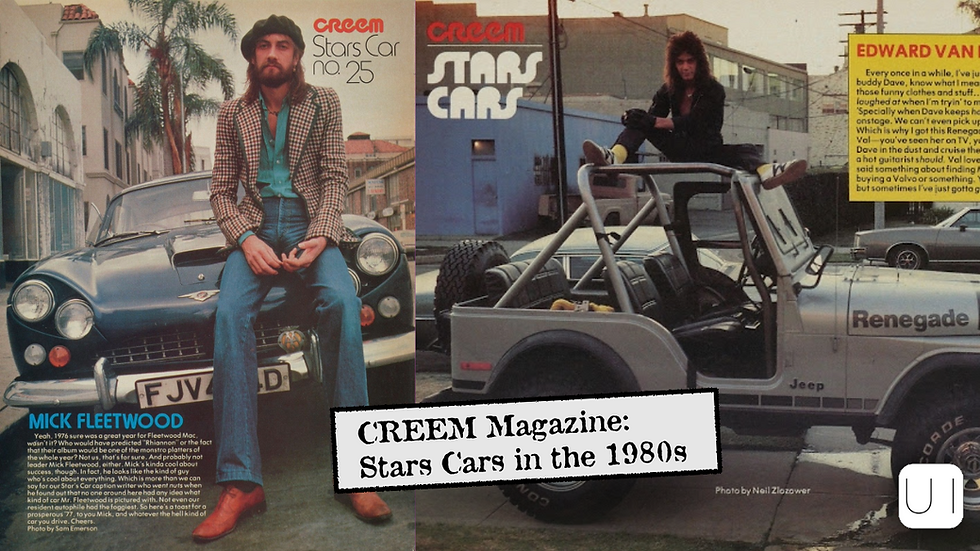
First off, you may be right in thinking that some of these cars aren't owned by these particular stars, secondly, the word 'stars' may be quite generous in describing some of these people. However, Rock stars have always looked slightly unsure of themselves when photographed next to cars. Guitars are fine. Microphones make sense. Cars, though, introduce a strange uncertainty. Do you lean on the bonnet. Sit on it. Stand near it like you have just discovered it in a car park. The results are rarely convincing. CREEM Magazine noticed this early on and decided not to help at all. If anything, it encouraged the discomfort.

By the time the 1980s arrived, CREEM was already a veteran troublemaker. Founded in Detroit in 1969, it had spent over a decade cheerfully dismantling rock star mythology with sarcasm, bad jokes, and an allergy to reverence. While other magazines polished musicians into lifestyle brands, CREEM preferred to catch them mid pose, mid ego, and occasionally mid mistake.
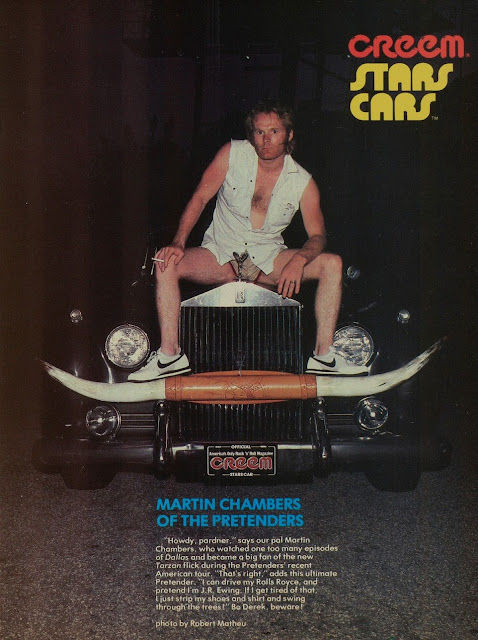
One of its most enduring features was Stars Cars, a recurring photo series that paired musicians with their vehicles and then quietly undermined the whole idea. The premise was simple. Here is a famous person. Here is their car. Now let us all take a moment to appreciate how strange this situation actually is.

Why Detroit made the difference
Stars Cars only really works if you understand where CREEM came from. Detroit was not a place where cars were abstract symbols of wealth. They were everywhere. They were built by neighbours, cousins, parents, and sometimes the readers themselves. Cars were not glamorous objects. They were heavy, oily, complicated, and essential.
That background shaped everything. When CREEM showed a rock star next to a luxury car, the message was never look how impressive this is. It was closer to look how hard this person is trying. The city’s working class sensibility ran through every caption. If a musician looked ridiculous next to a Ferrari, CREEM trusted the reader to spot it without explanation.

The 1980s arrive and things get shiny
The late 1970s version of Stars Cars had been chaotic in the best way. Muscle cars, dented tour vans, and questionable taste were part of the charm. The 1980s changed the tone. Money flooded into the music industry. Image became more deliberate. Cars followed suit.
Imported luxury replaced battered Americana. Everything got sleeker, louder, and more self conscious. CREEM did not resist the change so much as document it, eyebrow permanently raised.

Bernie Taupin and the inevitable Rolls Royce
In November 1980, CREEM featured Bernie Taupin with a Rolls Royce. This was not shocking. If you had written the lyrics to some of the most successful pop songs of the previous decade, a Rolls Royce was almost contractual.
CREEM’s caption, though, did the work. Parodying Your Song, it read, “It’s a little bit funny, owning a Rolls Royce, but I hope you believe me, I don’t get a choice.” The joke landed because it was true. At a certain level of success, restraint stops being an option. Luxury becomes expected. The Rolls Royce was not excess. It was administration.
Taupin himself did not look especially thrilled. He looked like a man who knew this was exactly how things were supposed to go, whether he liked it or not.

Vince Neil and the full performance
By January 1984, subtlety had left the building. CREEM’s Stars Cars feature with Vince Neil of Mötley Crüe felt less like documentation and more like theatre.
The photograph leaned hard into excess. Neil was surrounded by women, the car almost incidental. It looked like a parody of a car advert, except nobody involved seemed entirely sure whether it was a parody or not. CREEM’s caption gently suggested that the lengths bands would go to for publicity were becoming slightly exhausting.

Ted Nugent refuses to move on
Somewhere between the imported luxury and the staged chaos sat Ted Nugent and his zebra striped Ford Broncos. Though firmly a 1970s figure, Nugent’s vehicles continued to appear in CREEM contexts well into the 1980s.
They mattered because they felt stubborn. Loud and aggressively American, they made no attempt at elegance. In a decade increasingly obsessed with polish, Nugent’s Broncos looked like a refusal to play along. CREEM appreciated that, even if it did not always appreciate Nugent himself.

Why CREEM never fixed the photos
What separated Stars Cars from glossy car magazines was its lack of interest in improvement. The photos were not cleaned up. Awkward angles stayed. Bad posture remained. Reflections in chrome were not corrected. Nobody was told to try again.
This was not negligence. It was editorial instinct. CREEM understood that the moment you make a rock star look genuinely cool next to a car, the feature stops being funny. The slight embarrassment was the entire engine.
As one former contributor later put it, “If they looked too comfortable, we had failed.”

Cars as the great equaliser
Stars Cars worked because cars were familiar. Readers might never own a Ferrari, but they knew what one was for. They understood its impracticality. They knew how easily it could be scratched, dented, or written off.
By placing musicians next to their cars, CREEM pulled them closer to everyday reality. The distance between reader and star narrowed just enough for humour to creep in. The feature did not destroy the fantasy. It simply poked it with a finger.

The quiet end of a very loud idea
By the late 1980s, CREEM itself was struggling. Music journalism was changing, budgets were tightening, and the industry it had mocked so effectively had grown thicker skin. Stars Cars faded along with the magazine, but its influence lingered.
It captured a moment when rock stardom tipped from accidental absurdity into carefully managed excess. It did so without shouting, preaching, or flattering. Just a photograph, a caption, and the unspoken understanding that standing next to a car does not automatically make anyone cooler.
For modern readers used to carefully curated celebrity images, Stars Cars feels refreshingly honest. Nobody is perfect. Nobody quite knows what to do with their hands. And no amount of horsepower can fix that.
These pictures have a similar sort of vibe as the 'Rock Stars with their parents' gallery, take a look.