

Christopher Lee: The Tallest Man in the Room and the Most Unexpected Life in British Cinema
- Feb 24
- 14 min read
Updated: Mar 11

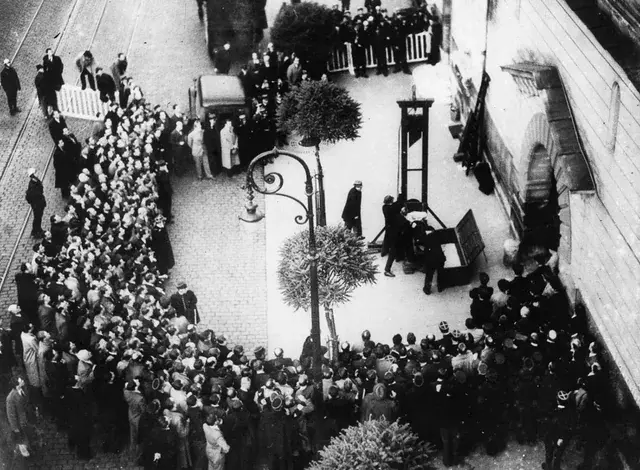
On the 17th of June 1939, a 17 year old English schoolboy stood in a crowd outside Saint Pierre Prison in Versailles and watched a guillotine fall. The condemned man was Eugen Weidmann. The crowd was loud, chaotic, almost theatrical in its morbid curiosity. It would become known as the last public guillotine execution in France. The teenager who witnessed it would go on to serve in wartime intelligence, help track Nazi war criminals, redefine Dracula for a new generation, play a Bond villain, become a wizard in Middle earth, a Sith Lord in Star Wars, and, in his nineties, release heavy metal albums about Charlemagne.
That teenager was Sir Christopher Lee.
It is tempting to treat his life as a list of improbable facts. The truth is more interesting. Christopher Lee did not simply collect extraordinary experiences. He approached each one with the same seriousness, whether it involved intelligence briefings, horror scripts, Shakespearean diction, or symphonic metal. The result is a career that feels less like a progression and more like several separate lifetimes that happened to share the same tall silhouette.
A childhood already brushing against history
Sir Christopher Frank Carandini Lee was born on 27th May, 1922 in Belgravia, London. His father, Lieutenant Colonel Geoffrey Trollope Lee, had fought in the Boer War and the First World War. His mother, Countess Estelle Marie Carandini di Sarzano, moved in artistic and aristocratic circles and had been painted and sculpted by respected Edwardian artists. From birth, Lee’s world contained uniforms, ceremony, performance, and a sense that Europe’s past was not distant but present.
His parents separated when he was four. His mother took him and his sister, Xandra, to Switzerland. He attended school in Territet and later returned to London. He picked up languages early and would eventually speak English, Italian, French, Spanish and German fluently, with some knowledge of others besides. This was not an affectation. It would later become professionally useful.

Through his mother’s remarriage, Lee became step cousin to Ian Fleming, who would later create James Bond. During the same period, he was introduced to Prince Felix Yusupov and Grand Duke Dmitri Pavlovich, two of the men involved in the assassination of Grigori Rasputin. Many years later, Lee would play Rasputin on screen. It is an almost absurdly neat historical loop, but it is real.
He attended Summer Fields in Oxford and later Wellington College. He excelled in the classics, struggled with mathematics, fenced competently and played racquets and cricket. He disliked parades and weapons drills, later joking that in mock battles he would “play dead” as soon as possible.
By the summer term of 1939, family finances were strained. His stepfather had accumulated gambling debts, and Lee left school before completing his final year. He needed work. Instead, before the war fully engulfed Europe, he found himself in Paris, and then in Versailles, watching the execution that would quietly mark the end of an era.
War, intelligence, and the quiet authority of experience
When the Second World War began, Lee volunteered for service. He trained and joined the Royal Air Force. He had hoped to fly and trained on Tiger Moths, but medical issues involving his eyesight prevented him from qualifying as a pilot. By his own account, it was a crushing disappointment.
Rather than drift into frustration, he transferred into intelligence roles. He served in RAF intelligence and was attached to units including No. 260 Squadron during the North African campaign. His work involved liaison, coordination, analysis and preparation. It was not cinematic heroics but structured responsibility. As he once put it, he was expected, broadly speaking, to know everything.

He moved with advancing Allied forces across North Africa and into Italy. He was seconded to the Army during part of the Italian campaign and spent time attached to the Gurkhas of the 8th Indian Infantry Division. After the war in Europe ended, he was seconded to the Central Registry of War Criminals and Security Suspects, assisting in the tracking and interrogation of Nazi war criminals before they were handed over to appropriate authorities.
Lee occasionally hinted at attachments to special forces work but declined to elaborate. Whether this was discretion, modesty, or a cultivated mystery, it fitted his temperament. He preferred implication to spectacle.
One moment from much later in his career gives insight into how these experiences shaped him. During filming for The Lord of the Rings, Peter Jackson initially asked for a dramatic scream when Saruman is stabbed. Lee reportedly corrected him. He explained, calmly, what a man actually sounds like in that situation, and demonstrated a quieter, more physical reaction. It was not bravado. It was memory. The detail was widely reported after his death and has become part of the quiet mythology around him.
From office clerk to actor by ambassadorial suggestion
Demobilised in 1946, Lee returned to London and was offered his former office job back at Beecham’s with a pay rise. He declined. He later said he could not imagine himself returning to the office frame of mind. During lunch with his mother’s cousin Nicolò Carandini, the Italian ambassador to Britain, the suggestion was made that he should become an actor.
It sounds glib, but it mattered. Acting, in that context, was framed not as frivolous but as a legitimate profession. Through contacts at the Rank Organisation, Lee signed a contract and began training.
One early producer reportedly told him he was too tall to be an actor. At 6 feet 5 inches, he was certainly hard to frame. Lee took this as a challenge. He watched, listened, learned and treated small roles as apprenticeship. He appeared uncredited in Laurence Olivier’s Hamlet in 1948 and built experience in a string of modest roles.
Then came Hammer.
Hammer Horror and the reinvention of Dracula
In 1957, Lee appeared in The Curse of Frankenstein as the Creature, opposite Peter Cushing as Baron Frankenstein. It marked the beginning of one of British cinema’s most enduring screen partnerships. Lee and Cushing would appear together in over twenty films.
In 1958, Lee first played Count Dracula in Dracula. His interpretation was markedly different from earlier portrayals. He brought physical power, contained sexuality and a sense of barely restrained force. Critics later described his Dracula as hypnotic and sensual. The image of the tall, red eyed vampire with blood on his lips became fixed in popular culture.

Lee’s relationship with the role was ambivalent. He recognised that it made him famous, but he grew frustrated with increasingly thin scripts. He said he was sometimes pressured into sequels through appeals about the livelihoods of colleagues. He wanted Dracula to be a character, not simply a mechanism for resurrection and bloodletting. On occasion, he attempted to slip lines from Bram Stoker’s original novel back into the films.
He would eventually play Dracula ten times across various productions. By the early 1970s, he felt the quality had declined and chose to move on.
The Wicker Man and choosing conviction over salary
In 1973, Lee played Lord Summerisle in The Wicker Man, a film that would eventually become one of the defining works of British folk horror. At the time, however, it was a modestly budgeted project with no guarantee of success. Lee believed in it so strongly that he waived his fee entirely to help it get made. He later described it, without hesitation, as the best film he ever made.
That decision is revealing. By the early 1970s, Lee was internationally recognised as Dracula and had steady work in genre cinema. He did not need to gamble on an eccentric, low budget production built around pagan ritual and theological debate. Yet he saw something in the script by Anthony Shaffer that went beyond conventional horror.
Lord Summerisle is not a traditional antagonist. He does not lurk in shadows or issue threats. He is calm, charming, educated and entirely convinced of the righteousness of his beliefs. As the laird of a remote Scottish island community that has revived pre Christian fertility rites, he presides over ceremonies with a kind of pastoral courtesy. He explains, rather than intimidates.
Lee plays him as a man of intelligence and certainty. There is no cackling villainy, no theatrical menace. Summerisle listens carefully, smiles politely, and defends his society with reasoned arguments. The horror emerges not from hysteria but from logic. That is precisely why the film remains unsettling. It presents belief as coherent and communal rather than deranged.
Lee later spoke about wanting to move beyond being simply a monster figure in other people’s stories. In The Wicker Man, he found a character who had depth and conviction. Summerisle is not evil in the melodramatic sense. He is pragmatic, rooted in tradition, and fully committed to what he sees as the survival of his people. Lee understood that such conviction is far more disturbing than exaggerated cruelty.
The production itself was far from smooth. The film was edited against the wishes of its creators and initially released in a shortened version as a supporting feature. For years, it was difficult to see in its intended form. Lee championed it tirelessly, attending screenings, speaking about it at festivals, and insisting on its artistic merit long before it acquired its later cult reputation.
His decision to waive his salary becomes even more significant in that light. It was not a romantic gesture made in anticipation of acclaim. It was a practical commitment to a project he believed in at a time when its future was uncertain.

Looking back, it is difficult to imagine The Wicker Man without Lee’s presence. His physical authority and measured delivery anchor the film. He sings, dances, debates and ultimately presides over the island’s rituals with an unsettling serenity. It is a performance built on restraint rather than spectacle.
The choice to work without pay says something fundamental about Lee. He valued coherence, ambition and seriousness over budget and prestige. He did not dismiss horror as trivial. He wanted it to be intelligent. In The Wicker Man, he found a role that treated belief, tradition and sacrifice with gravity rather than camp.
He once said that he had no regrets about his career, but if there was one film he wanted to be remembered for, it was this one. Not the cape. Not the fangs. The man in the summer suit, explaining his worldview with perfect courtesy while the music plays on.
Scaramanga and the elegance of menace
In 1974, Lee entered the Bond franchise properly as Francisco Scaramanga in The Man with the Golden Gun. It was a pleasingly circular moment. Ian Fleming, his step cousin, had once suggested him for the role of Dr No in the early 1960s, but the producers had already chosen Joseph Wiseman. More than a decade later, Lee found himself in the Bond universe anyway, this time not as the first villain, but arguably as one of the most refined.
Scaramanga is not a madman. He is a professional. An assassin who charges one million dollars per contract, he operates with the calm assurance of someone who views murder as a specialist service rather than a crime of passion. That tone suited Lee perfectly.
He approached the role not as a caricature, but as a mirror. Scaramanga is, in many respects, Bond stripped of government sanction. He is elegant, well dressed, multilingual, precise with a weapon, and perfectly at ease in luxurious surroundings. Lee once remarked that he saw the character as “the dark side of Bond,” and that is exactly how he plays him.
There is no need for bluster. No raised voice. No exaggerated cruelty. Instead, there is composure. His Scaramanga moves through scenes with a sense of inevitability, as though he has already rehearsed every possible outcome. When he speaks, it is with measured politeness. When he threatens, it is almost conversational. The menace lies not in volume, but in certainty.
Physically, Lee’s height and bearing give the character an advantage. He stands opposite Roger Moore’s Bond not as a grotesque adversary, but as an equal. Their duel in the film’s climactic funhouse sequence works precisely because it feels like a contest between two versions of the same archetype. The setting may be elaborate, but the tension rests in their shared composure.
The golden gun itself, assembled from seemingly innocuous objects, adds a theatrical flourish. In Lee’s hands, however, it never feels gimmicky. It becomes a symbol of precision and ritual. Scaramanga does not spray bullets. He takes aim.

It is also worth noting that Lee brought an undercurrent of dry humour to the role. He allows Scaramanga moments of amused detachment, particularly in scenes with Hervé Villechaize’s Nick Nack. There is a faint sense that Scaramanga enjoys the intellectual game as much as the physical duel. That balance between charm and threat prevents the character from becoming one dimensional.
In a franchise known for flamboyant villains, Lee chose restraint. The result is a performance that has aged well. While The Man with the Golden Gun divided critics at the time, Scaramanga himself remains one of the more memorable Bond antagonists. He is not the loudest villain in the series, but he may be one of the most self possessed.
And perhaps that is fitting. After missing out on Dr No, Christopher Lee eventually entered the Bond canon not as a footnote, but as a figure of cool authority. He did not need to overplay it. He simply stood there, impeccably dressed, looking as though he had already calculated the odds.
The late career renaissance: Saruman and Dooku
By the late 1990s, Lee’s career might have settled into dignified character roles. Instead, it accelerated again.
In 2001, he appeared as Saruman in The Lord of the Rings trilogy. He had long admired the novels and had met J R R Tolkien once. He admitted that he had once dreamed of playing Gandalf but recognised that age and physical demands made Saruman the more appropriate role. He read the novels regularly and approached the part with scholarly respect.
Saruman suited him. The role required presence, voice and intellectual weight rather than athletic spectacle. Lee’s performance made Saruman feel less like a fantasy figure and more like a fallen statesman.
Between 2002 and 2005, he played Count Dooku in the Star Wars prequels. Dooku, like Scaramanga and Saruman, is aristocratic, composed and quietly confident. Lee performed much of his own swordplay despite his age, using a stunt double only for the most physically demanding sequences.
At this stage, Lee had become something unusual: a living bridge between generations of cinema. He was the veteran of Hammer horror now appearing in global franchises that defined a new era.
Tim Burton and the pleasure of character work
Lee collaborated with Tim Burton on multiple films, including Sleepy Hollow, Corpse Bride, Charlie and the Chocolate Factory, Alice in Wonderland and Dark Shadows. These roles were often brief but distinctive. He enjoyed working with Burton and with Johnny Depp, whom he described as inventive and versatile.
Johnny Depp later remarked that acting opposite Lee felt like facing Dracula himself. It was a joke, but it carried truth. Lee’s screen history followed him into every new role.
The metal knight
If his film career were not enough, Lee also pursued music with increasing seriousness. Classically trained with a deep bass voice, he sang on The Wicker Man soundtrack and contributed narration and vocals to various projects.

In 2010, he released Charlemagne: By the Sword and the Cross, a symphonic metal concept album. A follow up, Charlemagne: The Omens of Death, followed in 2013. These were not novelty exercises. They were dramatic works built around his fascination with European history and legend.
In 2014, he released the EP Metal Knight and a playful Christmas track. “Jingle Hell” entered the Billboard Hot Singles Sales chart at number 22 and later rose to number 18. At 91 years and 6 months old, Lee became one of the oldest performers ever to enter the charts.
He explained his motivation simply. At his age, he said, the most important thing was to keep active doing things he enjoyed. It is difficult to argue with that, especially when the activity in question involves recording metal vocals in one’s tenth decade.
Honours and establishment recognition
For much of his career, Lee was associated with genre cinema, sometimes dismissed by critics. In his later years, institutions caught up with his impact.
On 30th October, 2009, he was knighted for services to drama and charity. In 2011, he received the BAFTA Fellowship. In 2013, he was awarded the BFI Fellowship during the London Film Festival. These honours marked a shift from cult icon to national cultural figure.
The tall man in the cape had become Sir Christopher Lee, a figure officially recognised as part of Britain’s cinematic heritage.
A steady private life behind the cape
Lee married the Danish painter and former model Birgit “Gitte” Krøncke on 17th March, 1961. They had met the previous year through mutual friends. The courtship was swift, the decision certain. In a profession known for instability, their marriage proved remarkably durable. They had one daughter, Christina Erika Carandini Lee, born in 1963, and remained together for more than five decades.
While Lee’s screen image was often dark, intense and occasionally apocalyptic, his private life was measured and disciplined. Friends frequently described him as courteous to a fault. He dressed formally, spoke precisely, and expected punctuality. Even in casual settings, there was a sense of old world decorum. It was not theatrical. It was habitual.

The couple lived for many years in Cadogan Square in west London, a quiet and elegant corner that suited them. Lee maintained a structured daily routine. He read widely, kept abreast of current affairs, practised his languages, and approached work with military punctuality. Colleagues often remarked that he arrived fully prepared, script learned, background researched. The seriousness that marked his performances was the same seriousness that marked his domestic life.
He was not a fixture of tabloid gossip. There were no public scandals, no dramatic headlines. In interviews, he occasionally spoke about the importance of privacy and stability. Acting, he insisted, was what he did, not who he was. Home was separate.
There is something quietly revealing in the contrast. On screen, he was Dracula, Scaramanga, Saruman, Count Dooku. At home, he was a husband who valued order and a father who protected his family from publicity. Christina would later contribute spoken vocals to some of his musical projects, a small but telling sign of shared creative life rather than spectacle.
When Gitte died on 23rd June, 2024, aged 89, it felt like the final page of a long chapter. Their marriage had outlasted most of his contracts, most of his franchises, and most of the studios he worked for. In an industry defined by reinvention, it was one constant.
For a man who played so many figures of doom and destiny, Christopher Lee’s personal life was remarkably calm. It may not be as dramatic as a duel with Bond or a council in Isengard, but in its own way, it is just as impressive.
The final curtain
Christopher Lee died of heart failure at Chelsea and Westminster Hospital on 7th June, 2015, aged 93. His wife, Birgit “Gitte” Krøncke, chose to delay the public announcement until 11th June, 2015 so that family members could be informed first. It was a measured, private decision, entirely in keeping with the way Lee conducted his personal life.
His funeral was held privately in London, attended by close family and friends. There was no large public ceremony. Lee had never encouraged celebrity spectacle around his private affairs, and the restrained nature of the service reflected that.
Public tributes, however, were immediate and global.
Prime Minister David Cameron described him as “a titan of the golden age of cinema.” The British Film Institute, which had awarded him its Fellowship in 2013, called him one of Britain’s most iconic actors. BAFTA, which had presented him with its Fellowship in 2011, honoured his extraordinary contribution to film. He was later included in the In Memoriam segment at the 88th Academy Awards on 28th February, 2016.
Fellow actors were quick to respond. Sir Ian McKellen praised his commanding presence and deep love of Tolkien. Peter Jackson described him as an icon and recalled his intelligence and authority on set. Johnny Depp, who worked with him on several Tim Burton films, spoke of his immense stature and screen presence. George Lucas acknowledged his contribution to the Star Wars saga.
Hammer Films paid tribute to the man who had redefined Dracula in 1958, noting the lasting impact of his portrayal. Newspapers across Britain and internationally ran detailed obituaries, reflecting not only on his horror legacy but also on his wartime service, his linguistic abilities, and his late career resurgence in global franchises. Music publications also marked his passing, recognising his genuine commitment to symphonic metal and his Charlemagne albums.
Fans organised screenings of his films and shared tributes across social media. Within the Tolkien community in particular, there was affection for the fact that Lee had once met J R R Tolkien in person, making him a rare bridge between literary and cinematic fantasy.
When Gitte died on 23rd June, 2024, aged 89, many outlets noted the quiet strength of their long marriage, which had lasted more than five decades.
Lee’s funeral may have been private, but his memorial unfolded publicly and internationally. He was remembered not simply as Dracula, Saruman or Count Dooku, but as a disciplined, courteous professional whose career spanned more than sixty years. The tone of the tributes was consistent: respect rather than exaggeration, admiration rather than sentimentality. It suited him perfectly.


