

When New York Tried to Ban Women from Smoking in Public
Updated: Mar 19

On 21st January, 1908, New York City briefly decided that women should not smoke in public. The idea lasted less than two weeks, but in that short time it managed to expose a surprising amount about gender, morality, and how awkward it can be to legislate everyday behaviour.
The story is usually told through the arrest of Katie Mulcahey, a working woman who lit a cigarette on a Bowery street and found herself hauled before a judge. It is an incident that has often been treated as comic or symbolic, but it becomes more interesting when placed back into the ordinary texture of early twentieth century city life.

Smoking, respectability, and double standards
By the early 1900s, smoking was still a relatively new habit in its modern form. Mass produced cigarettes had only become common in the 1880s, but by the turn of the century they were everywhere. Men smoked openly and constantly. Streets, saloons, workplaces, and restaurants were thick with smoke, and few people gave it a second thought.
Women also smoked, but usually out of sight. The issue was not the act itself, but visibility. A woman smoking in public was read as a sign of loose morals or poor character in a way that simply did not apply to men. This double standard was part of a broader pattern. Women entering shops, restaurants, or hotels alone could be viewed with suspicion. Independence in public space was still something that required justification.
Yet the city was changing. Department stores created respectable reasons for women to travel, linger, and spend time alone. Shopping, dining in tearooms, and browsing displays became socially acceptable activities. These shifts were small, but they mattered. By 1908, women were increasingly vocal about their right to vote, to work, to organise, and to move through the city on their own terms.
Not everyone was comfortable with this.
“Little Tim” Sullivan and a moral response
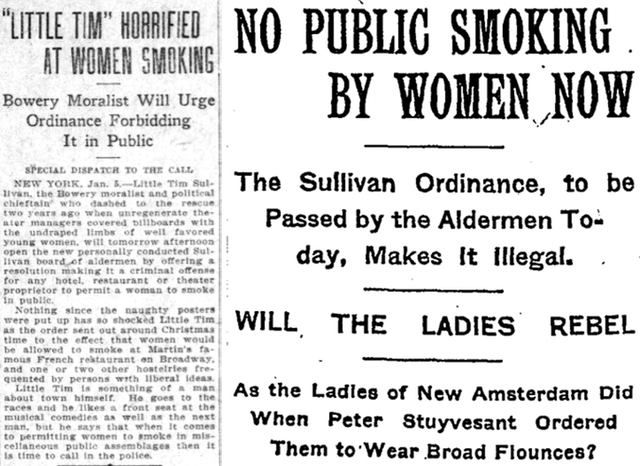
The man most closely associated with the smoking ban was Timothy Sullivan, widely known as “Little Tim” to distinguish him from his cousin, Timothy Daniel Sullivan, or “Big Tim”. The distinction matters. While Big Tim Sullivan was a progressive figure who supported women’s suffrage and labour reform, Little Tim held far more conservative views about women’s public behaviour.

Little Tim Sullivan believed that a woman smoking in public signalled immorality. He reportedly admitted that he had never actually seen a woman smoking on the streets of New York, but insisted that if he did, he would lose all respect for her. His views were reinforced by pressure from Christian reform groups, including the Women’s Christian Temperance Union, which, although best known for campaigning against alcohol, also took an interest in regulating women’s behaviour in public.
Responding to this pressure, Sullivan proposed an ordinance that would prevent women from smoking in public establishments. It was passed unanimously and went into effect on 21st January, 1908. Sullivan modestly named it after himself, though it quickly became known as the Sullivan Ordinance.
The wording of the law is important. It did not explicitly ban women from smoking in the street. Instead, it made business owners responsible for preventing women from smoking inside their premises. This distinction would soon prove crucial.
A cigarette on the Bowery
The very next day, Katie Mulcahey struck a match against the stone wall of a building in the Bowery district and lit a cigarette. There was nothing theatrical about it. The Bowery was a working class area where men smoked constantly, indoors and out.
A nearby police officer noticed her and approached. According to contemporary reports, he said, “Madam, you mustn’t… what would Alderman Sullivan say?” The appeal was less to the letter of the law than to authority and expectation.
Mulcahey was genuinely confused. She had not heard of the new ordinance and did not believe she was doing anything illegal. The officer arrested her anyway. She was taken to jail and later brought before a district court judge.
If Sullivan had hoped to make an example of someone, he chose poorly.

In court and in the newspapers
Mulcahey was described by reporters as outspoken and stubborn. In court, she made no attempt to apologise. Instead, she told the judge:
“I’ve got as much right to smoke as you have. I never heard of this new law and I don’t want to hear about it. No man shall dictate to me.”
The line was widely reprinted. Newspapers across the city reported the arrest, often with a tone that bordered on disbelief. While Christian temperance groups applauded the enforcement of the ordinance, most New Yorkers sided with Mulcahey. The idea of arresting a woman for smoking while men did so freely struck many as unnecessary and faintly absurd.
Feminist groups quickly added the issue to their broader campaigns. Public smoking was discussed alongside voting rights and workplace equality. Meetings and rallies were held, not because cigarettes were central to the movement, but because the incident neatly illustrated how unevenly public freedoms were applied.
A legal problem no one had noticed
When lawyers examined the Sullivan Ordinance more closely, its weaknesses became obvious. The law did not specify a punishment for women who smoked. It did not actually prohibit smoking on the street. Responsibility was placed on business owners, not individuals.
As a result, Mulcahey’s $5 fine had no legal basis. She refused to pay it, and she was released the following day without a mark on her record. She was the first and only person ever cited under the ordinance.
The episode exposed the law as poorly drafted and difficult to enforce. It had been passed as a moral gesture rather than a practical regulation.

Repeal and quiet embarrassment
Within two weeks, George McClellan Jr., the Mayor of New York City, vetoed the ordinance and struck it from the books. By that point, Little Tim Sullivan was in Hot Springs, Virginia, seeking treatment for the kidney disease that would kill him later that year. There was little appetite among city officials to defend a law that had already become a source of ridicule.
A month later, the satirical magazine Puck published a cartoon by Harry Grant Dart showing a bar full of women smoking, gambling, and eating fudge. The joke was clear enough. This, readers were told, was the chaos that would follow if women were allowed to indulge publicly. The humour worked precisely because the panic felt exaggerated.
How quickly things changed
In practice, change came swiftly. Within a few years, restaurants that allowed women to smoke were unremarkable. In 1911, restaurateur Andre Bustanoby, co owner of the Café des Beaux Arts, summed up the prevailing attitude:
“We think our clientele know better than we do what is proper and what is not. They are adults. They have traveled all over the world. We give all liberty to those coming here and none of them has ever taken advantage of us. We do not see we have any right to ask one of our friends to stop smoking if she thinks she ought to smoke. A law against smoking in public by women would be a foolish law.”
By the 1920s, cigarette companies were actively marketing to women. Campaigns linked smoking to slimness and modernity, most famously through slogans like “Reach for a Lucky Instead of a Sweet” from the American Tobacco Company. Smoking had shifted from scandal to style.

Consequences that arrived later
By World War II, around one third of American women smoked. Cigarettes were part of everyday working life, included in rations and widely accepted. The health consequences emerged more slowly. Lung cancer rates among women began rising in the 1960s, and by 1986 they overtook breast cancer as the leading cause of cancer death among women in the United States.
In 1979, Joseph A. Califano Jr., then Secretary of Health, Education, and Welfare, put it plainly:
“Women who smoke like men die like men who smoke.”
New York’s restaurants would remain smoky until 2003, when a citywide ban on indoor smoking was introduced under Mayor Michael Bloomberg. By then, the question was no longer who was allowed to smoke, but how much smoke anyone should have to endure.
Why this small episode still holds interest
Katie Mulcahey did not set out to make history. She did not organise a protest or issue a manifesto. She lit a cigarette in a place where men did so constantly and refused to be shamed for it.
The Sullivan Ordinance failed because it was built on assumptions that no longer fit the city it was meant to govern. Once enforced, even briefly, its logic collapsed. Mulcahey’s arrest exposed that collapse in the most ordinary way possible.
What remains interesting about the episode is not its drama, but its ordinariness. It shows how social change often arrives quietly, through laws that fail and habits that persist, rather than through grand turning points. Sometimes, all it takes is one cigarette on a city street.


