

Why Do Babies in Medieval Paintings Look Like Tiny Old Men?
Updated: May 8

Strolling through any European art gallery that houses works from the Middle Ages to the early Renaissance, one cannot help but notice something oddly humorous. The baby Jesus, and indeed many other infants in religious paintings, often look less like cherubic babies and more like stern, middle aged men who have seen rather a lot of life already. Their receding hairlines, solemn expressions, and oddly defined muscles leave modern viewers scratching their heads. Some appear to be contemplating the mysteries of the universe. Others look as if they have just finished reading a particularly difficult theological manuscript.
The phenomenon has become a favourite topic online, where people joke about “Benjamin Button Jesus” or “medieval meme babies”. Yet these unusual figures are not the result of artistic incompetence or accidental distortion. They reflect a complex mixture of medieval theology, artistic tradition, and cultural attitudes towards childhood.
To understand why medieval artists painted babies who seemed ready for retirement, it helps to step inside the intellectual world in which these works were created.

The Medieval Mindset: Symbol Over Naturalism
Medieval art was rarely concerned with strict realism. The purpose of religious imagery was not to reproduce the physical world exactly as it appeared but to communicate spiritual truths to the viewer.
Most paintings produced between the 11th and 14th centuries were commissioned for churches, monasteries, or private devotion. Their function was instructional as much as decorative. Images served as visual theology, helping worshippers understand religious ideas through recognisable symbols.
In depictions of the Virgin and Child, the infant Jesus was not intended to be an ordinary baby. Christian doctrine taught that Christ was both fully divine and fully human from the moment of his birth. Artists therefore sought to express that divine wisdom visually.
Rather than showing the helplessness of infancy, painters presented Christ as a figure of authority and awareness. The result was a child who often looks uncannily mature: high forehead, thoughtful gaze, and occasionally the muscular proportions of a small adult.
This visual approach reflected a theological concept sometimes referred to as the “Perfect Man” doctrine. Christ was believed to possess complete knowledge and divine understanding even as a newborn. Painting him as an ordinary infant might have risked diminishing that spiritual status.
The Idea of the Homunculus
Some historians connect these unusual images to an older philosophical idea known as the homunculus, meaning “little man”.
In medieval thought, human development was not always understood in the biological terms familiar today. Childhood was sometimes imagined simply as a smaller scale version of adulthood rather than a distinct stage with its own characteristics.
When artists painted the Christ Child with adult like features, they were visually expressing this concept of completeness. Christ was not gradually growing into wisdom. He possessed it from the very beginning.
The result is a baby whose face appears strangely experienced. He does not look as if he has just arrived in the world. Instead, he seems to have been quietly observing it for centuries.
Christ the Infant Teacher
Another reason these babies look so serious is that many paintings portray the infant Christ performing gestures associated with authority and teaching.
In numerous medieval images, the child raises two fingers in a blessing. This gesture was traditionally used by religious teachers and priests. It signalled Christ’s role as the spiritual guide of humanity.
Some works go even further. The infant is shown holding a small scroll or book, symbols of sacred knowledge and divine law. In such scenes, the child appears less like a baby and more like a miniature philosopher seated on his mother’s lap.
These visual cues were immediately recognisable to medieval viewers. They reinforced the idea that the Christ Child was already conscious of his divine mission.

The Influence of Byzantine Art
The unusual appearance of medieval babies also reflects the powerful influence of Byzantine iconography, which dominated religious art across Europe for centuries.
Byzantine painters developed a highly stylised visual language designed to convey spiritual meaning rather than physical realism. Figures were presented with elongated noses, large eyes, solemn expressions, and flattened bodies that seemed to exist outside ordinary space.
Infants were treated in much the same way as adults. Their proportions followed the same symbolic conventions, resulting in babies who looked like miniature grown people wrapped in elaborate robes.
These conventions spread throughout Western Europe during the Middle Ages. Churches and monasteries reproduced them in frescoes, illuminated manuscripts, and painted altarpieces. By the 12th and 13th centuries, this style had become the accepted visual vocabulary for depicting sacred figures.
Departing from it too radically could even appear theologically questionable. If Christ were painted too realistically as a helpless baby, some viewers might feel that his divine nature was being diminished.
Artistic Manuals and Workshop Traditions
Medieval artists did not always work with complete creative freedom. In many workshops, painters followed established iconographic models passed down through generations of apprentices.
Pattern books and manuals helped artists reproduce familiar religious scenes in ways that audiences would recognise instantly. These guides dictated how figures should be posed, clothed, and proportioned.
The Christ Child’s mature face therefore became part of a widely understood visual code. Artists were not improvising strange babies. They were following a set of conventions that had developed over centuries.

Medieval Attitudes Towards Childhood
Another important factor lies in the way medieval society viewed childhood itself.
Today, infancy is often associated with innocence, softness, and vulnerability. Images of babies tend to emphasise their chubby cheeks and playful expressions.
Medieval culture approached childhood somewhat differently. Infant mortality rates were high, and childhood was not always treated as a prolonged or sentimental phase of life. Children were expected to grow quickly into the roles they would occupy within society.
As a result, artists did not necessarily feel compelled to capture the fleeting softness of infancy. Depicting a child as a small adult did not seem strange within the cultural framework of the time.

The Challenges of Medieval Painting Techniques
Practical considerations also played a role. Many medieval painters worked with egg tempera, a fast drying medium made by mixing pigments with egg yolk.
Egg tempera produces crisp lines and bright colours, but it does not easily allow the soft shading that later oil painting would achieve. Rendering the subtle textures of baby skin was therefore technically difficult.
Artists were far more accustomed to painting adult faces with defined features and clear outlines. When it came to infants, the simplest solution was often to scale down those familiar proportions.
This contributed to the distinctive look of medieval babies: small adult faces placed onto compact bodies.

Famous Examples of the “Old Man Baby”
Several well known works illustrate the phenomenon perfectly.
In Coppo di Marcovaldo’s Madonna del Bordone (1261), the infant Christ sits stiffly on Mary’s knee with a face that seems far older than his tiny body would suggest. His expression is solemn and composed, as if quietly contemplating theological questions.
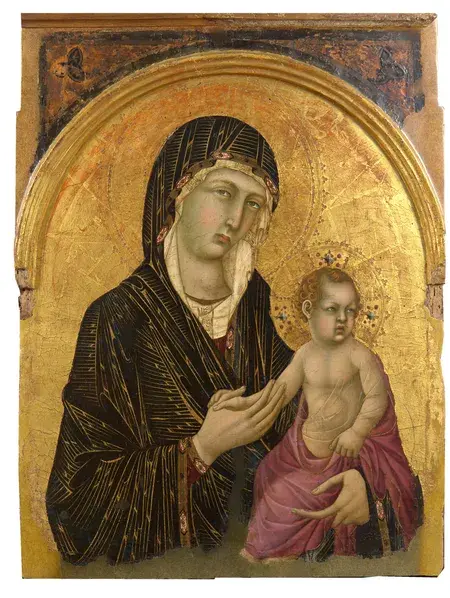
A similar effect appears in Cimabue’s Santa Trinita Madonna (around 1280). Here the Christ Child displays elongated features and a calm, authoritative gaze that feels remarkably mature.
Even later works by artists such as Duccio di Buoninsegna retain traces of this convention. Although his figures appear more refined and expressive, the infant still possesses the serious demeanour of a small adult.
The Gradual Shift Towards Naturalism
During the late Middle Ages, however, attitudes toward art began to change. Artists increasingly turned their attention to the observation of nature and the human body.
One of the key figures in this transformation was Giotto di Bondone, a Florentine painter working in the early 14th century.
In Giotto’s frescoes at the Arena Chapel in Padua, figures begin to display believable weight, emotion, and physical interaction. His depictions of the Nativity show a Christ Child who looks far more like a real infant than the miniature adults of earlier paintings.
Mary bends over the child in a recognisably maternal gesture, and the surrounding figures respond with expressions of tenderness and concern. Art historians often view Giotto as a crucial bridge between the symbolic world of medieval art and the observational realism of the Renaissance.
Renaissance Babies Finally Look Like Babies
By the 15th century, the study of anatomy and perspective had advanced dramatically.
Artists such as Leonardo da Vinci, Raphael, and Michelangelo devoted careful attention to the human form. Their paintings show infants with rounded limbs, soft skin, and playful expressions.
Raphael’s many depictions of the Madonna and Child, for instance, present babies who look unmistakably human. They twist, reach, and interact naturally with their mothers.
The stern miniature adults of earlier centuries gradually disappeared as Renaissance artists embraced a more naturalistic approach to the human body.

A Modern Rediscovery
Today, the peculiar babies of medieval art have gained unexpected popularity on the internet. Social media accounts and galleries celebrate these strange little figures with affectionate humour.
What once served as a serious theological image now often appears in memes and light hearted discussions about the quirks of history.
Yet beneath the amusement lies a genuine reminder of how differently people in the past understood both art and childhood. Medieval painters were not trying to make viewers laugh centuries later. They were attempting to communicate profound religious ideas through a visual language their audience understood.
Seen in that context, the mysterious old looking babies of medieval paintings are not mistakes at all. They are artefacts of a worldview in which symbolism mattered more than realism, and where the infant in Mary’s arms was already recognised as the eternal teacher of humanity.
The next time you encounter a baby Jesus who looks ready to deliver a sermon or balance a monastery’s accounts, it is worth remembering that the artist was not painting a child as we understand one today. They were painting a divine figure whose wisdom, according to medieval belief, had existed long before his birth.
Sources:
Gombrich, E. H. The Story of Art. Phaidon Press.
Honour, Hugh and Fleming, John. A World History of Art. Laurence King Publishing.
Kemp, Martin. The Science of Art: Optical Themes in Western Art from Brunelleschi to Seurat. Yale University Press.


