Huey P. Newton: The Revolutionary Mind Behind the Black Panther Party
Updated: Feb 17

In the late 1960s, in a modest office in West Oakland, a young man sat in a wicker chair with a rifle in one hand and a law book in the other. It was not a theatrical pose, although it would become an iconic image. It was a statement. For Huey P. Newton, politics was never abstract. It was lived, studied, tested, and defended on the streets of Oakland, in courtrooms, in prison cells, and later in lecture halls. His journey from a self described struggling student to co founder of the Black Panther Party remains one of the most complex and revealing stories of twentieth century American political life.
What follows is not a simple tale of heroism or decline. It is the story of a man shaped by the currents of migration, poverty, intellectual discovery, state repression, internal conflict, and personal weakness. To understand Newton is to understand the contradictions of the era that produced him.

Early Life in the Shadow of Jim Crow
Huey Percy Newton was born on 17th February, 1942 in Monroe, Louisiana. His father, Walter Newton, was a sharecropper and Baptist lay preacher. His mother, Armelia Johnson Newton, was known for her strength and insistence that her children value education. Newton was the youngest of seven. He was named after Louisiana governor Huey Long, a populist figure admired in some Black Southern households for his rhetoric about economic justice.
The Louisiana into which Newton was born was defined by segregation, economic exploitation, and racial violence. Although he was too young to fully grasp it, the structures of Jim Crow shaped the lives of his family. Like many African American families during the Second World War and after, the Newtons joined the second wave of the Great Migration, relocating to Oakland, California in search of industrial jobs and relative safety.

Oakland in the 1940s and 1950s offered opportunity but not equality. Shipyards and factories had drawn Black workers during the war, yet housing discrimination and policing practices confined many to under resourced neighbourhoods. Newton would later describe his childhood environment as one in which police presence felt constant and punitive. “We were confronted daily by the police,” he wrote. “They were in our communities more than any social service agency.”
Struggles in School and Self Education
Newton’s formal schooling was uneven. He later admitted that he graduated from Oakland Technical High School without being able to read properly. That admission has sometimes been treated as a dramatic anecdote, but it speaks to a wider reality of educational neglect in segregated and underfunded schools.
Determined not to remain intellectually limited, Newton taught himself to read more fluently after leaving school. He turned to philosophy, law, and political theory. He famously worked through Plato’s Republic with the aid of a dictionary, slowly building his literacy and analytical capacity. The image of Newton studying Plato is more than symbolic. It reflects his lifelong insistence that intellectual discipline and revolutionary politics were inseparable.
At Merritt College in Oakland, Newton met Bobby Seale. Both men were active in student politics and community discussions about racism, police brutality, and economic inequality. Merritt became a meeting point for young Black activists influenced by Malcolm X, anti colonial struggles in Africa and Asia, and Marxist theory. Newton read Karl Marx, Vladimir Lenin, and Frantz Fanon. He also studied California law closely, especially statutes relating to firearms.
The Founding of the Black Panther Party
In October 1966, Newton and Seale founded the Black Panther Party for Self Defense. The inclusion of “Self Defense” in the original name was deliberate. California law at the time allowed the open carrying of firearms, and Newton understood the legal framework precisely. The Panthers began armed patrols of Oakland police, observing arrests from a lawful distance to deter brutality.
Their Ten Point Program demanded full employment, decent housing, education that reflected Black history, exemption of Black men from military service, and an end to police violence. The language combined constitutional references with Marxist analysis. It was radical but grounded in concrete grievances.
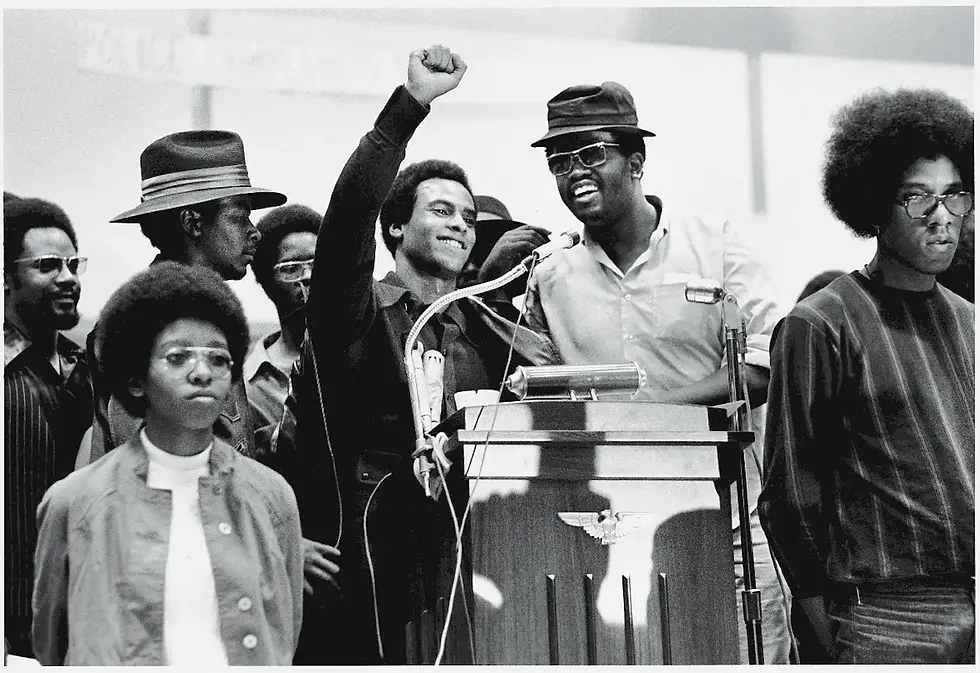
The Panthers’ visibility increased dramatically in May 1967 when armed members entered the California State Capitol in Sacramento to protest proposed gun control legislation. Although the protest was peaceful, it shocked the political establishment. For many white Americans, the image of disciplined, armed Black activists was deeply unsettling.
Community Survival Programmes
While armed patrols drew headlines, much of the Party’s daily work centred on community survival programmes. By the early 1970s, the Panthers had launched more than sixty initiatives nationwide. These included free medical clinics, sickle cell anaemia testing programmes, liberation schools, legal aid, clothing distribution, and prison bus services to allow families to visit incarcerated relatives.
The Free Breakfast for Children programme became one of the most effective and widely recognised efforts. In cities across the United States, volunteers served thousands of meals to children before school. The initiative exposed both the depth of poverty and the absence of adequate state provision. It also placed pressure on federal authorities, who later expanded school breakfast funding.
The Party newspaper, The Black Panther, became one of the most widely circulated Black publications in the country. It featured political essays, artwork by Emory Douglas, and reporting on local and international struggles.

Confrontation and Imprisonment
On 28th October, 1967, Newton was involved in a confrontation with Oakland police officers John Frey and Herbert Heanes. The precise sequence of events remains contested. Officer Frey was killed, and Newton and Heanes were wounded. Newton was charged and later convicted of voluntary manslaughter in 1968.
The conviction sparked the national Free Huey campaign. Rallies, teach ins, and endorsements from public figures amplified his case. In May 1970, the California Court of Appeal overturned the conviction, citing procedural errors. After two retrials ended in hung juries, the charges were dismissed in 1971.
Newton’s time in prison elevated him symbolically. He was described as a political prisoner by supporters, and his release was celebrated widely. Yet the period also intensified government scrutiny of the Panthers.
COINTELPRO and State Repression
Under FBI Director J Edgar Hoover, the Federal Bureau of Investigation launched COINTELPRO operations targeting the Panthers. Internal memos described the Party as the “greatest threat to the internal security of the country.” Surveillance, infiltration, forged letters, and the encouragement of factional disputes were employed to destabilise the organisation.
Police raids resulted in arrests and deaths, including that of Chicago Panther leader Fred Hampton in December 1969. Newton later examined these campaigns in his doctoral dissertation, arguing that state repression played a decisive role in the Party’s decline.
Intellectual Development and Revolutionary Humanism
Newton’s intellectual ambitions continued after his release. He enrolled at the University of California, Santa Cruz and earned a PhD in social philosophy in 1980. His dissertation, War Against the Panthers: A Study of Repression in America, analysed the mechanisms of state power.
Over time, Newton’s thinking shifted from orthodox Marxism Leninism towards what he termed revolutionary humanism. He became more critical of rigid ideological frameworks and more attentive to local community needs. In later years, he also expressed interest in spiritual questions and attended services at Allen Temple Baptist Church in Oakland.
Internal Strains and Personal Decline
By the late 1970s, the Black Panther Party was weakening. Membership had declined, financial pressures mounted, and internal disagreements deepened. Newton faced serious allegations, including the 1974 murder of Kathleen Smith. Before trial, he fled to Cuba, returning in 1977. He was later acquitted.
He was also linked to the death of Betty Van Patter, a Party bookkeeper, though he was never charged. Substance abuse, particularly cocaine addiction, increasingly affected his judgement. Former colleagues described him as suspicious and volatile during this period.
In 1982, he was arrested on charges related to misuse of funds connected to the Panther founded Oakland Community School. Although these charges were eventually dropped, his public standing suffered.
Death and Legacy
On 22nd August, 1989, Newton was shot and killed in West Oakland by Tyrone Robinson, a member of the Black Guerrilla Family prison gang. Robinson later stated that the killing was intended to enhance his status within the gang.
Newton was forty seven years old. His funeral drew hundreds, including former comrades and community members. In 2021, the City of Oakland unveiled a bronze bust near the site of his death and renamed a street Dr Huey P Newton Way, reflecting a renewed recognition of his historical significance.
Assessing His Place in History
Newton’s life resists simplification. He was at once a disciplined student of philosophy and a man capable of violence. He built community programmes that fed and educated thousands, yet presided over an organisation marked by internal conflict. He was both a target of extensive state repression and a figure whose personal choices contributed to his own decline.
His influence on discussions of policing, community control, racial justice, and political self defence remains evident. Contemporary movements addressing police accountability often echo themes first articulated in the Panthers’ Ten Point Program.
In his autobiography, Newton wrote, “You can kill a revolutionary, but you cannot kill the revolution.” Whether one agrees with his methods or not, his life invites serious examination of how societies respond to inequality and dissent.
Huey P Newton emerged from the specific conditions of mid twentieth century America, yet his questions about justice, power, and community responsibility continue to resonate. In Oakland, the city that shaped him and that he helped to reshape, his memory now stands in bronze, not as a flawless icon, but as a reminder of a turbulent period when young activists believed that study and struggle could change the structure of American life.