Vintage French Nude Photography of the 1920s: Prints, Postcards and Context
Updated: 2 days ago
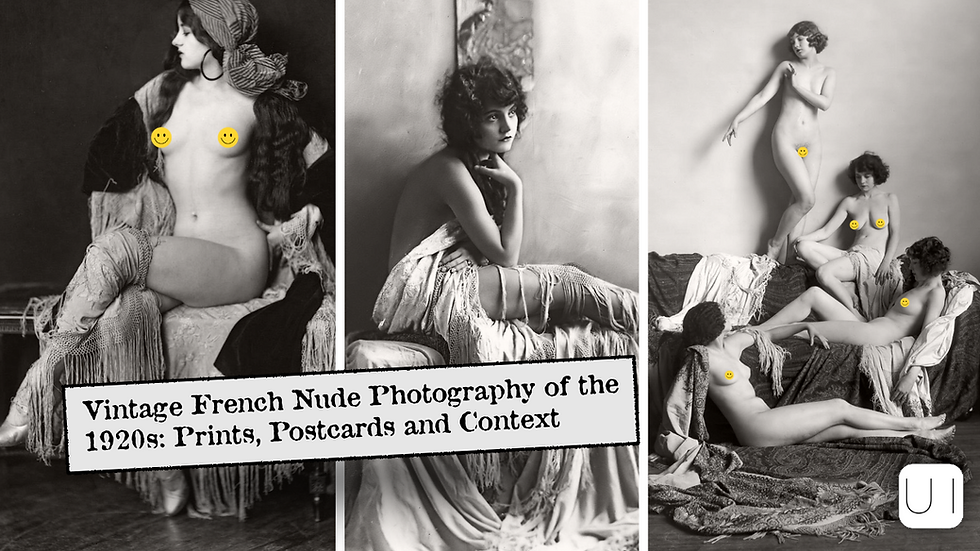
You can usually tell within a few minutes whether a collection like the one below is going to hold your attention. At first glance it might look like a mix of old postcards and studio photographs, loosely grouped under “vintage erotica”. But once you start separating the pieces, looking at the paper, the print quality, the staging, and the repetition of certain faces or poses, it becomes clear that you are looking at something more structured.
A collection of 1920s French nude studies, whether in postcard format or as higher quality photographic prints, sits within a well-established visual culture that developed in France from the late nineteenth century into the interwar period. These were not random images. They were produced within studios, sold through defined channels, and shaped by a mixture of artistic tradition and commercial demand.

Two formats, one market
The easiest way to understand the collection is to think in terms of format.
Postcards represent the more accessible end of the market. They were printed in volume, relatively inexpensive, and widely distributed. Some were sold openly as “art studies”, others more discreetly depending on how explicit they were. Their standardised size made them easy to store, trade, and collect.
Alongside these, you get photographic prints that feel immediately different in the hand. The paper is often thicker, sometimes with a matte or slightly textured finish. The tonal range is richer, the lighting more carefully controlled, and the overall image tends to have more depth. These prints were not produced as cheaply or in quite the same quantities.
They were often intended for a slightly different audience. Buyers might include amateur artists looking for reference material, private collectors, or individuals willing to pay more for something that felt less mass produced. In some cases, the same negative would be used for both formats, resulting in a postcard version and a higher quality print of the same image.

The studio environment
Whether postcard or print, most of these images originate from studio settings. The backgrounds are often simple, sometimes just a painted backdrop or a draped fabric. Props appear occasionally but are rarely elaborate. The focus remains on the model and the pose.
Lighting is one of the more telling details. Even in the cheaper postcard versions, there is a consistent attempt to shape the body through light and shadow rather than present it flatly. In the higher quality prints, this becomes more pronounced. Soft directional lighting gives a sculptural effect that links back to academic drawing and painting traditions.
Poses are rarely spontaneous. They are repeated, refined, and reused. You start to notice the same stance appearing across different images, sometimes with slight adjustments. This suggests that studios worked from a set of established compositions that were known to sell.

The influence of academic tradition
The connection to academic art is difficult to miss. France had a long tradition of life drawing and the study of the nude, particularly within the system of art academies. Even outside formal institutions, that visual language carried through into photography.
Many of the images in your collection echo classical references. Reclining poses, contrapposto stances, and carefully arranged limbs all mirror earlier painting and sculpture. Drapery is sometimes added not to conceal but to frame the body in a way that feels familiar from art history.
This was partly aesthetic and partly practical. Framing a photograph as an “art study” provided a degree of legitimacy. It allowed publishers and sellers to operate within a grey area where nudity could be justified as educational or artistic rather than purely erotic.

Models and repetition
One of the more noticeable aspects of these collections is the repetition of certain models. Even without names, faces and body types recur across multiple images. A model might appear in a series of postcards and also in larger prints, sometimes in entirely different settings but recognisably the same person.
There is very little documentation about who these women were. They were almost never credited, and records, if they existed, were not preserved in a way that allows easy identification today. What you see instead is their presence across the work itself.
From a practical point of view, studios likely worked with a relatively small number of models who were comfortable posing nude and available for repeat sessions. That consistency helped maintain a steady output.

Production details
The physical qualities of the prints are worth paying attention to. Postcards tend to have a more uniform finish, often with a slightly glossy surface or a standard photographic paper typical of mass production.
The higher quality prints vary more. Some use matte paper that softens the image, others have a slight sheen that enhances contrast. Edges can be cleanly cut or slightly irregular, depending on how they were produced and whether they have been trimmed over time.
In certain cases, you may find retouching marks or evidence of hand finishing. This could include subtle adjustments to smooth skin tones or remove imperfections. Occasionally, there are hand coloured elements, though this is less common by the 1920s than in earlier decades.

Distribution and use
Postcards and prints moved through overlapping but not identical channels. Postcards were easier to sell in larger numbers and could be found in certain shops, markets, or through catalogue sales. Some were exported, particularly to countries where French material carried a certain cachet.
Photographic prints, especially those of higher quality, were more likely to be sold directly or through more discreet means. They may have been ordered in sets or selected individually.
There is also the question of how they were used. While some were clearly collected for their own sake, others may have been used as reference material by artists or simply kept as private objects. The lack of wear on some prints suggests that they were stored carefully rather than handled frequently.
Shifting context over time
What stands out when looking at these images now is how much the context has changed. In the 1920s, they occupied a space that required a degree of discretion. Today, they can appear restrained, even formal, especially when compared to later developments in photographic erotica.
That shift does not reduce their significance. If anything, it highlights how attitudes towards nudity and representation have evolved. These images sit at a point where older artistic traditions were meeting newer forms of mass reproduction.

A collection as a whole
Bringing postcards and higher quality prints together in one collection allows you to see that range more clearly. You can trace how the same visual ideas move between formats, how a pose is simplified for mass production or refined for a more carefully produced print.
It also gives a better sense of the scale of the industry. This was not a handful of isolated images. It was a steady output supported by studios, printers, and a consistent audience.
In the end, the interest of a collection like this does not come from any single image. It comes from the accumulation. The repetition of poses, the variation in print quality, the small details in production, all build up into a broader picture of how these images were made and why they existed in the first place.
And that is where it becomes less about categorising them as erotica or art, and more about understanding them as part of a working visual culture that sat somewhere between the two.