Euzebe Vidrine: Confessions of Louisiana's Forgotten Serial Killer
Updated: Jul 25
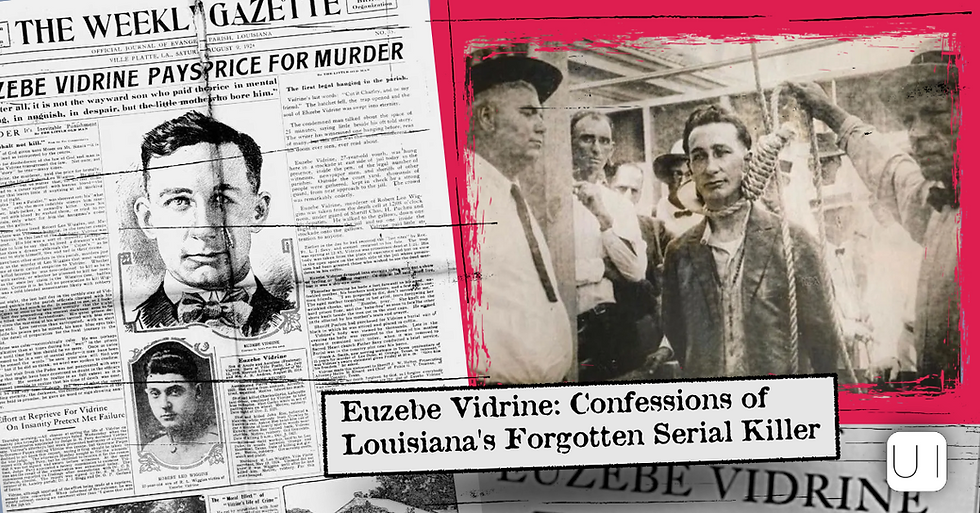
In the summer of 1924, twenty-six-year-old Euzebe Vidrine sat in a jail cell in Ville Platte, Louisiana, dictating his life story to a translator because he could barely read or speak English. He'd already confessed to killing five men. He already knew the date he was going to hang for it. And he still wanted the world to understand why. “I have grown and do not understand why and how I have been that way,” he said. “God knows I tried hard to change my life's course. But I never could resist the temptation which pulled me down to the very depth of hell.”
That confession became a memoir, published the same day he was executed, decades before the term “serial killer” existed and long before true crime turned into something people watch on purpose. But there's a lot more to Vidrine's story than the headlines from 1924 ever captured, including a strange thread that ties his case to one of the most famous political assassinations in American history.
A body behind a white oak tree
On May 19, 1924, Robert “Leo” Wiggins Jr. was found shot dead on the highway between Ville Platte and Mamou, one bullet in the head and one in the heart. Wiggins wasn't some random target. He ran a local business and was the son of the parish's outgoing sheriff, which meant this wasn't going to stay quiet for long.
Vidrine didn't run. He watched from the woods as officials carried Wiggins's body to the home of Dr. Yves Ardoin, the victim's father-in-law and also the parish coroner, then followed the crowd there himself with blood still on his clothes. “I went to the house, looked at the body, mixed with the people,” he later wrote. “My heart didn't even beat faster; no one looked at me suspiciously.”
He was wrong about that last part. Police showed up at his house before dawn and left with his bloody clothes, his pistol and his cartridges. When that wasn't proof enough, they brought in bloodhounds from Mississippi, including one named Red Eagle who tracked Vidrine's scent all the way to his own jail cell. Vidrine took one look at the dog snarling through the bars and fainted.

A killing nobody managed to pin on him
Wiggins wasn't Vidrine's first victim, and the one before him should have put him away years earlier. In April 1921, Vidrine shot his neighbor Pierre Vidrine (no relation) over a rumor that he'd been stealing hogs. He was arrested and tried, and a jury found him not guilty on purely circumstantial evidence. By some accounts the judge even apologized to him for the trouble of the arrest.
Free and apparently untroubled by what he'd done, Vidrine went looking for work that winter and found something else instead. Over two weeks in December 1921, he killed three strangers who'd each been decent enough to give him a ride: Charles Garbo, an Italian driver who pulled over to fix a tire; John Roy, who stopped so the two of them could share a smoke; and Lee Duke, shot mid-drag on a cigarette Vidrine later wrote he could never forget the smell of. He took a few dollars, a couple of cheap watches and once a “hoodoo,” his word for a pocketbook that turned out to be stuffed with sand instead of cash. In his memoir he also wrote plainly about who he'd sought out that week and who he'd passed over, a passage that says as much about the casual, everyday racism of 1920s Louisiana as it does about Vidrine himself.

None of those three killings were solved at the time. A Texas man named Frank Smith was actually convicted of murdering Duke and spent three years in the state penitentiary before Vidrine's later confession cleared his name and got him a pardon from the governor.
The making of a killer
To explain where all this came from, Vidrine went back to the beginning in his memoir. He was born July 12, 1898, in Ville Platte, one of ten children of Arcille Vidrine and Aureline Fontenot. He remembered a small dog named Soto, a sister named Aza who taught him to dance barefoot in the dust behind the kitchen, and a childhood that looked ordinary from the outside. He quit school after the fourth grade to work the family farm, and by his own account, the first “crooked” thing he ever did was steal his father's whiskey.
At fifteen he started having spells he couldn't explain, crying for no reason, restless and miserable for days at a time. He married fourteen-year-old Lillian Andrus in 1918, when he was twenty, all while still seeing another young woman named Estelle Ortego on the side. Money stayed tight for the whole marriage. At one point his father-in-law gave him a mule to help with the farm, and when the animal wouldn't let him near it, Vidrine shot it dead and lied to his wife about what happened. Whiskey runs through nearly every page of his account, and he leaned on it hard at his trial, blaming it for turning him into someone he claimed not to recognize.

The judge, the trial, and a name worth remembering
Vidrine's trial opened on May 24, 1924, in front of Judge B.H. Pavy of the 16th Judicial District. He represented part of his own defense, delivering a rambling speech in broken English that amounted mostly to a temperance lecture and a plea for mercy. The jury took ten minutes to find him guilty.
Here's the part almost nobody tells about this case. Eleven years later, that same judge, Benjamin Henry Pavy, became a household name in Louisiana for an entirely different reason. In 1935, Senator Huey Long pushed a bill through the legislature specifically to gerrymander Pavy out of his judgeship. Hours after it passed, Pavy's son-in-law, Dr. Carl Weiss, confronted Long in a Capitol hallway and shot him, an assassination still debated by historians today. The judge who sentenced Euzebe Vidrine to hang spent the following decade at the center of one of the biggest political mysteries in American history.
A last plea of insanity
Vidrine's family and lawyers made one final push before the execution. On August 1, an alienist named Dr. C.F. Holbrook signed a statement declaring Vidrine of a “diseased mind” and not responsible for his own actions, arguing that some form of psychosis had been building in him for years. His team asked Governor Henry Fuqua for a reprieve so a lunacy commission could investigate properly. The governor sent the decision straight back to the court that had already convicted him, and within a week the three doctors appointed to that commission unanimously found Vidrine sane. When his lawyers passed along the news, Vidrine reportedly just said, “I guess that ends it. The jig's up.”

“Courage, Charlie. Cut the rope.”
Vidrine's execution was set for August 8, 1924, the same day his memoir hit newsstands. It would be the only legal hanging Evangeline Parish ever carried out. Public executions ordered by a court, rather than a mob, were already growing rare in America by then. Six decades earlier the country had watched its first woman ever hanged by the federal government, Mary Surratt, executed for her alleged role in the plot to kill Abraham Lincoln, a case that stirred up its own arguments about spectacle and justice.
By noon, thousands had packed the courthouse square, the kind of crowd that regularly turned out across the South for a public reckoning in that era, whether the law had ordered it or a mob had taken matters into its own hands, as happened five years earlier during the 1919 courthouse riot in Omaha. Vidrine asked to be bathed, dressed in a new suit and photographed before he died, and he wouldn't move toward the gallows until the newspapermen confirmed the pictures were good enough to print. He asked to hear a violin, then asked the musician to stop after three songs. His last request was that his body be displayed afterward in an open casket in the middle of the courthouse square, and it was.

Even his final words got muddled in the retelling. One account has him telling the sheriff, “Courage, Charlie. Cut the rope.” Another, printed in the local Weekly Gazette, has him saying, “Cut it Charley and be my friend.” Two newspapers covering the same hanging couldn't agree on what a man said in the last seconds of his life. The trap opened at 12:45 p.m. Vidrine was pronounced dead at 1:21.
Local legend wrapped his death in a bit of weather folklore too. Ville Platte had gone weeks without rain that summer, and Pierre Vidrine's widow reportedly predicted the drought wouldn't break until Euzebe was dead and the parish was rid of him. He was hanged on a Friday. It rained two days later.
Cashing in on a killer
Vidrine's memoir went on sale the same day he died, and Louisiana papers ran pre-order ads for it weeks ahead of the execution at a dollar a copy. Not everyone thought that was fine. One Gazette editorial argued that publicizing his crimes for profit did nothing to prevent more of them, and suggested that if the point was really moral instruction, the book should have been given away for free instead of sold for “filthy lucre.” A Baptist minister in Turkey Creek went further, warning parents that a copy of Vidrine's memoir left lying around the house was exactly the kind of thing that could plant ideas in a child's head. The argument over whether true crime should be sold for entertainment isn't new. It's just rarely been this literal.
Whatever cursed the Vidrines
Euzebe wasn't the only Vidrine to die violently. His older brother René had been killed in a knife fight back in 1918, on the same stretch of highway where Euzebe would later leave Wiggins's body. Within six months of Euzebe's hanging, another brother, Elgee, was beaten to death on that same road, a case that went unsolved for nearly twenty years. In February 1937, their mother Aureline was struck and killed by a passing car while out driving her horse and buggy.
That same year, Euzebe's second cousin Melvin Vidrine murdered his common-law wife, Frozina Vizanat, luring her into the woods and shooting her while holding their eighteen-month-old child in his other arm. The sheriff who questioned him, the same Charles Pucheu who had walked Euzebe to the gallows, said Melvin looked and talked so much like his cousin that the interrogation felt like déjà vu. Melvin was sentenced to life at Angola.
Locals kept Euzebe's name alive for decades afterward, mostly as a boogeyman parents used to scare kids into behaving, complete with invented details about him drinking his victims' blood that had nothing to do with the actual case.
Born evil, or made that way
Vidrine spent his last weeks convinced his fate had been written before he was born. “My experience has made me believe that a human being has his destination,” he wrote near the end of his memoir. It's a conclusion that conveniently let him off the hook, but it's also the same question true crime keeps circling back to a century later: how much of this was Vidrine, and how much was simply where and when he happened to be born. Somewhere in the tangle of Louisiana's political history, the same courtroom that sent him to the gallows produced a judge who, eleven years on, would have a front-row seat, whether he wanted it or not, to one of the biggest unsolved mysteries in American politics.
Frequently asked questions
Who was Euzebe Vidrine?
Euzebe Vidrine was a Louisiana farmer who confessed to killing five men between 1921 and 1924. He was hanged in Ville Platte on August 8, 1924, the only legal execution Evangeline Parish ever carried out.
How many people did Euzebe Vidrine kill?
He confessed to five murders: Pierre Vidrine, Charles Garbo, John Roy, Lee Duke and Robert “Leo” Wiggins Jr. He stood trial and was executed specifically for Wiggins's murder.
Did Euzebe Vidrine write a book?
Yes. With help from his lawyer and two local writers, Vidrine dictated his memoir, “The Life of Euzebe Vidrine,” from his jail cell in the weeks before his execution. It went on sale the same day he was hanged.
Sources
1. The Life (and Death) of Euzebe Vidrine, Country Roads Magazine
2. Episode 79: Serial Killer Euzebe Vidrine, Southern Mysteries: A Southern History & True Crime Podcast
3. Spectacular Murder Trial Occurred 90 Years Ago, EvangelineToday.com, Ville Platte Gazette archive
5. The Assassination of Huey Long, HueyLong.com, the Long Legacy Project