

Mary Surratt and the Lincoln Assassination: Her Involvement, Legacy and Execution
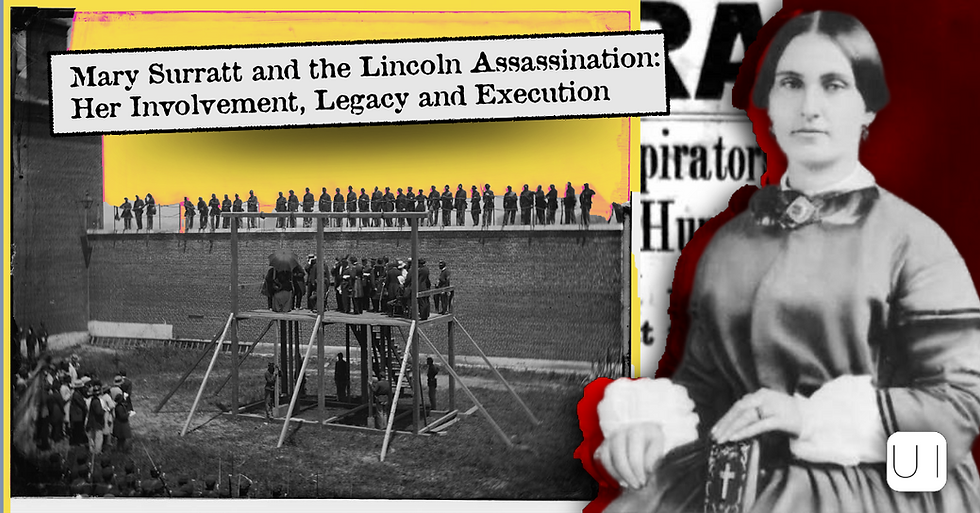
On 7 July 1865, four people were hanged at the Washington Arsenal for their roles in the conspiracy to assassinate President Abraham Lincoln. Three of them were men. One was a woman. Her name was Mary Surratt, and she went to the scaffold maintaining she was innocent. The hangman who dropped the trap agreed with her. Five of the nine military commissioners who had convicted her had already petitioned the president for clemency. Her own daughter had tried to storm the White House that morning to beg for her mother's life and been turned away. Andrew Johnson later claimed he never saw the petition. The man who signed the death warrant had a different story. Nobody was ever able to prove whose version was true.
Early Life and the Boarding House
Mary Elizabeth Jenkins was born around 1823 on a tobacco plantation in southern Maryland, near Waterloo. She was raised Catholic in a region where that still carried social weight, and at seventeen married John Harrison Surratt, a farmer and sometime postal contractor. They had three children: Isaac, Anna, and John Jr. John Sr. opened a tavern and post office in Surrattsville, Maryland, about twelve miles south of Washington, and the family prospered modestly.
When John Sr. died in 1862, Mary was left with debts and three children. She moved the family to a boarding house she owned in Washington DC, at 541 H Street NW, and took in lodgers to make ends meet. The house was comfortable and respectable. Her son John Jr., now a young man with Confederate sympathies, was already working as a courier for the Confederate secret service. It was through him that the boarding house began attracting the company that would eventually destroy his mother.

John Wilkes Booth and the Plot
John Wilkes Booth was one of the most famous actors in America in 1864, a Marylander from a celebrated theatrical family who had decided that Abraham Lincoln needed to die. His original plan wasn't assassination but kidnapping: capture the president, hold him as a bargaining chip to force the release of Confederate prisoners of war. The plan required a network of accomplices across Maryland, men who could move quietly through the countryside, hide horses and supplies, and ask no questions. John Surratt Jr. was perfect for this. His mother's boarding house became one of the planning venues.
Booth visited the H Street boarding house multiple times in the winter and spring of 1865. So did Lewis Powell, who would attack Secretary of State William Seward on the night of the assassination. So did David Herold and George Atzerodt. The evidence at trial would show that Mary Surratt knew these men, fed them, and received Booth in her parlour. What it couldn't conclusively show was whether she knew what they were planning, or had agreed to be part of it.
The kidnapping plan collapsed when Lincoln's schedule changed at the last minute on 17 March 1865. Six weeks later, on 14 April 1865, Booth revised his ambitions. Instead of kidnapping, assassination. And not just Lincoln: Seward was to be killed the same night by Powell, and Vice President Andrew Johnson was to be killed by Atzerodt. Johnson lost his nerve and never made the attempt. Powell attacked Seward in his bedroom and severely injured him and several others but failed to kill him. Booth shot Lincoln in the head at Ford's Theatre at around 10.15 that night. Lincoln died the following morning.

The Evidence Against Mary Surratt
Mary Surratt was arrested on 17 April 1865, three days after the assassination. The case against her rested primarily on two witnesses: Louis Weichmann, a boarder at the H Street house who testified that he'd driven her to her tavern in Surrattsville on the afternoon of the assassination, where she'd allegedly told tenant John Lloyd to have firearms and whiskey ready for men who would come to collect them that night. Booth and Herold did collect them during their escape. John Lloyd, the tenant, corroborated this, testifying that Surratt had told him the "shooting irons" would be needed soon.
A package containing binoculars, delivered to the tavern by Booth on the afternoon of 14 April and retrieved by Herold during the escape, was also cited. Surratt had reportedly delivered the package. She said she'd had no idea what was in it.
The defence countered that both Weichmann and Lloyd were compromised witnesses. Weichmann had been arrested initially as a suspect and was testifying to save himself. Lloyd had been drinking heavily that day and was also under pressure. Mary's lawyers, led by the Maryland Senator and former Attorney General Reverdy Johnson, argued that even if every word of the testimony was accurate, it didn't prove she'd known about the assassination rather than some other plan. The tribunal admitted virtually all prosecution evidence and excluded substantial defence material. There was, as historian Roy Chamlee later put it, no presumption of innocence.
The Military Tribunal and Its Controversies
The decision to try the conspirators before a military commission rather than a civilian court was itself deeply controversial. Secretary of War Edwin Stanton and Attorney General James Speed argued that the assassination was a wartime act of treason and therefore a military matter, even though the war was effectively over and civilian courts were functioning. Frances Clalin Clayton, who had disguised herself as a man to fight in the Civil War, represented a very different relationship between a woman and the military justice system than the one Mary Surratt now found herself in. Reverdy Johnson argued directly that a military commission had no jurisdiction over a civilian in peacetime. The head judge, Major General David Hunter, who had been a pallbearer at Lincoln's funeral, had no interest in hearing it.

The trial ran from 9 May to 28 June 1865. More than 300 witnesses testified. Nearly 5,000 pages of transcripts were produced. Mary was so ill during the final four days that she was permitted to stay in her cell. The commission found all eight defendants guilty on 30 June. Four, including Mary, were sentenced to death. Four others received life imprisonment or shorter sentences.
Then something unusual happened. Five of the nine commissioners, Generals Hunter, Kautz, Foster, Ekin, and Tompkins, felt uneasy about hanging a woman. Judge Advocate General Joseph Holt, the chief prosecutor, had already quietly suggested to commission members that if they voted for the death penalty they could simultaneously petition the president for clemency, and that the president would respond favourably. Taking Holt at his word, the five signed a petition asking Andrew Johnson to commute Mary's sentence to life imprisonment "in consideration of the sex and age of the said Mary E. Surratt."
The petition was attached to the pile of papers containing the commission's findings and sent to the president. Johnson approved the death sentences on 5 July. He signed the execution order. He did not sign the clemency order. The executions were scheduled for 7 July.
The Habeas Corpus Battle
Mary's junior lawyers, Frederick Aiken and John Clampitt, had one more card to play. On 7 July, the morning of the execution, they petitioned Judge Andrew Wylie of the Supreme Court of the District of Columbia for a writ of habeas corpus, arguing that the military commission had no jurisdiction over a civilian. Wylie agreed, and issued the writ, ordering General Winfield Hancock, who was responsible for the prisoners, to produce Mary before the civil court by 10am.
Hancock consulted the president. Within hours, Johnson suspended the writ under the Habeas Corpus Suspension Act of 1863, a wartime measure. Judge Wylie had no power to countermand the president during a declared suspension. Mary Surratt's last legal lifeline was gone.
Meanwhile, Anna Surratt had been trying to reach the president all morning. She went to the White House repeatedly and was turned away each time. A contemporary account described her collapsing on the steps, weeping, and still being refused entry. Stephen Douglas's widow, the wife of the late senator, also went to plead for Mary's life. Johnson would not see either of them.
The Execution
At around 1.30pm on 7 July 1865, Mary Surratt was led out into the courtyard of the Washington Arsenal alongside Lewis Powell, David Herold, and George Atzerodt. It was a brutally hot day. A crowd of about 1,000 people had gathered, including government officials, military officers, and journalists. Photographer Alexander Gardner, who'd famously photographed the dead at Antietam, was there with his camera.

Mary Surratt wore a black dress and black bonnet. She was assisted up the steps of the scaffold. Powell, who was physically powerful and who had come closer to completing his assigned murder than any of the other conspirators, leaned over to General Hartranft, who was supervising the executions, and said quietly: "She is innocent. She doesn't deserve to die with the rest of us."
The condemned were seated in chairs while their arms were bound and white hoods were placed over their heads. The ropes went around their necks. Mary's rope had five loops, making it a more powerful and quicker noose than the standard three-loop arrangement, apparently at the request of the supervising officer, who wanted to ensure a clean death.

When the trap fell, Mary Surratt died relatively quickly. One of the soldiers watching was heard to say, "She makes a good bow." Gardner's photographs of the four bodies hanging from the gallows, shot moments after the drop, became some of the most widely reproduced images of the execution of justice in American history.
She was initially buried in the grounds of the Arsenal. In 1869, she was reinterred at Mount Olivet Cemetery in Washington DC. Her grave is still there.
Did Johnson See the Petition?
At Andrew Johnson's impeachment trial in 1868, the clemency petition resurfaced. Johnson testified that he'd never seen it. Holt testified that he'd shown it to Johnson, who had read it and refused to act on it, saying that Mary Surratt "had kept the nest that hatched the egg." Multiple witnesses at the impeachment hearing confirmed they'd heard Johnson make similar statements before the execution. The two accounts cannot both be true, and it's never been settled which one is accurate.
What historians have largely agreed on is that even if Johnson had seen the petition, it almost certainly wouldn't have changed the outcome. Johnson had said repeatedly before the execution that Mary's sex made her no less guilty, and that allowing sentiment to override justice in a case of presidential assassination would set a dangerous precedent. The five commissioners may have been correct in thinking the petition would succeed. Holt, who knew Johnson better, apparently knew otherwise.
John Surratt Jr. and What Came After
While his mother was being tried, convicted, and executed, John Surratt Jr. was in Canada. He'd fled Washington the night of the assassination and made his way to Montreal, where Catholic priests sheltered him. From there he travelled to England and then to Rome, where he enlisted in the Papal Zouaves under the false name John Watson. In April 1866, a fellow Zouave named Henri Ste-Marie, who'd known Surratt in Canada, recognised him and reported him to the American ambassador.
Surratt fled to Alexandria, Egypt, where he was arrested and extradited back to the United States in 1867, two years after his mother's execution. He was tried before a civilian jury, which deadlocked and failed to convict him. The irony was stark: Mary Surratt, tried by a military commission without a presumption of innocence, had been hanged. Her son, tried by a civilian jury with full legal protections, walked free. He subsequently went on a lecture tour, giving talks in which he defended himself and, implicitly, undermined the case that had killed his mother.
John Surratt Jr. lived until 1916, dying at the age of 72. He never fully addressed what he knew about the plot or what his mother had known. He married, had seven children, and worked as a shipping clerk in Baltimore. He is buried in New Cathedral Cemetery.
Was She Guilty?
The question historians have wrestled with since 1865 is whether Mary Surratt genuinely knew about the assassination plot or only about the earlier kidnapping scheme. If she knew only about the kidnapping, and the assassination was a last-minute change of plan that Booth didn't share with her, then she wasn't guilty of what she was convicted of. Her conviction rested on circumstantial evidence delivered by two compromised witnesses, through a tribunal that admitted prosecution evidence almost without restriction.
The broad consensus among legal historians today is that if Mary Surratt were tried in a modern civilian court, with modern evidentiary standards, she'd almost certainly not be convicted. Whether she was morally innocent is a different question. She knew these men. She housed them. She made deliveries on Booth's behalf. What she knew about their ultimate intentions died with her.
The boarding house at 541 H Street NW in Washington DC is still standing. For many years it operated as a Chinese restaurant called Wok and Roll, occupying the same rooms where John Wilkes Booth sat in the parlour with Mary Surratt and her son. It was listed on the National Register of Historic Places in 2009. The man who pulled the trigger and started all of this, Boston Corbett, the self-castrated hat maker who shot John Wilkes Booth in a Virginia barn twelve days after the assassination, ended his own story much more ambiguously than Mary Surratt ended hers. Corbett disappeared in 1888 after escaping a mental institution. Nobody knows what happened to him.
Sources:
1. Washington Post: President Johnson claimed to not have seen a clemency petition for Mary Surratt. https://www.washingtonpost.com/news/house-divided/wp/2015/07/07/president-johnson-claimed-to-not-have-seen-a-clemency-petition-for-mary-surratt/
2. Columbia Law Review: The Law(?) of the Lincoln Assassination. https://www.columbialawreview.org/content/the-law-of-the-lincoln-assassination/
3. Boundary Stones WETA: Mary E. Surratt: The Woman Who Helped Kill Lincoln... Or Did She? https://boundarystones.weta.org/2025/04/14/mary-e-surratt-woman-who-helped-kill-lincoln-or-did-she
4. Lincoln Conspirators: June 30, 1865 Clemency petition transcript. https://lincolnconspirators.com/the-trial/june-30-1865/
5. Turner, Thomas R. Beware the People Weeping: Public Opinion and the Assassination of President Lincoln. Louisiana State University Press, 1982.
6. Kauffman, Michael W. American Brutus: John Wilkes Booth and the Lincoln Conspiracies. Random House, 2004.


