The Bizarre Plot To Kidnap Abraham Lincoln's Body

On 4th of May, 1865, the United States believed it had completed one of the most solemn duties in its history. After weeks of lying in state, a funeral train that crossed the country, and public viewings in twelve cities, Abraham Lincoln was placed inside a receiving vault at Oak Ridge Cemetery, close to the town he had once called home.
The arrangement was meant to be temporary. The Lincoln Tomb was still under construction, and the vault was simply a holding place until the monument could be completed. What followed instead was a thirty six year saga of concealment, exhumation, official anxiety, criminal ambition, and repeated interference that left Lincoln’s body more travelled in death than most people are in life.
Between 1865 and 1901, Lincoln’s coffin was moved seventeen times and opened on five separate occasions. He was hidden beneath a woodpile, buried secretly, exhumed to confirm his identity, shifted again during tomb repairs, and finally sealed inside a steel cage beneath thousands of pounds of concrete. By the time the process ended, even those responsible were exhausted by it.
Mourning a president before the tomb existed
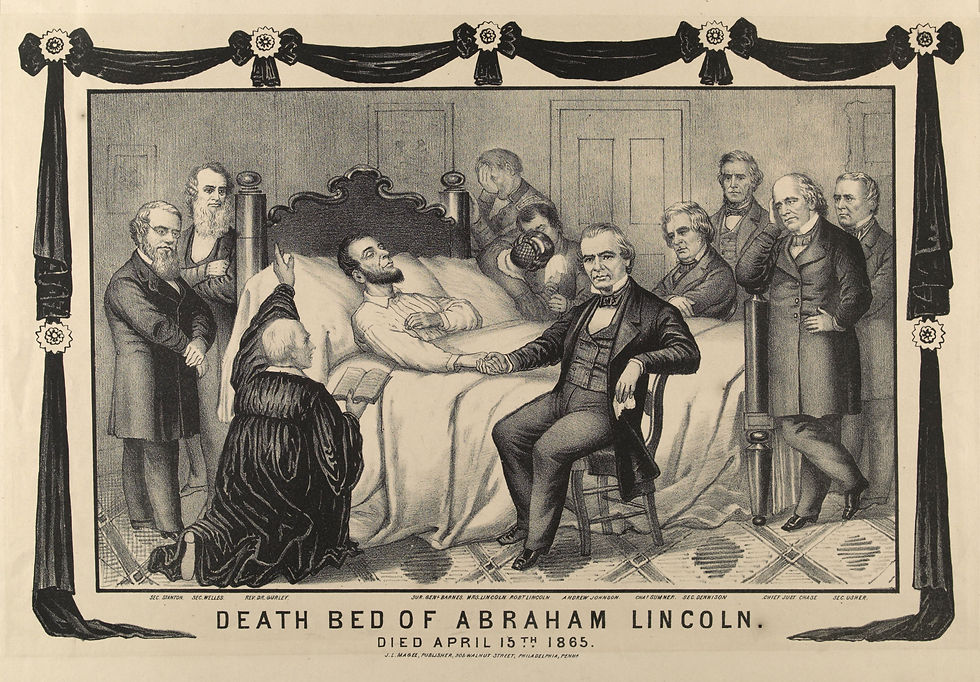
Lincoln’s assassination on 14th of April, 1865 stunned a nation already drained by four years of civil war. His funeral became an event without precedent. Millions stood in silence as the train passed. Newspapers recorded how entire towns stopped work. The scale of grief was both personal and political.
Yet the physical reality was more prosaic. When Lincoln’s coffin arrived in Springfield, the monument planned in his honour was unfinished. The receiving vault was a practical solution, not a symbolic one.
The coffin itself was imposing. Constructed from mahogany and lined with lead, it weighed close to 500 pounds. It rested inside a stone sarcophagus, behind iron bars, secured with a single padlock. In theory, it was protected. In reality, it was vulnerable.
Currency reform and an unintended afterlife
One of the deeper ironies of the story lies in Lincoln’s own legislation. In 1862, he signed the bill establishing a national paper currency, replacing the chaotic system of private banknotes that had made counterfeiting rampant. On the very morning of his assassination, he also signed legislation creating the United States Secret Service, originally tasked not with protecting presidents but with suppressing counterfeiters.

By the mid 1870s, counterfeiting was still widespread. One of the most skilled engravers of fraudulent plates was Benjamin Boyd, whose work supported an entire Chicago syndicate run by James “Big Jim” Kinealy. Boyd’s arrest and ten year sentence in 1876 destroyed the operation overnight.
Kinealy did not accept the loss quietly. He needed Boyd free, and he needed legitimate money to restart elsewhere. His solution was to turn Lincoln’s body into leverage.
Election night and a calculated gamble
On 7th of November, 1876, Americans voted in one of the most chaotic elections in their history, choosing between Rutherford B. Hayes and Samuel Tilden. The result would remain disputed for months.
That uncertainty created opportunity.
Kinealy’s associates planned to steal Lincoln’s body from its tomb in Springfield, transport it by wagon to the sand dunes near Lake Michigan, bury it secretly in northern Indiana, and reveal the location only to Boyd in prison. Boyd would then ransom the information to the governor of Illinois.
The price was exact. A full pardon and 200,000 dollars in cash, roughly equivalent to six million dollars today. To prove the theft was genuine, the gang planned to tear a foreign newspaper into irregular shapes, leave part inside the empty tomb, and send the rest to Boyd. It was a grimly methodical plan.
It might have succeeded if the men involved had been capable of silence.

Loose talk and a deliberate decision
One conspirator, drunk and eager to impress a woman in a Chicago saloon, spoke too freely about the ransom. She reported it to the police chief. The information reached the Secret Service, and then Robert Todd Lincoln.
Robert Lincoln’s response was careful and unsentimental. Rather than stopping the plot, he insisted it proceed. He wanted the men caught in the act, but before they could physically touch his father’s remains.
Unknown to Kinealy, two of the men he recruited, Louis Swegles and wagon driver Bill Nealy, were already Secret Service informants. The trap was in place before the train ever left Chicago.
Inside the tomb on election night
On 6th of November, 1876, the conspirators boarded a train to Springfield carrying a carpetbag filled with chisels, saws, and other tools. On the same train, and others arriving soon after, travelled Secret Service agents including Patrick D. Tyrrell, Elmer Washburn, and two Pinkerton detectives.
On the night of 7th of November, 1876, agents entered the Lincoln Tomb and waited in complete darkness for more than two hours, standing in their stocking feet to avoid noise.
When the grave robbers arrived, they cut through the padlock and lifted the lid of the sarcophagus. They quickly discovered a problem. The coffin was too heavy to remove intact. Their solution was to cut away part of the stone casing so the coffin could be slid lengthwise toward the door.
As they began dragging it free, a gun discharged accidentally in the darkness.
Confusion, gunfire, and escape
“I called on whomsoever was within to surrender,” Tyrrell later wrote in 1905. “There was no response.”
Striking a match, he saw tools scattered across the floor and the sarcophagus battered apart. Outside, silhouettes moved. Shots were fired. In the confusion, lawmen fired at one another while the criminals escaped.
Despite the farce, the plot collapsed. Two men were arrested ten days later. Yet body snatching was not a federal crime, nor clearly illegal under Illinois law. They were instead convicted of attempting to steal Lincoln’s coffin, valued at 75 dollars, and sentenced to one year in prison.
The attempt left Springfield humiliated. Publicly, newspapers treated the incident lightly. Privately, civic leaders were alarmed that the nation’s most sacred body had come so close to being stolen.
Secrecy, woodpiles, and the Lincoln Guard of Honor
Fearing another attempt, the tomb’s caretaker John Carroll Power and a small group of associates acted without public knowledge. They secretly removed Lincoln’s coffin and attempted to bury it in the tomb’s basement. The water table was too high.
Instead, they placed the coffin on wooden supports, covered it with scrap lumber, and concealed it beneath a woodpile. They swore each other to secrecy and named themselves the Lincoln Guard of Honor.
For two years, the president lay hidden in a damp basement.
When they later reburied him in an unmarked spot where the ground was drier, they dug him up again two days later to confirm the body was genuinely Lincoln’s before reburying him. Doubts about substitution were widespread at the time, and this inspection was meant to silence them.
When Mary Todd Lincoln died in 1882, her coffin was placed beside her husband during the public ceremony, then quietly removed and hidden with him in the basement once more.

Internal conflict and a failing monument
Throughout the 1870s and 1880s, the National Lincoln Monument Association was plagued by internal disagreement. Members argued over tomb design, public access, and whether Lincoln’s remains should be permanently concealed or symbolically visible. These disputes contributed directly to the repeated movements of the coffins.
By 1899, the tomb itself was failing. Its foundation was unstable, and the entire structure, including the obelisk, was dismantled. During reconstruction, the Lincolns’ coffins were placed in a concrete lined pit outside the tomb.
Final inspection and a permanent solution
When the rebuilt monument reopened in 1901, Robert Lincoln insisted on one final inspection. Witnesses were invited to view the remains to silence persistent rumours. Contemporary accounts report that Lincoln’s facial features were still recognisable, including his beard and the wound from John Wilkes Booth’s bullet.
Robert then ordered a definitive solution. His father’s coffin was placed inside an industrial steel cage, riveted rather than bolted, lowered into a ten foot chamber, and sealed beneath roughly 4,000 pounds of concrete. Above it, a granite cenotaph marked the spot.
It was not symbolic. It was practical. Tomb robberies had grown more sophisticated by the turn of the century. This was the only way to ensure finality.
An uneasy tradition
Lincoln’s fate was not unique. Thirty one years after George Washington died, a former gardener attempted to steal Washington’s skull and took the wrong head. Thomas Paine’s bones were stolen and lost. Oliver Cromwell’s corpse was exhumed and posthumously executed. Jeremy Bentham’s body was preserved and displayed.
Powerful figures, it seems, rarely enjoy quiet afterlives.
More than a century later, Lincoln still rests beneath steel and concrete at Oak Ridge Cemetery. After decades of movement, secrecy, and fear, the president who preserved the Union was finally allowed to remain still.