

The Life and Legacy of Michael X: From Black Power Icon to the Hangman's Noose
Updated: Sep 3
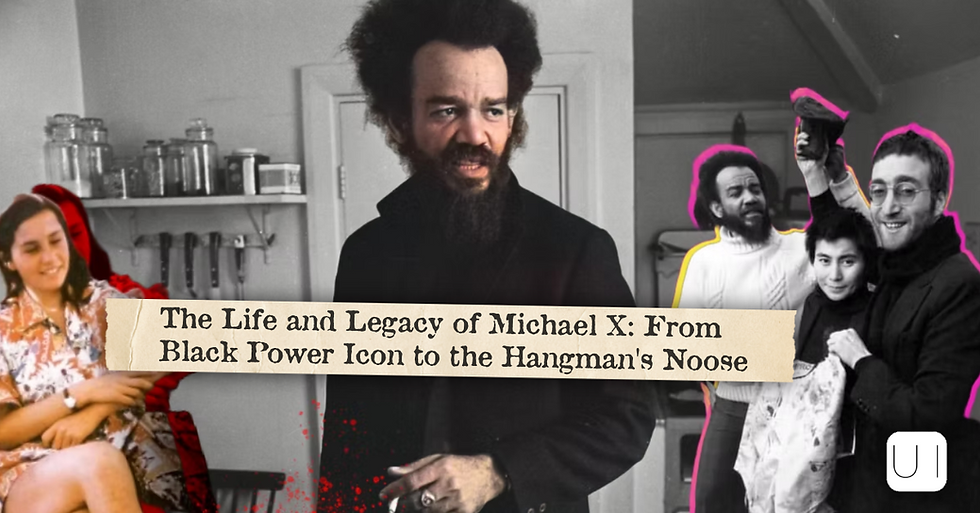
Michael X was hanged in Trinidad's Royal Gaol in May 1975, convicted of a murder carried out by his own followers at a commune he'd built to be a utopia. A decade earlier, he'd walked the streets of Smethwick alongside Malcolm X, run a London community centre funded partly by John Lennon, and been treated by parts of the British counterculture as a genuine voice of Black Power. Both versions of him are real, and neither cancels the other out.
Quick Answers
● Who was Michael X? A Trinidad-born activist, born Michael de Freitas, who became a prominent figure in Britain's Black Power movement in the 1960s before being convicted of murder in Trinidad and executed in 1975.
● Was Michael X really the first person prosecuted under British race relations law? Yes. In 1967 he became the first person convicted of incitement to racial hatred under the Race Relations Act 1965, Britain's first law against racial discrimination.
● What was the Black House? A community centre Michael X founded in London in 1969, meant to support young black men, which was also the site of a violent extortion known as the slave collar affair.
● Why was Michael X executed? He was convicted of ordering the 1972 murder of Joseph Skerritt at his Trinidad commune. A second victim, Gale Benson, was also killed there, though he was never tried for her death.
● Did John Lennon really support him? Yes. Lennon and Yoko Ono donated to the Black House, paid Michael X's bail in 1971, and later funded his defence lawyer at the murder trial.
Red Mike: A Childhood Between Two Worlds
Michael de Freitas was born in August 1933 in Belmont, a suburb of Port of Spain, Trinidad. His mother, a Barbadian woman who practised Obeah, the Afro-Caribbean folk spirituality, raised him largely without his father, a Portuguese merchant from St Kitts who kept his own shops and never lived with the family. Nicknamed “Red Mike” for his lighter skin, de Freitas grew up caught between communities, not fully accepted by black or white children in colonial Trinidad. He was expelled from St Mary's College, a well-regarded school, at 14, and spent his teens and early twenties drifting through odd jobs and years at sea before arriving in Britain in 1957 as part of the Windrush generation.
Notting Hill and a Slumlord's Enforcer
What de Freitas did next complicates any tidy version of his story. In London, he found work as an enforcer and rent collector for Peter Rachman, the notorious Notting Hill landlord whose name became shorthand for exploiting tenants, many of them fellow Caribbean migrants, through intimidation and slum conditions. It sat uneasily alongside the racial politics he'd later build his reputation on, and it toughened him considerably. He also worked as a pimp, gambler and petty con man during these years, all while racial discrimination and blocked opportunity in Britain hardened his outlook.

The killing of Kelso Cochrane, a young Antiguan carpenter murdered in a racially motivated attack in Notting Hill in 1959, pushed de Freitas further toward organised activism; he was among those who spoke publicly in the aftermath, as the case galvanised the local Caribbean community. Around this period he converted to Islam and began using the name Michael Abdul Malik, a shift that marked the start of his transformation from hustler to political figure.
Malcolm X and a Walk Through Smethwick
The defining turn came in February 1965, when Michael de Freitas met Malcolm X during the American leader's brief visit to Britain. The two travelled together to Smethwick in the West Midlands, a town that had become a byword for racial segregation in housing and had returned an MP the previous year on an openly race-baiting campaign. Malcolm X's decision to walk its streets in defiance of that reputation left a deep impression, just days before his assassination back in New York. Afterward, de Freitas began calling himself Michael X, a name that announced where his politics now stood, and became a leading voice in London's Black Power movement.
RAAS and a Landmark Prosecution
Michael X's main vehicle for activism through the mid-1960s was the Racial Adjustment Action Society, or RAAS, a militant organisation he led that's often described as Britain's first real Black Power group. It was RAAS, not Michael X personally, that bought the Holloway Road premises that became the Black House in 1969. Two years earlier, in July 1967, Michael X spoke at a RAAS meeting in Reading, standing in for the recently deported American activist Stokely Carmichael, and made remarks calling for violence against white men who assaulted black women. Press reports of the speech led to him being charged and convicted of incitement to racial hatred under the newly passed Race Relations Act 1965, becoming the first person ever prosecuted under Britain's first race discrimination law. He was sentenced to a year in prison. Michael X wasn't alone in facing this kind of prosecution; fellow RAAS figure Roy Sawh was jailed on similar charges around the same time, and the law's early use against black activists rather than the discrimination it was meant to address became a point of lasting controversy.
The Black House
In 1969, Michael X founded the Black House on Holloway Road, a centre intended to give young black men in London a space for self-defence training, cultural education and a sense of collective pride. Funding came from a mix of sources, including the young millionaire Nigel Samuel alongside contributions tied to figures like John Lennon, Sammy Davis Jr and Dick Gregory.
The centre's reputation didn't survive its association with crime for long. In what became known as the slave collar affair, a businessman named Marvin Brown was lured to the Black House, assaulted and forced into a spiked collar as part of an extortion attempt, an incident that sent two men involved to prison. Police raided the building soon after, and it burned down not long afterward under circumstances that were never fully explained.
A Trade of Hair for Boxing Shorts
Michael X's most enduring brush with fame came through John Lennon and Yoko Ono, who'd been drawn to him after he praised them for covering fines handed to anti-apartheid protesters who'd disrupted a rugby match. Lennon paid Michael X's bail in January 1971 when he was arrested on extortion charges, but the stranger episode came a year earlier. Having just cut off their hair, partly, they said, to move through public more easily, Lennon and Ono offered to swap it for a pair of Muhammad Ali's boxing shorts, with the hair to be auctioned for the Black House and the shorts sold for their own peace campaign. The haircut happened in Denmark on 20 January 1970, and the pair met Michael X on the Black House roof on 4 February for a press conference, where Lennon shrugged off questions about the stunt, saying only that his hair had been “gettin' in me ears.”
Flight to Trinidad and a Commune Turned Cult
By 1971, facing mounting legal trouble and a Black Power movement in Britain that had largely moved past him, Michael X fled to Trinidad and set up a rural commune that drew in a handful of idealistic followers, among them a young man named Joseph Skerritt and a British woman named Gale Benson.

What had been pitched as a utopian project collapsed into paranoia within months. In January 1972, police investigating a fire at the commune found Skerritt's body with his throat cut. In a separate shallow grave nearby, they found the remains of Gale Benson, the daughter of a Conservative MP, who had joined the commune through her relationship with Michael X associate Hakim Jamal and had been living under the name Hale Kimga. She had been stabbed and buried in the commune's grounds. Michael X was later found to have ordered both killings, telling followers Stanley Abbott and Edward Chadee to carry them out. Skerritt was killed for refusing an order to attack a local police station; Benson, by most accounts, for causing what Michael X described as mental strain to Jamal.
Capture, Trial and Execution
Michael X went on the run after the bodies were discovered, fleeing into Guyana, where he was eventually captured in the rainforest attempting to cross into Brazil. Extradited to Trinidad, he was tried and convicted for Skerritt's murder, though never charged over Benson's death. International figures including Angela Davis, Dick Gregory and the American radical lawyer William Kunstler, whose fee was paid by John Lennon, campaigned publicly for clemency. It didn't come. Michael X was hanged in Port of Spain's Royal Gaol on 16 May 1975, aged 41.
Naipaul, Guerrillas, and a Contested Legacy
Michael X's afterlife has been shaped almost as much by literature as by history. The Trinidad-born Nobel laureate V.S. Naipaul covered his trial for the London Sunday Times and turned it into a ninety-page essay, Michael X and the Killings in Trinidad, later collected in his 1980 book The Return of Eva Perón. Naipaul went further still, using the case as the basis for his 1975 novel Guerrillas, in which a fictionalised version of Michael X becomes the character Jimmy Ahmed. Naipaul's account is a harsh one, and not everyone who actually knew the people involved agrees with it: the writer Diana Athill, who was Naipaul's own publisher and had personally known both Michael X and Gale Benson, gave a notably different, more sympathetic reading of Benson in her own memoirs.
Academics researching British Black Power still debate how to weigh him: a man who worked as muscle for one of London's worst slum landlords before becoming, for a time, one of the loudest domestic voices against the racism that made landlords like Rachman possible. Unlike Malcolm X, the man he modelled his name on, Michael X has never become a household name, remembered less as a martyr than as a warning about how easily conviction and self-invention can shade into something far darker.
Frequently Asked Questions
Was Michael X related to Malcolm X?
No. He adopted the name after meeting Malcolm X in 1965 as a mark of political alignment, not because of any family connection.
Was Michael X ever tried for Gale Benson's murder?
No. He was convicted and executed for the murder of Joseph Skerritt. He was never formally tried over Benson's death, though he was widely believed responsible.
Is Michael X the basis for a character in fiction?
Yes. V.S. Naipaul used him as the model for Jimmy Ahmed in the 1975 novel Guerrillas, after covering his trial as a journalist.


