

Peter Rachman: The Notorious Slumlord of Notting Hill
Updated: Sep 3
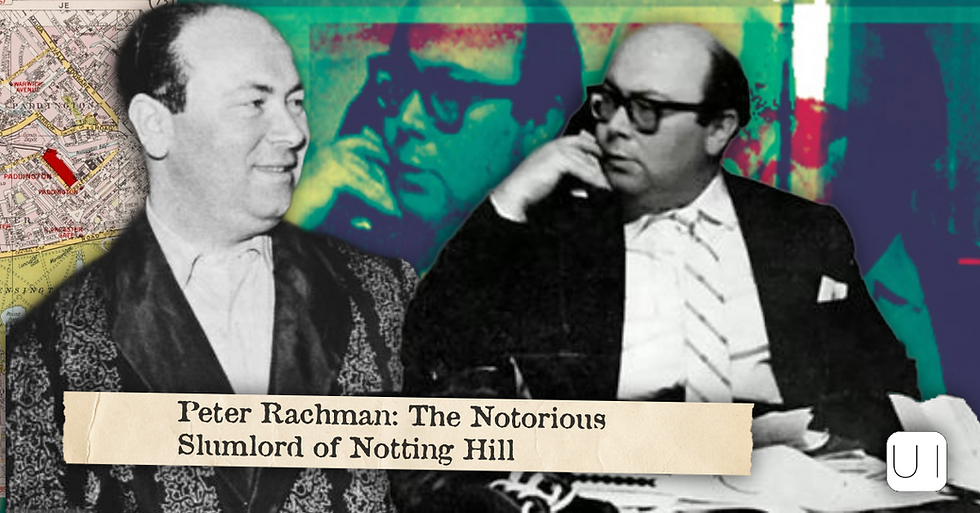
Peter Rachman died in 1962, but his name outlived him in the strangest possible way: "Rachmanism" entered the Oxford English Dictionary as shorthand for the exploitation and intimidation of tenants by their landlord, a rare case of a slumlord's surname turning into a permanent fixture of the English language. What rarely makes it into the story is how directly his empire of overcrowded, subdivided houses fed into one of postwar Britain's ugliest weeks: the Notting Hill race riots of 1958.
Quick Answers
● Who was Peter Rachman? A Polish-born landlord who built a large property empire in Notting Hill and North Kensington in the 1950s, notorious for exploiting and intimidating tenants, particularly recent West Indian immigrants.
● What does "Rachmanism" mean? A term coined by MP Ben Parkin for the exploitation and intimidation of tenants by landlords. It entered the Oxford English Dictionary and helped drive the Rent Act 1965.
● Was Rachman connected to the Notting Hill race riots? Indirectly but significantly. Properties he owned or controlled in the Colville area, right where the 1958 riots reached their worst violence, included at least fourteen brothels, and one of his own enforcers, Michael de Freitas, became a key organiser of the West Indian community's response.
● How did Rachman die? He died of a heart attack on 29 November 1962, aged 43, before the full scale of his activities became public in the wake of the Profumo affair.
A Stateless Man's Route to London
Perec Rachman was born on 16 August 1919 in Lwów, then part of Poland, the son of a Jewish dentist. When Nazi Germany invaded Poland in 1939, he may have joined the Polish resistance, though the details of this period are thin. He was interned by the Germans, escaped across the Soviet border, and was promptly rearrested by Soviet forces and sent to a labour camp in Siberia.
When Germany invaded the Soviet Union in 1941, Rachman, like thousands of other Polish prisoners, was released to join the II Polish Corps, fighting alongside the Allies through the Middle East and Italy. His unit remained in Italy as an occupation force until 1946, when it transferred to Britain.
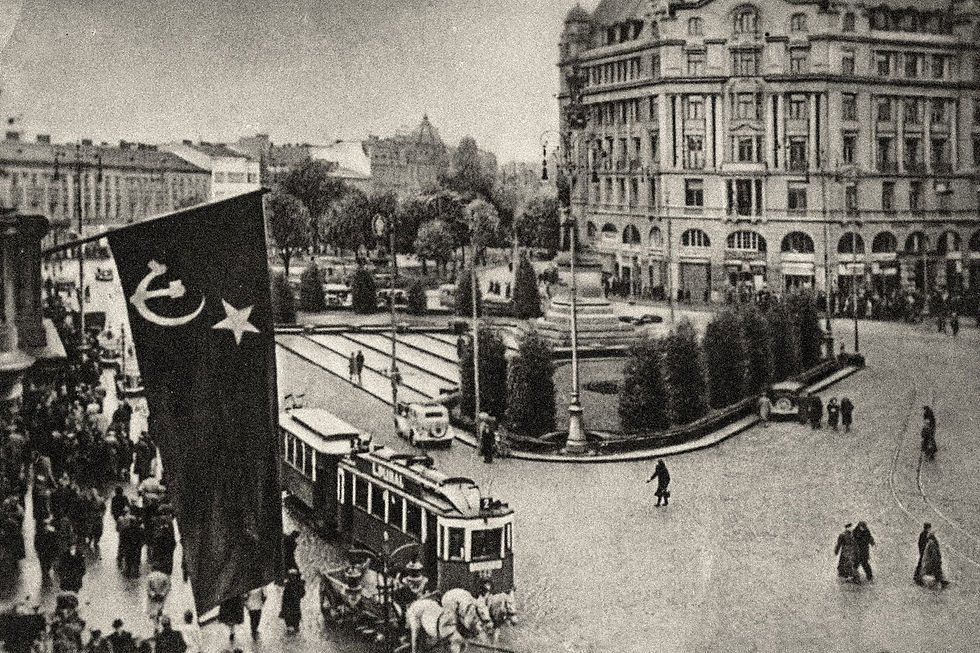
Rachman was demobilised in 1948 and settled in London, but his legal position remained oddly precarious for the rest of his life. Lwów had been absorbed into the Soviet Union after the war and is now Lviv, in Ukraine, and Britain never granted him citizenship. Rachman spent the years that made him infamous as a stateless man, belonging officially to nowhere.
Building an Empire on Rent Control Loopholes
Rachman found his first job with an estate agent in Shepherd's Bush and quickly spotted the opportunity London's postwar housing crisis presented. Notting Hill and North Kensington were full of large, decaying Victorian houses, some bomb damaged, occupied by a mix of poor long-term tenants and recently arrived immigrants. By 1957 he owned more than a hundred of these properties, run from an office at 91-93 Westbourne Grove.

His core method exploited a specific gap in the law. Existing tenants in these houses often held statutory rent-controlled tenancies, which capped what he could legally charge them. Rachman's approach was to get these tenants out, whether by relocating them to smaller flats, buying them out directly, or, when persuasion failed, making their lives difficult enough that they left on their own. Once a controlled tenancy ended, he could re-let the space at whatever rent the market would bear, typically by subdividing it into several smaller flats.
The tactics used to clear out protected tenants ranged from petty harassment to outright intimidation: cut utilities, blocked-up plumbing, late-night noise, and crews of enforcers whose presence alone did most of the work. Rachman rarely appeared in person. That was what the enforcers were for.
The Enforcer Who Became Michael X
One of those enforcers was Michael de Freitas, a Trinidadian immigrant who worked collecting rents and intimidating tenants on Rachman's behalf, reportedly including killing pets and dumping people's belongings into the street to force them out. De Freitas would later reinvent himself entirely, becoming the Black Power activist Michael X, and later still Michael Abdul Malik. In 1975 he was hanged in Trinidad for murder, a startling endpoint for a man who started his London career doing Peter Rachman's dirty work.
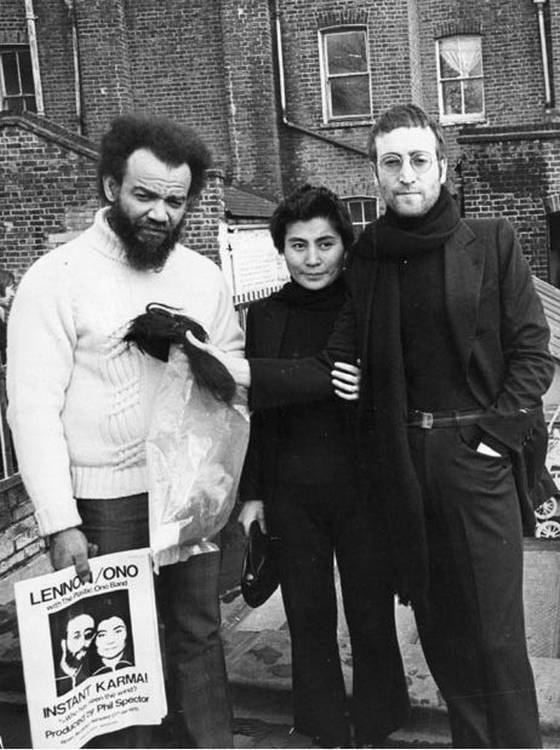
De Freitas's Rachman connection matters for more than biographical trivia. By the mid-1950s Rachman had also moved heavily into subdividing his Notting Hill and North Kensington properties for prostitution, and academic research into the 1958 riots has found that the Colville area, where the rioting reached its worst violence that August and September, contained at least fourteen brothels in premises owned directly or indirectly by Rachman.
The Summer the Area Exploded
Rising racial tension, stoked by Oswald Mosley's Union Movement and Colin Jordan's White Defence League, boiled over into the Notting Hill race riots of late August and early September 1958. Crowds of white youths, some numbering in the hundreds, attacked the homes of West Indian residents over several nights. Michael de Freitas, no longer just Rachman's enforcer but by then an organiser within the West Indian community, helped coordinate a defensive response alongside figures like Frank Critchlow and Frances Ezzreco. He was arrested during the unrest after refusing a police order to move along while talking to a white woman on the street.
The following May, in 1959, Kelso Cochrane, a young Antiguan carpenter, was murdered in a racially motivated attack not far from the same streets. No one was ever convicted. Rachman himself was never accused of involvement in either the riots or the murder, and it would be wrong to suggest otherwise. But the overcrowded, subdivided, brothel-riddled housing stock that made the Colville area a flashpoint in the first place was, in large part, his.
Diversifying, and the Krays
By 1958 Rachman had begun shifting away from the slum-landlord model toward straightforward property development, though his earlier activities kept his name circulating. Scotland Yard set up a dedicated unit to investigate him in 1959, uncovering a network of 33 companies used to manage his holdings, along with evidence that led to two separate prosecutions for brothel-keeping.
His underworld connections ran deeper still. After Ronnie Kray was jailed for running a protection racket, his brother Reggie approached Rachman with an offer to "protect" his properties in exchange for a cut of the rents, a fairly transparent attempt to muscle in on his empire. Rachman, unwilling to hand over control, countered by offering the Krays a stake in one of his nightclubs instead, a deal that gave them the piece of the West End nightclub scene they actually wanted while letting him keep his property business intact.
Keeler, Rice-Davies and the Profumo Connection
Rachman married his longtime girlfriend Audrey O'Donnell in 1960, though the marriage did nothing to slow his other relationships. Among his mistresses was Mandy Rice-Davies, whom he installed in a flat in Bryanston Mews West previously occupied by another of his partners, Christine Keeler. Both women would go on to become central figures in the Profumo affair, the 1963 scandal that brought down the War Secretary John Profumo and badly damaged the Macmillan government. Rachman was already dead by the time the affair broke, but his name was pulled back into the headlines regardless, once the public learned how closely his orbit had overlapped with Keeler's and Rice-Davies's.

Death, and the Reckoning That Came After
Rachman died of a heart attack on 29 November 1962, aged 43, and was buried at Bushey Jewish Cemetery in Hertfordshire. It was only in the aftermath of the Profumo affair the following year that the full scale of his activities became widely known to the public, thanks largely to the Sunday Times' recently formed Insight investigative team, reporters Clive Irving, Ron Hall and Jeremy Wallington, who forensically dug through his business dealings after his death. The tabloids then picked up and sensationalised what Insight had uncovered.
Ben Parkin, the Labour MP for Paddington North, had already spent years raising Rachman's name in Parliament, building on groundwork laid locally by Notting Hill politician Donald Chesworth. Parkin coined the term "Rachmanism" for the exploitation and intimidation of tenants, and was convinced enough of Rachman's ongoing menace that he later alleged the reported death was itself a ploy, a way for Rachman to escape further scrutiny rather than an actual death. Nothing ever substantiated that claim, but it says something about how thoroughly Rachman had convinced people he was capable of anything.
The public outcry helped push through the Rent Act 1965, which extended statutory protection to tenants in privately rented accommodation. It didn't work out entirely as intended. The new security of tenure made landlords considerably warier of letting property at all, and the private rental market in London contracted noticeably in the years that followed, a reminder that laws written to stop one Rachman don't always land the way Parliament hopes.
A BBC Radio 4 documentary examining his legend decades later, The Real Rachman: Lord of the Slums, found that some of the wilder claims about him, entire streets of brothels, an empire built purely on menace, had calcified into myth in the years since his death, even as the underlying facts of what he actually did to his tenants held up under scrutiny.

Frequently Asked Questions
Is "Rachmanism" still used today?
Yes, though less commonly than in the 1960s. It remains in the Oxford English Dictionary as a term for exploitative or intimidatory landlord behaviour, particularly against tenants with limited legal protection.
Was Peter Rachman ever prosecuted?
He was prosecuted twice for brothel-keeping. He was never charged over his tenant intimidation tactics directly, and died before the full scope of his activities became public knowledge.
What happened to Michael de Freitas, Rachman's former enforcer?
He reinvented himself as the Black Power activist Michael X, later Michael Abdul Malik, and was hanged in Trinidad in 1975 after being convicted of murder.
You Might Also Like
Rachman wasn't the only figure of this period whose name became tangled up with the Krays. See Lord 'Bob' Boothby: Charm, Corruption, Ronnie Kray and a Life of Scandal for another respectable public figure quietly entangled with London's underworld.


