

The Profumo Affair: The Sex, Spies and Scandal That Brought Down a Government
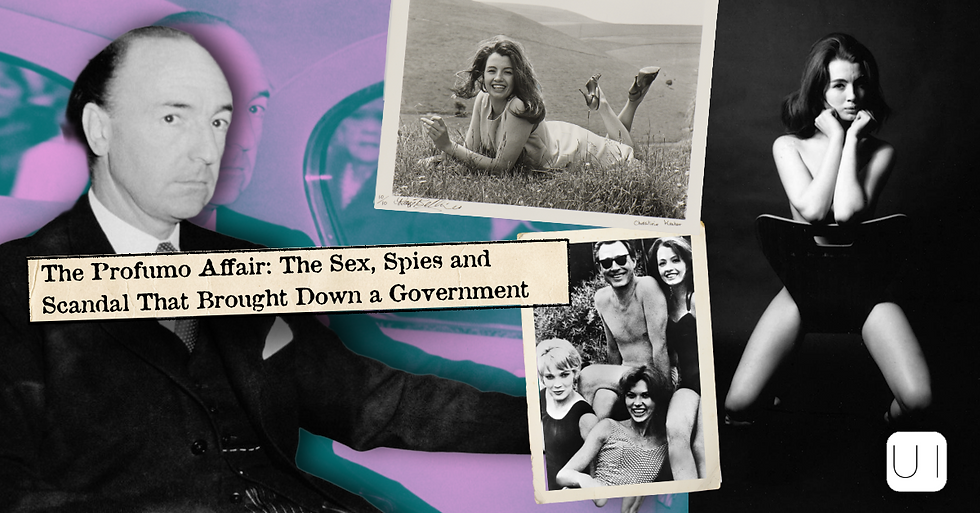
In the summer of 1961, a 19 year old model climbed out of a swimming pool at a Buckinghamshire country estate, and a British government started dying without anyone in the room realising it yet. By the time the fallout finished two years later, a cabinet minister had lied to Parliament and resigned in disgrace, an osteopath had killed himself rather than face a guilty verdict, a prime minister had quit citing his health, and an entire government had lost the next election. The Profumo affair became shorthand for British establishment hypocrisy, and it's still one of the most retold scandals in the country's political history. But strip away the politics and it's also a story about how a handful of powerful, well connected men used two young women for years and then, when it all came out, largely walked away intact while the women carried the consequences.
A Chance Meeting in a Soho Nightclub
Stephen Ward was an osteopath with a client list that read like a Who's Who of British society, including members of the aristocracy and, at various points, the royal family. He'd trained in Missouri, which let him use the title Dr in America but not in Britain, where osteopathy wasn't yet recognised as a real medical profession. On the side, he sketched portraits at the Slade School and had a genuine gift for talking his way into rooms most people never got near.

In 1959, Ward met a teenage dancer named Christine Keeler at Murray's Cabaret Club in Soho, where she performed semi naked on stage and sat with paying customers afterward for a hostess fee. Keeler's childhood had been brutal. A school health inspector had once flagged her for malnutrition, she was sexually abused as a young teenager by her mother's partner and his friends, and at 17 she'd given birth to a premature son who died within days. Ward, 26 years her senior, took her in. The two never became lovers, but he became her patron, an arrangement that reads today far less like kindness and more like an older, connected man building his own social currency off a vulnerable teenager, introducing her around and pulling her into a social circle far above anything she'd known, including the slum landlord Peter Rachman, whose exploitative rental empire in Notting Hill ran alongside a parallel life of mistresses that included both Keeler and her close friend Mandy Rice-Davies.
The Swimming Pool at Cliveden
Ward was lent a cottage on the grounds of Cliveden, the Buckinghamshire estate belonging to Lord Astor, and he and Keeler were regulars at the weekend parties held there. On the night of 8 July 1961, Keeler was swimming naked in the walled garden pool when John Profumo, the 46 year old Secretary of State for War, wandered over. Profumo was married to the actress Valerie Hobson and was widely tipped as a future star of the Conservative government. He and Keeler began a brief affair that lasted only a few months and had fizzled out by the autumn.

The Shooting That Actually Broke the Story
What actually put the affair on newspaper front pages wasn't Cliveden at all, it was a jealous ex-boyfriend with a gun. Keeler had been briefly involved with a jazz promoter named Johnny Edgecombe, and their relationship soured after a separate feud between Edgecombe and another of Keeler's former lovers, a musician known as Lucky Gordon, turned violent at a Soho club. When Keeler later refused to help Edgecombe and threatened to testify against him, he turned up at Ward's flat in Wimpole Mews on 14 December 1962 and fired several shots at the door trying to get to her.

Nobody was hurt, but Edgecombe's arrest and subsequent trial dragged Keeler into open court, and once journalists started digging into who she was and who she knew, the Profumo connection was only a matter of time. Edgecombe always maintained he'd been made a convenient villain, later describing his seven year sentence as wildly disproportionate for a case where nobody was hit, and pointing out that the scandal that followed made careers for people who wrote about it while he did the time. The bitter irony is that Lucky Gordon, the man whose earlier violence against Keeler had set the whole chain of events off, was never really the story either. Keeler later withdrew part of her testimony against him under pressure, and it was that retraction, not his assault on her, that eventually formed the basis of her own perjury conviction.

A Second Man in the Picture
What turned an ordinary political indiscretion into a national security scare was the fact that Keeler, around the same time, was also seeing Yevgeny Ivanov, a Soviet naval attache and intelligence officer, who she'd likewise been introduced to through Ward. British intelligence was well aware of Ivanov, and there's long been speculation that MI5 had hoped Ward might help turn him into an informant. Instead, Ward had unknowingly created a scenario where a British war minister and a Soviet spy were sharing the same lover during the height of the Cold War, a coincidence that made the eventual scandal about far more than an affair.
The Lie That Ended a Career
Rumours of the Profumo and Keeler affair circulated in political and press circles through 1962, but nothing broke publicly until early 1963. On 22 March that year, Profumo stood up in the House of Commons and denied any impropriety with Keeler, a statement made under parliamentary privilege that meant he couldn't be sued for it. It wasn't true. Ten weeks later, as evidence mounted and a police investigation closed in, Profumo admitted he'd misled the House and resigned from both his cabinet post and Parliament. The damage to Harold Macmillan's government was immediate. Macmillan resigned as prime minister that October, officially citing ill health, and the fallout is widely credited with helping tip the Conservatives out of power at the 1964 general election.
Stephen Ward's Trial
With Profumo gone, public and press attention turned to Ward, who was charged with living off the immoral earnings of Keeler and Rice-Davies, essentially a pimping charge. His society friends, the same people who'd used his flat for parties and his hospitality for years, abandoned him almost overnight. The trial opened at the Old Bailey in July 1963, and it quickly became less a prosecution of specific crimes than a public flogging of Ward's character.
Christine Keeler and Mandy Rice-Davies over various court days.
A future Labour MP, then just 15 and working as Ward's gopher during the trial, later recalled his job was timing a taxi to arrive at the courthouse door so Ward could step straight from the entrance into the back seat, avoiding the crowds. On the last day of the trial, after the judge delivered a scathing summing up that all but told the jury how to rule, Ward went quiet and withdrawn on the ride home, a stark change from how chatty he'd been that morning.
That night, at a friend's flat in Chelsea, Ward wrote a string of apologetic suicide notes and swallowed 94 Nembutal sleeping pills. He was found unconscious the next morning and rushed to hospital, but never woke up. The jury delivered its verdict, guilty on two of the charges, while he lay in a coma, and he died four days later without regaining consciousness. During cross examination at the trial, Rice-Davies had been told that Lord Astor denied ever sleeping with her, and her reply, "Well he would, wouldn't he?", got such a big laugh in the courtroom that it made the front page and eventually landed in the Oxford Dictionary of Quotations. It's still used today as journalistic shorthand for a self-interested denial, sometimes abbreviated simply as MRDA.

Ward's conviction has never sat easily with historians. Declassified MI5 files later showed he'd written to the Labour leader Harold Wilson from his prison cell weeks before his death, insisting he'd never acted as any kind of go-between for Ivanov and pleading that comments made about him in Parliament had already ruined any chance of a fair hearing. In 2014, a lawyer petitioned to have the case reopened by the Criminal Cases Review Commission, arguing the trial had amounted to the establishment sacrificing Ward to protect everyone above him.
The Photograph Everyone Remembers
If one image defines the entire scandal, it's Lewis Morley's shot of Keeler sitting naked astride a moulded plywood Arne Jacobsen chair, her body angled just enough to keep the picture technically decent. Morley took it in May 1963 as the final frame of a rushed nude publicity shoot for a proposed film called The Keeler Affair, which never got made. Keeler had already sat through two rolls of film in a leather jerkin before the producers insisted on nude shots as her contract required. When she balked, Morley cleared the room, turned his back while she undressed, and had her sit backward on the chair so she'd technically fulfilled the contract while staying mostly hidden. The whole exchange took less than five minutes. The film it was made for vanished, but the photo outlived everyone involved and became one of the defining images of 1960s Britain, endlessly referenced, parodied and recreated ever since.

What Happened to Everyone Afterward
Keeler was later convicted of perjury, unrelated to the Profumo affair itself but connected to an earlier court case involving one of her ex-boyfriends, and served nine months in prison. She spent the following decades in and out of financial difficulty, wrote several memoirs revisiting her version of events, married twice and had three children. She died in 2017 at 75, after years of declining health.
Rice-Davies, who was never charged with anything, went on to have arguably the most successful post-scandal life of anyone involved. She moved to Israel, married a businessman named Rafi Shauli, converted to Judaism, and built a career running nightclubs and restaurants in Tel Aviv before eventually returning to Britain. She died of cancer in 2014, aged 70.

Profumo's path was the strangest of all. About a year after his resignation, he turned up as an unpaid volunteer at Toynbee Hall, a charity supporting London's East End poor, and started out washing dishes. He never gave an interview about the affair again and spent the next four decades at Toynbee Hall, working his way up to fundraiser, then chairman, then president, all as an unpaid volunteer living off his own inherited wealth. In 1975, Queen Elizabeth II appointed him a Commander of the Order of the British Empire for his charity work, a rehabilitation so complete that commentators still cite it as one of the great redemption stories in modern British public life. He died in 2006, having reportedly worked at Toynbee Hall right up until the week before his death.
Redemption for Everyone Except Her
Look at how differently the story treated each of them and a pattern is hard to miss. Ward, ruined and dead within months, has become the closest thing the affair has to a tragic hero, endlessly revisited on stage and screen as a man consumed by an establishment he'd spent his life trying to impress. Profumo, the one who actually lied to Parliament and triggered the whole crisis, spent four decades quietly rebuilding his name and was rewarded with a CBE and, eventually, obituaries calling him one of the era's great stories of redemption. Keeler got none of that. She spent the rest of her life as the woman blamed for nearly bringing down a government with her body rather than anyone else's decisions, and Harold Macmillan is reported to have dismissed her outright as a tart. Late in life she put it far more simply than any historian has managed since: "I was a young fool, used by old men."
Look at how differently the story treated each of them and a pattern is hard to miss. Ward, ruined and dead within months, has become the closest thing the affair has to a tragic hero, endlessly revisited on stage and screen as a man consumed by an establishment he'd spent his life trying to impress. Profumo, the one who actually lied to Parliament and triggered the whole crisis, spent four decades quietly rebuilding his name and was rewarded with a CBE and, eventually, obituaries calling him one of the era's great stories of redemption. Keeler got none of that. She spent the rest of her life as the woman blamed for nearly bringing down a government with her body rather than anyone else's decisions, and Harold Macmillan is reported to have dismissed her outright as a tart. Late in life she put it far more simply than any historian has managed since: "I was a young fool, used by old men."
In 2023, her son Seymour Platt and granddaughter Daisy Devine-Platt petitioned the Ministry of Justice for a posthumous pardon over her perjury conviction, the same one that traced back to Lucky Gordon's assault on her. Working with the human rights barrister Felicity Gerry KC, they submitted a 300 page dossier arguing the case was less a story of a lying witness than a template for how women get treated as scandal fodder by the press, the courts and the state all at once. The petition described Keeler as someone who'd been "abused and used as a teenager" and who spent six decades wrongly cast as the villain of a scandal that powerful men had actually caused, calling for public recognition of just how much damage that treatment had done to her. In her will, the final paragraph was addressed directly to Platt, asking him to look after her reputation once she was no longer around to defend it herself.
Why It's Never Really Gone Away
The government's own official inquiry didn't exactly settle things either. Lord Denning was tasked with investigating whether the affair had compromised national security, and his report cleared Profumo and Ivanov of any breach, though it's since been widely dismissed as thin and toothless. It was published in the same month as another huge British sex scandal, the Duchess of Argyll's divorce case, which centred on a set of photographs showing the duchess with an unidentified lover whose head was cropped out of frame entirely. The press had a field day naming candidates for the so called headless man, and Keeler herself added fuel to the fire that summer by describing a masked man who'd waited on guests naked at one of Ward's parties, sparking a fresh round of speculation about who else had been involved. Despite the salacious subject matter, or maybe because of it, Denning's report became an unlikely bestseller when it went on public sale.
The Profumo affair keeps getting revisited because it captures a moment when Britain's old class deference was starting to crack. Similar establishment scandals followed in the same decade, including the aristocrat Bob Boothby's entanglement with the Kray twins, but none captured the public imagination quite like Profumo's fall. The story has since been dramatised as the 1989 film Scandal, the 2013 Andrew Lloyd Webber musical Stephen Ward, and the 2019 BBC series The Trial of Christine Keeler, each one trying to pin down exactly who was villain, victim or scapegoat in a scandal that, six decades on, still doesn't have a clean answer.


