Mandy Rice-Davies: The Teenage Showgirl Who Laughed Her Way Through the Profumo Affair

In the summer of 1963 an 18 year old from the Midlands stood up in a London courtroom, was told that one of the richest men in England denied ever sleeping with her, and gave a five word answer that people are still quoting more than 60 years later. Mandy Rice-Davies never met John Profumo. She wasn't the spy angle and she wasn't the one who brought the government down. But she was the one who made the whole sorry business look ridiculous, and then she spent the next half century refusing to be the scandal's victim.
Quick Answers
Who was Mandy Rice-Davies? A model and showgirl, born Marilyn Rice-Davies on 21 October 1944, who became one of the best known faces of the Profumo affair.
What did she say? Told in court that Lord Astor denied having an affair with her, she replied: "Well, he would, wouldn't he?"
Did she ever meet John Profumo? No. She said so for the rest of her life and her obituaries agree.
What happened to her afterwards? She sang in cabaret, moved to Israel, converted to Judaism and ran nightclubs in Tel Aviv, then came back to act, write novels and marry for a third time.
When did she die? On 18 December 2014 in London, aged 70, after a short illness with cancer.
A Birthplace She Kept Fudging
Even the basics of Mandy's life are slippery, and that's partly her own doing. Her 1964 memoir and a few obituaries say she was born in Mere, Wiltshire. The Irish Times put her birth in Llanelli, while New Zealand's The Post reckoned it was probably Pontyates, a village just outside Llanelli, and noted that she later worked hard to lose her Welsh accent. The journalist Phillip Knightley described her parents as a Welsh-born policeman and a Welsh mother who'd once had ambitions as an actress, which makes the Welsh version look the likelier one.
What everyone agrees on is that she grew up in Solihull, on the edge of Birmingham, after her father left the police for work tied to Dunlop's tyre business. She went to Sharmans Cross Secondary Modern in Shirley and, as the Socialist Standard put it, came across as older than her years. She sang in the local church choir and paid for her own pony with a paper round and odd jobs, the Morning Star's obituary recalled. She was also, by her own account, a teenage bookworm with a soft spot for F. Scott Fitzgerald and a strong urge to be somewhere more glamorous than the West Midlands.
From the Bonnet of a Mini to a Soho Cabaret
At 15 she picked up a Saturday job at the Marshall & Snelgrove department store in Birmingham, which quickly turned into modelling work. Then came the break that pulled her south: a week posing on a brand new Austin Mini at the Earls Court Motor Show, for which she was paid £80. Accounts differ on whether that was 1959 or 1960, but either way she was a schoolgirl draped over the car that would come to define the decade.
She didn't stay at home for long. By 16 she was in London, having lied about her age, dancing at Murray's Cabaret Club in Soho, a members' club where the showgirls wore very little and the clientele had plenty of money. The Spectator later reported that she'd forged a letter from her father giving his permission. This was the Soho of strip clubs and late licences, a few streets from where Paul Raymond had opened his Revuebar in 1958.

Murray's had serious pedigree. Percival Murray had opened it in 1913 in a basement at 16 to 18 Beak Street, and over the decades its floor shows drew Princess Margaret, King Hussein of Jordan and Henry Kissinger, Londonist notes. Costumes took around 300 hours apiece to make. Ruth Ellis had worked there before her fame, and so had the actress Kay Kendall. One of the regulars in Mandy's day was a certain Peter Rachman, which would matter soon enough. The club never really recovered from its starring role in 1963, and it eventually closed its doors.
Murray's is where she met Christine Keeler. Her first impression, she said later, was "dislike at first sight", and she came to believe Keeler could never really be relied on. They became flatmates and friends anyway, and Keeler introduced her to two men who'd shape the next couple of years: the society osteopath Stephen Ward and William Astor, the 3rd Viscount Astor, master of Cliveden.
Peter Rachman, a White Jaguar and the Wife Nobody Mentioned
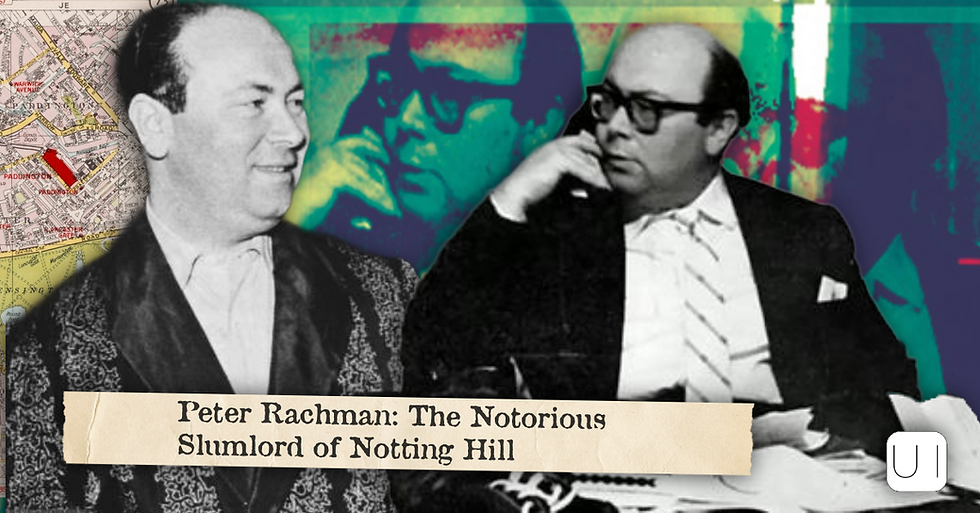
Keeler also led her to Peter Rachman, the Polish-born landlord whose name would end up in the dictionary as shorthand for bullying tenants. Mandy was 16 when she became his paid mistress, a role Keeler had filled before her, and she stayed with him for close to two years. For her 17th birthday he gave her a white Jaguar and, with typical Rachman flair, a forged Irish driving licence to go with it.
She was remarkably unsentimental about him. Describing their relationship to the papers, she said sex for Rachman was "something functional like drinking a glass of water". She and Keeler were both paid for their stories about him, an early example of chequebook journalism. And it was only after he died that Mandy discovered the woman she'd known as his lodger, Audrey, was in fact his wife.
Rachman died suddenly in November 1962, and it was the one blow that genuinely flattened her. She attempted suicide, recovered and moved into Stephen Ward's flat. Ward, by one account, even asked her to marry him.
There were other admirers too. Spartacus Educational records that after Rachman's death she was kept by Emil Savundra, the Ceylon-born financier later jailed for a huge insurance fraud, for £25 a week. Lord Dudley, an elderly regular at Murray's, proposed marriage. "I could have been a Dowager Duchess by the time I was 22," she joked years later.

How She Was Dragged Into the Profumo Affair
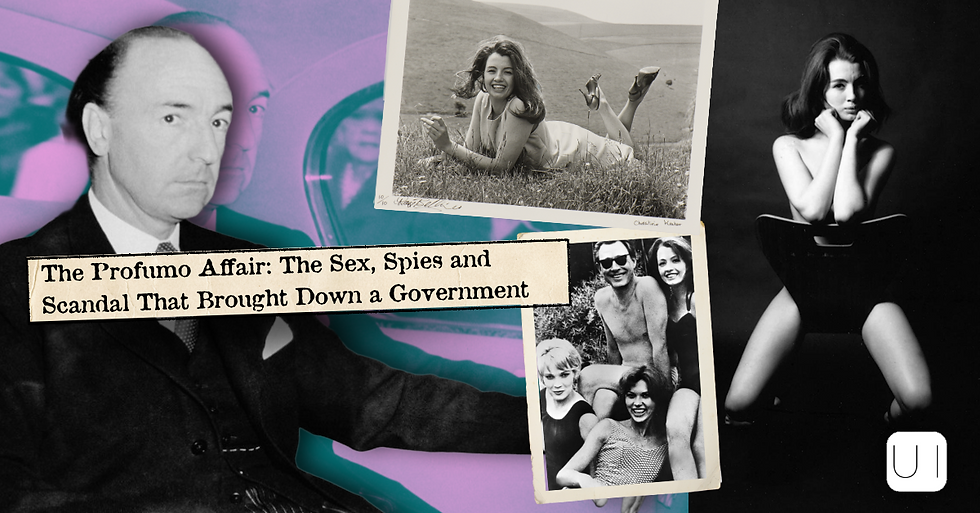
The full scandal is in our piece on the Profumo affair, but the short version goes like this. In 1961 Keeler had a brief affair with John Profumo, the Secretary of State for War, while she was also seeing Yevgeny Ivanov, a Soviet naval attaché. When it came out in 1963, Profumo lied to the Commons, then admitted the truth and resigned in June. The establishment needed someone to blame, and it settled on Stephen Ward. It wasn't the only scandal that establishment was sitting on, either. A year later the papers would come for Lord Boothby and his friendship with Ronnie Kray.
Mandy's own role was secondary. She never met Profumo. What she did have was a direct line into Ward's world, a list of well-connected lovers and the bad luck to be extremely useful to a police force building a case.

On 23 April 1963 she was arrested at Heathrow as she tried to fly to Spain and charged with possessing a document resembling a driving licence. She spent nine days in Holloway Prison, the same jail where Ruth Ellis had been hanged eight years earlier. Chief Inspector Samuel Herbert came to see her there, and her own account makes it clear she felt leaned on to talk about Ward. On 1 May she was found guilty and fined £42.
In June she was stopped at Heathrow again, this time charged with stealing a television set Rachman had rented for her flat, and her passport was taken. She always maintained that charge was held over her until she agreed to give evidence against Ward, a claim retold in Tara Hanks's account of her life.
Mandy Rice-Davies posing nude (NSFW)
"Well, He Would, Wouldn't He?"
Ward's case opened with a preliminary hearing at the end of June 1963, then went to the Old Bailey in July. Mandy was 18 and the press treated her arrival each day like a film premiere. She dressed up every morning, she explained later, because it felt like a wedding or a funeral and you ought to wear a hat. When she saw Keeler pelted with eggs outside court she decided it wasn't happening to her, so she smiled and waved at the crowd instead. Nobody threw a thing.
Then came the line. A barrister put it to her that Lord Astor had denied having an affair with her. Her reply, "Well, he would, wouldn't he?", has been doing the rounds ever since. The exchange is usually placed at the preliminary hearing at Marylebone Magistrates' Court rather than at the Old Bailey trial, although plenty of reports simply say "the trial".
By 1979 it had made the third edition of the Oxford Dictionary of Quotations, Hello! noted. It even has its own acronym, MRDA, which the Free On-line Dictionary of Computing defines as shorthand for a denial that's exactly what you'd expect from someone protecting their own interests. It's often misquoted as "he would say that", and when the former MP Sir Ivan Lawrence later suggested she'd never said it at all, she wrote to The Times pointing him to the court transcript. Liberal Democrat blogger Mark Pack picked up the row as a neat example of how hard history is to pin down.
Was she right about Astor? She never backed down, and Channel 4 News noted that she stuck to the claim for decades. Astor's widow, Bronwen, later argued that he'd been elsewhere on the dates in question. It's a contested point and it's likely to stay that way.
Ward was found guilty on 31 July 1963 of living off immoral earnings, specifically hers and Keeler's. He'd taken an overdose the night before and died three days later. Mandy didn't go to the funeral. Years afterwards she affectionately called him "a great gossip queen" with principles that wobbled a bit, but she never accepted the verdict. In a 2009 statement she described R v Ward as "one of the most vindictively rigged trials of the 20th Century".
The Mandy Report and the Men Who Denied Everything
Mandy had no intention of fading away. In 1964 she published The Mandy Report, a tell-all laid out like a tabloid magazine, partly to answer Lord Denning's official report on the affair. In it she claimed relationships with Douglas Fairbanks Jr, Robert Mitchum, Bob Hope and George Hamilton. They all denied it. Her response, as Pulp International gleefully recorded, was pure Mandy: "Well, they would, wouldn't they?" She posed holding the book on the cover of the American scandal magazine Confidential that May. The publishers then vanished, she said, and she never saw a penny.
She had a go at singing too. A 1964 news photo shows her leaving London Airport for a singing engagement in Munich, the Associated Press reported, and she released a record called Introducing Mandy. She toured working men's clubs and played Spain, Australia, Hong Kong and Singapore. New Zealand was less keen. Spartacus records that she was banned from the country after a complaint from the Girl Guides. There were bits of film work as well, including The Keeler Affair, a 1963 cash-in on the scandal.
Tel Aviv's Queen of Nightlife
The move that really changed her life came in 1966. Performing at the Caliph nightclub in Jaffa, she met Rafi Shauli, a former El Al steward turned businessman, who later admitted to Ynetnews that he'd thought she was a fairly mediocre singer. They married that September. She learned Hebrew, converted to Judaism and settled in Tel Aviv, and their daughter Dana arrived a couple of years later.
Together they opened a run of clubs and restaurants. Mandy's Discotheque became a hub for the city's bohemian crowd, and a restaurant called The Singing Bamboo was a favourite with foreign correspondents covering the 1973 Yom Kippur War. In the 1970s she also helped Shauli launch what's been described as Israel's first glossy magazine, and Spartacus mentions a dress factory too. Uri Avnery, the veteran editor of HaOlam HaZeh, called her the queen of nightlife, and designer Yuval Kaspin remembered her European style standing out against the Israeli fashions of the day, as The Jewish Chronicle recounted in its tribute.

The marriage didn't last. Shauli remembered it running for about a decade, though Spartacus says they separated as early as 1971 and stayed business partners. Either way, he said they never lost touch. Mandy kept her Israeli business interests, moved to Spain and in 1978 married a Frenchman, Jean-Charles Lefevre. It was over almost before it began. She liked to claim the marriage lasted a matter of hours and that she couldn't remember his name.
Stoppard, Ab Fab and Holidays With the Thatchers
Back in London she ran a clothes business and kept working as an actress. She appeared in Tom Stoppard's Dirty Linen, a comedy about a Commons sex scandal, which must have felt a bit close to home. On screen she turned up in Nana, The Seven Magnificent Gladiators, Chance in a Million and Absolute Beginners, and later had a cameo in Absolutely Fabulous. Her autobiography, Mandy, came out in 1980 and a novel, The Scarlet Thread, followed in 1989.
In 1987 she married Ken Foreman, a waste management boss she'd met at a dinner party in Surrey. She took the name Marilyn Foreman and the couple split their time between Belgravia, Surrey, Florida and the Bahamas. In one of the odder twists of her story, Denis Thatcher was a vice-president of Foreman's company, and the Foremans holidayed in Florida with Denis and Margaret Thatcher. For a woman whose sex life had been picked over at the Old Bailey, it was quite the social climb.
Her life after 1963, she told Avnery in their last conversation, had been "one slow descent into respectability". Keeler's went a very different way. While Mandy prospered, Keeler ended up struggling for money, and Mandy put it down to her old friend never adapting the way she had.
Fighting the Prostitute Label
The one thing that never stopped bothering her was the word prostitute. The papers had used it freely in 1963 and the case against Ward depended on it. At the trial she admitted taking money from Rachman and Savundra, and some later accounts go further and describe paying clients. She rejected that for the rest of her life. She told Channel 4 News that the reason she still talked about the affair was to "fight the misconception that I was a prostitute", and that the stigma hadn't gone away. She was particularly keen that her grandchildren shouldn't remember her that way.
In 2013, fifty years on, she turned up to support barrister Geoffrey Robertson's book Stephen Ward Was Innocent, OK, which argued that the trial judge's summing-up all but told the jury to convict, the Law Gazette's review explained. She said she was still angry that she and Ward had been made scapegoats. She also shared her memories with Andrew Lloyd Webber for his musical Stephen Ward, and was at the launch in Soho, where WhatsOnStage reported she'd be played by Charlotte Blackledge. The show closed at the Aldwych on 29 March 2014 after about four months, but she'd made her point.
Not everyone agreed the trial itself was rigged. Reviewing her ghosted 1980 autobiography for the London Review of Books, the human rights lawyer Paul Sieghart thought Judge Marshall had been about as fair as he could manage towards a defendant he plainly loathed, and laid the blame on the investigation instead. He pointed out that police interviewed somewhere between 125 and 140 potential witnesses, questioned Keeler 24 times and still called only eight people at trial. He also noted that the jury acquitted Ward of procuring and convicted him only on the immoral earnings charge. Sieghart's verdict on Mandy and Keeler was that they were good-time girls rather than professional prostitutes, which was roughly what Mandy had been saying all along.
Her Death and the Tapes She Left Behind
Mandy Rice-Davies died in London on 18 December 2014, aged 70. She was survived by Ken and Dana. Bridget Fonda had already played her in the 1989 film Scandal, and the obituaries mostly led with the five words from 1963.
The story had one more chapter, though. Her daughter later found a set of dictaphone tapes on which Mandy had recorded her own thoughts on that summer. They became The Mandy Rice-Davies Tapes, a 2024 programme presented by Kirsty Wark for BBC Radio 4's Archive on 4, letting her tell the story in full in her own voice for the first time.

Her image has outlasted her too. The National Portrait Gallery holds eight photographs of her, including Keystone's shot of Mandy with her poodle, taken on 17 June 1963, the day after her second Heathrow arrest by her own dating, and a 1967 portrait by Tom Blau. It's a nice irony, given that she once complained the events of 1963 followed her around like a poodle.
Profumo lost his career, Ward lost his life and Keeler spent decades wrestling with what 1963 had done to her. The teenager who'd laughed off a viscount in the witness box went on to run nightclubs in Tel Aviv, marry a millionaire and holiday with a sitting Prime Minister. She brushed off the whole Profumo business as little more than a pimple on a long and busy life. Well, she would, wouldn't she?
Further Reading
If you want the full picture, Richard Davenport-Hines's An English Affair: Sex, Class and Power in the Age of Profumo is the best all-round account of the scandal and the people caught up in it, Mandy very much included.
For the legal side, Geoffrey Robertson's Stephen Ward Was Innocent, OK takes the trial apart line by line.
As an Amazon Associate, Utterly Interesting earns from qualifying purchases.
You Might Also Like
Sources
The Irish Times: Showgirl at the heart of the Profumo affair that shook 1960s Britain
The Post, New Zealand (via PressReader): Smart showgirl turned Cold War scandal to advantage
The New York Review of Books: The Real Meaning of Rachmanism
Mark Pack: Why history is hard to get right, what did Mandy Rice-Davies say?