

The F(art Of War) As Depicted In The He-gassen Scroll (放屁合戦)

It is not often that a historical artefact manages to be both carefully observed and completely absurd at the same time, yet the Japanese scroll known as He-gassen does exactly that. At first glance, it appears playful, even childish. But spend a little time with it, and a more layered picture begins to emerge, one that sits comfortably within the rich and often surprising visual culture of Edo period Japan.
A Scroll Unlike Any Other
He-gassen, which translates loosely as “fart battle”, is a hand scroll believed to have been created during the mid nineteenth century, towards the later years of Japan’s Edo period. It is composed of a sequence of scenes, usually counted at around fifteen, in which groups of figures engage in exaggerated and highly stylised contests using nothing more than directed bursts of wind.

The imagery is striking. Figures, often partially or fully nude, are depicted in dynamic poses, bracing themselves, aiming, or recoiling from incoming blasts. The “farts” themselves are rendered visually as shaded, cone like plumes, giving them a physical presence that transforms something ordinarily invisible into a central dramatic force.
Despite its notoriety, the artist or artists responsible for He-gassen remain unknown. This anonymity is not unusual for the period, particularly for works that fall outside the more formal traditions of court painting or commissioned art. What is clear, however, is that the scroll belongs to a broader tradition of humorous and satirical imagery that flourished alongside more refined cultural output.
Edo Period Culture and Its Contradictions
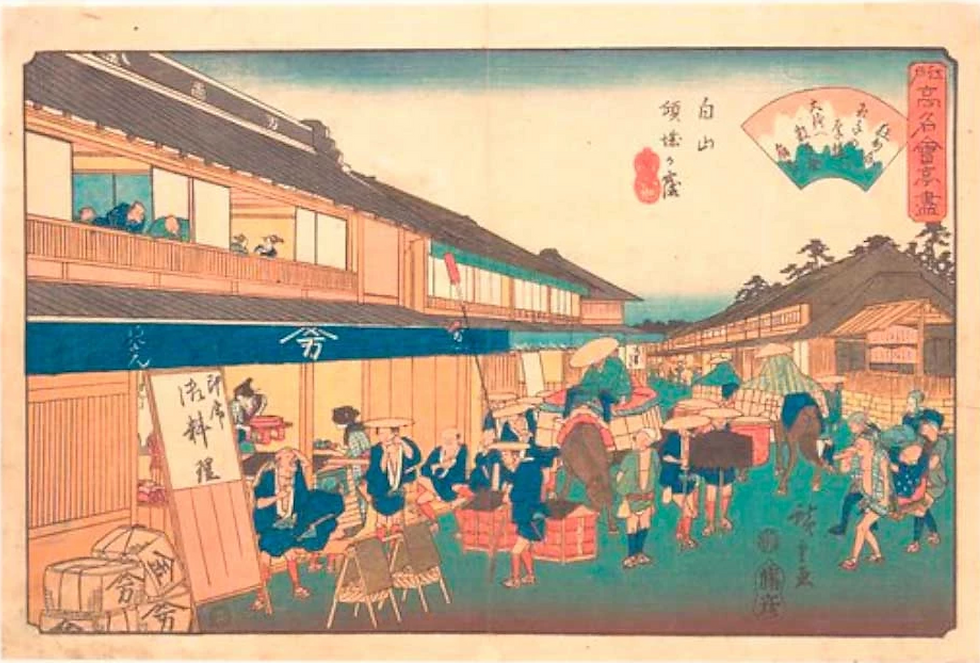
The Edo period, spanning from 1603 to 1868, is often remembered as a time of stability and cultural sophistication in Japan. Urban centres such as Edo, Osaka, and Kyoto developed thriving artistic and entertainment scenes. Theatre, poetry, woodblock prints, and literature were widely consumed, particularly among the growing merchant class.

This was, in many respects, a pleasure seeking society. Kabuki theatre, for example, drew large audiences, while ukiyo e prints celebrated everything from actors and courtesans to landscapes and seasonal beauty. Yet alongside this polished cultural surface existed a lively countercurrent of humour, parody, and irreverence.
He-gassen sits firmly within that counterculture. It reflects a world in which bodily functions could be exaggerated and turned into spectacle, not purely for shock value, but as a form of comic expression. As with many traditions of satire, what appears crude on the surface often carries a more nuanced intent beneath.

The Mechanics of the “Battle”
The scroll does not simply depict isolated incidents. It presents a sequence that suggests preparation, escalation, and aftermath. In one scene, participants are shown consuming large quantities of food, presumably chosen for its ability to produce gas. This detail adds a surprisingly practical dimension to the narrative, grounding the absurdity in a recognisable cause and effect.
Elsewhere, figures are shown directing their efforts with surprising precision. Opponents are knocked off their feet, animals are swept aside, and bystanders react with visible discomfort, often covering their noses or turning away. In one particularly memorable moment, a cat is caught in the crossfire, an example of the scroll’s willingness to extend its humour beyond human subjects.
There are also defensive tactics. Some participants are depicted using fans, not as decorative accessories but as tools to deflect incoming blasts. This introduces an almost strategic element to the scenes, as if the encounters are governed by their own internal logic.
Perhaps the most inventive detail is the suggestion that some combatants stored their efforts in bags, only to release them later in concentrated bursts. While clearly exaggerated, it reinforces the idea that the scroll is less about realism and more about pushing a simple concept to its imaginative limits.
Humour, Satire, and Possible Meaning
Although He-gassen can be enjoyed purely as visual humour, many historians and art scholars have suggested that it may carry a deeper meaning. Satirical works of the Edo period often used exaggeration and absurdity to comment on contemporary issues, sometimes in ways that could evade direct censorship.
One interpretation is that the scroll reflects a broader sense of social tension. By the mid nineteenth century, Japan was beginning to experience increasing contact with Western nations, particularly following the arrival of Commodore Perry in 1853. This period of transition brought both curiosity and unease.

Within that context, the exaggerated “battles” could be read as a metaphorical response to external pressures. The act of directing something as crude and uncontrollable as a fart towards others might symbolise disdain, resistance, or even ridicule. It is not difficult to imagine how such imagery could be used to mock perceived foreign intrusion or shifting social hierarchies.

At the same time, it is important not to overstate the case. Edo period audiences were well acquainted with humour for its own sake, and not every playful work was intended as political commentary. As with much historical art, He-gassen likely operates on multiple levels, allowing viewers to interpret it according to their own sensibilities.
A Broader Tradition of Bodily Humour
While He-gassen may seem unusual, it is far from unique in its use of bodily humour. Across cultures and historical periods, artists have often drawn on the human body as a source of comedy. Medieval European manuscripts, for example, are filled with marginal illustrations featuring exaggerated or irreverent scenes, including depictions of flatulence.

In Japan itself, humour of this kind appeared in various forms, from illustrated books to theatre. What distinguishes He-gassen is not simply its subject matter, but the way it elevates that subject into a sustained visual narrative.
Even ancient sources occasionally touch on similar themes. The Greek historian Herodotus recorded stories, some likely exaggerated, in which bodily functions were used in acts of defiance or mockery during conflicts. These accounts, whether factual or not, suggest that such humour has long been intertwined with ideas of power, ridicule, and resistance.

Scientific Curiosity in the Modern Era
Interestingly, the subject has not been confined to art and humour. In 2009, a group of students at Cornell University undertook an experiment to measure the velocity and composition of flatulence. Using a device designed to detect intensity, they attempted to quantify something that had long been treated as a joke.
Their findings identified hydrogen sulphide as a key component in what they described as the most “aromatic” emissions. They also noted that temperature played a role in how quickly the gas dispersed. Foods such as meat, eggs, beans, cabbage, and certain vegetables were found to contribute to higher levels of gas production.

While this modern study is clearly far removed from the world of He-gassen, it highlights an enduring curiosity about the subject, one that spans both scientific inquiry and cultural expression.
The Scroll’s Structure and Survival
Like many Japanese hand scrolls, He-gassen is designed to be viewed sequentially. As the viewer unrolls the scroll from right to left, the scenes unfold gradually, creating a sense of progression. This format encourages a more intimate engagement with the work, as each moment is revealed in turn.

The scroll concludes with a colophon, a brief inscription that typically provides information about the work’s creation or ownership. Although the precise details of He-gassen’s origins remain uncertain, its survival into the modern era is a testament to the durability of such materials and the value placed on preserving cultural artefacts.
Today, the scroll is held within the digital collections of Waseda University, where it has been made accessible to a wider audience. The full set of images, numbering around thirty eight, offers a comprehensive view of the work in its entirety.
A Curious but Enduring Legacy
What makes He-gassen particularly interesting is not simply its subject, but the way it reflects the broader cultural environment from which it emerged. It sits at the intersection of humour, artistry, and social observation, reminding us that historical societies were no less capable of irreverence than our own.
As one modern commentator has noted, “Humour often reveals more about a culture than its most formal expressions.” In the case of He-gassen, that humour is unmistakably direct, yet it opens a small window into the everyday concerns, amusements, and creative impulses of Edo period Japan.
For a work that centres on something as fleeting as a gust of wind, it has proved remarkably enduring.


