


Alice Cooper and the Most Unexpected Address Book in Rock History
Updated: Mar 13

There are certain images in popular culture that feel fixed. Charlie Chaplin with a cane. Dalí with a moustache. John Lennon in round glasses. Alice Cooper beneath a descending guillotine.
The assumption is that these people lived in entirely different universes. Silent film royalty does not share beer with shock rockers. Surrealist masters do not build holograms of glam musicians’ brains. Marx Brothers do not telephone men with boa constrictors at one in the morning.
Except, in the case of Alice Cooper, they absolutely did.

By the early 1970s, Vincent Furnier, better known as Alice Cooper, had become the most controversial figure in rock music. School’s Out had become an anthem of adolescent rebellion. His live shows featured fake executions, snakes, blood, baby dolls and a nightly beheading that alarmed newspaper columnists across two continents. In 1973, British MP Leo Abse denounced him in Parliament, claiming Cooper was promoting “the culture of the concentration camp”.
It was theatrical outrage, but it worked.
And yet, when the stage blood dried, Cooper’s social circle looked less like a horror convention and more like a roll call of twentieth century cultural royalty.
The Night Salvador Dalí Entered the Room
April 1973. King Cole Bar, St Regis Hotel, New York.
Even in Manhattan, there are entrances and then there are Entrances.
“All of a sudden these five androgynous nymphs in pink chiffon floated in,” Cooper later recalled. “They were followed by Gala… Then came Dalí.”

Salvador Dalí arrived in a giraffe skin vest, gold Aladdin shoes, a blue velvet jacket and purple socks said to have been gifted by Elvis. He announced himself with a dramatic, syllable stretching proclamation: “The Da lí… is… he re!”
Scorpion cocktails were ordered in conch shells. Dalí requested hot water for himself, produced a jar of honey from his pocket, poured it theatrically from increasing heights, sliced the stream mid air with scissors, and concluded with a flourish. Applause followed.

“Me and my manager looked at each other in amazement,” Cooper said. “I realised at that point that everything was about Dalí. I wasn’t meeting him. I was entering his orbit.”
Dalí had a proposal. He intended to create the First Cylindric Chromo Hologram Portrait of Alice Cooper’s Brain. It would involve chocolate éclairs, ants, diamonds and experimental holographic technology. His explanation moved fluidly between English, French, Italian, Spanish and Portuguese, often within a single sentence.
“You could only understand one fifth of what he was saying,” Cooper admitted.
Despite the linguistic fog, the collaboration happened. For Cooper, who had admired Dalí’s melting clocks and crawling ants since art school in Phoenix, this was not absurdity. It was confirmation that shock rock and surrealism were distant cousins.
John Lennon, Lost Weekends and the Hollywood Orbit
If Dalí was surrealism incarnate, John Lennon represented something equally disruptive.
During Lennon’s so called Lost Weekend period in Los Angeles in the mid 1970s, he gravitated towards Cooper’s circle. The two drank together, wrote together and appeared in photographs that look like alternate universe Beatles publicity shots.
Lennon understood spectacle. He had returned an MBE to the Queen. He had staged bed ins for peace. Cooper’s guillotine was not scandalous to him. It was theatre.

May Pang, who was with Lennon at the time, is often seen alongside Cooper in photographs from this era, smiling in a way that suggests that none of this felt particularly strange at the time. In 1974 Los Angeles, a Beatle sharing a bar with a man who simulated decapitation was simply Tuesday.
Andy Warhol and the Business of Persona
Andy Warhol collected celebrities the way other people collected stamps.
He understood that fame itself was a medium. Cooper, with his deliberate theatrical menace, was perfect material. The two were photographed laughing together, which is notable because Warhol rarely appeared openly amused.

Both men grasped that persona was architecture. Warhol turned consumer goods into icons. Cooper turned moral panic into ticket sales.
They were operating in parallel lanes of the same cultural motorway.
Groucho Marx and the 1am Budweiser Club
The most unlikely friendship of all may have been with Groucho Marx.
They met at a Frank Sinatra birthday party while duetting on Lydia the Tattooed Lady. That sentence deserves to exist on its own.

Groucho took to him immediately.
He began calling him “Coop,” borrowing the nickname he had once used for Gary Cooper. The fact that the same affectionate shorthand could apply both to a laconic Hollywood leading man and a mascara wearing stage villain amused Groucho enormously. It stuck for the rest of Cooper’s life.
By the early 1970s, Groucho was in his eighties and living in Beverly Hills. His razor sharp wit remained intact, but insomnia plagued him. Night after night, when sleep refused to cooperate, he would pick up the telephone and call Cooper.
One o’clock in the morning.
“Hey Coop, can’t sleep. Come on over.”
And Cooper would go.

The domestic details make the story richer. Groucho kept a chair beside his bed with a six pack of Budweiser placed neatly within reach. The two would sit up watching old films on television, sometimes Marx Brothers pictures, sometimes entirely unrelated classics. Cooper has described those evenings as surprisingly calm
After a couple of movies, Cooper would glance across and see Groucho finally asleep, still in his beret, cigar drooping precariously.
“He’d finally go to sleep,” Cooper remembered. “I’d put out his cigar, turn out the lights and go home.”
The next night, the phone would ring again.
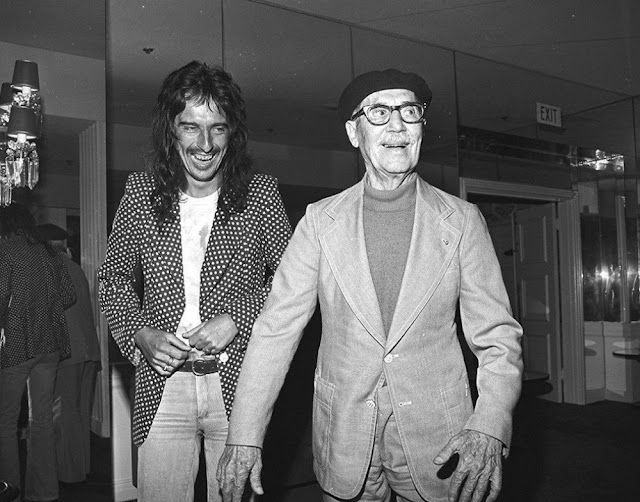
There is something deeply touching about the arrangement. The man publicly condemned for corrupting youth had become, in private, a dependable late night companion to one of America’s most revered comedians.
More importantly, Groucho did not suffer fools. He had spent decades skewering pomposity and mediocrity. That he chose to spend his sleepless hours with Cooper suggests he recognised intelligence beneath the theatrics. Cooper has often said that he learned more about comic timing from those midnight conversations than from anyone else.
In many ways, their friendship symbolised a passing of the comic baton. The Marx Brothers had weaponised absurdity in the 1930s. Cooper weaponised absurdity in the 1970s. Both understood that humour and shock share the same rhythm. It is all about timing. Pause half a second too long and the moment dies. Hit it precisely and the audience roars.
The image of Cooper gently removing a cigar from the fingers of an ageing Marx Brother, switching off the bedside lamp, and tiptoeing into the California night genuinely warms my cold dead heart!

The Hollywood Vampires
At the centre of much of this cross pollination sat the Hollywood Vampires.
Founded by Alice Cooper in the early 1970s, the Hollywood Vampires were less a formal club and more a nightly migration pattern. Their headquarters was the upstairs back room of the Rainbow Bar and Grill on the Sunset Strip, a location that, at the time, functioned as something between a diplomatic embassy for touring musicians and a holding pen for the gloriously overextended.
Membership was simple in theory. To join, you had to outdrink the existing members.

Principal members included:
Keith Moon
Ringo Starr
Micky Dolenz
Harry Nilsson
Each brought a distinct flavour of chaos. Moon embodied kinetic unpredictability. Nilsson supplied sardonic intelligence and a voice capable of angelic sweetness by day and barroom demolition by night. Starr, often mischaracterised as the quiet Beatle, proved fully capable of keeping pace. Dolenz carried with him the peculiar experience of having been in a band assembled for television that became musically credible in its own right.
Around this core rotated an ever shifting cast of cultural satellites:
Marc Bolan
Klaus Voormann
Bernie Taupin
Keith Emerson
Voormann, who had designed The Beatles’ Revolver cover, brought art school sensibility. Taupin, Elton John’s lyricist, added literary craft. Emerson represented prog virtuosity. Belushi, meanwhile, introduced a strain of comedic volatility that could tip the evening from amusing to operatic within minutes.
The name “Hollywood Vampires” reportedly emerged from the fact that the group kept nocturnal hours and metaphorically “drained” the bar. The Rainbow staff eventually gave them their own table.

To describe it purely as a drinking club, however, is to miss something subtler.
Yes, it was excessive. Yes, the consumption levels would make a public health official wince. But it was also a salon in the eighteenth century sense. Musicians debated songs. Comedians tested lines. Industry gossip flowed freely. Deals were floated, abandoned, reshaped by midnight logic. You could find a Beatle discussing production techniques while a member of The Who argued about cymbal sizes and someone from the comedy circuit dismantled the entire premise of arena rock.
Los Angeles in the 1970s allowed these worlds to overlap. Film, music, art and television were not siloed. They collided nightly in that upstairs room.

Cooper has often described the atmosphere as strangely egalitarian. Fame did not grant immunity. If you could not keep up conversationally or chemically, you drifted to the edges. If you survived initiation, you were in.
“The original Hollywood Vampires was a drinking club, a last-man-standing kinda thing. You’d go over to the Rainbow Bar & Grill in Hollywood every night and there would be myself, Mickey Dolenz from The Monkees, [Elton John co-writer] Bernie Taupin, Keith Moon and Harry Nilsson. If John Lennon was in town, he’d always be hanging out with Harry, so he’d come by too. Everything became an argument: if John said white, Harry would say black; if John said Republican, Harry would say Democrat. I was the guy in the middle, trying to referee these ridiculous arguments they would have. People started calling us the Hollywood Vampires because we’d never see daylight. We figured instead of drinking the blood of the vein, we were drinking the blood of the vine.” - Alice Cooper

In retrospect, the Hollywood Vampires read like a roll call of talent that defined the 1960s and 1970s. Some would not survive the decade. Others would retreat from the chaos. Cooper himself would eventually become sober and reflect on the period with the clarity of someone who lived through it and outlasted it.
That survival adds another layer of irony. The man publicly framed as the corruptor of youth would become one of the steadier figures of his generation, while some of his fellow Vampires became cautionary tales.
Today, a plaque still marks “The Lair of the Hollywood Vampires” at the Rainbow Bar and Grill. It is a modest piece of brass commemorating a period when rock stardom, surrealism, comedy and bravado converged nightly over beer and bourbon.
Cultural history occasionally leaves behind monuments of marble.
Sometimes it leaves a table reservation and a bar tab.

The Pattern Beneath the Mascara
What emerges from all of this is not chaos, but the connective tissue of showmanship.
Older, culturally literate figures repeatedly warmed to him. Groucho Marx did not collect fools. Dalí did not invest time in dull company. Zappa did not sign mediocrity.
Beneath the eyeliner was someone who understood surrealism, vaudeville timing, art history and persona construction. He could discuss Dalí with credibility, watch films with Groucho at 2am, write with Lennon, and still make it back to the stage in time to lose his head.
It is tempting to argue that Alice Cooper accidentally wandered into history’s most interesting dinner parties.
But perhaps it was not accidental at all.
Perhaps the man who built a career on theatrical death simply recognised that the most enduring art is not about shock.
It is about timing.
And occasionally, about remembering to put out Groucho Marx’s cigar before you go home.


Also, this Elvis anecdote is well worth a listen.


