

Weegee: The Lens Behind New York’s Darkest Hours
Updated: Aug 8

Weegee once claimed he'd photographed close to 5,000 murders. Whether that number was exactly true or classic tabloid self-promotion is hard to say, especially since he stamped his own prints "Credit Photo by Weegee the Famous." Either way, it wasn't far off. For a good stretch of the 1930s and 40s, if someone in New York City got shot, stabbed or thrown off a fire escape, there was a decent chance Arthur Fellig got to the scene before the ambulance did.
He wasn't psychic, even though his nickname suggested otherwise. He was fast, he was connected, and he'd built his whole life around never missing a call.
From Złoczów to the Lower East Side
Usher Fellig was born on 12 June 1899 in Złoczów, then part of Austria-Hungary and known today as Zolochiv, Ukraine. His father emigrated to America first, in 1906, and sent for the rest of the family four years later. Usher was ten when he landed at Ellis Island, where an immigration officer anglicised his name to Arthur, the same way plenty of immigrant kids got renamed on arrival that decade.

The Felligs settled into a cramped tenement on the Lower East Side, one Jewish immigrant family among hundreds of thousands packed into a few square miles of lower Manhattan. Money was tight enough that Arthur left school as a teenager to help support the household, working a string of odd jobs before he ended up in a newspaper darkroom, which turned out to be the job that mattered.
A Decade in the Dark Before the Big Break
In 1923 he took a job in the darkroom at Acme Newspictures, mixing chemicals and printing other photographers' negatives. It wasn't glamorous, but it got him inside a newsroom, and he started sneaking out at night to shoot his own pictures on the side. By 1935, with the country still climbing out of the Depression, he made the leap and went freelance. "I didn't wait 'til somebody gave me a job," he said later. "I went and created a job for myself, freelance photographer."

For two years he worked without a press card, hanging around Manhattan police headquarters and listening for whatever came through on the teletype. Then in 1938 the NYPD did something it had never done for anyone else: it granted him a permit, for $25 a year, to install a police-band shortwave radio in his own car. Suddenly he could hear about a shooting or a fire the moment it was called in, and he'd often reach the scene before the patrol cars did. That's supposedly where the name Weegee came from, a nod to the Ouija board, as if he had some supernatural sense for tragedy. There's a competing story too, that it grew out of "squeegee boy," his old darkroom nickname from drying prints, worn down over the years into something catchier.

Living Above a Gun Shop, Working Out of His Car
Weegee moved into a cheap room at 5 Centre Market Place, directly above the John Jovino gun shop and directly across the street from police headquarters. He kept a 1938 Chevrolet parked outside with a portable darkroom built into the trunk, so he could develop a negative and sell a print to an editor before rival photographers had even left the scene. His Speed Graphic camera usually sat preset at f/16, a 1/200 shutter speed and a ten-foot focus, wired to a single flashbulb that threw everything nearby into harsh white light against pitch black, the high-contrast look that later got tagged as film noir.
He didn't just chase crime, he lived inside it. "I was friend and confidant to them all," he once said of the city's underworld, "the bookies, madams, gamblers, call girls, pimps, con men, burglars and jewel fencers." He handed out cigars to build sources and once got close enough to the gangster Dutch Schultz to hand him an aspirin and light his cigarette. Word got around that he was tight enough with the city's contract killers that colleagues started calling him the official photographer for Murder Incorporated, the crew run in part by Abe Reles before he became one of the most notorious informants in New York gangland history. He photographed plenty of other headline gangsters behind bars too, including Jack "Legs" Diamond, a man whose own violent afterlife is still argued over today.
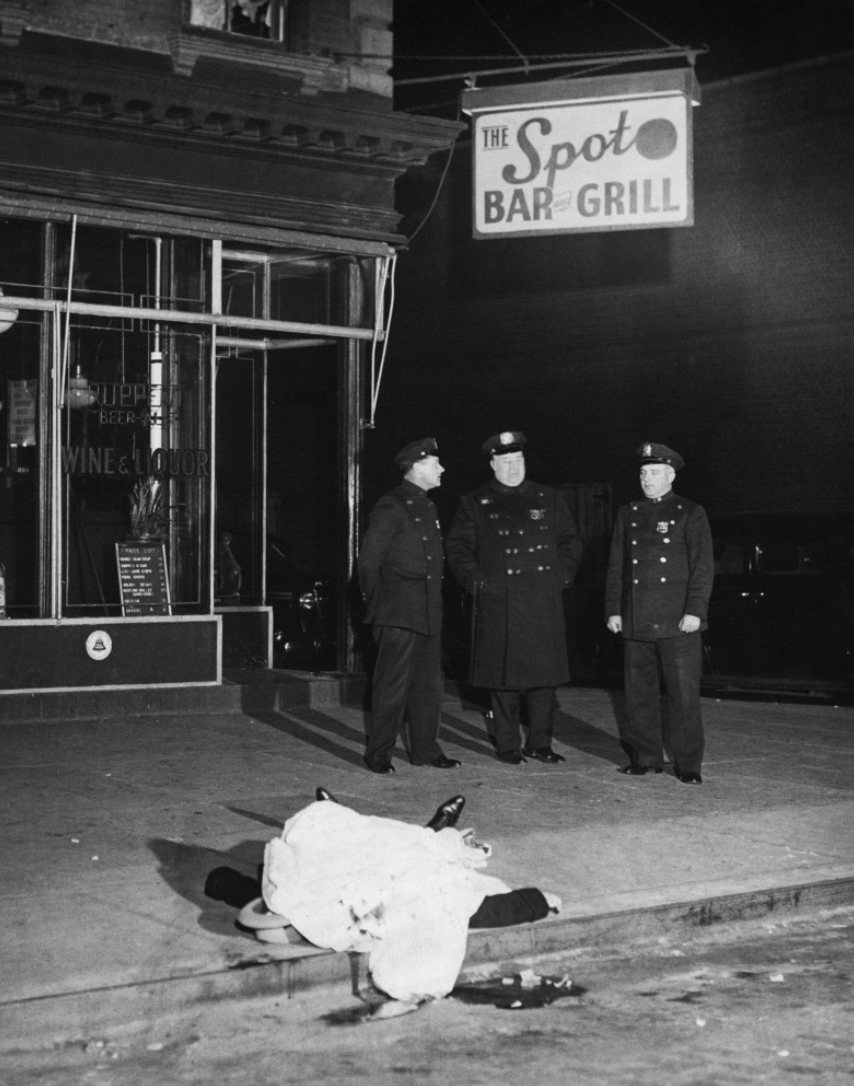
The Picture That Made Him Famous
On 8 October 1941, Weegee caught the photograph most people still associate with him. Peter Mancuso, a 22-year-old small-time gambler working the same underworld that men like Arnold Rothstein had turned into a genuine New York institution, was shot twice at a traffic light outside P.S. 143 in Williamsburg, Brooklyn, right as the school day let out. He died in the street while children were still filing past. Weegee got there fast enough to capture the aftermath: Mancuso's aunt in the crowd, her son tugging a young girl away from the sight, a priest giving last rites while a detective and an ambulance doctor looked on. PM ran the shot the next morning under the headline "Brooklyn School Children See Gambler Murdered in Street." The photo later got its own title for exhibition, Their First Murder, a nod to the kids in frame seeing violent death up close for what was presumably the first time.

From Naked City to Hollywood
In 1945 he published Naked City, a collection of his crime and street photography that became a surprise bestseller and cemented his reputation well beyond the tabloids. It did well enough that Hollywood borrowed the title outright for a 1948 police drama, on which Weegee worked as an uncredited still photographer, and a television series called Naked City later ran on the same borrowed name into the early 1960s, long after Weegee had moved on to other things.

The book's success pulled him out to Los Angeles, where he spent roughly five years, from 1947 to 1952, taking small acting parts and working as a technical consultant on trick photography. He shows up, mostly uncredited, as a cab driver in The Yellow Cab Man, a timekeeper in The Set-Up and a street photographer in Every Girl Should Be Married, and he helped design a distortion effects sequence for one of those films using lenses he'd built himself. He hated almost every minute of it. He called Hollywood "the land of zombies" and claimed the people there "drank formaldehyde instead of coffee." He also got married there in 1947, to a woman named Margaret Atwood, reportedly after opening with the line "Are you single, fully and footloose, babe?" The marriage didn't survive the year. By 1952 he was back in New York for good.

The Distortion Years and a Late Career Twist
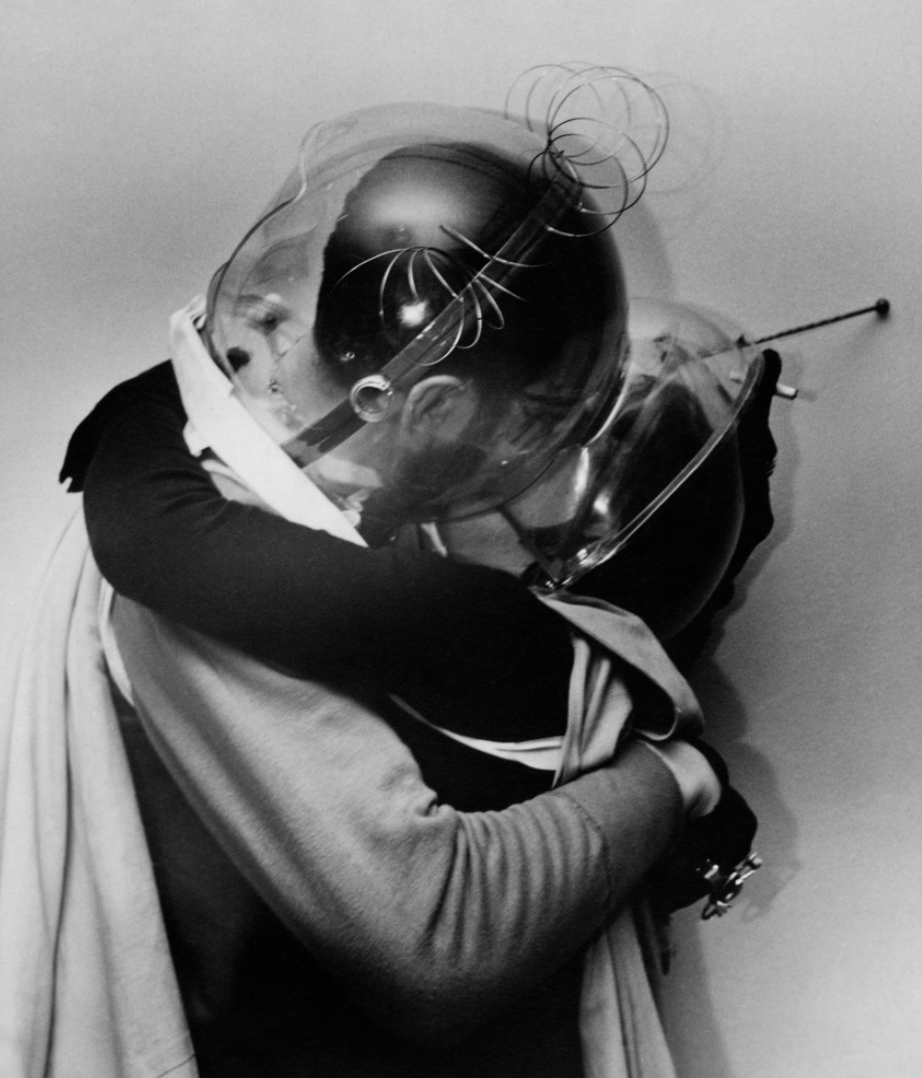
Back home, Weegee spent much of the 1950s and 60s experimenting with the trick lenses he'd picked up in Hollywood, warping portraits of celebrities and ordinary faces alike into stretched, kaleidoscopic caricatures. Critics were never as taken with this later work as they'd been with his crime photography, but he kept at it anyway, alongside a few more books, including Naked Hollywood in 1953 and a memoir, Weegee by Weegee, in 1961.
His last notable film credit came in 1964, when Stanley Kubrick brought him on as an uncredited special effects consultant for Dr. Strangelove, helping with the visual distortion work in the film's closing sequences. It's a strange bit of symmetry. Two decades earlier, a teenage Kubrick had spent his own nights wandering 1940s New York with a camera, building the same instinct for the decisive street moment that Weegee had already turned into a career.
By 1957 he'd been diagnosed with diabetes, and it was his partner, a Quaker social worker named Wilma Wilcox, who looked after him through his final years. They never married, but she stayed with him until his death in New York on 26 December 1968, from an untreated brain tumour. He was 69.
The Afterlife of a New York Legend
Wilcox held onto Weegee's archive after he died, something like 20,000 prints, negatives, personal papers and objects, and in 1993 she donated the entire collection to the International Center of Photography, which has built several major exhibitions around it since. His flash-lit, high-contrast style went on to shape film noir cinematography and generations of street and crime photographers who followed him, and his ambulance-chasing persona has echoed through pop culture ever since, from the 1992 film The Public Eye, whose lead character is loosely based on him, to the comparisons critics keep drawing between Weegee and the crime-scene-hustling protagonist of 2014's Nightcrawler.

He wasn't the first crime photographer New York produced, and he wasn't the last. Photographers had been documenting the city's crime scenes decades before Weegee ever picked up a Speed Graphic, and long after he'd moved on to distortion lenses, photographers like Jill Freedman were still walking the same NYPD beat with a camera. But he's the one whose name became a verb for getting there first. Not bad for a kid who came off the boat at Ellis Island with a name nobody in America could pronounce.


![[Police officer and lodge member looking at blanket-covered body of woman trampled to death in excursion-ship stampede, New York]](https://static.wixstatic.com/media/d5cc5f_79bddc81f4ab40368267816af257fa82~mv2.jpg/v1/fill/w_900,h_1117,al_c,q_85,enc_avif,quality_auto/d5cc5f_79bddc81f4ab40368267816af257fa82~mv2.jpg)


![[Police officer and assistant removing body of Reception Hospital ambulance driver Morris Linker from East River, New York]](https://static.wixstatic.com/media/d5cc5f_b2168a7f7acf4c92ad0649b3b79880b4~mv2.jpg/v1/fill/w_800,h_1014,al_c,q_85,enc_avif,quality_auto/d5cc5f_b2168a7f7acf4c92ad0649b3b79880b4~mv2.jpg)


![[Hats in a pool room, Mulberry Street, New York]](https://static.wixstatic.com/media/d5cc5f_36be8358f01d4d6dac33ac4fc70801c1~mv2.jpg/v1/fill/w_980,h_782,al_c,q_85,usm_0.66_1.00_0.01,enc_avif,quality_auto/d5cc5f_36be8358f01d4d6dac33ac4fc70801c1~mv2.jpg)
![[Body of Dominick Didato, Elizabeth Street, New York]](https://static.wixstatic.com/media/d5cc5f_eaf1433e63e54d1f83bcbf5e19110c83~mv2.jpg/v1/fill/w_800,h_998,al_c,q_85,enc_avif,quality_auto/d5cc5f_eaf1433e63e54d1f83bcbf5e19110c83~mv2.jpg)


