

Stanley Kubrick's Teenage Photos of 1940s New York
Updated: Aug 20
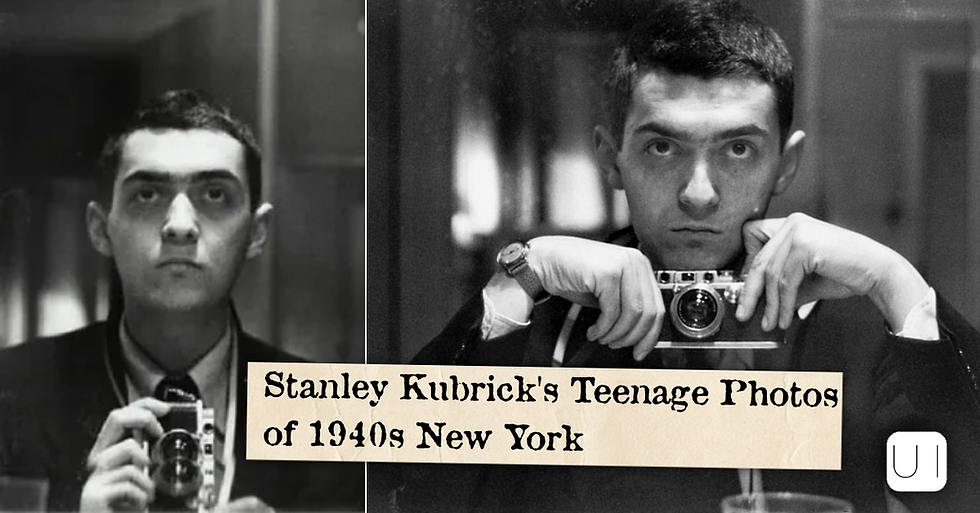
Before 2001: A Space Odyssey, before The Shining, before Kubrick was even old enough to vote, he was a Bronx teenager who talked his way into becoming the youngest staff photographer in the history of Look magazine. Between 1945 and 1950, he shot somewhere north of 13,000 photographs of New York City, of which fewer than a thousand were ever published. The rest sat in storage for decades until the Museum of the City of New York began digitising them, revealing a body of work that looks less like a hobby and more like film school, five years before he ever picked up a movie camera.
Quick answers
How did Stanley Kubrick become a photographer? He sold a photo of a grieving newsstand vendor to Look magazine for $25 in June 1945, aged 17, and was hired as a staff photographer within months, the youngest in the magazine's history.
How many photos did Kubrick take for Look magazine? Over 13,000 negatives between 1945 and 1950, across more than 135 assignments, though fewer than a thousand were ever actually published.
The photo that started it all
In April 1945, days after Franklin Roosevelt's death, a 17-year-old Kubrick photographed a newsstand vendor slumped among headlines announcing the news. He skipped school to develop it himself in the darkroom his father had helped him build at home. Confident he had something, he took the print first to the New York Daily News, who offered ten dollars, then used that number as leverage at Look magazine's offices. Photo editor Helen O'Brian bought it for twenty-five. It ran as the final image in a June 1945 spread on Roosevelt's death, and by January 1947, Kubrick had left high school behind and landed on Look's masthead as a staff photographer, the youngest the magazine had ever hired.

None of it would have happened without his father's gift four years earlier. Dr Jack Kubrick, an amateur photographer himself, gave his son a Graflex camera for his thirteenth birthday, and the interest it sparked never really let up. Kubrick spent his teenage years shooting alongside a neighbourhood friend, Marvin Traub, who had his own darkroom, the two of them inventing photojournalism assignments for themselves years before either of them had an actual editor to answer to.
The staff who raised him
Once he arrived at Look full time, Kubrick had an entire newsroom quietly looking out for him. Staff reportedly nicknamed their informal mentorship of the teenager the Bringing Up Stanley Club. The most significant figure in it was Arthur Rothstein, Look's director of photography and a genuinely major figure in American photojournalism, having spent the 1930s documenting the Dust Bowl for the Farm Security Administration before joining the magazine. Rothstein confirmed the relationship himself decades later, telling an interviewer in 1978 that he'd helped Kubrick in his early days at Look, adding that "the greatest satisfaction an older photographer can have in his work is helping younger photographers achieve something." It was Rothstein, not a filmmaker, who gave Kubrick his first real education in visual storytelling, years before he ever pointed a camera at actors.
Learning from Weegee
Rothstein wasn't the only influence shaping how Kubrick saw the city. His earliest New York assignments show him experimenting with a technique he almost certainly picked up from a different source entirely. For a 1946 story called Park Benches: Love Is Everywhere, museum curators believe Kubrick used infrared film paired with flash to photograph couples in near total darkness, a method borrowed directly from Weegee, the crime scene photographer famous for beating police to the scene of New York's worst nights. Weegee gave the teenage Kubrick real, practical guidance on how to work the city after dark, lessons that shaped the moody, high-contrast look Kubrick would carry straight into his first three feature films.
Following Mickey through Brooklyn
One of Kubrick's earliest attempts at real narrative storytelling came in October 1947, when he spent days following a twelve-year-old Brooklyn shoeshine boy named Mickey, who shined shoes for a dime a time to help support nine younger brothers and sisters. Kubrick shot more than 250 photographs of Mickey boxing, playing basketball, doing laundry and working the street, building an entire day's arc around a boy nobody outside his own neighbourhood would otherwise have noticed. Almost none of it was ever published.
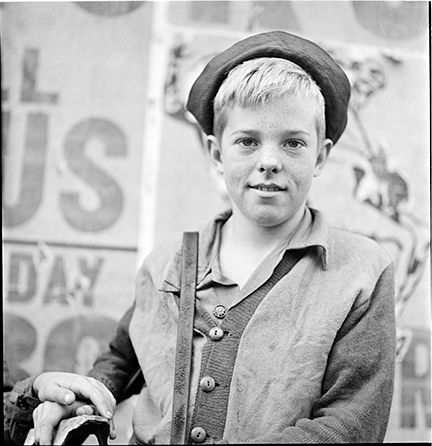
Nearly eighty years later, nobody knows what happened to Mickey. The Museum of the City of New York, which holds the negatives today, has publicly appealed for anyone with information about him or his family to come forward. For now, one of the most fully realised character studies of Kubrick's entire photographic career remains attached to a name and nothing else.
Life and love on the subway
In March 1947, Look ran a six-page, twenty-nine-photo story called Life and Love on the Subway, built from Kubrick's documentation of New York's underground commute. Riders stare into thousand-yard distances, ride escalators that seem to vanish into infinity, and, in the story's most memorable image, share a kiss. Many of the shots were genuine candids taken with a concealed camera, though the standout photograph, the one everybody remembers, was actually staged, an early example of Kubrick blurring the line between documentary honesty and deliberate composition that would define his filmmaking later on.
On the road with a circus and a dental office
Kubrick's assignments ranged far beyond street photography. In 1948 alone, Look sent him to cover a travel piece in Portugal and to Sarasota, Florida, to document the Ringling Bros. and Barnum & Bailey Circus, spending days photographing performers, animal trainers and the children who grew up travelling with the show. He was just as comfortable finding drama in far less glamorous settings.
One 1946 assignment sent him to a dentist's office to shoot eighteen photographs of ordinary patients waiting their turn, an early study in quiet, mundane anxiety that previewed the kind of psychological close observation his films would later be known for. His first genuinely staged narrative photo, published that April under the title A Short Story from a Movie Balcony, captured a man and woman mid-argument, timed perfectly to catch the man's face at the exact moment he's slapped.
Colleagues at the time didn't necessarily peg him as a future genius. Fellow Look photographer G. Warren Schloat Jr. later remembered him as unremarkable to talk to, describing him simply as a quiet, thin, poor young man like the rest of the junior staff. Whatever ambition was driving him, it showed up in the pictures rather than in conversation.
Prizefighter: the story that became his first film
The most direct line between Kubrick's photography and his filmmaking runs through a boxer named Walter Cartier. In January 1949, Look published an eight-page, twenty-photo essay called Prizefighter, following Cartier through twenty-four hours of his life, from breakfast in Greenwich Village and a bed shared with his twin brother Vincent to the transformation into a hardened middleweight in the ring.
Two years later, Kubrick turned that same structure into Day of the Fight, his first film, made with childhood friend Alexander Singer. Cartier and Vincent, who'd grown fond of Kubrick during the original shoot, agreed to appear in it, with Walter serving as technical advisor. Kubrick figured a typical newsreel short cost roughly $40,000 to produce and believed he could make his own for $1,500 and turn a real profit selling it. Singer later admitted they'd badly misjudged the economics: distributors didn't pay for shorts like theirs at all, they simply took them for free. Cartier, for his part, went on to a respectable boxing record and a later career in film and television, including a recurring role on The Phil Silvers Show.
Leaving Look for film
Kubrick shot his last assignments for Look in 1950 and walked away from a steady staff job to gamble everything on filmmaking, a decision that looked considerably less certain at the time than it does in hindsight. He'd later say plainly that he couldn't have become the filmmaker he was without first developing a photographer's eye, and it's not hard to see why. The instincts he built shooting thousands of frames of ordinary New Yorkers, knowing exactly which fraction of a second told the whole story, are visible in nearly every static, meticulously composed frame of his films.
Where the archive lives now
The bulk of Look magazine's photo archive, more than five million images including Kubrick's negatives and contact sheets, was donated to the Museum of the City of New York, which has been steadily digitising the collection. Roughly 120 of Kubrick's photographs, many never published in his lifetime, were shown together in the museum's 2018 to 2019 exhibition Through a Different Lens: Stanley Kubrick Photographs, and a 2005 anthology, Stanley Kubrick: Drama and Shadows, gathered around 350 of the strongest images into a single book. Together they make the case that Kubrick's five years behind a still camera weren't a detour on the way to becoming a director. They were the actual beginning of it.
You might also like
For the crime photographer who directly shaped Kubrick's early style, read about Weegee, the lens behind New York's darkest hours.
Sources
The Daily Beast: The Secret Photographs of Stanley Kubrick: https://www.thedailybeast.com/the-secret-photographs-of-stanley-kubrick/
Open Culture: Young Stanley Kubrick's Noirish Pictures of Chicago, 1949: https://www.openculture.com/2014/10/young-stanley-kubricks-noirish-pictures-of-chicago-1949.html
Nighthawk NYC: Stanley Kubrick, A Photographer's Odyssey: https://nighthawknyc.com/2019/02/04/stanley-kubrick-a-photographers-odyssey/
The New Criterion: Stanley Kubrick's Photo Odyssey: https://newcriterion.com/dispatch/stanley-kubricks-photo-odyssey-10147/
CNN Photos: The First Glimpse of Kubrick's Genius: https://www.cnn.com/interactive/2018/06/entertainment/stanley-kubrick-cnnphotos/
Museum of the City of New York: The Tale of the Shoe Shine Boy: https://www.mcny.org/story/tale-shoe-shine-boy
Museum of the City of New York: Through a Different Lens exhibition: https://www.mcny.org/exhibition/through-different-lens
Flashbak: Day of the Fight, 24 Hours With Stanley Kubrick and Boxer Walter Cartier: https://flashbak.com/stanley-kubrick-day-of-the-fight-474490/
TCM: Day of the Fight: https://www.tcm.com/articles/143145/day-of-the-fight
Photogpedia: Stanley Kubrick, From 17-Year-Old Photography Prodigy to Master Film Director: https://photogpedia.com/stanley-kubrick-photography-look-magazine/
MCNY Blog: Circus: https://blog.mcny.org/2011/07/19/circus/
All About Photo: Stanley Kubrick, Photographer: https://www.all-about-photo.com/photographers/photographer/1336/stanley-kubrick
Amazon: Philippe D. Mather, Stanley Kubrick at Look Magazine: https://www.amazon.com/Stanley-Kubrick-Look-Magazine-Photojournalism/dp/1841506117
Roosevelt House Public Policy Institute: A Lens on FDR's New Deal, Photographs by Arthur Rothstein: https://www.roosevelthouse.hunter.cuny.edu/exhibits/lens-fdrs-new-deal-photographs-arthur-rothstein-1935-1945/


