


Recalling the Death of John Lennon on December the 8, 1980
Updated: Mar 13

It began like any other quiet Monday in the lull before Christmas. The date was 8 December 1980. All across the United States people drifted back into weekday routines after the weekend. Office workers prepared for another long stretch of winter leading up to the holidays. American football fans chatted about the Miami Dolphins and New England Patriots game scheduled for that evening.
In newsrooms across the country The Washington Post syndicate saw the debut of a new comic strip, Bloom County, which would soon become a cherished fixture of the American newspaper landscape.
It had all the hallmarks of an ordinary day. Yet by midnight that same evening the world would be locked into collective grief. Radio stations would switch their scheduled playlists to Beatles songs. Fans would gather in spontaneous vigils outside a darkened building in Manhattan. And millions would wake the next morning to headlines announcing that John Lennon, one of the most influential musicians of the twentieth century, had been murdered.
On that winter day in New York City, a troubled man from Honolulu named Mark David Chapman achieved the purpose that had been festering inside him for months. He shot and killed John Lennon outside the Dakota building on West 72nd Street, ending the life of a musician who had spent two decades urging the world to give peace a chance.
What follows is a detailed account of that day as experienced by Lennon, his fans, his colleagues and the people who witnessed the events unfold.

The Path That Led Mark David Chapman to the Dakota
John Lennon might have lived into old age were it not for the peculiar obsessions of a man he had never met. Mark David Chapman, born in 1955, had shown signs of instability and dissatisfaction long before he travelled to New York. By his own later admission he had been heavily shaped by two books. The first was J. D. Salinger’s novel The Catcher in the Rye. Chapman identified intensely with the disillusioned narrator Holden Caulfield and internalised the book’s condemnation of phoniness to an extreme degree.
The second book, Anthony Fawcett’s biography John Lennon: One Day at a Time, had a more dangerous impact. During a 2000 parole hearing Chapman explained that the biography inflamed a belief that Lennon was a hypocrite who preached anti-materialism while living comfortably. According to Chapman, the book made him see Lennon as a symbol of everything Caulfield detested. This reasoning would become a core part of his justification.
Chapman revealed that he had flown to New York earlier in the year intending to carry out the murder, only to abandon the attempt. Yet, as he told the parole board, the urge gradually returned. The New York Times recorded his statement: “The urges started building in me again to do this crime, and I flew back to New York on December 6th and checked into a hotel, and then on the day of December 8, stayed outside the Dakota waiting for him with intent to shoot and kill him.”
He was not alone outside the building. It was not unusual for small groups of fans to gather outside the Dakota in hopes of catching a glimpse of Lennon and Yoko Ono. Chapman later told CNN that he had been distracted by conversation with other fans when Lennon arrived by taxi earlier in the afternoon. He had missed his first opportunity.
By nightfall he would not miss again.
The Final Photoshoot: Annie Leibovitz Visits the Dakota
On the morning of 8 December, photographer Annie Leibovitz arrived at the Dakota for what was meant to be a finishing session for Rolling Stone magazine. The magazine planned a major cover story on Lennon’s return to recording after five quiet years in which he had largely withdrawn from public life.
Leibovitz later told Smithsonian Magazine that she was startled when Lennon opened the door wearing a black leather jacket with his hair slicked back. “I was thrown a little bit by it,” she recalled. “He had that early Beatle look.”
While she aimed for a compelling, romantic image, Leibovitz had also been thinking about the cover of Double Fantasy, the recently released album on which Lennon and Ono shared space and songwriting duties. The album cover featured the couple kissing in a simple but poignant black and white photograph.

“In 1980, it felt like romance was dead,” Leibovitz said. “I remembered how simple and beautiful that kiss was, and I was inspired by it.”
Her initial suggestion was a nude portrait of both Lennon and Ono, but Ono declined. Leibovitz then proposed a concept in which Lennon would pose nude while Ono remained fully clothed. She shot a test on Polaroid, and Lennon instantly approved. The resulting image, capturing Lennon curled against Ono in a gesture of raw vulnerability, would become iconic not only for its artistic power but because it was the last portrait of Lennon taken before his death. It carries the weight of those final hours.
Lennon's Optimism During His Final Interview
After the photoshoot, Lennon settled into an extended interview with radio host Dave Sholin from RKO Radio. The conversation, which lasted nearly two hours, now stands as one of the most bittersweet documents of his final day. Speaking with sincerity, Lennon talked about the new decade with a level of hope that contrasts painfully with what would follow.
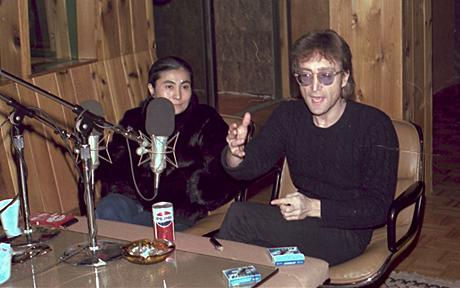
“I hope the young kids like Double Fantasy as well, but I'm really talking to the people who grew up with me,” Lennon said. “And saying, 'Here I am now. How are you? How's your relationship goin'? Did you get through it all? Wasn't the seventies a drag, you know? Here we are, well, let's try to make the eighties good, you know?' 'Cause it's still up to us to make what we can of it.”
He also offered a strikingly prescient reflection on his creative life. “I always considered my work one piece, whether it be with Beatles, David Bowie, Elton John, Yoko Ono ... and I consider that my work won't be finished until I'm dead and buried, and I hope that's a long, long time.”
Sholin later recalled being struck by the deep connection between Lennon and Ono. “The eye contact between them was amazing. No words had to be spoken. They would look at each other with an intense connection.”
When the interview ended, Lennon asked Sholin for a lift to the Record Plant studio to work on a mix. Sholin agreed. Neither could have known that the short walk to the waiting car would bring Lennon face to face with his killer.
The Encounter on the Pavement: Chapman Gets an Autograph
As Lennon stepped out of the Dakota that afternoon he encountered Paul Goresh, a regular presence with a camera who had taken candid photographs of the musician before. While Goresh showed him some prints, a familiar figure stepped forward. Mark Chapman approached with a copy of Double Fantasy in hand.
“This encounter,” Goresh would later say, “felt perfectly normal.” He even raised his camera and captured the moment, producing what would become one of the most chilling images in rock history: John Lennon signing an album cover for the man who intended to murder him.

At a later parole hearing in 2012, Chapman described the exchange: “He was very kind to me. Ironically, very kind, and he was patient with me. The limousine was waiting, his wife was waiting in the limousine, and he took his time with me, and he got the pen going, and he signed my album. He asked me if I needed anything else. I said, 'No. No, sir,' and he walked away. Very cordial and very decent man.”
When asked whether he considered abandoning his plan, Chapman admitted he had hesitated briefly. “There was an inner struggle for a while there, you know, what am I doing here? Leave now. ... I did try to tell myself to leave. I've got the album, take it home, show my wife, everything will be fine. But I was so compelled to commit that murder that nothing would have dragged me away from that building.”
The Final Session at the Record Plant
Lennon and Ono arrived at the studio to continue work on Walking On Thin Ice, a track that Lennon had invested great creative energy into. With Ono performing the vocals, the song had been under development for some time but had not met the deadline for inclusion on Double Fantasy.
According to Salon, Lennon had recently pushed guitarist Hugh McCracken to redesign the guitar parts, even contributing a blistering guitar solo himself. On the evening of 8 December Lennon and producer Jack Douglas worked intensely on the mix.

Douglas later remembered Lennon’s excitement. When they finished for the night Lennon told Ono, “From now on, we're just gonna do this.” He even suggested that the song would mark a bold new direction for their collaborative work. He felt certain it would become a major hit. The prediction became true decades later when a remix reached the top of the American dance charts in 2003.
For the original release in early 1981 Ono wrote a heartfelt liner note. “Getting this together after what happened was hard. But I knew John would not rest his mind if I hadn't. I hope you like it, John. I did my best.”
The Return to the Dakota
By around 10:30 p.m., Lennon and Ono decided to leave the studio. Lennon wanted to say goodnight to Sean before going to the Stage Deli restaurant with Ono. The Lennons exited their limousine on 72nd Street instead of driving into the more secure courtyard of the Dakota. At approximately 10:45 p.m. their limousine stopped outside the Dakota.
Based on statements made that night by NYPD Chief of Detectives James Sullivan, numerous reports at the time stated that Chapman called out "Mr. Lennon" and dropped into a combat stance before firing. Chapman said that he does not remember calling out to Lennon before he fired, and that Lennon didn't turn around. He claimed to have taken a combat stance in a 1992 interview with Barbara Walters.

Mark David Chapman was positioned near the archway. In an interview with CNN he later described the moment:
“I was sitting on the inside of the arch of the Dakota Building. And it was dark. It was windy. Jose, the doorman, was out along the sidewalk. And here's another odd thing that happened. I was at an angle where I could see Central Park West and 72nd, and I see this limousine pull up and, as you know, there are probably hundreds of limousines that turn up Central Park West in the evening, but I knew that was his. And I said, this is it, and I stood up.”
He continued: “Yoko got out. John was far behind, say 20 feet, when he got out. I nodded to Yoko when she walked by me. John came out, and he looked at me, and I think he recognised, here's the fellow that I signed the album for earlier, and he walked past me.”
Seconds later Chapman fired five hollow-point bullets.
One bullet missed Lennon and struck a window of the Dakota. According to the autopsy, two bullets entered the left side of Lennon's back, with one exiting through his chest and lung and the other lodging in his neck, and two more bullets hit his left shoulder. Lennon, bleeding profusely from his external wounds and from his mouth, staggered up five steps to the lobby, crying, "I'm shot! I'm shot!" He then fell to the floor, scattering the cassettes he had been carrying.

Chapman Waits for Arrest
In the immediate aftermath there was a moment of surreal stillness. Chapman, holding the empty gun, remained by the archway. Doorman Jose Perdomo rushed towards him in shock and demanded, “Do you know what you just did?”
Chapman replied, “I just shot John Lennon.”
Believing the gun still loaded, Perdomo knocked it from Chapman’s hand and kicked it across the pavement.
Concierge worker Jay Hastings first started to make a tourniquet, but upon ripping open Lennon's blood-stained shirt and realizing the severity of his injuries, he covered Lennon's chest with his uniform jacket, removed his blood-covered glasses, and summoned the police. Chapman removed his coat and hat to show that he was not carrying any concealed weapons and remained standing on 72nd Street, waiting for police to arrive.
Chapman calmly took out his copy of The Catcher in the Rye, sat down and began reading. On the inside cover he had written the words: “This is my statement.”
The Desperate Race to Hospital
New York Police Department officers Peter Cullen and Steve Spiro were among the first responders. Cullen remembered arriving to find Chapman reading quietly while Perdomo yelled and Yoko Ono screamed in terror. Lennon was lying face down, bleeding heavily.
Speaking with The New York Post in 2020, Officer Peter Cullen remembered how he and his partner Steve Spiro were greeted with a bizarre scene when they arrived at the Dakota: Mark Chapman reading, the doorman, Jose Perdomo screaming, and Yoko Ono in complete hysterics. Spiro slammed Chapman against a wall to cuff him, while Cullen observed that John Lennon was in bad shape, "laying face down with blood coming out of his mouth." More officers shortly arrived, two of whom — Tony Palma and Herb Frauenberger — quickly loaded Lennon into the back of a squad car, realizing immediately he was in no condition to wait for an ambulance.

Cullen recalled about Chapman: “He was docile. He apologised to us for ruining our night. I turned around and said to him,
'You've got to be f****** kidding me. You're worried about our night? Do you know what you just did to your life?'”
Realising the severity of Lennon’s wounds, other officers decided not to wait for an ambulance. Officers Tony Palma and Herb Frauenberger carried Lennon into the back of their squad car and sped to Roosevelt Hospital. Lennon was still alive when they left the Dakota.
Frauenberger recalled telling Ono, “He’s going to the best hospital in New York City.”
A few minutes before 11:00 p.m., Moran arrived at Roosevelt Hospital with Lennon in his squad car. Moran carried Lennon on his back and placed him onto a gurney, demanding a doctor for a multiple gunshot wound victim. When Lennon was brought in, he was not breathing and had no pulse. Three doctors, a nurse, and two or three other medical attendants worked on Lennon for 10 to 20 minutes in an attempt to resuscitate him. As a last resort, the doctors cut open his chest and massaged his heart in an attempt to restore circulation, but they quickly discovered that the damage to the blood vessels above and around Lennon's heart from the bullet wounds was too great.
Three of the four bullets that struck Lennon's back passed completely through his body and out of his chest, while the fourth lodged itself in his aorta beside his heart. Several of the wounds could've been fatal by themselves because each bullet had ruptured vital arteries around the heart. Lennon was shot four times at close range with hollow-point bullets and his left lung and major blood vessels above his heart were virtually destroyed upon impact.
Stephan Lynn, the head of the Emergency Department at Roosevelt Hospital, is usually credited with performing Lennon's surgery. In 2005, Lynn said that he massaged Lennon's heart and attempted to resuscitate him for 20 minutes, that two other doctors were present, and that the three of them declared Lennon's death.
Richard Marks, an emergency room surgeon at Roosevelt Hospital, stated in 1990 that he operated on Lennon, administered a "massive" blood transfusion, and provided heart massage to no avail. "When I realized he wasn't going to make it," said Marks, "I just sewed him back up. I felt helpless." David Halleran, who had been a third-year general surgery resident at Roosevelt Hospital, disputed the accounts of both Marks and Lynn. In 2015, Halleran stated that the two doctors "didn't do anything", and that he did not initially realize the identity of the victim. He added that Lynn only came to assist him when he heard that the victim was Lennon.
Lennon was pronounced dead on arrival at 11:15 p.m, but the time of 11:07 p.m. has also been reported. Witnesses noted that the Beatles song "All My Loving" came over the hospital's sound system at the moment Lennon was pronounced dead. Lennon's body was then taken to the city morgue at 520 First Avenue for an autopsy. According to the autopsy report, even with prompt medical treatment, no person could have lived for more than a few minutes with that many bullet wounds affecting all of the major arteries and veins around the heart.
Yoko Broke the News to Sean Before he Saw it on the News.
Ono asked Roosevelt Hospital not to report to the media that her husband was dead until she had informed their five-year-old son Sean, who was still at home at the Dakota. Ono said that he was probably watching television and that she did not want him to learn of his father's death from a TV announcement. However, news producer Alan J. Weiss of WABC-TV happened to be waiting for treatment in the emergency room after being injured in a motorcycle crash earlier in the evening. Police officers wheeled Lennon into the same room as Weiss and mentioned what happened. Weiss called his station and relayed the information

She was led away from the hospital by a policeman and Geffen Records president David Geffen. The following day, Ono issued a statement:
"There is no funeral for John. Later in the week we will set the time for a silent vigil to pray for his soul. We invite you to participate from wherever you are at the time. ... John loved and prayed for the human race. Please pray the same for him. Love. Yoko and Sean."
Three days after the murder she wrote in The Washington Post:
“I told Sean what happened. I showed him the picture of his father on the cover of the paper and explained the situation. I took Sean to the spot where John lay after he was shot. Sean wanted to know why the person shot John if he liked John. I explained that he was probably a confused person.”
The Reaction From John's Friends
George Harrison issued a prepared statement for the press:
"After all we went through together, I had and still have great love and respect for him. I am shocked and stunned. To rob a life is the ultimate robbery in life. The perpetual encroachment on other people's space is taken to the limit with the use of a gun. It is an outrage that people can take other people's lives when they obviously haven't got their own lives in order."
Harrison later privately told friends, "I just wanted to be in a band. Here we are, twenty years later, and some whack job has shot my mate. I just wanted to play guitar in a band."

Paul McCartney addressed reporters outside his Sussex home that morning and said,
"I can't take it at the moment. John was a great man who'll be remembered for his unique contributions to art, music and peace. He is going to be missed by the whole world."
Later that day, McCartney was leaving an Oxford Street recording studio when reporters asked him for his reaction; he concluded his response with, "Drag, isn't it? Okay, cheers, bye-bye". His apparently casual response was widely condemned. McCartney later clarified that he had intended no disrespect and simply was unable to articulate his shock and sadness. Reflecting on the day two years later, McCartney said the following: "How did I feel? I can't remember. I can't express it. I can't believe it. It was crazy. It was anger. It was fear. It was madness. It was the world coming to an end. And it was, 'Will it happen to me next?' I just felt everything. I still can't put into words. Shocking. And I ended up saying, 'It's a drag,' and that doesn't really sum it up."
Ringo Starr, who was in the Bahamas at the time, received a phone call from his stepchildren informing him about the murder. He flew to New York to console Ono and Sean.
In a 1995 interview with the NME Keith Richards claimed that he was just a few miles south of the Dakota when he found out about Lennon's murder, whereupon Richards obtained a firearm of his own and went searching the streets for the alleged killer.
Aftermath
The day after the murder, Lennon's remains were cremated and his ashes were scattered in Central Park, in sight of the Dakota.
Chapman was taken to the NYPD's 20th Precinct on West 82nd Street, where he was questioned for eight hours before being remanded to Bellevue Hospital for psychiatric evaluation.
Chapman was charged with second-degree murder of Lennon, as premeditation in New York State was not sufficient to warrant charge of first-degree murder. Despite advice by his lawyers to plead insanity, Chapman pleaded guilty to the murder, saying that his plea was the will of God. Under the terms of his plea, Chapman was sentenced to 20-years-to-life imprisonment with eligibility for parole in 2000. Before his sentencing, Chapman was given the opportunity to address the court, at which point he read a passage from The Catcher in the Rye.
As of September 2025, Chapman has been denied parole 14 times and remains locked up at Green Haven Correctional Facility.
The Worldwide Vigil for John Lennon
In the days immediately following Lennon’s death, the grief that had gathered outside the Dakota spread across the world. On 14 December 1980 Yoko Ono asked fans everywhere to refrain from gathering in New York and instead join her in ten minutes of silent reflection at the precise time Lennon’s body was cremated. In Central Park more than one hundred thousand people assembled in near total quiet despite the freezing temperatures, a silence broken only by spontaneous weeping and the distant hum of traffic.
Similar gatherings took place in cities across the United States, Europe and Japan. No music was played at Ono’s request, but many fans later recalled that the silence felt more powerful than any song. It was a moment that crystallised the scale of Lennon’s influence, creating a peaceful global vigil that contrasted starkly with the violence that had taken him. For many who attended, the quiet of that December afternoon remains one of the defining memories of their youth.

Sources
Smithsonian Magazine -https://www.smithsonianmag.com/history/what-happened-john-lennons-last-day-180976410/
National Galleries of Scotland.- https://www.nationalgalleries.org/art-and-artists/42479
Washington Post - https://www.washingtonpost.com/archive/politics/1980/12/10/i-just-shot-john-lennon-he-said-coolly/41d37bda-f5dd-4133-b9eb-4bf40935ae78/
Associated Press - https://apnews.com/article/5c3fd4207e13baf7e16ce099945f7217 AP News
Washington Post - https://www.washingtonpost.com/archive/politics/1980/12/11/a-confused-person/11612f3b-0b06-48e9-b2e0-4c3ad2cb8cd1/


