The Boys Who Ran Away to New York: How Two Dublin Kids Fooled the World in 1985
Updated: Jul 27

On a mild evening in 1985, two boys from the Darndale housing estate in Dublin slipped out to play. Their mothers thought they'd be back within the hour, dinner was nearly ready, and nothing about the evening suggested anything more dramatic than a football kicked around the flats. By the time the news came on, ten year old Keith Byrne and thirteen year old Noel Murray weren't in Dublin anymore. They weren't even in Ireland.
Within a couple of days they'd crossed three borders, talked their way past airline staff twice over, and landed in New York City with no passports, no tickets and a handful of coins nicked from a charity fountain.
Keith's answer for why they did it has never changed. He wanted to meet his favourite television star, B.A. Baracus of The A-Team, better known to most people as Mr T.
Darndale in the 1980s: A Place to Dream Big
To understand the trip, it helps to picture where the boys were coming from. Darndale, on Dublin's north side, was built in the 1970s and 80s with good intentions and a Radburn layout of cul de sacs and shared green spaces meant to build community. In practice it often did the opposite, leaving the estate feeling cut off and forgotten. Unemployment was high through the mid 80s and money was tight, but Keith and Noel had the same big imaginations as any kid glued to American telly. Shows like The A-Team, Knight Rider and Magnum, P.I. served up fast cars and bigger than life heroes, a world a long way from grey Dublin streets.
When Keith's mam told him not to go far because his dinner was nearly ready, he told her he wouldn't. Technically, for the first hour or so, he didn't.
A Dart Ride That Went Further Than Planned
The boys hopped the DART train to Dún Laoghaire, small enough at ten and thirteen to slip past notice and cheeky enough to talk their way out of trouble with anyone who did clock them. At the harbour they pulled off their first real con, sneaking aboard a ferry bound for Holyhead in Wales. Port security in the mid 1980s was a fraction of what it is today, and two scrappy Irish kids could vanish into a crowd of boarding passengers without much bother. By the time the ferry pulled out of Dún Laoghaire harbour, Keith and Noel were already a long way further from home than either of them had ever been on their own.

Across Britain on Nothing but Cheek
Landing in Holyhead, the boys faced a country they knew nothing about and a total of a few coins between them. It didn't slow them down. They dodged ticket collectors, hid out in crowded carriages and somehow kept clear of guards and police all the way to London. For most kids that would've been the end of the road. London was massive, unfamiliar and more than a little frightening. Keith and Noel weren't finished yet.
Heathrow: Two Kids Slip Past the Guards
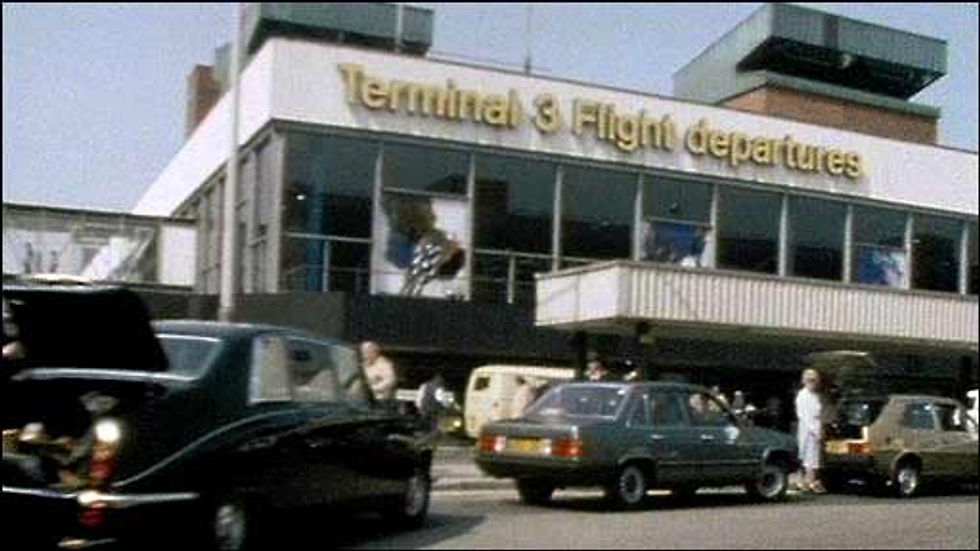
How the boys got as far as Heathrow still stops people in their tracks. Airport security in 1985 was nowhere near what it is now, but it was hardly nonexistent either, and the era had its own famous case of someone beating the system entirely. Just over a decade earlier a man calling himself D.B. Cooper had walked onto a commercial flight, extorted a ransom and vanished mid air, and he was never caught. Keith and Noel weren't after money, just a lucky break, and by sheer nerve they got one.
They picked a random traveller in the terminal and asked where his flight was headed. New York, he said. That was all the information they needed. When airline staff questioned the pair, they simply said their parents were already through security and waiting ahead of them. Nobody asked for tickets. Nobody asked for passports. Nobody checked their age. They were waved straight through.
It's worth remembering just how strange the timing was. The flight was barely two months after Air India Flight 182 was bombed off the coast of Ireland, killing all 329 people on board, a disaster that was supposed to put airport security everywhere on edge. Somehow, in the middle of that heightened alert, two children from Darndale strolled onto an international Air India flight with no tickets and no ID at all.
Keith later put the whole thing down to luck as much as nerve. The plane was only half full, so nobody came near them once they'd found their seats.
A Half Empty Plane, a Curry and James Bond
Once airborne, the adventure kept getting stranger. The boys were served a spicy Indian curry that proved far too hot for Keith's ten year old palate, so he gave up on dinner and turned to the in flight entertainment instead, which happened to be the Bond film A View to a Kill. Less than 48 hours earlier they'd been kicking a ball around Darndale. Now they were somewhere over the Atlantic watching 007 on the big reclining seats of a half empty jumbo jet.
Caught at JFK by Officer White
Their run of luck held all the way to touchdown. Once inside JFK, the boys spent a while just wandering the terminal before heading out to see what New York looked like from the kerb. That's where it fell apart. A police officer named Kenneth White stopped the pair and asked where they were headed. They told him they were meeting their mother in town, and when he pushed a bit harder, they admitted the truth: there was no mother, no adult, nobody but the two of them.
White radioed his sergeant, Carl Harrison, and the boys were brought in for questioning. It took hours of going back and forth before officers pieced together that two unaccompanied children with thick Dublin accents, no luggage and no papers really had crossed the Atlantic entirely on their own.
Once on board, the fantasy continued. The boys were offered meals — spicy Indian curry — which proved far too hot for Keith’s young palate. Instead, he turned his attention to the in-flight entertainment, which featured the latest James Bond film, A View to a Kill.
It must have felt surreal. Barely 48 hours earlier, they were playing in Darndale. Now, they were hurtling across the Atlantic, living out an adventure fit for the movies.
Chips, Unloaded Guns and a Terrorism Scare
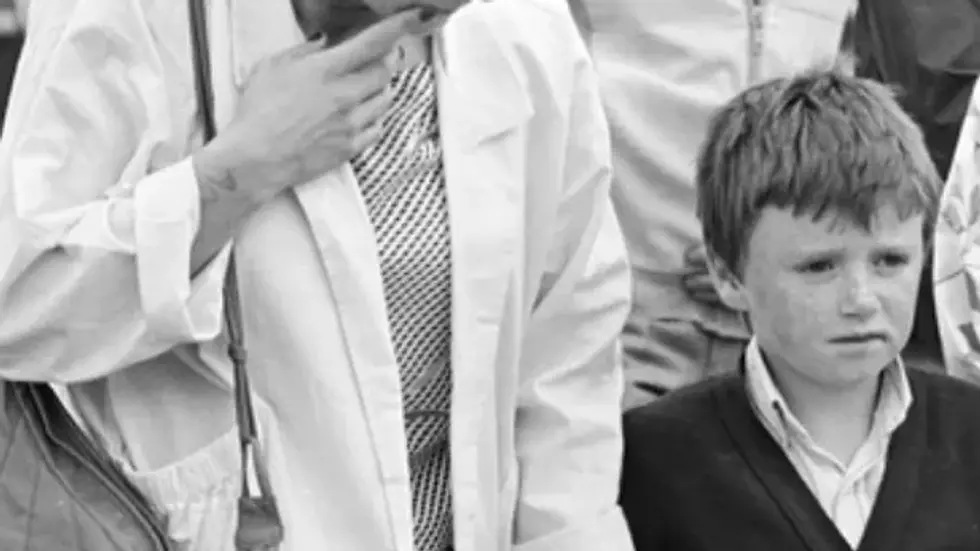
Back at the precinct, officers fed the boys chips and soda and, in a detail that would raise a few eyebrows today, let them play around with their unloaded service weapons while everything got sorted out. Because of how recent the Air India bombing had been, investigators also had to rule out something far darker before anyone could relax, checking whether the boys had any terrorist connections or were being used to smuggle something into the country. It didn't take long for that line of inquiry to go nowhere. They were exactly what they looked like: two homesick kids who wanted to meet a television star.
Once Air India and the airline confirmed the boys' story, the airline itself stepped in and put them up in a suite at a five star Manhattan hotel, with five security guards assigned to keep an eye on them around the clock. Keith remembered being fed like royalty, with sandwiches and chips laid on so generously that the whole ordeal barely felt like trouble at all. Rather than simply babysitting the boys, the guards ended up giving them a proper tour of the city, handing over some spending money and sending them home with I Love New York t-shirts as souvenirs.
Media Frenzy and a Joke for Maggie Thatcher
The press couldn't get enough of it. New York's tabloids splashed the boys across their front pages, marvelling at how a ten and a thirteen year old had beaten airport security across three separate countries. Back in Ireland, reaction swung between disbelief and quiet admiration, with parents everywhere shaking their heads while secretly wondering if their own kids could ever pull off something so bold.
The story even reached Downing Street. British Prime Minister Margaret Thatcher reportedly voiced her doubts about the whole tale live on radio, unable to believe two schoolboys had really managed it. Decades later, when Murray was asked about it, his response was simple: they really had done it, Maggie.
Back home, the moment police told Keith's mother where her son actually was became a story in itself. When officers explained that Keith was safe in New York, she reportedly assumed they meant York Street, a road not far from Darndale, and had to be corrected before the full scale of the adventure sank in.

What Happened to Keith and Noel Next
Life after New York wasn't quite as glamorous as the hotel suite. Keith was sent to boarding school not long after coming home. Noel, who already had a few minor brushes with the law before the trip, came close to being sent to a boys' home, and was only spared that after a judge decided to let him off. The two boys who'd crossed the Atlantic together as a team drifted apart in the years that followed, the way childhood friendships often do.
Both men still live in Darndale, and both are well into adulthood now. Keith is edging up on 50 and Noel has already passed it, a good reminder that this was never some distant folk tale, it happened to two Dubliners who are still very much around today. Keith has settled down with a long term partner and children of his own. Noel has been open about a much harder chapter of his adult life, a battle with drug addiction that lasted around three decades, and had reached seventeen months of sobriety by the time filmmakers came calling to tell his story properly. Looking back on the trip itself, he's joked that he might go back to New York again someday, only next time he'll actually pay for the flight.
From a Short Documentary to a Hollywood Deal
The story resurfaced in a big way when director Garret Daly of Mixed Bag Media tracked the pair down decades later and made a short documentary called Nothing to Declare, weaving grainy archive footage together with new interviews with Keith and Noel as grown men. The film caught enough attention that Daly went on to secure the rights to a full feature adaptation, titled Don't Go Far after the very words Keith's mother used before he vanished for a week.
Limerick screenwriter Conor Ryan wrote the screenplay, and the project picked up development support from Screen Ireland along the way. In 2020, the film landed a genuine Hollywood partner when The Kennedy/Marshall Company, the production house behind decades of blockbusters and run by Frank Marshall and Kathleen Kennedy, signed on to help bring it to the screen. Marshall himself called the boys' stowaway adventure almost too incredible to believe, and said it was exactly the kind of uplifting story audiences could use more of. As of now the film remains in development, but between the documentary and the Hollywood backing, Keith and Noel's teenage stunt has had a longer afterlife than either of them could have imagined back in 1985.
Could It Happen Today?
Looked at now, the whole story feels almost impossible. Between CCTV, biometric passports, electronic ticketing and far tighter border checks, it's hard to imagine two children getting anywhere near repeating the trip. Modern airports track every passenger, ferries use barcoded boarding passes, and train travel is watched far more closely than it ever was in the 1980s. Keith and Noel would likely have been flagged before they even reached Heathrow.
But 1985 was a different world. Kids roamed their neighbourhoods for hours without anyone panicking, and travel systems leaned heavily on human judgement rather than technology. Two confident children with quick answers could talk their way through gaps that simply don't exist anymore.
Why the Story Still Captivates
Nearly four decades on, the tale still gets shared and rewatched, and it's not hard to see why. It captures something about childhood that rarely survives into adulthood, boldness without fear and imagination without limits. Keith and Noel weren't trying to prove a point or make a statement. They just wanted an adventure, and in chasing it they exposed just how much the adult systems meant to protect kids relied on nothing more than good faith.
It's also a small time capsule of an era when the world felt looser and less monitored than it does now. And even though B.A. Baracus never did find out two Dublin kids crossed an ocean to meet him, for one wild week in 1985, Keith Byrne and Noel Murray lived out an adventure bigger than anything television could have scripted for them.
Sources
The Irish Star: The remarkable story of two schoolboys who ran away to New York
The Irish Post: The story of the Dublin boys who ran away to New York
JOE.ie: The young Dublin stowaways who went to New York will have their incredible story made into a Hollywood movie
RTÉ Documentary on One, "Don't Go Far" (2023)