

The World’s First Pocket Record Player: The 1924 Mikiphone
Updated: Mar 13

It fits easily into the palm of the hand, closes with a soft metallic click, and looks more like a gentleman’s pocket watch than a machine capable of filling a room with sound. Yet when the Mikiphone pocket phonograph appeared in the mid 1920s, it represented one of the most ambitious attempts ever made to shrink recorded music into a truly portable form. Long before the Sony Walkman, long before cassette tapes or earbuds, this small nickel plated disc promised recorded sound on demand wherever its owner happened to be.
The Mikiphone was the creation of Hungarian brothers Miklós and Étienne Vadász, two engineers who understood that the future of recorded sound did not lie only in louder machines or grander cabinets, but in portability. Their idea was simple and radical. Take the essential mechanics of a disc gramophone and compress them into the smallest workable form without sacrificing sound quality. It was a concept that aligned perfectly with the growing modern appetite for compact, efficient design in the years following the First World War.

To bring their idea into mass production, the Vadász brothers turned to a company with deep roots in precision engineering and musical technology. That company was Paillard of Saint Croix, Switzerland.
Paillard was founded in 1814 by Isaac Paillard as a consortium of local watchmakers. Saint Croix itself was already a centre of fine mechanical craftsmanship, known for horology and later for music boxes. By the 1860s, Paillard had become one of Europe’s most respected manufacturers of music boxes, exporting intricate mechanical instruments around the world. These were not novelties but precision devices, valued for reliability and musical accuracy.
As sound recording technology evolved, Paillard evolved with it. Towards the end of the nineteenth century, the firm added cylinder phonographs to its catalogue, embracing Thomas Edison’s format while maintaining Swiss standards of build quality. By 1905, recognising the dominance of disc records, Paillard transitioned to disc gramophones. This adaptability would become one of the company’s defining traits.
In 1913, Paillard developed an electric AC gramophone motor, a significant technical step that placed the company at the forefront of sound reproduction technology. By 1927, it was building electric amplifiers for gramophones and moving decisively into radio equipment. Somewhere between these innovations, Paillard produced one of the most charming and technically daring audio devices of the twentieth century.

The Mikiphone entered production during this transitional moment. According to the Science Museum in London, the first machine was made in 1923. In 11/1924, the design was patented and licensed by Paillard. Production followed swiftly. As Earthly Mission notes, Paillard manufactured the device between 1925 and 1927, producing approximately 180,000 units in total. For such a complex object, this was a substantial run.
The appeal of the Mikiphone lay not only in its novelty but in its thoughtful design. When closed, the entire phonograph was stored in a circular nickel plated case with a diameter of just 11.5 cm and a thickness of 4.7 cm. The finish was elegant and understated. While nickel was the standard, versions were also available in gold or silver plating, making the device as much a luxury accessory as a piece of technology.

Opening the Mikiphone was a small ritual. The case split into its functional components, which were then assembled into a working gramophone. The recorder head connected to a fold out tone arm. The sound was amplified not by an external horn but by a two part Bakelite resonator, carefully shaped to project sound efficiently despite its compact size. Bakelite, one of the earliest synthetic plastics, was still a modern material in the 1920s, and its use signalled the Mikiphone’s place at the intersection of tradition and innovation.
The record was placed onto the turntable pin, and the user wound the handle around 50 times to power the spring driven motor. Once a standard 78 rpm 10 inch disc was set in place, the needle dropped and music filled the space around the listener. Contemporary descriptions often note the surprise of first time users at the volume and clarity produced by such a small machine.

One period reviewer reportedly remarked that it was “astonishing to hear a full orchestra issuing from an object scarcely larger than a man’s wallet”. While the Mikiphone could not rival full sized cabinet gramophones in richness or bass response, it performed remarkably well given its constraints. It was loud enough for a small room, a picnic, or a hotel bedroom. For many owners, that was more than enough.
The timing of the Mikiphone’s release was crucial. The mid 1920s were years of mobility and social change. Urbanisation, leisure travel, and modern consumer culture were reshaping daily life. Portable cameras, wristwatches, fountain pens, and compact cosmetics all reflected a desire for personal technology that could move with the individual. The Mikiphone fitted neatly into this world.
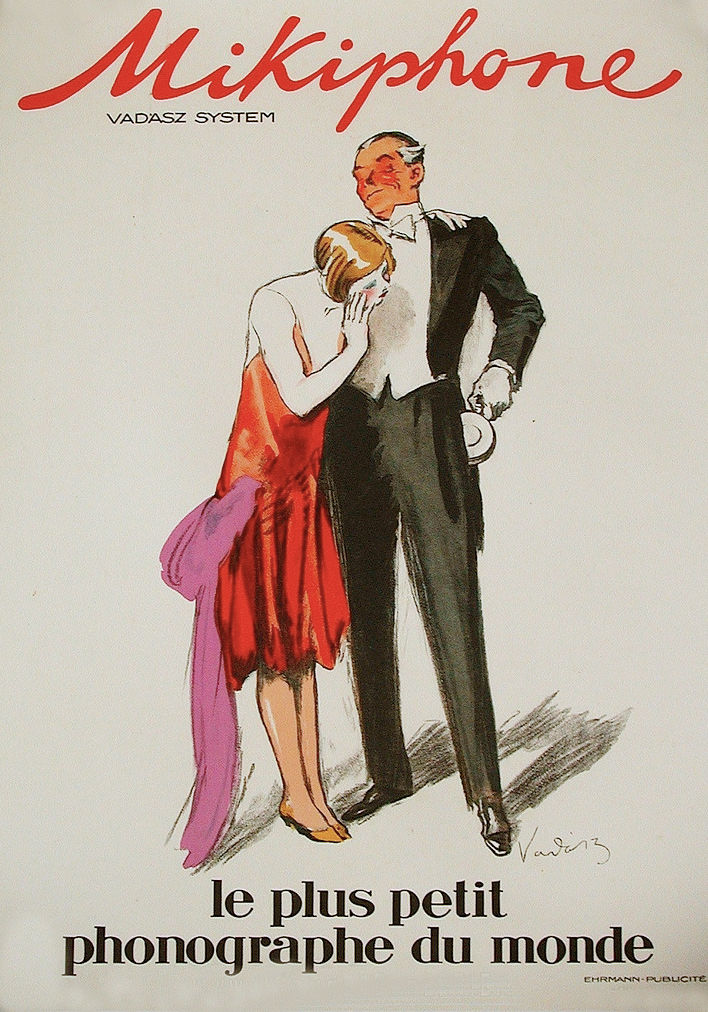
Its marketing often emphasised freedom and independence. This was a machine for travellers, students, soldiers on leave, and anyone who wanted music without being tied to the parlour gramophone. In this sense, it anticipated later portable audio devices not only technically but culturally.

Paillard’s role in the Mikiphone’s success cannot be overstated. Manufacturing such a compact mechanical device required extraordinary precision. The tolerances involved in fitting a spring motor, turntable, tone arm, and resonator into such a small volume were unforgiving. Paillard’s background in watchmaking and music box production gave it a distinct advantage. Every component had to be robust enough to survive repeated assembly and disassembly, yet delicate enough to function smoothly.
The choice to limit production to a few years suggests both the ambition and the limitations of the design. The Mikiphone was expensive compared to conventional gramophones, and by the late 1920s the rapid rise of electrical recording and amplification was changing expectations of sound quality. Portable electric players were still decades away, but domestic listening was already moving towards radio and electrically amplified gramophones.
Even so, the Mikiphone left a lasting impression. Today, surviving examples are highly sought after by collectors. Many remain in working condition, a testament to Paillard’s engineering. Museums often display them not only as curiosities but as milestones in the history of personal media.
The Science Museum describes the Mikiphone as “an early attempt to make recorded music genuinely portable, combining mechanical ingenuity with elegant design”. That assessment captures its significance well. It was not a gimmick, but a serious answer to a question that would dominate the twentieth century. How do we carry our music with us.
There is also something quietly human about the device. Unlike later portable players, the Mikiphone demanded physical engagement. Winding the handle, assembling the parts, carefully placing the needle. Listening was an active process. The owner participated in the making of the sound, aware of the mechanism at work. In an age increasingly dominated by invisible electronics, this mechanical intimacy feels almost radical.
The Vadász brothers never achieved the household name recognition of later audio innovators, but their contribution deserves attention. They understood that technology does not only move forward by becoming bigger or more powerful. Sometimes it moves forward by becoming smaller, more personal, and more thoughtful.
Paillard, for its part, continued to evolve. The company later became famous for its Thorens brand turntables and high quality audio equipment, maintaining its reputation for precision well into the twentieth century. The Mikiphone sits within this longer story as a moment of playful ambition, a reminder that even established manufacturers occasionally take creative risks.


