

Rockwell Kent, Herman Melville and the Revival of Moby Dick
Updated: Mar 11
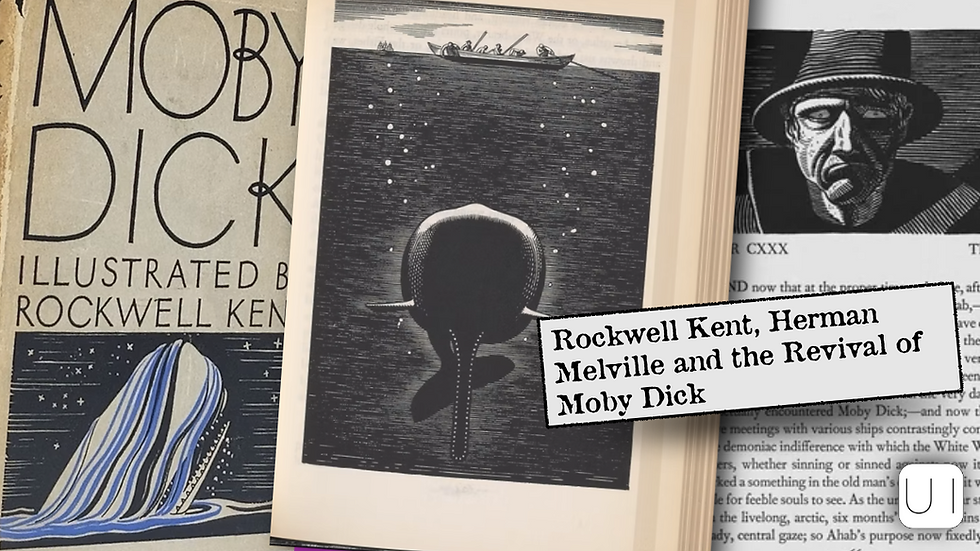
It begins with a sentence so steady and so quietly thunderous that readers sometimes remember where they were the first time they encountered it. Herman Melville’s narrator is weary, restless and slightly irritated with his own existence. His cure involves the open sea. Few openings in nineteenth century fiction have the same staying power, which is remarkable considering how little attention the book received in Melville’s own lifetime. Before 1920, “Moby Dick” was rarely mentioned outside specialist circles. By the end of the 1930s, it had become central to the American literary canon. How that happened is a story in itself. It involves a slow rediscovery, shifting tastes, and perhaps most importantly, one very determined artist with an eye for bold black and white images.
“Whenever I find myself growing grim about the mouth. Whenever it is a damp drizzly November in my soul. Whenever I find myself involuntarily pausing before coffin warehouses, and bringing up the rear of every funeral I meet. Then, I account it high time to get to sea as soon as I can.”
These opening lines of “Moby Dick” set a rhythm and mood that readers immediately latch onto. They also show Melville’s ability to capture the inner life of a troubled man with surprising humour. The story that follows is a blend of adventure, philosophy, ethnography and obsession. Yet for decades after Melville’s death in 1891, almost no one cared.

Melville published “Moby Dick” in 1851 at the age of thirty two. It sold poorly. Reviewers were baffled. His previous books, especially “Typee,” had been lively travel narratives that appealed to readers looking for exotic escapism. “Moby Dick,” however, was something different. It wandered. It lectured. It philosophised. There were entire chapters that read like scientific treatises on whales. Melville’s bold attempt to widen the novel form simply did not find its audience. By the 1860s, he had all but quit writing fiction. By the early twentieth century, he was better known as a customs inspector in New York than as a novelist.
Then, around the 1920s, something changed. A generation of writers and thinkers began looking for bold voices from the past who had been overlooked in their own time. Melville’s work was reassessed and gradually welcomed back into the conversation. Universities began teaching him. Literary scholars praised his ambition. Readers discovered that the very qualities that had confused Victorians now made the book feel modern. But the real turning point, the one that cemented Melville’s place in the public imagination, came from an unlikely direction. It came not from scholars but from an artist.

Rockwell Kent was born in 1882 and by the 1920s was known for his rugged landscapes, stark use of colour, and fascination with remote places. He worked as a painter, wood engraver and book illustrator. He had a reputation for independence, for seeking out harsh climates and for wanting to test his endurance. In that sense, he was not unlike Melville, whose own life included long periods at sea, time spent in the Pacific islands and a constant desire to push beyond conventional expectations.
Kent had grown up reading American transcendentalists. Emerson, Thoreau and Whitman shaped his worldview long before he picked up a chisel or pencil. Later, he would apply that same spirit to his art. He travelled to Newfoundland, Greenland, Alaska and Tierra del Fuego, often working alone in cold, isolated landscapes. His books “N by E” and “Voyaging Southward from the Strait of Magellan” are filled with first person accounts of these journeys, and they show how naturally he paired visual art with narrative adventure.

By the late 1920s, Kent had established himself as one of the most recognisable illustrators in the United States. His reputation led the Lakeside Press in Chicago to contact him in 1926 with a project. They intended to publish a fine press edition of Richard Henry Dana’s “Two Years Before the Mast,” and they wanted Kent to illustrate it. The commission would have been a safe and sensible one. Dana’s book was a classic maritime memoir with broad appeal. Yet Kent surprised them. He suggested “Moby Dick” instead.
What happened next was one of the most fortunate creative decisions in twentieth century publishing. Kent threw himself into the project. He carved scenes not with soft sentiment but with sharp angles, deep shadows and vast areas of ink. His whales appear enormous and almost architectural. His depictions of the sea are turbulent, geometric and filled with tension. Ahab looms like a figure carved from granite, a man driven by purpose rather than melodrama. The engravings feel modern yet timeless, making Melville’s nineteenth century prose seem newly alive.
When the Lakeside Press edition finally appeared in 1930, it arrived in three imposing volumes. Only one thousand copies were printed. They were intended for collectors and connoisseurs, but word of the publication spread rapidly. The images caused a sensation. Kent’s stark black and white engravings matched the novel’s philosophical intensity in a way no illustrator had quite achieved before. The limited edition sold out almost immediately. Random House then released a more affordable single volume trade edition that same year, which also sold extremely well. For many readers, these illustrated versions were their first encounter with the novel.

Kent’s illustrations became inseparable from the book. They were bold enough to feel modern yet respectful enough to keep Melville’s original structure intact. Instead of softening the novel, Kent sharpened it. Instead of making it gentle, he made it monumental. Many scholars argue that Kent played a central role in pulling Melville back from obscurity and into widespread admiration. The timing helped too. The 1930s saw a cultural shift towards interest in American identity, symbolism and myth making. Melville’s story of obsession, ambition and the limits of human knowledge fit perfectly within that moment.
There is a striking biographical symmetry between the two men. Melville lived in New York and in the mountainous regions to the north and west. Kent did too. Melville knew the sea intimately. Kent had spent years navigating treacherous waters in the far south and north. Melville’s novels wrestled with questions about society, morality and the pressures of modern life. Kent was equally sceptical of materialism and embraced socialist ideas throughout his life, receiving the Lenin Peace Prize in 1967.
Although separated by generations, their sensibilities align. Both were captivated by nature at its most extreme. Both distrusted the easy comforts of urban life. Both blended adventure with philosophy. And both, interestingly, had complicated relationships with their own public reputations.

Melville was forgotten for decades. Kent, once celebrated, gradually slipped from mainstream attention as modernist and abstract movements came to dominate American art after the Second World War. Today, Kent is admired by specialists and collectors, but he is no longer a household name.
Yet his “Moby Dick” remains. It has been in print for more than seventy five years and continues to accompany new readers on their first journey with Ishmael. Kent’s images appear frequently in exhibitions of book art. The edition is often cited as one of the finest illustrated books of the twentieth century. And it stands as a reminder that literature is not fixed in time. Books can vanish and reappear. Writers can be forgotten and rediscovered. A single creative partnership, even one formed across decades, can change the course of cultural memory.
Melville did not live to see his reputation restored. He died quietly in 1891, receiving only brief newspaper notices. But the world eventually caught up with him. His novel, once dismissed as strange or excessive, is now understood as one of the great achievements in literature. Its questions about fate, obsession and the human desire for meaning still resonate. And its journey back into the public imagination owes a great deal to the artist who understood that the right images could help bring a very old book back to life.
Kent, for his part, found his perfect match in Melville. When his engravings collide with Melville’s language, something happens. The sea grows colder. The shadows deepen. The white whale becomes a symbol that feels carved into the collective imagination. It is a creative pairing so natural that it is difficult to imagine one without the other.
In the end, the revival of “Moby Dick” is a story about timing, patience and the power of illustration. It is about how a book can disappear, wait quietly for a sympathetic reader and then rise again with unexpected force. Melville gave the world a story about the dangers of obsession. Kent gave it the images that helped everyone finally pay attention.


