

The Jewish Children Who Found Refuge in a Welsh Castle During the Holocaust
- Aug 27, 2020
- 5 min read
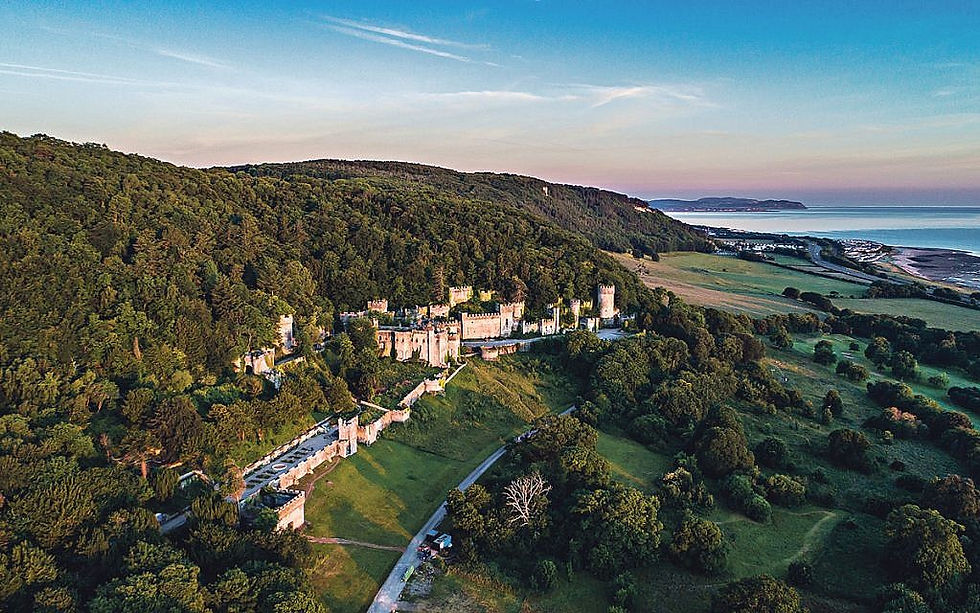
When people think of Holocaust history, their minds often go straight to ghettos, concentration camps, and stories of resistance. Yet there are quieter, less well-known chapters—stories of survival that unfolded in unexpected places. One such story took place in Abergele, a small town in North Wales, where a group of Jewish children fleeing Nazi Germany ended up living in a castle perched above the Irish Sea.
It was November 1938, just days after Kristallnacht, the “Night of Broken Glass”, when Jewish homes, businesses, and synagogues across Germany and Austria were attacked in a coordinated wave of violence. The terror convinced many Jewish families that escape was the only hope for survival. Parents faced unthinkable decisions: stay together and risk everything, or send their children abroad alone in the desperate hope of saving their lives.

The Kindertransport Rescue
On 15 November 1938, a delegation of prominent British Jewish leaders met with Prime Minister Neville Chamberlain, pleading for Britain to open its doors to Jewish children in immediate danger. A week later, Home Secretary Sir Samuel Hoare announced that Britain would offer temporary refuge to unaccompanied children under 17, provided the Jewish community itself covered the costs of their care.
This initiative became known as the Kindertransport, a rescue mission that would eventually save nearly 10,000 children from Nazi persecution between 1938 and 1940.
Most of these children travelled to Britain on trains and ferries, often clutching a single suitcase or rucksack. For many, it was the last time they ever saw their parents.

Gwrych Castle Opens Its Doors
Among the British organisers was Arieh Handler, a Zionist leader searching for safe spaces where Orthodox Jewish children could live and prepare for agricultural work in Palestine through the hachsharah (training) movement. He was unexpectedly offered a remarkable solution when Lord Dundonald, the aristocratic owner of Gwrych Castle, donated the property rent-free for the refugee children.
Gwrych Castle, an early 19th-century Gothic revival mansion, sat on a vast 500-acre estate overlooking the sea. Its dramatic façade stretched for more than 2,000 yards and featured 18 towers, a sweeping 52-step marble staircase, and over 128 rooms. Once a symbol of wealth and power, it would now become a sanctuary for children with nowhere else to go.

Between late 1939 and 1941, more than 200 Jewish refugee children aged 15–16 lived at Gwrych. The group included 60 members of Bachad (a religious Zionist youth movement), 129 from Youth Aliyah, and 43 children evacuated from Llandough Castle in South Wales after it was damaged in bombing raids.
Life in the Castle
Arriving at the castle was not quite the fairytale the children might have imagined. One survivor later recalled:
“We arrived at the castle late at night. There was no electricity, only paraffin lamps. There was no hot water, no showers, just bathtubs. Hot water came several weeks later and was rationed. We slept on straw for the first few nights until the Quakers in Abergele supplied us with furniture and other items.”
Daily life was structured but challenging. With Handler as their organiser and his brother Julius serving as the group’s doctor, the children were divided into groups and cared for by volunteer counsellors. Education was improvised, often combining religious instruction with agricultural training, since many hoped to emigrate to Palestine after the war.

The castle’s sheer size made it both awe-inspiring and difficult to manage. Maintaining warmth in the draughty halls during Welsh winters was a constant struggle. Yet for many of the children, the hardships were softened by the knowledge that they were safe.
Integration with the Welsh Community
The surrounding community of Abergele played a surprisingly important role in easing the children’s transition. Several local farms hired the boys to help with agricultural work, collecting them in the mornings and returning them by afternoon. These experiences provided both employment and a sense of belonging in a land so far from home.
Not all encounters were so simple. One boy described a pivotal early incident:
“Three weeks after our arrival, three boys and I went for a walk in Abergele browsing shop windows. As a policeman approached us, two of the boys fled. After the policeman caught them, he asked, ‘Why are you boys running away?’ I spoke fluent English and replied, ‘If a policeman approaches Jewish children in Germany, it means trouble.’ The policeman nearly cried. He said, ‘Tell them this is not Germany. Here a policeman is your friend. When you’re in trouble, you don’t run away from a policeman. You look for one.’”
Moved by this story, local police officers visited the castle to speak to the children directly, reassuring them that they could feel safe in Britain. They even brought tea, coffee, and cakes—gestures that left lasting impressions on the young refugees.

Letters Home and Lingering Worry
Communication with their families in Germany was heartbreakingly limited. Each child was allowed to send one letter per month of no more than 25 words, arranged through the Red Cross at a cost of 2 ½ shillings. Choosing which words to send was agonising, how could a teenager compress love, longing, and fear into just 25 words?
For many, the letters stopped altogether as their parents were deported or murdered in the Holocaust. The sense of loss weighed heavily within the castle’s walls, even as the children tried to build new lives.
The End of the Castle Years
In 1941, the British government requisitioned Gwrych Castle for military purposes. The children were relocated, some to Youth Aliyah centres elsewhere in Britain, others to farms in Northern Ireland.
One boy, Glanz, later recounted his path after leaving the castle. Between 1942 and 1944, he worked in a factory manufacturing machine guns. Eventually, he joined the U.S. Army as a censor of German mail, which took him back to Munich, the very heart of the regime he had fled as a child.

Legacy and Memory
The story of Gwrych Castle’s Kindertransport children is a reminder of how extraordinary places can play unexpected roles in history. A castle once designed to showcase aristocratic grandeur became a lifeline for hundreds of teenagers, allowing them to survive the Holocaust and go on to build new lives.
Today, Gwrych Castle is better known as the filming location for shows like I’m a Celebrity… Get Me Out of Here! But behind the TV glamour lies a history of resilience and refuge. For the children who once slept on straw in its draughty halls, the castle was not just stone and marble—it was survival.
As one survivor later reflected, “We were safe, and that was everything.”
Sources
Fast, Vera K. Children’s Exodus: A History of the Kindertransport. London: I.B. Tauris, 2011.
Harris, Mark Jonathan. Into the Arms of Strangers: Stories of the Kindertransport. Bloomsbury Publishing, 2000.
Gwrych Castle Preservation Trust – “Gwrych Castle and the Kindertransport.” https://www.gwrychcastle.co.uk/
Bauer, Yehuda. Out of the Ashes: The Impact of American Jews on Post-Holocaust European Jewry. Pergamon Press, 1989.
Cesarani, David. The Kindertransport: Rescue or Ruin? (Jewish Historical Studies, 1993).
Abergele Local History Society – Archive on Kindertransport children at Gwrych. https://abergelepost.com/
United States Holocaust Memorial Museum – Kindertransport overview. https://encyclopedia.ushmm.org/
Oral testimony of Arieh Handler and survivors quoted in Bachad archives, available via The Wiener Holocaust Library, London. https://wienerholocaustlibrary.org/


