

Irma Grese: Beauty, Power, and the Machinery of Cruelty
Updated: Mar 19

“She was one of the most beautiful women I have ever seen. Her body was perfect in every line, her face clear and angelic, and her blue eyes the gayest, the most innocent eyes one can imagine. And yet Irma Grese was the most depraved, cruel, imaginative pervert I ever came across.” - Dr Gisella Perl
Gisella Perl’s words are not remembered because they are dramatic. They endure because they are unsettlingly precise. Perl, an experienced gynaecologist before her deportation to Auschwitz Birkenau, was not prone to exaggeration. She had witnessed human cruelty in many forms. That she singled out Irma Grese remains one of the most troubling testimonies to survive the Holocaust.
Grese was young, strikingly attractive, meticulously groomed, and seemingly untouched by the deprivation that surrounded her. At just 20 years old she had risen to become one of the most powerful women inside the Nazi camp system. Her presence was enough to silence entire barracks. Survivors did not remember her merely as cruel, but as inventive in cruelty.
Long after her execution, historians still return to the same question. How did an ordinary rural girl from northern Germany become one of the most feared figures in Auschwitz and Bergen Belsen?

A Childhood Shaped by Loss and Authority
Irma Ilse Ida Grese was born October, 1923 in the village of Wrechen in Mecklenburg, a rural region defined by farmland, forests, and isolation. Her father, Alfred Grese, was a conservative farmer and a devout churchgoer. Discipline in the household was strict and physical punishment was routine. Her mother, Bertha Grese, died by suicide in 1932 when Irma was nine years old, reportedly after years of marital conflict.
The loss of her mother was a defining rupture. Several postwar psychologists who reviewed Grese’s background suggested that the absence of maternal attachment and the presence of an authoritarian father created a volatile emotional environment. What is clear is that Irma grew up in a household governed by control, silence, and obedience.
Although Alfred Grese disliked the Nazis and forbade his daughters from joining their youth organisations, Irma defied him and joined the Bund Deutscher Mädel. The organisation offered structure, praise, camaraderie, and escape from her home life. For a teenager seeking belonging and validation, the appeal was obvious.
Indoctrination and Ideology
After 1933, Nazi ideology became mandatory in German schools. Grese absorbed its racial doctrines eagerly. Later testimony indicates that she viewed the Weimar Republic as weak and morally lax, a belief she adopted unusually early for a child of her age.

The Nazi emphasis on blood, soil, and rural purity resonated deeply with her upbringing. Farming families were elevated within the Nazi worldview, and Grese appears to have internalised this sense of superiority. Her background did not place her at the margins of Nazi ideology. It placed her squarely within its idealised centre.
Leaving school at 14, Grese worked briefly as a farm labourer and later as a shop assistant. By her late teens she was already searching for a role that offered authority, status, and purpose.
Hohenlychen and the Normalisation of Suffering
In 1939, Grese applied to train as a nurse at the SS hospital at Hohenlychen. There she came under the influence of Karl Gebhardt, one of the most prominent Nazi physicians. Hohenlychen was not simply a hospital. It was a place where medicine and ideology merged into experimentation.

Gebhardt and his colleagues conducted bone grafting and wound infection experiments on prisoners from Ravensbrück. These procedures were conducted without consent, often without anaesthetic, and frequently resulted in death.
Although Grese later claimed she merely trained as a nurse and failed due to lack of aptitude, historians believe her exposure to this environment was formative. At Hohenlychen, human suffering was clinical, sanctioned, and rewarded. Pain was no longer accidental. It was purposeful.
Ravensbrück: Learning Power
By 1941, Grese had entered Ravensbrück as a trainee Aufseherin. Training was designed to strip recruits of empathy and replace it with ideological obedience. Politeness was punished. Detachment was praised.

Survivor accounts note that Grese initially appeared hesitant and even apologetic. This lasted only days. Within weeks she had adapted completely. According to camp records, she demonstrated unusual enthusiasm and efficiency.
Sexual relationships between male and female SS staff were common, while any intimacy involving prisoners was forbidden. This imbalance reinforced the sense of absolute power enjoyed by the guards. Grese thrived in this environment.
Auschwitz Birkenau: Authority Without Restraint
Irma Grese arrived at Auschwitz II Birkenau in March of 1943, at a point when the camp was fully operational as the primary site of mass murder within the Nazi system. The infrastructure of extermination was no longer experimental. Selections, gassings, and cremations were embedded in daily routine, carried out with administrative regularity.
Her first posting was in Camp B, where she worked as a telephone operator in the office of a Blockführer. Although clerical, the role placed her close to decision making processes. According to later testimony, she was removed from this position after committing a disciplinary violation and reassigned to oversee a Strafkommando, a punishment detail composed of women already weakened by hunger and disease.
At her trial, Grese claimed she supervised the Strafkommando for only two days. This claim was directly contradicted by Kapo Helena Kopper, who testified that Grese commanded the unit for approximately seven months and that prisoners under her authority were dying in large numbers each day. The court rejected Grese’s account and accepted the testimony of former prisoners.
Over the following months, Grese was rotated through a series of supervisory roles. She led a gardening squad in late 1943 and later became responsible for censoring prisoner correspondence, replacing Elisabeth Volkenrath in that position. These assignments reflected growing trust from her superiors. In early 1944, aged just 21, she was promoted to Oberaufseherin, the second highest rank available to female guards, a promotion officially recorded as satisfactory service.

In 1944, Grese was placed in charge of Camp C, a vast section of Birkenau consisting of thirty one huts and holding roughly 30,000 Jewish women, primarily deported from Hungary and Poland. Survivor Helen Spitzer Tichauer later testified that Grese lacked the experience to command such a large section alone and was therefore paired with Aufseherin Luise Danz, transferred from Kraków Płaszów. Despite this, Grese exercised broad authority.
It was during her tenure in Camp C that the bulk of testimony concerning her violence originates. Survivors described her carrying a whip, rubber truncheon, and pistol, and using them frequently. Abraham Glinowieski testified that Grese selected both sick and healthy women for the gas chambers. Edith Trieger recalled that Grese beat prisoners who broke ranks or hesitated during selection parades.
Grese also routinely ordered prisoners to “make sport”, a term used for punitive physical exercises performed until collapse. During her trial, she defended this practice by claiming prisoners were physically capable of enduring it, a claim contradicted by medical evidence and survivor accounts.
Dr Gisella Perl described Grese as deriving satisfaction from humiliation as much as from violence. Olga Lengyel later recalled that Grese was recognisable by her perfume before she was recognised by sight. In an environment of filth, lice, and deprivation, Grese’s deliberate display of cleanliness and luxury functioned as an additional form of domination.
Bergen Belsen and Collapse
Grese left Birkenau in January 1945 as SS personnel were ordered westward ahead of the advancing Soviet army. After a brief return to Ravensbrück, she was transferred to Bergen Belsen in early March, 1945.
By this stage, Bergen Belsen had ceased to function as a controlled camp. Severe overcrowding, absence of food supplies, and total collapse of sanitation led to mass death from typhus, dysentery, and starvation. Thousands died weekly, not through organised killing, but through neglect.
Grese served as Arbeitsdienstführerin and Rapportführerin, overseeing labour details and supervising female guards. Witnesses testified that despite the collapse of camp infrastructure, she continued to enforce discipline through beatings and forced exercises. She again ordered prisoners to “make sport”, a practice she later justified by claiming inmates were capable of physical exertion.
Grese opposed her assignment to Bergen Belsen and expected to be transferred elsewhere. One reason appears to have been personal. She wished to remain with Oberscharführer Franz Wolfgang Hatzinger, a married SS man fourteen years her senior, with whom she was having an affair. Fellow guard Johanna Bormann later testified that the two met frequently in secret.
When British forces liberated Bergen Belsen on the 15th of April, 1945, Grese remained in the camp. Witnesses described her as hostile and defiant. One account records that she attempted to strike a British officer entering a hut and was immediately restrained.
Trial and Execution
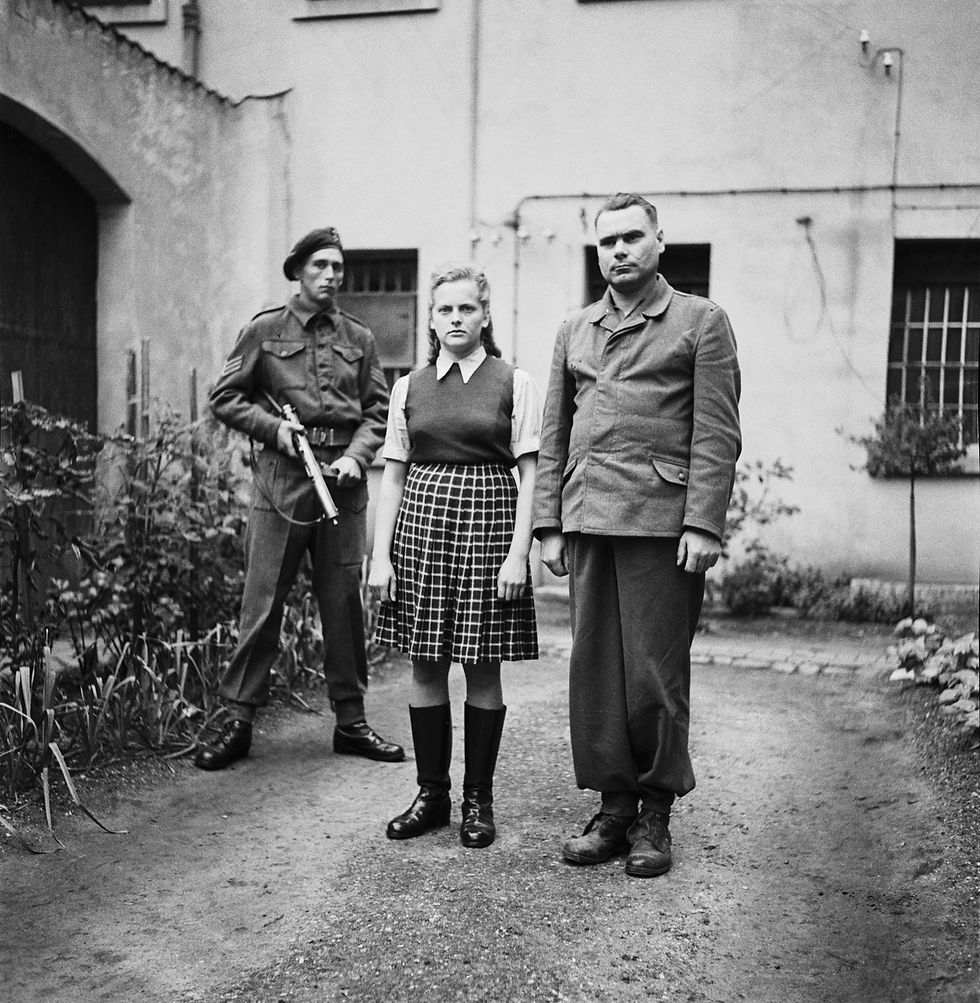
Following her arrest, Grese was imprisoned at a nearby Wehrmacht training facility and interrogated before being transferred to Lüneburg. The Belsen Trial opened on the 17th of September 1945, with Grese tried alongside forty four other defendants. Although named for Bergen Belsen, much of the evidence against her concerned crimes committed at Auschwitz Birkenau.
She faced two charges of war crimes covering the period from 1942 to 1945. Witness testimony was extensive and consistent, describing beatings, selections for death, and deliberate cruelty. Grese denied most accusations, claiming she had followed orders and disputing survivor accounts.

During the trial, she stated, “Himmler is responsible for everything that has happened, but I suppose I am as much to blame as the others above me.” Her demeanour was described as cold and dismissive. She objected to repeated questioning and showed little emotion.
Her only visible breakdown occurred when her sister Helene testified, recounting a violent confrontation between Grese and their father in 1943. Grese sobbed openly during this testimony.
She was found guilty on both charges. When the sentence of death was announced, she initially appeared indifferent, later breaking down in fear while awaiting execution. Her appeal for clemency was denied.
On the 13th of December 1945, Irma Grese was executed by hanging at Hamelin Prison. One of the many prisoners that were hanged by the expert British hangman, Albert Pierrepoint.
Official records show she was executed at 10:03. Her reported final word was “Schnell”.
Attempting to Understand Irma Grese
Irma Grese is most unsettling when viewed not as an exception, but as a product of the system that elevated her. She was young, ideologically committed, and rewarded for efficiency within a structure that normalised cruelty and punished hesitation.
Her actions were not impulsive acts of madness. They were learned behaviours reinforced by authority, promotion, and institutional approval. Grese’s case demonstrates how ordinary individuals, when granted power without accountability, can become capable of extreme harm.
The enduring discomfort of her story lies in that recognition.


