

Howard Unruh and the Walk of Death: America’s First Modern Mass Shooting
Updated: May 13
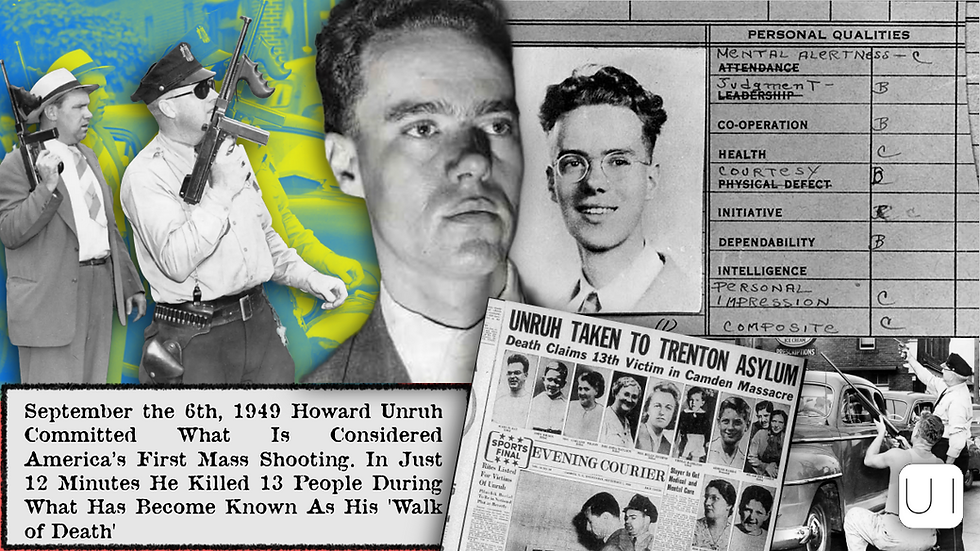
On the morning of 6 September 1949, a quiet street in Camden, New Jersey became the site of something the United States had never quite seen before. A 28-year-old war veteran named Howard Barton Unruh walked out of his front door in his best brown suit and a striped bow tie, carrying a German Luger pistol and enough ammunition to end thirteen lives. In just twelve minutes, he did exactly that.
Newspapers would call it the "Walk of Death." Historians would eventually call it the first modern American mass shooting. At the time, most of Camden simply couldn't believe their quiet, Bible-reading neighbour had done it at all.
This is the full story of Howard Unruh, the life that led him to River Road, the twelve minutes that left thirteen people dead, and the sixty years he spent behind locked doors until his death in 2009.

Who Was Howard Unruh?
Howard Barton Unruh was born on 21 January 1921 in East Camden, New Jersey, the eldest son of Samuel Shipley Unruh and Freda Vollmer. His parents separated when he was young, and he and his younger brother James were raised by their mother in a modest apartment at 3202 River Road, Cramer Hill.
By all accounts, childhood Howard was unremarkable. He attended Cramer Junior High before moving on to Woodrow Wilson High School, where his classmates respected him enough to nickname him "How" and noted his above-average grades. His 1939 yearbook listed his ambition as becoming a government employee. He was quiet, kept to himself, and spent his free time on two hobbies: stamp collecting and building model trains.
He wasn't a drinker, a smoker, or a troublemaker. He went to church every Sunday at St. Paul's Evangelical Lutheran Church and read his Bible at home. He seemed, to everyone around him, completely harmless.
What no one knew was how much pressure was already building inside him.
A Soldier Who Kept Score
In 1942, Unruh was drafted into the United States Army and assigned to the 342nd Armored Field Artillery. He served as a tank gunner in the European Theatre, fighting across Italy, France, Belgium, Austria, and Germany. He took part in some of the war's most brutal engagements, including the Battle of the Bulge and the Western Allied invasion of Germany.
By every military measure, he was outstanding. He earned marksmanship and sharpshooter ratings, conducted himself with discipline, and was described by one fellow soldier as "worth having on your side in a fight." He didn't drink, swear, or gamble during his off-duty hours. Instead, he cleaned his rifle, wrote letters to his mother, and read his Bible.

But there was something else. Throughout his time overseas, Unruh kept a meticulous personal diary. In it, he recorded every enemy soldier he killed, noting the date, time, location, and, where he could see the result, the condition of the body. It wasn't a duty log. It was something more personal than that, something that would turn out to be deeply revealing about the kind of mind Howard Unruh had.
He was honourably discharged on 30 November 1945, having been awarded the European Theater of Operations Medal, the World War II Victory Medal, and the Good Conduct Medal.
He came home to Camden a decorated veteran. But his brother James, who knew him well, later said simply: "The war made him nervous and jumpy. He was never the same again."
The Years of Festering Resentment
Back in Camden, Unruh returned to his mother's apartment and tried to build a civilian life. He worked briefly at a printing firm, then as a sheet-metal worker, then attempted to study pharmacy at Temple University in Philadelphia. He dropped out after three months. By the late 1940s, he was largely unemployed, supported almost entirely by his mother's wages from her job packing soap at the Evanson Soap Company.
His bedroom had transformed into something unsettling. The walls were decorated with crossed pistols, crossed German bayonets, and photographs of armoured artillery in action. Ashtrays made from artillery shells sat on shelves alongside war souvenirs and machetes. He'd also converted the family basement into a private shooting range, too low for him to stand upright, where he practised with his Luger almost every day.
He briefly dated a woman he'd known before the war, a pious young woman from his Bible study class. But he ended the relationship, reportedly so he could devote more time and money to his weapons collection. After that, he began visiting a cinema on Market Street in Philadelphia known locally as a meeting place for gay men. He was homosexual, at a time when homosexuality was not only stigmatised but illegal, and he kept his sexuality carefully hidden. Or tried to.
Unruh was increasingly convinced his neighbours knew his secret and were gossiping about it. He believed Maurice Cohen, the pharmacist who lived next door, had called him a "queer" and spread rumours about him. He was certain local teenagers had seen him going into the Philadelphia theatre. Whether these things were true or imagined didn't matter to him. What mattered was that he believed them.
He began keeping a list. In a notebook, he recorded every perceived slight, insult, and injustice, annotating each entry with either "retal." (short for retaliation) or the initials "D.N.D.R." (Do Not Delay Retaliation). By the summer of 1949, the list contained nearly 200 entries. More than 180 of them were marked for retaliation.
The Cohen family appeared on that list scores of times.
The Night Before
On the evening of 5 September 1949, Unruh left his apartment and headed to the Family Theatre in Philadelphia. He'd been going there regularly for about two years. That night, he was supposed to meet a man he'd been seeing. By the time he arrived, the man had already left.
Unruh sat alone in the dark cinema until about 2:20 in the morning, watching the same double feature twice: I Cheated the Law and The Lady Gambles. Then he made his way home.
When he arrived back at River Road at around 3 a.m., he discovered that the gate he'd recently installed at the bottom of his backyard had been stolen. He and his father had built the gate specifically to give him direct access to the street without having to pass through the Cohens' yard. Someone had taken it in the night.
He later told police: "When I came home last night and found my gate had been stolen, I decided to kill them all."
He removed his shoes, lay down on his bed fully clothed, and spent the rest of the night staring at the ceiling.
The Morning of 6 September 1949
Unruh woke at around 8:20 a.m. He dressed carefully in his brown worsted suit and striped bow tie. His mother prepared his breakfast: cereal, fried eggs, and milk. He sat at the table, stared at her with a strange, menacing expression for several minutes, then abruptly got up and ran back to his bedroom.
His mother, alarmed, followed him. He threatened her with a large wrench. She fled to the home of a neighbour, Elias Pinner, where she fainted on the living room floor.
Alone now, Unruh loaded a clip into his Luger P08 pistol, pocketed a second loaded clip, a hunting knife, a tear gas pen with six shells, and several loose rounds of additional ammunition. He left the house at approximately 9:17 a.m., slipping out through the gap in the fence where his gate had been.
He was wearing his best clothes. He was completely calm.
Ten-year-old John Wilson was killed along with his mother Garland Wilson and his grandmother Emma Ma Charles Peterson, 18, was injured during the Howard Unruh massacre Oriss Smith was 6 years old when he was killed in the Howard Unruh massacre Helga Zegrino, 28, formerly of River Road in Camden, was killed in the Howard Unruh rampage Sept. 6, Armand Harrie, 16, was injured along with his mother Madeline during the Howard Unruh massacre in Ca John Pilarchik, 27, of Pennsauken, was killed during the Howard Unruh massacre in Camden on Sept. 6, Madeline Harrie recovers at Cooper Hospital after being wounded. Armand Harrie recovers in Cooper Hospital after surviving Howard Unruh's deadly shooting spree Maurice and Rose Cohen, two of the 13 victims Madeline Harrie, of Camden, was wounded during the Howard Unruh massacre in Camden Alvin Day, of Mantua, was killed while stopped at a traffic light and was unaware of the murders Marguerite Rice was admitted to the hospital in critical condition from shock and hysteria. Thomas Hamilton, 2, was the youngest victim of the Howard Unruh shooting rampage in Camden Emma Matlack, formerly of Pennsauken, was killed along with her daughter Garland Wilson and grandson Garland Wilson, formerly of Pennsauken, was killed along with her mother Emma Matlack and son John
The Walk of Death: Twelve Minutes, Thirteen Dead
9:17 a.m. The first person Unruh encountered was a 33-year-old delivery driver named Roxy DiMarco, parked one block from home. Unruh fired once through the truck window. The shot missed DiMarco by inches. DiMarco threw himself down, then drove off to warn residents. It was the only shot of the morning that missed its target by design.
John Pilarchik, 27 was the first to die. Unruh walked into the shoe repair shop, approached within three feet of the cobbler he'd known for over a decade, and shot him. A small child who had been in the shop hid behind the counter and survived.
Clark Hoover, 45, and Orris Smith, 6 were next. Unruh entered the barber shop at 3210 River Road, where young Orris was perched on a novelty carousel horse having his hair cut, his mother Edwina and 11-year-old sister Norma watching nearby. A witness later reported that Unruh approached Hoover and said quietly, "I've got something for you, Clarkie," before shooting Orris once in the head and then shooting Hoover twice. He walked out without a word while Orris's mother screamed.
Dominick Latela, who ran a nearby restaurant, saw Edwina Smith stagger into the street holding her son. He bundled both of them into his car and raced to Cooper Hospital. It was an act of extraordinary courage in those chaotic few seconds.
Helga Zegrino, 29, a newlywed of less than two months, was in the tailor shop where her husband Thomas worked. Thomas wasn't there. Helga saw Unruh come through the door with the Luger and burst into tears, sinking to her knees: "Oh my God, please don't!" He shot her twice. She died on the floor.
At the tavern on the corner, the owner Frank Engel had heard the shooting and locked his doors. Unruh fired several rounds through the panels but couldn't get in. Engel ran upstairs to his apartment, retrieved his .38 revolver, leaned out the window, and fired at Unruh. The shot hit Unruh in the upper left thigh. Unruh stumbled briefly, then kept walking. He didn't return fire. He later told police he "didn't have anything against" Engel.
James Hutton, 46, the Unruh family's own insurance agent, was stepping out of the Cohen drugstore when he came face to face with Unruh. He greeted him. Unruh said, "Excuse me, sir," and tried to pass. When Hutton didn't move quickly enough, Unruh shot him in the head and chest. He later explained to investigators that Hutton "didn't get out of my way."

Inside the Cohen pharmacy, Maurice Cohen, 41, saw Hutton fall and ran upstairs to warn his family. His wife Rose, 38, tried to hide in a storage cupboard. Unruh shot twice through the door. She fell out of the closet and he shot her through the head. His mother-in-law, Minnie Cohen, 63, was trying to reach the telephone to call the police. He shot her in the head and chest. Maurice had climbed out onto the pitched roof of the building. Unruh leaned out of the window, shot him in the back, then took careful aim and put a second shot through the back of his head. Maurice fell to the pavement of 32nd Street below.
The only member of the Cohen family to survive was 12-year-old Charles, who had been pushed into a closet by his mother and stayed hidden. He would spend decades of his adult life campaigning to ensure Unruh was never released.
Alvin Day, 24, had stopped his car near James Hutton's body to try to help. Unruh walked up to the window and shot him once in the head at point-blank range. Day slumped against the steering wheel.
Helen Wilson, 37, and Emma Matlack, 69 were stopped at a red light in a blue Chevrolet coupé. They had no idea what was happening. Unruh walked up and fired through the open driver's side window, killing both women. Helen's 10-year-old son John Wilson was shot in the neck. He survived the immediate shooting but died the following day at Cooper Hospital from his wounds.
Back in the tailor shop, Unruh had already killed Helga Zegrino. Her husband Thomas, the man actually on his list, never appeared. He was one of the intended targets who lived.
Thomas Hamilton, 2, was the last to die. Standing at a ground-floor apartment window at 3208 River Road, the toddler watched the chaos in the street outside. Unruh raised the Luger and shot him once between the eyes. The child's caregiver, Marguerite Rice, collapsed in shock and had to be briefly hospitalised.
Unruh then forced his way into the home of Madaline Harrie, 36, and her teenage sons. He wounded Madaline in the shoulder and shot her son Armond, 16, in both arms before pistol-whipping him across the skull. By this point he was down to his last three bullets. Both Harries survived.
Hearing police sirens, Unruh retreated to his apartment.

In twelve minutes, he had fired thirty-three rounds from his Luger. Thirteen people were dead. Three others were wounded but survived.
The Phone Call During the Siege
Within minutes, more than fifty armed officers had surrounded the building. Machine guns, shotguns, and pistols were all trained on Unruh's apartment windows. The crowd that gathered outside was estimated at around a thousand people, some of them dangerously close to the line of fire. It was a chaotic scene with no established protocol, because there simply wasn't one. Mass shootings like this had never happened before.
While police debated what to do, Philip W. Buxton, assistant city editor at the Camden Evening Courier, had a different idea. He picked up the phone, looked up Howard Unruh's number in the directory, and dialled it.
Unruh answered.
Police officers point their guns at Howard Unruh's apartment during a standoff in Camden on Sept. 6, Police officers point their guns at Howard Unruh's apartment during a standoff in Camden on Sept. 6, Police officers point their guns at Howard Unruh's apartment during a standoff in Camden on Sept. 6,
The conversation, as Buxton later recalled it, went like this:
"Is this Howard?" "Yes... what's the last name of the party you want?" "Unruh. I'm a friend. I want to know what they're doing to you." "They haven't done anything to me yet, but I'm doing plenty to them." "How many have you killed?" "I don't know yet. I haven't counted them. But it looks like a pretty good score." "Why are you killing people?" "I don't know. I can't answer that yet. I'm too busy. I'll have to talk to you later. A couple of friends are coming to get me."
The line went dead.
Police eventually lobbed two tear gas canisters through the apartment windows. The first turned out to be a dud. Unruh moved to another room. The second detonated. Minutes later, Unruh appeared at the window.
"Okay," he called down. "I give up. I'm coming down."
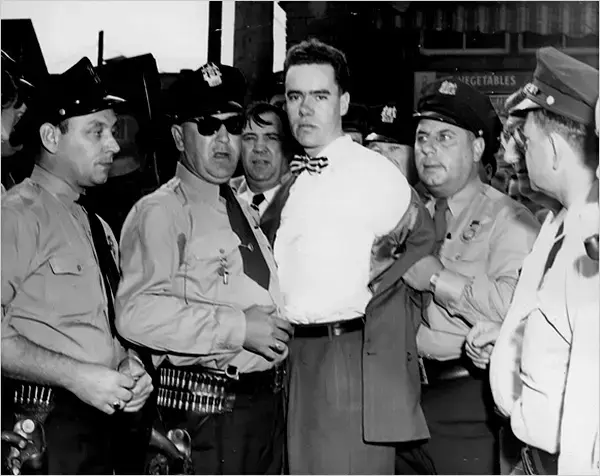
He emerged from the rear of the building and fell at the feet of the waiting officers. As Sergeant Earl Wright snapped handcuffs onto his wrists, someone in the crowd cried out "Lynch him!" No one moved. Detective Vincent Connelly asked him: "What's the matter with you? Are you a psycho?"
Unruh looked at him steadily. "I'm no psycho. I have a good mind."
He was bleeding from the gunshot wound in his thigh. He'd said nothing about it during the entire siege. It was only the bloodstain on his chair during the subsequent police interview that gave it away.
What Was Found in His Apartment
When officers searched Unruh's flat, they found over 700 rounds of ammunition in various calibres, alongside a collection of weapons and military paraphernalia. On his bedroom walls hung crossed pistols, crossed bayonets, and wartime photographs.
On the table, his Bible lay open to the 24th chapter of Matthew, the passage about the end of days and coming judgement.

As for the Luger he'd used to kill thirteen people, it ended up in the personal locker of Detective Ron Conley, following the somewhat relaxed police practices of the era. Conley held onto it for decades. It was only recovered in the early 1990s and finally handed over to the Camden County Prosecutor's Office as evidence.
The Trial That Never Happened
On 22 September 1949, a grand jury formally indicted Unruh on thirteen counts of first-degree murder and three counts of assault with intent to kill. But he never stood trial.
A panel of psychiatrists examined him over several weeks and, on 7 October 1949, unanimously declared him legally insane. Their official classification was "dementia praecox, mixed type, with pronounced catatonic and paranoid coloring." Under New Jersey law, an insane person couldn't be tried. Camden County prosecutor Mitchell Cohen (no relation to the Cohens of River Road) made a public statement that day: "So long as I live, I shall vigorously oppose any attempt by anyone at any time to have this man released into society."
Unruh was committed to the Vroom Building, the maximum-security ward of the New Jersey State Hospital in Trenton (now Trenton Psychiatric Hospital), where he would remain for the rest of his life.
During his initial interrogation, before the insanity finding, Unruh had been remarkably candid. He expressed no remorse, described each shooting in detail, and said he would "do the same thing again" given the chance. He named additional people he'd intended to kill but had missed, including the tailor, the restaurant owner, and a boy named Sorg who'd stolen electricity from his supply by plugging Christmas tree lights into an outdoor socket the previous December.
The Man Who Won a Pulitzer Writing About It
The morning of the shootings, the New York Times assigned the story to its star reporter, Meyer Berger. Berger spent the day retracing Unruh's steps and interviewing around fifty witnesses. He then sat down and typed the entire 4,000-word account in two and a half hours. It was published the following morning, essentially unedited.
The piece won the 1950 Pulitzer Prize for Local Reporting.
Berger donated the entire $1,000 prize money to Unruh's mother.
Sixty Years in a Cell
Howard Unruh spent over six decades in psychiatric confinement. His mother was the only person he agreed to correspond with or receive visits from, and she maintained regular contact with him until her death in June 1985.
In 1979, he applied to be transferred to a lower-security facility closer to where his mother lived. The hospital administrator supported the move. It was denied anyway, on the grounds of overwhelming public opposition.
In 1993, as his physical and mental health deteriorated, he was moved from the maximum-security Vroom Building to a geriatric unit on the same hospital grounds.
A 1980 psychiatric report noted that "his mental condition has deteriorated greatly. His physical condition has also deteriorated and he has aged far beyond what would be expected merely by the number of years that have passed."
He gave occasional interviews over the years. Sometimes he appeared remorseful. More often, he was detached. One of his final public statements, made to a psychologist, was: "I'd have killed a thousand if I'd had bullets enough."
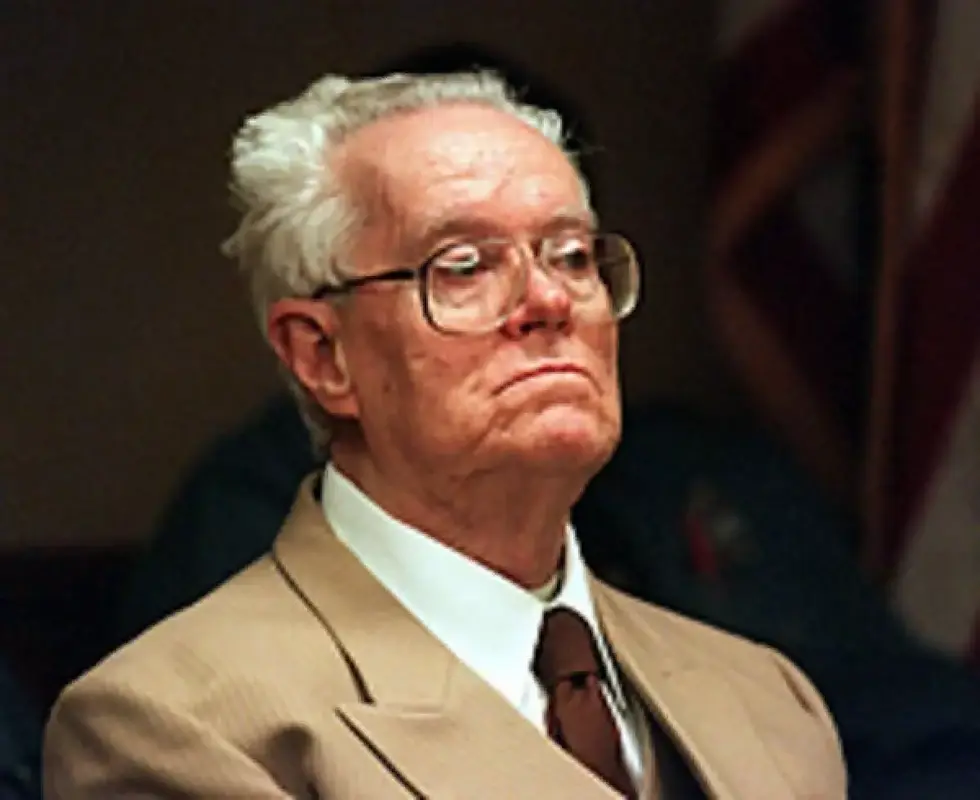
Howard Barton Unruh died on 19 October 2009, at the age of 88. At the time of his death, he was the oldest person incarcerated in the state of New Jersey. He had no known survivors.
The Survivor Who Outlasted Him (Barely)
Charles Cohen, the 12-year-old boy who'd hidden in a closet while Unruh killed both his parents and his grandmother in the rooms around him, lived with the aftermath of that morning for the rest of his life.
He spent decades campaigning to ensure Unruh stayed locked up. In 2009, aged 72, he gave one of his final interviews and said: "You get through it, but you never get over it. I think about my parents every day."
Three days after that interview, Charles Cohen died of a stroke. He was buried on the 60th anniversary of the Walk of Death, the same day his family had been killed six decades earlier.
Howard Unruh died a little over a month later.

The Gate Was Returned That Evening
One strange footnote: on the evening of the shootings, the person (or persons) who had stolen Unruh's security gate quietly returned it to the property.
Their identity was never established. The case was never pursued. The gate simply appeared back where it had been, as though someone, somewhere, understood exactly what they'd set in motion.
Why Howard Unruh Matters to History
The Camden shootings remained the deadliest mass shooting in the United States until Charles Whitman climbed the University of Texas tower in 1966 and killed 16 people. They're widely regarded as the first example of a lone-gunman mass shooting in post-war America, the template for a form of violence that would eventually become a grim and recurring feature of American life.
Several things about Unruh's case feel startlingly modern. The grievance list. The careful planning. The targeting of ordinary civilians in public spaces. The standoff with police. The psychiatric diagnosis that prevented a trial. The arguments about mental illness, gun access, and what society failed to notice in time.

Why Howard Unruh Matters to History
The Camden shootings remained the deadliest mass shooting in the United States until Charles Whitman climbed the University of Texas tower in 1966 and killed 16 people. They're widely regarded as the first example of a lone-gunman mass shooting in post-war America, the template for a form of violence that would eventually become a grim and recurring feature of American life.
Several things about Unruh's case feel startlingly modern. The grievance list. The careful planning. The targeting of ordinary civilians in public spaces. The standoff with police. The psychiatric diagnosis that prevented a trial. The arguments about mental illness, gun access, and what society failed to notice in time.
The federal government responded to the Camden shootings by announcing increased funding for mental health resources for World War II veterans. It was a small measure, and by then, far too late for the thirteen people on River Road.
In the immediate aftermath, tailor Tom Zegrino, one of Unruh's intended targets who happened not to be in his shop that morning, described the man who had just killed his wife of two months as "awfully polite. The kind of guy who wouldn't hurt a flea." His wife Helga, before she died, had told a journalist the same thing: "I think he's a nice fellow. He seems devoted to his mother."
That's perhaps the most unsettling part of all of it. Howard Unruh didn't look like what he was. He looked like a quiet man in a good suit on his way somewhere ordinary.
Sources
Meyer Berger, "Veteran Kills 13 in Mad Rampage on Camden Street," The New York Times, 7 September 1949. Pulitzer Prize-winning original report: https://www.pulitzer.org/article/mass-shooting-tight-deadline
Smithsonian Magazine, "The Story of the First Mass Shooting in U.S. History" (2022): https://www.smithsonianmag.com/history/story-first-mass-murder-us-history-180956927/
Wikipedia, "Howard Unruh" (comprehensive documented entry with cited primary sources): https://en.wikipedia.org/wiki/Howard_Unruh
Meyer Berger, Wikipedia biographical entry including Pulitzer details: https://en.wikipedia.org/wiki/Meyer_Berger
The Pulitzer Prizes, official entry for Meyer Berger (1950): https://www.pulitzer.org/winners/meyer-berger
Weird NJ, "Howard Unruh's Walk of Death" (includes details on the Luger's post-shooting history): https://weirdnj.com/stories/howard-unruh/
AJC / Associated Press, "Florida Shooting Survivor's Grandpa Saw Family Slain in First U.S. Mass Shooting" (2018, includes Charles Cohen's final interview): https://www.ajc.com/news/national/florida-shooting-survivor-grandpa-saw-family-slain-first-mass-shooting/M6LF1UT5vnE5CjUTFlnbLL/
FBI Records Vault, Howard Unruh file (FOIA release): https://vault.fbi.gov/Howard%20Unruh
Camden County Historical Society, South Jersey History Project archives: https://www.cchsnj.org/
PBS NewsHour, "The Origins of the Modern Mass Shooting": https://www.pbs.org/newshour/nation/
NJ.com / Star-Ledger, "Remembering the Walk of Death: Howard Unruh's 1949 Rampage": https://www.nj.com/news/
Mel Ayton, Hunting Howard Unruh: America's First Mass Murderer (Arcturus, 2022)


