

The Girl in the Box: The Harrowing Kidnapping of Colleen Stan
Updated: May 15
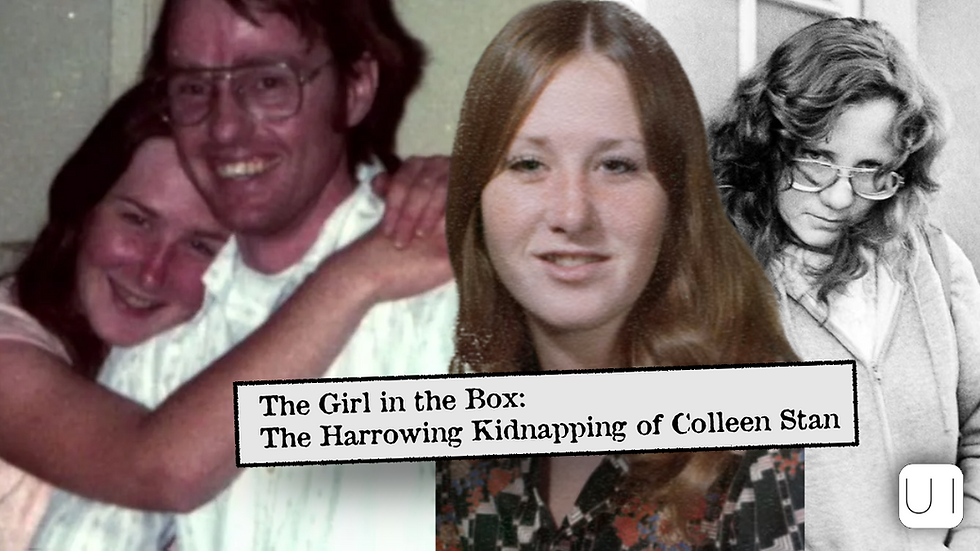
On the morning of 19 May 1977, a 20-year-old woman named Colleen Stan stood on the roadside in Red Bluff, California, having already turned down two rides she didn't feel good about. She was hitchhiking from her home in Eugene, Oregon, to Westwood, California, to celebrate a friend's birthday. When a blue van slowed to a stop and she saw a young woman holding a baby in the passenger seat, she felt safe enough to climb in.
That decision would cost her seven years of her life.

What followed was one of the most disturbing and psychologically complex cases of prolonged captivity in American criminal history. Colleen Stan wasn't held in a dungeon beneath a stranger's house. She was confined in a wooden box under a couple's waterbed, allowed out to babysit their children, permitted to visit her parents, and even given a part-time job. She didn't run. She didn't scream for help. She didn't tell a soul.
Understanding why is the real story.
The Hookers: Who They Were Before Colleen
Cameron Hooker was born on 5 November 1953. By his early twenties he was working at a lumber mill in Red Bluff, a small town in Tehama County in Northern California. He was a skilled carpenter, methodical and controlled. He'd met his future wife, Janice, in 1973 when she was just 16 years old. From the beginning of their relationship, Cameron introduced her to a world of bondage and sadistic sexual fantasy. Janice later testified that she had been subjected to Cameron's controlling behaviour throughout their entire relationship, and that she had developed ways of compartmentalising her life to cope.
The two had an arrangement, as disturbing as it sounds. Janice agreed that Cameron could pursue his fantasy of keeping a female slave, on the condition that he would not have vaginal sex with this person and would remain faithful to her. It was an agreement rooted in Janice's own subjugation to Cameron's will, and one he would ultimately disregard entirely. Cameron had reportedly been inspired by the 1954 French erotic novel Story of O, which depicts a woman who consents to sexual slavery, and wanted to recreate its dynamics in real life.

Before Colleen, they had already tried.
The Murder of Marie Elizabeth Spannhake
A year before Colleen's abduction, on 31 January 1976, an 18-year-old woman named Marie Elizabeth Spannhake, known to friends as Marliz, vanished in Chico, California. She'd had an argument with her boyfriend at a local flea market and was walking home along Mangrove Avenue when Cameron and Janice Hooker pulled up beside her and offered a ride.
She accepted.
According to Janice's later testimony to police, Cameron drove Spannhake toward her destination on Rio Linda Avenue, then, as Janice opened the door to let her out, Cameron grabbed Spannhake by the wrist and dragged her back inside the car. They drove her to their home, took her to the basement, stripped her, and hung her from the rafters by her wrists. Cameron placed his specially constructed wooden headbox over her head.
Spannhake wouldn't stop screaming. Cameron, according to Janice, attempted to damage her vocal cords. He shot her twice in the abdomen with a pellet gun. When she was still alive and capable of communication, she persuaded Cameron to give her a pen and paper, and wrote: "I'll give you anything you want if you let me go."
He strangled her to death that same night.

Janice told police Cameron came back upstairs in a state of distress, asking, "What did I do?" Together they wrapped Spannhake's body in a blanket, drove out of town, and buried her in a shallow grave near Lassen Volcanic National Park. Cameron wore a watch that had belonged to Spannhake for years afterward, until it was eventually crushed at his job at the lumber mill.
Spannhake's body was never found. Cameron was never charged with her murder.
Colleen Stan would later tell investigators that during her years of captivity, she saw a photograph propped up in the space under the bed where she was kept, positioned against the wall. It looked like a school portrait. Every time she climbed in and out of the box, she could see it. She believed it was a picture of another victim. It was almost certainly Spannhake.
19 May 1977: The Day Colleen Got into the Van
Colleen Stan was an experienced hitchhiker. She knew how to read a situation. She'd already declined two rides that morning because something hadn't felt right. But when Cameron's blue van pulled over and she saw Janice sitting in the passenger seat holding their baby, every instinct told her this was safe. A family. A mother. A child.
She climbed in.
When they stopped at a petrol station along the way, Colleen got out to use the bathroom. She later recalled that something inside her said to run, to climb out of a window and not look back. She didn't listen. She talked herself out of it and returned to the van.
About 20 miles further along the road, Cameron turned down a side road, claiming he wanted to take a look at some nearby caves. Janice took the baby and walked down toward a lake. Then Cameron climbed into the back of the van, held a knife to Colleen's throat, tied her up, gagged her, and forced the wooden headbox over her head.

The box weighed around 20 pounds. Cameron had built it himself. It was lined with soundproofing material and designed to block out light, sound, and fresh air entirely. Colleen was plunged into complete darkness.
They drove her back to the Hooker home on Oak Street in Red Bluff.
The First Five Months: The Basement
That night, Cameron stripped Colleen and hung her by her arms from the basement rafters. When she cried and tried to find something to rest her feet on, he whipped her.
Through her blindfold she could just about make out a magazine lying open to a photograph of a woman hanging in a similar position. When Cameron and Janice had finished having sex with each other in front of her, he let her rest her toes on a box briefly before hanging her again.
The following morning, he moved her onto a homemade rack he'd built himself, chaining her wrists and ankles to its four corners and leaving her there for an entire day.
For the next five months, Colleen remained in the basement, naked, gagged, blindfolded, and wearing the headbox. She was allowed out of the box just once a day to eat, drink, and use the bathroom, always in Cameron's presence. He regularly suspended her from the rafters, constricted her breathing, whipped her, and burned her. She was given the name Kay, later shortened to K, and was forbidden from speaking without permission.

Cameron told her she was to model herself on the submissive female character in Story of O. He began orally raping her almost immediately. He didn't pursue vaginal sex at this stage because he'd told Janice he wouldn't, but he used implements to rape her vaginally and anally instead.
In 1978, Janice gave birth to the couple's second child. Colleen was in the box underneath the waterbed when Janice delivered.
The Slavery Contract
In 1978, Cameron presented Colleen with a contract. She signed it. In it, she pledged herself to Cameron as his property for life, agreeing to obey him in all things. The contract formalised what Cameron had already made a reality through fear and systematic degradation.
Cameron also created The Company.
He told Colleen that The Company was a vast, shadowy organisation with eyes everywhere. They were watching her at all times. If she tried to escape, they would hunt her down and torture her. If she ran to her family, The Company would hurt them too. There was no point in running, no point in screaming, no point in trying. Resistance was not just futile but fatal to the people she loved.

He told her it had elements of a satanic organisation. He enforced The Company's presence through a set of rigid rules Colleen had to follow at all times. The psychological architecture of her captivity was as confining as the wooden box itself.
Life in the Box
After the first five months in the basement, the Hooker family moved to a mobile home in Red Bluff. Cameron built a new box, this time coffin-shaped, designed for Colleen to lie flat. It was placed under the couple's waterbed. Colleen spent up to 23 hours a day inside it, dealing with bodily functions using a bedpan she had to manoeuvre with her feet, surviving on scraps of food.
She was allowed out for one to two hours each day, during which time she cooked, cleaned, and looked after the Hooker children. The couple had two young daughters who were told that Colleen went home every night. They had no idea she was living beneath their parents' bed.
"Anytime I was taken out of the box, I never knew what to expect," Colleen later said. "Fear of the unknown was always with me as I was kept in the dark both physically and mentally."

During this period Cameron continued to rape Colleen regularily. Despite his agreement with Janice, he had discarded it quietly and without explanation. Janice began to resent Colleen, though she continued to participate in and enable the captivity.
Colleen's physical health deteriorated. The chronic confinement caused severe and lasting damage to her shoulders and back, injuries she has carried into adult life.
The Visit to Her Parents
In March 1981, nearly four years into her captivity, Cameron made a decision that shocked even those who later studied the case. He allowed Colleen to visit her parents alone.
She went. She sat with her family. She didn't say a word about what was happening to her.
Her parents were concerned. She was wearing homemade clothes, had very little money, and hadn't been in proper contact for years. They assumed she'd joined a cult of some kind and were frightened of pushing her away by asking too many questions. They took a photograph of her and Cameron together when he came to collect her, Cameron posing as her boyfriend.

"I was so scared of Cameron and The Company that even when I was alone with my parents, I didn't tell them where I'd been for three years," she later told Closer magazine. "We mostly talked about everything I'd missed out on. They were convinced I'd joined a cult."
When she returned, Cameron decided he'd given her too much freedom. He locked her back in the box for the next three years, barely letting her out at all.
Working at the Motel
By 1983, Cameron's grip had evolved in a different direction. He allowed Colleen to take a part-time job as a cleaner at a local motel. She went to work. She interacted with people. She handed her entire wage packet over to Cameron when she got home.
She didn't ask for help. She didn't try to leave.
The psychological conditioning Cameron had built over six years had become total. The Company was as real to Colleen as the walls around her. The idea of breaking free had been systematically dismantled from the inside.
The Breaking Point: Janice Tells the Truth
By 1984, Janice had had enough. Years of witnessing Cameron's abuse, combined with her own long experience of being his victim, had brought her to a point of collapse. But what finally made her act was Cameron's announcement that he wanted to take Colleen as a second wife and sex slave. It crossed a line Janice had drawn for herself, and she broke.
Before going to police, Janice had also confessed to a priest, who counselled her to leave. In August 1984, seven years and three months after Colleen had stepped into that blue van, Janice told her the truth.
The Company didn't exist. There was no organisation. No one was watching. No one was going to hurt her family. Cameron had invented all of it.
Colleen walked out of the house.

She even phoned Cameron afterward to tell him she was leaving him. He broke down and wept. Despite everything he had done to her, the years of conditioning meant she still experienced him as a human being capable of feeling. At Janice's request, Colleen agreed to give Cameron a chance to change. She did not go to the police.
Three months later, Janice did.
The Murder Confession and What Came Next
On 7 November 1984, Janice Hooker walked into the Red Bluff Police Department and told Lieutenant Jerry Brown everything. She described Colleen's captivity in detail. She also told him about Marie Elizabeth Spannhake.
Investigators pursued the Spannhake lead as far as they could. They searched near Lassen Volcanic National Park. They couldn't find her. Janice claimed that everything belonging to Spannhake had been burned, except for the watch Cameron had worn until it was destroyed at the mill. Without a body and without physical evidence, the District Attorney's office couldn't bring a murder charge. Cameron denied any involvement in Spannhake's disappearance.
Her case remains officially unsolved. Marie Elizabeth Spannhake is still listed as a missing person.
The Trial of Cameron Hooker
Cameron's trial took place in 1985 in San Mateo County, after a change of venue was granted due to the level of local publicity in Tehama County. He was represented by a defence that argued Colleen had remained of her own free will and that their relationship had been consensual. The prosecution produced the headbox, photographs, the slavery contract, and the coffin-like box as physical evidence.
Colleen and Janice both testified. Janice received full immunity from prosecution in exchange for her cooperation.

The judge described Cameron as "the most dangerous psychopath I have ever encountered." The jury convicted him of kidnapping, rape, oral copulation, rape with a foreign object, and sodomy, finding him guilty on seven of eight counts. He was sentenced to a combined term that effectively amounted to 104 years in prison.
At his trial, FBI investigators described Colleen's ordeal as unparalleled in American criminal history.
Cameron Hooker: Still Fighting for Freedom
Cameron Hooker's legal story didn't end in 1985. Over the decades that followed, he accumulated good behaviour credits in prison, making him eligible for release under California's Elderly Parole Program well ahead of his original schedule.
His first parole hearing came in 2015. It was denied. In 2021, he was technically released to parole status, but immediately transferred to the custody of the California Department of State Hospitals to undergo Sexually Violent Predator proceedings, a legal mechanism designed to keep dangerous offenders in secure psychiatric facilities.

The SVP trial has been delayed multiple times, originally scheduled for March 2024, then pushed back again. A jury trial was set for 26 January 2026. As of May 2026, the trial is underway in San Mateo County, with jury selection begining on 18 May 2026. A state prison psychiatrist has already diagnosed Hooker as a sexual sadist and sexually violent predator. Prosecutors must convince a jury of the same finding to keep him civilly committed indefinitely.
The Tehama County District Attorney's Office has been unequivocal. "The crimes against Ms. Stan occurred over a seven-year period," they stated. "What is most concerning is that he is suspected in the kidnapping and torture of another woman, Marie Spannhake. However, due to the fact that her body cannot be located, he was never charged or convicted of those crimes. His release cannot be allowed to happen."
Cameron Hooker remains in custody while the trial proceeds.
What Happened to Janice Hooker?
Janice Hooker took full immunity in exchange for her testimony, a deal that drew significant criticism from legal commentators and the public alike. Many felt she had been a willing participant for too long and caused far too much harm to walk away entirely free.
Supporters of the deal pointed out that without Janice's cooperation, the case might never have been successfully prosecuted, and that Colleen's story might never have been believed. They also noted that Janice had herself been a victim of Cameron's abuse from the time she was a teenager.
After the trial, Janice changed her surname and disappeared from public life. According to reports, she went on to work as a social worker in California, a fact that prompted its own wave of public commentary. She and Cameron divorced. Colleen Stan has confirmed she has no contact with Janice and has no interest in establishing any.
Janice has not given a substantive public interview since her courtroom testimony in 1985.
Where Is Colleen Stan Now?
After leaving the Hooker home in 1984, Colleen changed her name to protect her privacy and began the long process of rebuilding. She underwent years of therapy to process the trauma of captivity and the psychological control Cameron had exerted over her.
She has spoken publicly on a number of occasions, always with a focus on healing and education rather than bitterness. "Life today is good," she told documentary producers. "You have to learn how to live in the now and not let that past drag you back."
She became a mother and is now a grandmother. She continues to live in California. She has participated in several television documentaries about her case and has spoken about the importance of understanding psychological abuse as a form of violence equal to physical restraint.
"I learned I could go anywhere in my mind," she told People magazine in 2016. "You just remove yourself from the real situation going on and you go somewhere else. You go somewhere pleasant, around people you love."
Colleen suffers from chronic pain in her shoulders and back as a lasting physical consequence of the years she spent in the box.
The Psychology Behind the Captivity
The Colleen Stan case is cited extensively in academic and law enforcement discussions of coercive control, trauma bonding, and learned helplessness. The term Stockholm syndrome is often applied loosely, though many psychologists prefer more precise language when discussing her case.
What Cameron Hooker created was not simply a physical prison. He dismantled Colleen's sense of reality, replacing it with one in which escape was impossible, help was unavailable, and obedience was the only rational response to her situation. The Company was a masterpiece of psychological engineering, a fictional threat that operated as effectively as any locked door.
Colleen's compliance was not consent. It was survival.
Her case fundamentally changed how law enforcement and prosecutors approached cases involving long-term captivity, particularly where victims appeared to have had opportunities to escape that they didn't take. It shifted the conversation from "why didn't she leave?" to "what had been done to her mind to make leaving feel impossible?"
Cultural Legacy
The case inspired the 2003 book The Perfect Victim by prosecutor Christine McGuire and journalist Carla Norton, which remains one of the most detailed legal accounts of the case.
A Lifetime television film, Girl in the Box, premiered on 10 September 2016, starring Addison Timlin as Colleen, Zane Holtz as Cameron, and Zelda Williams as Janice.
The case has been the inspiration for several fictional television episodes, including the Criminal Minds episode The Company in season seven, a Law and Order: SVU episode called Slaves in season one, and a Ghost Whisperer episode titled Ball and Chain in season four.
The 2007 horror film The Poughkeepsie Tapes drew on the central elements of Colleen's case in its narrative.
Netflix's Unsolved Mysteries revisited the connected disappearance of Marie Elizabeth Spannhake in Volume 3, Episode 8.
Colleen's ordeal has shaped training programmes for law enforcement and social workers across the United States, contributing to a broader understanding of coercive control that has influenced domestic abuse legislation and victim support frameworks.
A Story That Still Isn't Over
Colleen Stan stepped out of that wooden box in 1984. Cameron Hooker stepped into a courtroom in 1985. Nearly forty years later, the legal machinery set in motion by that case is still turning.
Colleen has rebuilt her life in ways that people who know only the surface of her story might find difficult to comprehend. She has raised a family, found peace, and made something whole from what was broken. She's also ensured, through her testimony and her ongoing public presence, that Cameron Hooker hasn't been able to quietly disappear into old age.
As of spring 2026, with his SVP trial now underway, that remains true.
Not all prisons are made of wood and darkness. Some are made of lies. Cameron Hooker understood that better than almost anyone. What he perhaps didn't count on was that Colleen Stan, once she knew the truth, would prove just as hard to contain as he once made her believe she was.
Sources
FindLaw: People v. Hooker (1988) — https://caselaw.findlaw.com/court/ca-court-of-appeal/1771222.html
McGuire, C. & Norton, C. (2003). The Perfect Victim. Berkley Books.
Crime + Investigation UK: Colleen Stan — https://www.crimeandinvestigation.co.uk/article/colleen-stan-the-girl-in-the-box
Investigation Discovery: Girl in the Box — https://www.investigationdiscovery.com/crimefeed/survivor-stories/girl-in-the-box-held-captive-under-california-couples-bed-for-7-years
Oxygen / Snapped Notorious: Girl in the Box — https://www.oxygen.com/snapped/crime-news/girl-in-the-box-colleen-stans-story-explained
The Charley Project: Marie Elizabeth Spannhake — https://charleyproject.org/case/marie-elizabeth-spannhake
The Line-Up: Marie Elizabeth Spannhake — https://the-line-up.com/marie-elizabeth-spannhake
Newsweek: Where is Cameron Hooker Now — https://www.newsweek.com/unsolved-mysteries-cameron-hooker-now-colleen-stan-marie-elizabeth-spannhake-1756613
KRON4: Trial begins for Girl in the Box kidnapper — https://www.kron4.com/news/bay-area/trial-begins-for-girl-in-the-box-kidnapper-in-san-mateo-county-courthouse/
San Mateo Patch: SVP Proceedings 2026 — https://patch.com/california/sanmateo/hearing-begins-keep-parole-eligible-sexually-violent-predator-civilly-committed
People Magazine: Colleen Stan interview 2016 — https://people.com/where-is-colleen-stan-now-girl-in-the-box-kidnapping-8648943


