

Pink Floyd's Floating Concert In Venice That Forced The City Council To Resign, 1989
Updated: Mar 19

On the evening of the 15th of July 1989, as the light faded over the Venetian lagoon and the domes of St Mark’s Basilica glowed in the summer heat, Venice became the unlikely stage for one of the most controversial concerts in European music history. Pink Floyd, a band synonymous with stadiums and vast open spaces, performed on a floating stage moored just off Piazza San Marco. More than 200,000 people gathered to watch. By the time the last notes faded, the concert had not only entered rock folklore but had also triggered the resignation of Venice’s mayor and the entire city council.
The idea had begun with a mix of cultural ambition and political optimism. Venice’s city authorities agreed to host a free concert in the historic heart of the city, to be broadcast live on television across more than a dozen countries. In an era when large scale televised events were increasingly seen as markers of international relevance, the council defended its decision by arguing that Venice “must be open to new trends, including rock music”.

For many residents, the announcement was thrilling. Pink Floyd were at the height of their late career revival, touring after the release of A Momentary Lapse of Reason, and their performances were known for their scale and technical sophistication. The prospect of such a band performing against the backdrop of San Marco seemed, to some, like a once in a lifetime collision of popular music and historic grandeur.

For others, the reaction was immediate and hostile. Older Venetians in particular voiced strong objections, calling for the concert to be banned outright. Their concerns were not abstract. Venice is a city acutely aware of its physical fragility, and the idea of hundreds of thousands of people converging on its most famous square raised fears of irreversible damage to ancient stonework, mosaics, and foundations. There was also a strong cultural objection. The concert was scheduled close to the Festa del Redentore, the Redeemer Festival, one of Venice’s most important religious and civic celebrations. Critics argued that a global rock broadcast would erode the cultural integrity of a tradition rooted in local history and communal memory.
These objections were articulated bluntly by figures within the city’s own administration. “Historic centres should not be used for performances that are incompatible with their historic nature,” said Augusto Salvadori, a former Venice commissioner for tourism, in comments to The New York Times. “If they want rock, let them do it in a football stadium, but not in the Piazza San Marco.”
The controversy intensified just days before the scheduled performance. Three days before the concert, Venice’s superintendent for cultural heritage formally vetoed the event. The reasons were stark. The amplified sound, it was argued, could damage the mosaics of St Mark’s Basilica, while the sheer weight of the crowd risked destabilising the piazza itself, which already sat on centuries old foundations in a city slowly sinking into the lagoon.

At this late stage, cancellation would have been an international embarrassment. Negotiations resumed urgently, and a compromise was eventually reached. Pink Floyd agreed to reduce the sound levels from 100 decibels to 60, and the performance was moved off the square itself. Instead, the band would play on a floating stage positioned around 200 yards from San Marco. The solution was framed as being in keeping with Venetian tradition, joining what organisers described as “a long history… of floating ephemeral architectures” on the city’s canals and lagoons.
On the night, the spectacle was carefully choreographed for a global audience. Filmed by state run broadcaster RAI, the concert was transmitted “in over 20 countries with an estimated audience of almost 100 million”. The demands of live satellite broadcasting imposed strict limits. Several songs were shortened, others removed entirely, and the band were required to adhere to an exact running order to the second.
Around the floating stage, the lagoon filled with boats. Traditional Venetian vessels clustered alongside modern craft, including sandalo rowing boats and Sanpierotta fishing boats, their occupants watching from the water. On land, Piazza San Marco and the surrounding areas were packed to capacity. Many who attended later described it as one of the most extraordinary live performances they had ever witnessed, not only because of the music, but because of the setting itself.

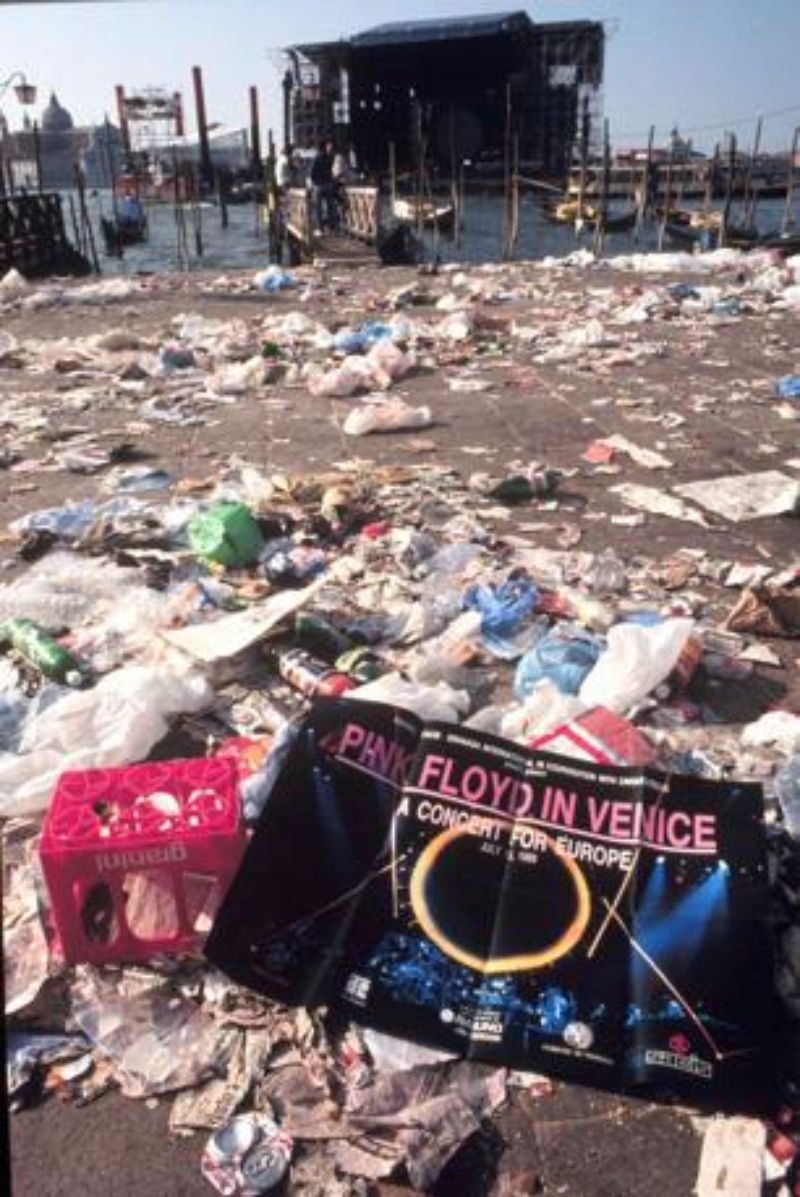
Yet the scale of the crowd quickly overwhelmed the city’s infrastructure. In the aftermath, officials reported that concertgoers had left behind around 300 tons of rubbish, along with 500 cubic metres of empty cans and bottles. The situation was made far worse by the failure to provide adequate portable toilets. With nowhere else to go, many in the crowd relieved themselves against walls and monuments, leaving visible damage and an enduring sense of humiliation among residents.
Public anger boiled over almost immediately. Two days after the concert, Mayor Antonio Casellati attempted to address the situation publicly and calm tensions. Instead, he was met with furious chants from residents shouting “resign, resign, you’ve turned Venice into a toilet.” The outrage was not symbolic. Casellati stepped down, and with him went the entire city council that had supported the decision to host the event.
From the band’s perspective, the experience was both exhilarating and deeply stressful. David Gilmour later reflected on the performance with a mixture of pride and frustration. “The Venice show was great fun, but it was very tense and nerve wracking,” he said. “We had a specific length of show to do; the satellite broadcasting meant we had to get it absolutely precise.
“We had the list of songs, and we’d shortened them, which we’d never done before. I had a big clock with a red digital read out on the floor in front of me, and had the start time of each number on a piece of paper. If we were coming near the start time of the next number, I just had to wrap up the one we were on.”
Gilmour was particularly critical of the city authorities’ handling of the practical arrangements. “We had a really good time, but the city authorities who had agreed to provide the services of security, toilets, food, completely reneged on everything they were supposed to do, and then tried to blame all the subsequent problems on us.”
In retrospect, the 1989 Venice concert stands as a cautionary tale about the limits of spectacle in historic spaces. It highlighted the tension between global media events and local responsibility, between cultural openness and preservation. Pink Floyd did not set out to destabilise a municipal government, yet their performance exposed deep fractures in how Venice was governed and how its identity was negotiated at the end of the twentieth century.
The band left the city behind them much as they found it, floating away into the night. Venice, meanwhile, was left to reckon with the consequences. What remained undeniable was the power of the moment itself. For Italian fans in the square and millions watching from home, it was a concert they would never forget, even as the city struggled to forgive it.


