

When Muddy Waters and Sister Rosetta Tharpe Played a Train Station in Manchester, England in 1964
Updated: Mar 20

It began, quite unassumingly, on a damp Thursday evening, 7th May, 1964, at a place most people in Manchester had long since stopped thinking about. Wilbraham Road station in Whalley Range had been closed for years. Its platforms were quiet, the signage fading, and the tracks largely unused. For one night, however, it was brought back into service, not for ordinary passengers, but as the setting for a television recording that would introduce a particular strand of American music to a wider British audience.
A Disused Station Reimagined for Television
The event was organised by Johnnie Hamp of Granada Television, who had already worked with American performers on earlier programmes. Rather than stage the second Blues and Gospel Tour in a studio, Hamp chose to build the programme around movement and location. Audience members were issued tickets for a specially arranged train departing from Manchester city centre, with cameras capturing their journey as part of the broadcast. The intention was to create something that felt less staged than a conventional television performance, even though the production itself was carefully planned.

When the train arrived at the disused station, the audience stepped directly onto a platform that had been transformed for filming. Lighting rigs had been installed, camera positions fixed, and props arranged to suggest a stylised version of the American South. Station signs were altered, and the train itself was fitted with a cow catcher to reinforce the visual theme. For the purposes of the programme, the station was renamed “Chorltonville”. Although it appeared informal on screen, the setting was constructed with a clear visual plan in mind.
The Performers and Their Place in the Blues Tradition
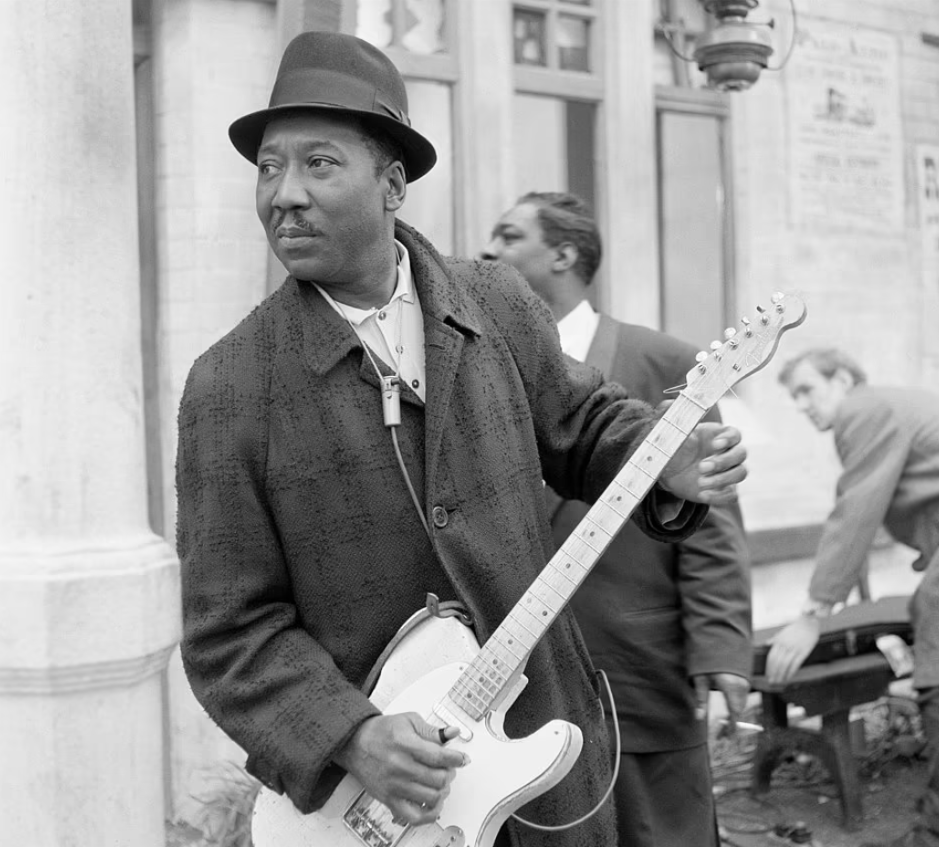
The performers who took to the platform were established figures within American blues and gospel, though not all were widely known to British audiences at the time. At the centre of the line up was Muddy Waters, whose move from Mississippi to Chicago had helped define a more amplified, urban form of the blues. His use of electric guitar and band based arrangements differed from earlier acoustic traditions and would later be taken up by British musicians exploring similar sounds.

Alongside him was Sister Rosetta Tharpe, whose career already stretched back several decades. Known for combining gospel vocals with electric guitar, she occupied a space between musical categories that were still being defined in the early 1960s. While her influence on later rock musicians is now widely recognised, at the time her work was not always clearly understood outside the United States.
The line up also included Sonny Terry and Brownie McGhee, whose performances relied on close musical interplay, as well as Cousin Joe, Otis Spann, and Reverend Gary Davis. Together, they represented a range of approaches within blues and gospel, from solo acoustic performance to full band arrangements.
Why Manchester Was Chosen
For many people in Britain, this was music that had previously been encountered only through imported records. Cities like Manchester had developed a particular interest in American rhythm and blues, with venues such as the Twisted Wheel introducing audiences to recordings that were not widely available elsewhere. Concerts at the Free Trade Hall regularly attracted large crowds, suggesting that there was already a receptive audience in place.
That interest had been evident during the first Blues and Gospel Tour in 1963, when Manchester was the only British stop. Among those reported to have travelled from London to attend were Eric Clapton, Jeff Beck, Keith Richards, and Brian Jones. Their presence reflected a growing curiosity among British musicians about the structure and sound of American blues.

Rain, Practical Challenges, and a Change in the Set
The weather on the evening of 7th May was unsettled. Rain began shortly after the audience arrived, creating practical difficulties for both performers and crew. Electrical equipment had to be protected, and performers adjusted their positioning on the platform to avoid the worst of the conditions. The rain also altered the visual character of the broadcast, giving it a more subdued and less controlled appearance than originally planned.
It was during this period that Sister Rosetta Tharpe made a small but notable change to her performance. She asked if she could alter her opening number and instead performed Didn’t It Rain. The choice suited the conditions without being presented as a deliberate piece of theatre. She stepped forward with her electric guitar and delivered the song in a way that drew attention from both the audience at the station and those watching later at home.

Some viewers later recalled that her guitar playing stood out in particular. At a time when lead guitar was still commonly associated with male performers, there was a degree of surprise among those unfamiliar with her work. One account described people looking around for the guitarist before realising it was her.
Broadcast to a National Audience
The programme, titled Blues and Gospel Train, was broadcast by Granada Television to an audience estimated at around ten million viewers. In 1964, British television was limited to a small number of channels, and viewing was often shared within households. As a result, the programme reached beyond the relatively small audience that might attend a live blues performance, bringing the music into a wider domestic setting.
For many viewers, the structure of the music itself was unfamiliar. Extended instrumental passages, call and response vocals, and a different approach to rhythm distinguished it from much of the British pop being produced at the time. Some responded immediately, while others required time to adjust to a style that did not follow familiar patterns.
Reception at the Time and Later Reputation
Contemporary reactions to the programme were not always framed in terms of long term importance. For some, it was simply an unusual and well produced broadcast. Its reputation has grown gradually, particularly as musicians who watched or attended later described its influence on their own work.
In the years that followed, elements of the styles performed that evening began to appear more prominently in British music. Bands such as The Rolling Stones drew directly from the work of artists like Muddy Waters, while musicians including Jimmy Page and John Paul Jones would later incorporate similar structures into their recordings. The connection was not the result of a single event, but part of a wider process of exposure and adaptation.
Wider Social Context and the Civil Rights Era
The programme also sat within a broader social context. During the early 1960s, British audiences were increasingly aware of the civil rights movement in the United States through news broadcasts. Images of demonstrations and violence were becoming more common. Against that background, Blues and Gospel Train presented Black American performers in a different light, as working musicians travelling internationally and performing to appreciative audiences.
For the performers, European tours offered practical advantages. By the mid 1960s, musical tastes in the United States had begun to shift, with younger audiences turning towards newer styles such as soul and Motown. In Britain and Europe, however, there was a developing interest in earlier blues forms, providing opportunities that were sometimes less available at home.
After the Broadcast
After its initial broadcast, Blues and Gospel Train was not widely repeated. Like many television programmes of the period, it existed primarily as a one time transmission. Over time, however, recordings have been preserved and circulated through archives and later releases, allowing it to be revisited by audiences who were not present in 1964.

Looking back, the programme provides a clear example of how American blues was presented to British audiences during a period of change. It brought together a group of performers, a receptive local scene, and a television format capable of extending their reach. The effect was not immediate or uniform, but it formed part of a broader shift in how this music was understood and adopted in Britain in the years that followed.


