


Ruth Snyder and the First Photograph of an Electric Chair Execution
Updated: Oct 6
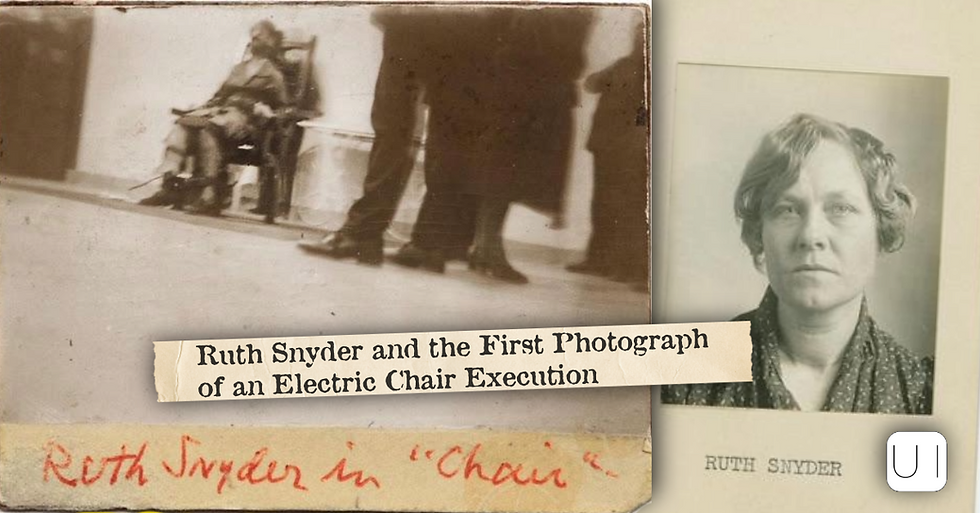
Just after 11pm on 12 January 1928, a man in the front row of the Sing Sing death chamber hitched up his trouser leg, pointed his toe at the electric chair and squeezed a rubber bulb hidden in his pocket. Within hours his blurred picture of Ruth Snyder dying was on the front page of the New York Daily News under a one-word headline: DEAD!
It was the first photograph of an electric chair execution and it's still the only one ever taken of a woman. Behind it sits one of the clumsiest murders of the 1920s, a forged insurance policy, a trial that got more column inches than Lindbergh's flight, and a newspaper stunt that took a month of rehearsal in a Manhattan hotel room. This is the whole story, from a wrong sort of marriage in Queens to an ankle camera in the Smithsonian.
Quick Answers
Who was Ruth Snyder? A Queens housewife who murdered her husband Albert on 20 March 1927 with her lover Judd Gray, hoping to collect on his life insurance.
Who took the photograph? Tom Howard, a Chicago Tribune photographer borrowed by the New York Daily News because nobody at Sing Sing knew his face.
How did he do it? With a one-shot miniature plate camera strapped to his ankle, fired by a cable that ran up his trouser leg to a bulb in his pocket.
When was it published? On 13 January 1928, in an extra edition that was on the streets within hours of the execution, and again the day after.
How many copies did it sell? The Daily News sold around half a million more copies than usual, taking that day's run to roughly 1.5 million.
Was anyone punished? No. New York's prison commissioner demanded a prosecution but no charges were ever brought.
Did the insurance pay out? No. A New York court later ruled the big policies void because the agent had forged Albert's signature.
Where's the camera now? At the Smithsonian's National Museum of American History, which got it from the Daily News in 1963.
Who were Ruth and Albert Snyder?
Ruth Brown was born in 1895 on 125th Street in Manhattan to a working-class Scandinavian family. She left school after the eighth grade, got a job with the telephone company and took night classes in shorthand and typing. At 19 she landed a secretarial post at Motor Boating magazine, where the art editor was a 32-year-old called Albert Snyder. They married in 1915.

It was a bad match from the start, as Ann Jones set out in a long American Heritage piece on the case. Ruth liked restaurants, the theatre and card games, and her friends called her Tommy because she was good company. Albert liked tinkering with his car, pottering in the garden and taking out his motorboat. Ruth loved animals and children. Albert put up with one canary, hadn't wanted to be a father and was disappointed when the baby turned out to be a girl.
He'd also never got over his late fiancée, Jessie Guischard, who died before they could marry. He kept a pin engraved with her initials and, as EBSCO's biography of Ruth puts it, he often compared his wife unfavourably with his first love. Even Ruth's own mother, Josephine Brown, who moved in with the couple after she was widowed, described Albert as glum and advised her daughter to get a divorce.
By the mid-1920s the family was living in an eight-room house at 93-27 222nd Street in Queens Village. On paper Ruth had everything a suburban wife was supposed to want: the house, a car, a radio, good furniture and money in the bank. In practice she was stuck in the suburbs with a man who didn't like going out.
Judd Gray and the suitcase at the Waldorf
In the summer of 1925 Ruth met Henry Judd Gray over lunch in Manhattan. Gray was a travelling salesman for a corset and brassiere firm, five feet five and about 120 pounds, with a spotless reputation back home in East Orange, New Jersey. He'd been married for 11 years to his childhood sweetheart and had a daughter Lorraine's age. He taught Sunday school, belonged to the Elks and the country club and had done Red Cross work during the war.

The affair ran for about 18 months. They met at the Waldorf-Astoria, where they kept a suitcase, and on some afternoons Ruth brought Lorraine along and left her riding up and down with the lift operators while she went upstairs. They wrote to each other in code and tipped postmen to keep the letters away from Albert. He called her Momsie.
Who first suggested murder was never established and each of them later said it was the other. Gray's line was that Ruth wore him down and threatened to tell his wife. Ruth's line, written from the death house, was that Gray kept touching her for money, saw other women on his sales trips and talked about killing Albert whenever he'd had too much to drink, which she said was most of the time.
The forged insurance policy
The insurance is where most retellings go vague, with figures anywhere from $45,000 to $100,000. The clearest account is in the court record. In Prudential Insurance Co. of America v. Snyder, the judge set out exactly what happened.
In October 1925 a Prudential agent called Leroy Ashfield visited the Snyders to discuss a modest $1,000 endowment policy. He put two application forms in front of Albert, who signed both, apparently thinking it was one form in duplicate. One of them was blank. After talking to Ruth alone, Ashfield filled in the blank form for $50,000 of cover that Albert had never discussed. When head office wanted the application amended, Ashfield forged Albert's signature by tracing it from the medical examiner's paperwork.
Three policies were issued: one for $1,000, one for $5,000 and one for $45,000. Only the largest carried an accidental death benefit, the double indemnity clause that paid twice over if Albert died by violence. That's where the famous total comes from. Add $1,000 and $5,000 to a doubled $45,000 and you get $96,000. Ashfield delivered the policies to Ruth on 24 November 1925. Albert never saw them. Ruth paid the premiums by cheque, $1,652.28 in all.
Ashfield was later sacked and jailed for forgery. Killing for a payout wasn't new and it didn't go away, as Jack Gilbert Graham proved when he blew up an airliner for one in 1955. But few people have ever gone about it as badly as Ruth Snyder did.
Seven failed attempts
Gray later claimed Ruth had tried to kill Albert at least seven times before he got involved. Testimony summarised in Encyclopedia.com's account of the trial covered several of them. Twice she disconnected the gas range while he slept. Once she shut the garage door on him while the car engine was running. When he was ill she slipped narcotics into his medicine. She also laced his whiskey with poison, so clumsily that Albert noticed the taste, poured it away and concluded that he needed to change bootleggers.
Through all of it, Albert never suspected his wife. By March 1927 Ruth had decided she needed help, and Gray agreed to give it.
The night of 20 March 1927
Gray prepared in advance. He bought what he needed beforehand and set up an alibi in Syracuse, about 250 miles away, where a friend called Haddon Gray (no relation) agreed to rumple his hotel bed, hang a Do Not Disturb sign on the door and post letters to his wife as though he'd never left. Haddon thought he was covering for an ordinary bit of adultery.
On the Saturday night the Snyders went out to a bridge party. Gray let himself into the house and waited in a spare bedroom, working his way through a bottle of bootleg whiskey Ruth had left out for him. They got home at about 2am and Albert went straight to bed.
What happened next depends on whose confession you believe. In Gray's version, which the jury accepted, he hit Albert with the five-pound sash weight and it wasn't enough. Albert woke up and fought, Gray shouted to Momsie for help and Ruth finished the job with the weight. They then stuffed chloroform-soaked cotton against his face and tightened picture wire round his neck. In Ruth's version she was in the bathroom, had spent the evening trying to talk Gray out of it and came back to find it done.
One detail the papers loved: Gray had wrapped the sash weight in paper, supposedly so that it wouldn't hurt Albert quite so much.
They then staged a burglary. Drawers were emptied and the contents thrown about. Albert's revolver was left on the bed, broken open, to suggest he'd reached for it. Ruth's jewellery went under a mattress. Gray tied her ankles, gagged her loosely and left for Syracuse. Ruth lay on the floor for several hours and then roused nine-year-old Lorraine, who fetched a neighbour.
“It don't look right”: how the story collapsed
Ruth told police she'd been attacked by a tall man with a dark moustache who looked Italian, and that she'd been unconscious for five hours. It wasn't a ridiculous story on its face, because the house had been burgled three times in the previous year. It fell apart in about a morning.

No door or window had been forced. A doctor found no bump or bruise where she said she'd been hit. Her feet were tied but her hands were free, and the bindings hadn't even marked her skin. The burglars had walked past Albert's gold watch and platinum chain. The stolen jewellery was under the mattress, and the sash weight was in the basement. One detective told her flatly, “It don't look right.”
Then there was the pin. Police found one on the bedroom floor marked J.G. and assumed the killer had dropped it. It was Albert's keepsake of Jessie Guischard, a dead woman's initials that happened to match a living man's. Ruth's address book, which listed 28 men, had a Judd Gray in it. When detectives asked what she knew about him, she asked whether he'd confessed. They let her believe he had, and she started talking.
Gray was picked up at his Syracuse hotel and called the whole thing ridiculous until he was told Ruth had named him. He confessed soon afterwards. By Tuesday both confessions were on the front pages, each one blaming the other. It was the same decade that produced Dolly Oesterreich and the lover she kept in her attic, but nobody mistook this for a clever crime. Damon Runyon christened it the Dumbbell Murder, because it was so dumb.
The trial that got more coverage than Lindbergh
Testimony ran from 27 April to 9 May 1927 in Long Island City, before Judge Townsend Scudder. Three years after Leopold and Loeb had shown how much newsprint a murder could shift, New York's three picture tabloids went to war over this one. The Daily News, the Daily Mirror and the Evening Graphic (nicknamed the Porno-Graphic) ran as many as eight Snyder stories a day across their editions, according to research summarised by JSTOR Daily. The Graphic simply made pictures up, pasting the defendants' faces onto the bodies of posed actors.

History.com counts 1,500 people in the courtroom each day and up to 2,000 in the street outside, with hawkers selling fake tickets at $50 and sash-weight souvenir pins at ten cents. Smithsonian Magazine notes that the case got more column inches than Charles Lindbergh's Atlantic flight, which happened 11 days after the verdict.
The press benches were stuffed with celebrities hired to have opinions. D.W. Griffith and David Belasco were there. So was Natacha Rambova, Rudolph Valentino's second wife, who decided after an hour in court that Ruth had no heart. The Mirror, as PleaseKillMe's history of the coverage recalls, paid a phrenologist to examine Ruth's photographs. He compared her mouth to a crack in a dried lemon and found signs of treachery in her chin.
Two people in that courtroom would do more with the material than any of the hired names. James M. Cain was an editorial writer on the New York World at the time. The journalist Sophie Treadwell sat through the whole trial and never filed a word of it.
Two defendants, two standards
Because they were tried together, each defendant's lawyers could cross-examine the other, which Ruth's counsel called novel and dangerous. In practice it meant the pair did much of the prosecution's work for it.
It also wasn't an even contest, and this is the heart of Ann Jones's argument. Ruth was “Ruthless Ruth, the Viking Ice Matron of Queens Village”, the fiend wife and the marble woman. Reporters reviewed her skin, her hair and her frock. Gray, who had been unfaithful for just as long and had bought the weapons, was written up as a decent family man who'd been led astray. The detective who arrested him said he was as nice a gentleman as you'd want to meet. Even the district attorney called him an upstanding American.

His lawyers first tried insanity, sending in four alienists who X-rayed his head and tested his spinal fluid. When that went nowhere they switched to seduction. William Millard told the jury: “That woman, like a poisonous snake, drew Judd Gray into her glistening coils.” When Ruth tried to explain herself on the stand she was told repeatedly to answer yes or no.
The jury was all male, middle-aged and married. It took an hour and 40 minutes. An unofficial jury of six women and six men from the press bench had already voted to send her to the chair. When sentence was passed Ruth became hysterical, while Gray took it calmly.
Death row and the fight for clemency
The execution was first set for June 1927 and pushed back by appeals. One argued that Ruth was needed as a witness in the civil case over the insurance. Another argued that Gray should never have been tried alongside her. Both failed.
In the death house Ruth wrote her life story for the Mirror, a long and angry document in which Gray became a jackal hiding behind her skirts. She converted to Catholicism, which most of New York assumed was aimed at the state's Catholic governor, Al Smith. One account has her receiving 164 proposals of marriage. Gray read his Bible, prayed and advised young men to steer clear of bad liquor and bad women.
The politics were awkward. American women had only had the vote since 1920, and the line taken by the New York Times and by plenty of politicians was that equal rights meant equal penalties. Papers dug out Theodore Roosevelt's refusal, as governor, to spare Martha Place in 1899. It was an old argument, as old as Mary Surratt, and it conveniently ignored how differently the two defendants had been treated in court. Smith turned down both appeals on 10 January 1928, saying he found the prospect of executing a woman distressing but had been given no reason to interfere.
Why Tom Howard got the job
New York had banned cameras from executions since adopting the electric chair in 1888. Sing Sing's warden, Lewis Lawes, who opposed the death penalty himself, received more than 1,500 applications for 20 press seats. Daily News publisher Joseph Medill Patterson, whose paper sold itself as New York's Picture Newspaper and had a circulation above a million, wanted a photograph regardless.
His problem was that the guards at Sing Sing knew every news photographer in the city by sight. His answer, as Smithsonian Magazine tells it, was to borrow one from the Chicago Tribune, which was run by his cousin Robert McCormick. Tom Howard was 33, experienced and completely unknown in New York.
How the ankle camera worked
The Smithsonian's catalogue record for the camera says Howard was brought in a month ahead. The kit was a modified miniature plate camera strapped just above his ankle, with a long cable release running up inside his trouser leg to a bulb in his pocket. It held a single plate, so he had one chance.
The technical problem was light. Fast film didn't exist yet, the death chamber was dim and a flash would have got him thrown out before the current was switched off. The only option was a long exposure, held for several seconds, taken without looking through the camera at all. Howard would have to aim with the toe of his shoe.
So he rehearsed. For a month he sat in a Manhattan hotel room lifting his trouser cuff, squeezing the bulb, holding it for a few seconds and letting go. On the night he went in on a writer's credentials and got himself a seat in the front row.

11pm at Sing Sing
It was a cold night and a crowd had gathered at the prison gates. Estimates of its size run from 400 to the 3,000 that Lawes himself gave. Inside were 24 invited witnesses. Both prisoners had eaten the same last meal of roast chicken, soup, celery and mashed potatoes. Gray, who'd complained about prison coffee for months, added one instruction: “And I mean good coffee.”
State electrician Robert G. Elliott wasn't looking forward to it. He'd executed Sacco and Vanzetti the previous summer and would later execute Bruno Hauptmann for the Lindbergh kidnapping, but he'd never killed a woman. Crime Library's history of Sing Sing records that he told reporters he didn't like the job and asked Lawes for a $200 rise for doing it. Lawes said no.

By Sing Sing tradition the more distressed prisoner went first, so Ruth did. Sing Sing's electric chair had already killed the priest Hans Schmidt in 1916 and would kill Ethel Rosenberg in 1953. Ruth was only the third woman New York had electrocuted, after Martha Place at Sing Sing in 1899 and Mary Farmer at Auburn in 1909.
The best eyewitness account is Gene Fowler's report for the New York American, filed about half an hour afterwards. Ruth had been moved to a cell 20 paces from the chair. She walked in at 11pm between two matrons, wearing a brown smock with imitation pearl buttons, a short black skirt, black cotton stockings with the right one rolled down for the electrode, and brown felt slippers. A patch of her bobbed hair had been clipped. Her blonde hair had gone nearly grey in prison.
She was praying as she came in, cried out when she saw the chair and had to be helped into it. Fowler recorded her calling on Jesus for mercy and repeating Christ's words about forgiving those who don't know what they're doing. Lawes turned his face away.
Elliott sent 2,000 volts through her in three surges. In the front row Howard lifted his cuff, pointed his toe and held the bulb for about six seconds. That long exposure is why the picture is smeared. It isn't one instant but several seconds of a body under current. She was pronounced dead at 11.07pm.
Gray had the longer walk, 160 feet from the east wing. He came in at 11.08pm in a pressed grey suit, unaided, his lips moving along with the chaplain's Beatitudes, and was dead by 11.14pm. Elliott wrote in his diary: “This was a very exciting night, second only to the Sacco and Vanzetti night!” He later told Collier's it had been a grisly business.

Four hours to the front page
Howard was driven back to Manhattan in the back of a Ford sedan with no idea whether he'd got anything. The plate was developed, and there she was, slightly tilted and blurred but unmistakable. The News cropped the frame hard for the front page. Time's account of the picture notes that it had been shot at an angle and caught a guard's legs at the right-hand edge.
The original contact print is tiny, about 3.5cm by 5.4cm. Fans in a Flashbulb, the International Center of Photography's collections blog, has tracked the different editions and shows that the fuller frame takes in the prison chaplain and an autopsy table waiting beside the chair. Both bodies were autopsied that night.
By one account the first extras were on the street about four hours after Ruth died. The News captioned the picture “the most remarkable exclusive picture in the history of criminology”. The edition is said to have sold out in 15 minutes and the paper shifted about half a million more copies than usual. It ran the photograph on the front page again the next day. Howard's reward was a $100 bonus. The Mirror moved on and put Charles Lindbergh's face where Ruth's had been.

The fallout
Correction commissioner Raymond Kieb was furious and asked the state attorney general to prosecute both Howard and the newspaper, saying the photographer had betrayed the trust of prison officials and of the public. No charges were ever brought. Sing Sing's own answer was more practical. For decades afterwards, witnesses had to lift their trouser legs on the way in.
Elliott didn't hide what he thought of it in his memoir: “It was, indeed, a horrible picture.” The News argued that a camera had simply reported what a pencil and a typewriter couldn't. One of its own reporters later admitted that opinion split between people who thought it a great feat and people who thought it a disgrace.
Was it journalism?
That argument has never really been settled. The Smithsonian curator Shannon Perich has pointed out that the editors knew perfectly well a picture of a woman being killed would land differently from one of a man, and chose it for that reason. She also argues that, whatever the motive, it showed the public what the electric chair really did to a person. Former Daily News crime reporter David Krajicek has called it the picture that defined jazz journalism. Patterson's stated reason was that people ought to see what was done in their name. His other reason was that it would sell.
And it did sell. Hundreds of thousands of New Yorkers recoiled from the front page and bought it anyway. The same tension followed Weegee around New York's crime scenes a decade later, and it's the same uneasy overlap of punishment and spectacle that drew thousands to the last public execution in the United States in 1936. Britain had its own jolt in 1955, when the hanging of Ruth Ellis helped turn public opinion against the rope.
The picture's long afterlife
Hollywood got to it within five years. In Picture Snatcher, a 1933 Warner Brothers quickie shot in 15 days, James Cagney plays an ex-convict turned tabloid photographer who smuggles a camera into the death house on his ankle and photographs an execution. Ruth Snyder is never mentioned and didn't need to be.
Sophie Treadwell turned her notes from the trial into Machinal, which opened on Broadway on 7 September 1928, less than eight months after the execution. It makes its heroine an ordinary woman ground down by what's expected of her, which is more or less the reading Ann Jones arrived at half a century later. It's still regularly revived.
James M. Cain used the case twice, for The Postman Always Rings Twice in 1934 and then for Double Indemnity, which borrowed its title straight from the clause in Albert's policy. Billy Wilder filmed it in 1944 with Barbara Stanwyck and Fred MacMurray. Wilder even shot an execution scene, reportedly at a cost of $150,000, which was dropped after the censors called it “unduly gruesome”. Sixteen years on, nobody was allowed to show what the Daily News had put on a front page.
What happened to Lorraine, the money and the camera
Ruth's body was released to her mother the next morning and Gray's to his. Ruth is buried at Woodlawn Cemetery in the Bronx under her maiden name. The house on 222nd Street is still standing.

The insurance, the whole point of the exercise, came to almost nothing. Prudential had written to Ruth in June 1927, three months after the murder, to say the big policies had never existed as contracts and to offer the premiums back. She refused the cheque. That October, from the death house, she signed her rights in the policies over to Lorraine. The court eventually sided with the insurer and declared them “null and void”, on the grounds that Albert had never knowingly applied for them.
Lorraine went to live with her grandmother. The Queens Chronicle records that she inherited a net $12,101 in 1932, a fraction of the sum her mother had killed for.
Howard went back to Chicago, ended up as chief photographer at the Sun-Times and died in 1961. The Daily News gave his ankle camera to the Smithsonian two years later. His grandson became rather better known than he ever was: George Wendt, who played Norm in Cheers.

You Might Also Like
Further Reading
Want the full story? The Double Indemnity Murder by Landis MacKellar is the detailed account of the Snyder and Gray case and trial.
This is an affiliate link. As an Amazon Associate, Utterly Interesting earns from qualifying purchases, at no extra cost to you.
Sources
Smithsonian National Museum of American History, Howard ankle camera (object record)
American Heritage, She Had To Die! by Ann Jones (October/November 1980)
Prudential Insurance Co. of America v. Snyder, New York court opinion (CourtListener)
Gene Fowler, A Woman Burns, New York American, 1928 (reprinted by The Sunday Long Read)
Fans in a Flashbulb (International Center of Photography), Actual Photo of Ruth's Execution
Time, The First Photograph of an Execution by Electric Chair
History.com, The 1927 Murder That Became a Media Circus and a Famous Movie
Crime Library, Robert G. Elliott, the official Sing Sing executioner
Queens Gazette, Snyder Murder Case Still Remembered In Queens Village
Queens Chronicle, A true case of Double Indemnity, in Queens Village
Executed Today, 1899: Martha Place, the first woman electrocuted
Mental Floss, A Forged Deed and a Bloody Trunk: Mary Farmer's Plot to Steal Her Landlord's Home
PleaseKillMe, Scandal! The 1927 Case That Jump-Started the Tabs
The Online Photographer, 'Norm!' and his Photo-history Connection


