

Why The Beatles Were Deported From Hamburg: The Club Feud Behind the 1960 Arson Arrest
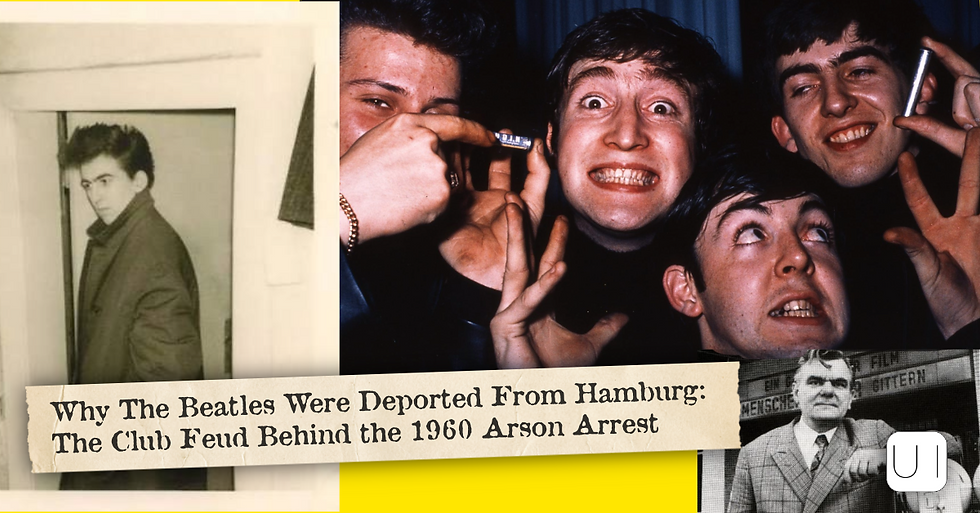
On 29 November 1960, Paul McCartney and Pete Best set fire to something small in a pitch-black corridor behind a Hamburg cinema screen. By the following night they were being put on a plane to London, with Pete's drum kit still sitting in Germany. George Harrison had already been thrown out of the country eight days earlier.
It usually gets told as a daft rock and roll anecdote, the one about the burning condom. Line up the dates and the paperwork though and it starts to look like something else: a nightclub owner who was losing his house band to a rival a few minutes' walk away and who knew exactly how to stop them getting there.
Quick Answers
Who was deported? George Harrison on 21 November 1960, then Paul McCartney and Pete Best on 30 November. John Lennon wasn't deported. He made his own way home on 10 December.
Why George? He was 17. Under-18s had to be out of St Pauli's clubs by 10pm and he was on stage until the early hours.
Why Paul and Pete? Club owner Bruno Koschmider reported them for attempted arson after a tiny fire at the Bambi Kino, the cinema where he'd been housing the band.
What did they burn? It depends who's telling it and when. A condom is the famous answer. Paul's earliest account says a piece of cord.
What was really going on? The band had agreed to jump ship to the rival Top Ten Club while still under contract to Koschmider.
Who was Horst Fascher? Koschmider's head bouncer, an ex-boxer who'd served time over a man's death. He switched to the Top Ten as well and became the band's minder.
What was Preludin? A German slimming pill that worked like amphetamine. It's how Hamburg's club bands got through six-hour nights.
How did they get back? The Top Ten's owner paid the German authorities 158 marks to cover the deportation costs and the band returned in spring 1961.
A Circus Man With a Strip Club to Fill
Bruno Koschmider wasn't anyone's idea of a pop impresario. Born in the Free City of Danzig, he's usually described as a former circus clown and fire-eater who'd been badly injured in the war and walked with a pronounced limp. George Harrison remembered him in the Anthology as “an old guy who had been crippled in the war” who didn't seem to know much about music.

What he did know was St Pauli. The district around the Reeperbahn was Hamburg's port playground, a few streets of bars, brothels and sailors' dives that was documented from the inside by people like the tattooist Herbert Hoffmann and later by Anders Petersen in his photographs of Café Lehmitz. Koschmider ran a cluster of businesses there, including two clubs on Grosse Freiheit, the Indra and the bigger Kaiserkeller, plus a small cinema round the corner.
The Beatles opened at the Indra on 17 August 1960 on a deal brokered by their Liverpool manager Allan Williams. The terms were brutal on paper and worse in practice: 30 Deutschmarks a day each, roughly £2.50, for four and a half hours on weeknights and six at weekends. After 48 nights the Indra was shut down over noise complaints and on 4 October Koschmider moved them down the road to the Kaiserkeller.
Living Behind the Cinema Screen
The accommodation was the cinema. The Bambi Kino stood at Paul-Roosen-Strasse 33 and the band were given two windowless storerooms behind the screen. A German researcher who's mapped the Beatles' Hamburg addresses puts the bigger room at about 16 square metres and the smaller at about six. There were army cots, bare concrete walls, no heating and no bathroom. They washed in the cinema's toilets, often with customers wandering in.
Even what the Bambi showed is disputed. Hamburg's own tourist board calls it a children's cinema with morning screenings. The Beatles Bible says it ran mainly old westerns. Plenty of retellings upgrade it to a porn cinema, which suits the story better than the evidence does.
The band's feelings about their landlord weren't subtle. One Hamburg story has Lennon buying a pig at the Fischmarkt, naming it Bruno and chasing it around the stalls.
The Slimming Pills That Kept Them Upright
Up to six hours a night, seven nights a week, is a lot to ask of five teenagers on beer and cornflakes. St Pauli's answer was Preludin. “Prellies” were phenmetrazine, an appetite suppressant launched by the German firm Boehringer Ingelheim in the 1950s. It curbed hunger by acting much like amphetamine, which meant it also kept you awake, talkative and able to hammer out another set at one in the morning.

It wasn't the harmless diet aid the packaging suggested and that was already known. Sweden put phenmetrazine on its national narcotics list in 1959, a year in which more than eight million doses were still sold legally there. It banned the drug outright in December 1965. Those figures come from a 1968 United Nations bulletin on Swedish drug abuse, which found it had become the country's dominant street stimulant. In the Hamburg clubs of 1960 it was just part of the furniture.
Supply was never a problem. Lennon said the waiters handed pills over whenever a musician looked like falling down, after which “you could work almost endlessly”. Taylor Parkes, writing in The Quietus, has a toilet attendant called Rosa dispensing them from “a sweet jar stashed beneath a table”. Astrid Kirchherr took them from her mother's medicine cabinet. Sounes quotes a Hamburg girlfriend who remembered the band crushing them into Coke and passing the glass round.
Not everyone joined in equally. Lennon was the keenest. McCartney has said he'd take one while the others were on four or five in an evening and Pete Best stuck to drink. There's also a question over timing. The Beatles Bible dates the band's introduction to the pills to Tony Sheridan in 1961, while other biographers have them on prellies at the Kaiserkeller in 1960. So it isn't certain the band Koschmider got deported were already taking them. They certainly were by the time they came back and the photograph that now marks the Bambi Kino site shows them brandishing their tubes of Preludin.

The Better Offer Up the Road
In autumn 1960 a younger operator called Peter Eckhorn opened the Top Ten Club on the Reeperbahn itself, with the English singer Tony Sheridan as the main draw. The Beatles started drifting over there during their hourly breaks. Harrison later said the place had a better sound system, a better atmosphere and paid a bit more. They'd already got up and played there a couple of times.
That was a problem. Koschmider's contract is reported to have carried a radius clause, put at 50 kilometres in one German account, banning the group from playing for any competitor nearby. The Top Ten was a few minutes' walk away. Howard Sounes writes in his McCartney biography Fab that Koschmider banned them from even visiting the place. They went anyway and then agreed, verbally, to move there for good. Eckhorn was also offering beds in the attic above the club, which after the Bambi counted as luxury.
The Bouncer Who Changed Sides
The band weren't the only thing Koschmider lost that autumn. The Kaiserkeller's door was run by Horst Fascher, a Hamburg ex-boxer. The club needed him. The Beatles Bible describes a crowd of gangsters, sailors and sex workers, kept in order by bodybuilder waiters who called each other to a fight by whistle.

Fascher's route to the job is the darkest part of the Hamburg story. TIME, drawing on interviews he gave the American journalist Larry Kane, reported that in 1959 he'd qualified for the national championships when he knocked a man unconscious in a fight. The man hit his head as he fell and died. Fascher served nine months. Other tellings make the victim a sailor in a street brawl and give a shorter sentence, so the details aren't settled, but every version agrees it finished his boxing career and put him on the Reeperbahn. TIME adds that he worked as a pimp when he first came out.
He took to the Liverpool lads straight away. A large part of the job was keeping Lennon in one piece. In a German radio interview decades later Fascher recalled Lennon hurling Nazi insults at the audience and diving into the crowd, with Fascher wading in after him. His mother got involved too, doing the band's washing and cooking them soup. McCartney called him a very good friend and offered a general theory to go with it: “Gangsters are very very sentimental guys.”
When Eckhorn opened the Top Ten, Fascher went with him as manager. The Beatles made their verbal agreement with Eckhorn on Sunday 30 October. So by the end of October Koschmider had lost his head doorman and learned his house band were following him to the same rival. His written notice to the band is dated two days later.
Fascher stayed close to them for the rest of their Hamburg years. He later helped run the Star-Club, where the Beatles played in 1962. TIME notes he was back in prison for part of the decade. One loose thread belongs here as well. Parkes writes that after the arson arrest a gentleman from the band's place of work smoothed things over with the police using a bottle of Scotch.
The Notice Dated 1 November
Here's the detail most versions skip. On 1 November 1960 Koschmider handed the band a written notice terminating their engagement from 30 November. It didn't mention the Top Ten at all. Instead it said he was acting “by order of the Public Authorities”, who had discovered that Mr George Harrison was only 17.
Two things stand out. First, George's age had been true since the day they arrived and Koschmider had been happy to put him on stage since August. It only became a legal problem once the band had another offer. Second, that notice is dated nearly three weeks before the police actually removed Harrison. For most of November the group carried on playing the Kaiserkeller with a deportation hanging over their guitarist. None of them had proper work permits either, which gave the authorities all the grounds they needed.

Did Koschmider tip off the police himself? Almost every biographer thinks so. Sounes treats a tip-off from him as the likely explanation and so do most others. Nobody has produced a document proving it. It's a strong suspicion with an obvious motive, not an established fact.
George Goes First
The order came on 20 November. Harrison spent that night teaching Lennon his lead guitar parts so the band could keep working without him. The next day Astrid Kirchherr and probably her boyfriend Stuart Sutcliffe dropped him at Hamburg station.
The trip home took about 24 hours: train to the Hook of Holland, day boat to Harwich, train to Liverpool Street, taxi across London to Euston and another train north. He was carrying an amplifier he'd bought in Hamburg, a battered suitcase, a guitar and his clothes in boxes and paper bags. He remembered “standing in the corridor of the train with my belongings around me”, surrounded by drinking soldiers and praying his money would last. He got back to Liverpool with nothing left.
What Actually Got Set on Fire?
By 29 November Lennon and Sutcliffe had already moved into the Top Ten's attic. McCartney and Best went back to the Bambi to collect their things and found the place in darkness. What happened next has at least four versions.
The famous one is that they pinned a condom to a nail in the concrete wall and lit it, either for light to pack by or as a parting gesture to Koschmider. Some tellings make it several condoms. The Beatles Bible notes that other accounts mention rags or a wall tapestry.
Then there's the version that rarely gets quoted. Sounes found that Paul's own account from the time describes burning “a piece of cord nailed to the wall”. That's the earliest telling and the least funny, which is one reason to take it seriously. On the other hand, a teenager explaining himself to German officials had every reason to leave a condom out of it. There's no way to settle it now.
McCartney has stuck with the condom ever since. In May 2026 he told Amelia Dimoldenberg on Chicken Shop Date that the room was dingy with cement walls, that Pete happened to have one on him and that lighting it was an act of defiance. He added, “you haven't lived 'til you've burned a condom”.
Every version agrees on the damage: a scorch mark on a damp wall. The flame went out by itself.

The Davidwache and a Midnight Flight
Koschmider reported it to the police as attempted arson. Accounts of the arrest differ again. McCartney remembered being stopped while walking down the Reeperbahn. Sounes has officers turning up at the Top Ten the next morning. Either way the pair ended up in the Davidwache, the police station that covers St Pauli.
How long they were held is also contested. Several accounts, including recent German coverage, describe a few hours in the cells. The Beatles Bible's day-by-day record says they were kept overnight, then taken to criminal police headquarters, where the officer in charge is named as a Herr Gerkins.
From there it moved fast. They were given five minutes to pack at the Top Ten, refused permission to telephone the British Consul and driven to the airport. The flight left around midnight on 30 November and they landed in London on 1 December before catching a train from Euston. Pete's drums stayed in Hamburg.
No court ever heard the case. McCartney's memory of the police position was simply “we don't want you to burn our German houses”. He's pointed out more than once that the building was made of stone. It also wasn't the last time he'd be flown out of a country by its government. Twenty years later he spent nine days in a Tokyo jail before Japan did the same thing.
John, Stu and the Long Way Home
That left Lennon in Hamburg with no band. He hung on for another ten days, then set off by train and boat on 10 December with an amplifier strapped to his back that he hadn't finished paying for. In the Anthology he said “being stuck in Hamburg with no food money was no joke”. When he got to Liverpool he was so fed up he didn't contact the others for days and seriously wondered whether to pack it in.
Sutcliffe stayed behind with Astrid and didn't come home until January. Paul's father told him to get a proper job, so for a short while a future Beatle was coiling electrical cable at Massey & Coggins in Edge Hill.
What nobody had clocked yet was what Hamburg had done to them. On 27 December the reunited band played Litherland Town Hall, billed as “Direct from Hamburg”. The music historian Gordon Thompson notes that some of the crowd assumed they were German. Hundreds of hours on Koschmider's stages had turned an average Liverpool group into something the city hadn't heard before.
How They Got Back In
Getting back into West Germany took about four months and it was Koschmider's rival who fixed it. Harrison turned 18 on 25 February 1961, which removed the curfew problem. Sutcliffe flew out ahead of the others on 15 March and he and Astrid sorted the paperwork in Hamburg.
Eckhorn dealt with the arson deportation the simplest way possible. He paid the authorities 158 Deutschmarks, the cost of flying McCartney and Best home the previous winter, a figure recorded by Mark Lewisohn in The Complete Beatles Chronicle. The band left Liverpool on 27 March and from 1 April played the Top Ten for 92 nights straight.
So the whole exercise bought Koschmider one winter. He lost his band, his rival got them with proper permits and the Beatles got the attic.
What's Left of It
The Bambi Kino is long gone as a cinema. All that marks Paul-Roosen-Strasse 33 now is a Bambi painted on a garage door and a photograph of the band outside for the walking tours. The Kaiserkeller's address, Grosse Freiheit 36, is still a music venue.
Koschmider himself is usually cast as the villain of the Hamburg story and on this evidence he earned it. He's also the reason there's a Hamburg story at all. He booked a band that was nobody's first choice, worked them half to death and shouted at them to put on a show until they learned how. Lennon's own summary of those months was that he “grew up in Hamburg”, not Liverpool.
You Might Also Like
Sources
Bruno Koschmider terminates The Beatles' Kaiserkeller contract, 1 November 1960 (The Beatles Bible)
George Harrison is deported from Germany, 21 November 1960 (The Beatles Bible)
Paul McCartney and Pete Best are arrested in Hamburg, 29 November 1960 (The Beatles Bible)
Paul McCartney and Pete Best are deported from Germany, 30 November 1960 (The Beatles Bible)
John Lennon leaves Hamburg, 10 December 1960 (The Beatles Bible)
Live: Indra Club, Hamburg, 17 August 1960 (The Beatles Bible)
The Beatles' second day in Hamburg, 18 August 1960 (The Beatles Bible)
Travel: Liverpool to Hamburg, 27 March 1961 (The Beatles Bible)
Howard Sounes, Fab: An Intimate Life of Paul McCartney (HarperCollins, 2010)
Mark Lewisohn, The Complete Beatles Chronicle (1992)
How Hamburg changed the Beatles (The Local Germany)
Bambi cinema (Hamburg Travel)
Wolfgang Röhl, Auf Spurensuche der Beatles in Hamburg
Paul McCartney recalls setting fire to a condom in an 'act of defiance' (People, via AOL)
60 Years Ago: The Beatles Arrested for Arson (Ultimate Classic Rock)
Bruno Koschmider: the man who saved The Beatles in 1960 (Far Out Magazine)
Gordon Thompson, December 1960: A wild time for the Beatles (OUPblog)
Festnahme der Beatles in Hamburg: Wie ein Kondom sie ins Gefängnis brachte (t-online)
The Beatles agree to play the Top Ten Club, 30 October 1960 (The Beatles Bible)
Live: Kaiserkeller, Hamburg, 4 October 1960 (The Beatles Bible)
The Beatles and drugs (The Beatles Bible)
Lily Rothman, A Very Strange Story from the Beatles' Ex-Con Bouncer (TIME, 2014)
Taylor Parkes, The Beatles in Hamburg (The Quietus, 2010)
Beatles' adventures with girls, drugs, rock revived in Hamburg (Bloomberg, via The Royal Gazette)
Leonard Goldberg, Drug abuse in Sweden (II) (UN Bulletin on Narcotics, 1968)
Andrew Hammel, Horst Fascher and the Early Beatles (summary of a German radio interview, 2006)


