The Essex Whaling Ship: The Whale Attack, the Cannibalism and the True Story Behind Moby Dick

On 20 November 1820, in the middle of the Pacific, a sperm whale did something whalers swore whales didn't do. It turned on the ship that was hunting it and rammed it. Then it came back and did it again. Within minutes the Nantucket whaleship Essex was going down, and her 20 crew were left in three flimsy open boats roughly 2,000 nautical miles from South America.
The whale turned out to be the least of their problems. What followed was three months adrift, a lottery to decide who'd be shot and eaten, a cave full of skeletons and a captain so unlucky he'd lose a second ship and spend the rest of his life as Nantucket's night watchman. Herman Melville borrowed the ending for Moby Dick. He left out the darkest parts.
Quick Answers
What was the Essex? A Nantucket whaleship built in 1799 that sailed for the Pacific in August 1819 with a crew of 21.
What happened to it? A bull sperm whale, which the crew reckoned was around 85 feet long, rammed it twice and sank it on 20 November 1820.
How many survived? Eight of the 20 men who escaped the wreck in the whaleboats.
Did the survivors resort to cannibalism? Yes. Several dead crewmen were eaten, and teenager Owen Coffin was shot after the men in his boat drew lots.
Did it inspire Moby Dick? Yes. First mate Owen Chase's 1821 account gave Herman Melville the climax of his 1851 novel.
A Veteran Ship With a Young Crew
By whaling standards the Essex was getting on a bit. Built at Amesbury, Massachusetts, in 1799, she was about 88 feet long and 238 tons, small and stubby but with a decent track record of coming home full of oil. When she slipped out of Nantucket on 12 August 1819, she was booked for two and a half years at sea.
The men running her were young. Captain George Pollard Jr was 29 and on his first command. His first mate, Owen Chase, was 23. The cabin boy, Thomas Nickerson, was just 14. Of the 21 crew, 12 were Nantucket men, including all the officers, while the rest were off-islanders, and seven of the crew were Black. That detail matters later, and not in a good way.
The voyage started badly. Just two days out of Nantucket, a sudden squall knocked the ship almost flat and smashed up her whaleboats. Pollard pressed on anyway. The Essex rounded Cape Horn in January 1820 and headed into the Pacific, where the whaling grounds off South America were already badly fished out.
The Prank That Burned an Island
In October 1820 the Essex stopped in the Galápagos to fix a leak and stock up on food. Whalers loved giant tortoises because they'd survive for months in a ship's hold without food or water, giving the crew fresh meat on demand. The Essex crew loaded about 180 from Española and another 100 from Floreana, which they knew as Charles Island, as Scientific American has detailed.
Then boatsteerer Thomas Chappel decided it'd be funny to start a fire. It wasn't. The dry scrub went up so fast that the hunting parties had to run through the flames to get back to the boats, and the island was still burning on the horizon after the Essex had sailed a full day away. Pollard swore he'd punish whoever was responsible. Chappel kept his mouth shut until long after the ship was gone.
When Nickerson passed Floreana years later, the burnt areas were still a barren wasteland. The fire has been linked to the collapse of the island's wildlife, and Floreana's own giant tortoise later died out completely, although decades of whalers hauling them away by the hundred did most of the damage. Remember Chappel's name, because the Pacific wasn't finished with him.
The Whale That Fought Back
Whales were hard to find. On 16 November one surfaced right underneath Chase's whaleboat and tipped it over. Four days later, at around 8am, the lookout spotted spouts and the three working boats went after the pod. Chase's boat got holed by a thrashing whale, so he rowed back to the Essex to patch it up while Pollard and second mate Matthew Joy carried on.

That's when Chase spotted a huge bull sperm whale lying still in the water, roughly a ship's length off the bow. The crew put it at around 85 feet, which is probably an exaggeration since bull sperm whales rarely top 60 feet, but whatever its real size it was enormous. It started swimming towards the ship, picked up speed and slammed into the bow, knocking the men off their feet.
Then it swam off, turned and came back. Chase later wrote that he saw it appear with “ten-fold fury and vengeance in his aspect.” The second hit stove in the bow completely. The Essex lurched over and started to fill, and Chase barely had time to grab compasses, navigation books and some bread before he and his men piled into their leaky boat.
When Pollard's boat came racing back, the captain found his ship on her side and his first mate in shock. Over the next two days the crew salvaged what they could from the wreck: ship's biscuit, casks of fresh water, a few surviving tortoises and timber to build up the sides of the whaleboats. Then came the big question: where to go?
Choosing the Long Way Round
The nearest land was the Marquesas and the Society Islands, roughly 1,200 miles to the west, and the wind would carry them there. Pollard wanted to go. Chase and Joy talked him out of it, convinced the islands were full of cannibals.
Instead they settled on a far longer plan: sail south until they picked up the westerly winds, then turn east for Chile or Peru, thousands of miles away. It's one of the grimmest ironies in maritime history. The men chose the open ocean to avoid being eaten by islanders, and within weeks they'd be eating each other.
Henderson Island and the Cave of Skeletons
Around a month after the sinking, half dead from thirst, they sighted an island. They thought it was Ducie Island, but it was actually Henderson, a lump of raised coral in what's now the Pitcairn group. They found a trickle of fresh water and tucked into seabirds, eggs, crabs and peppergrass. Within a week they'd stripped the place bare.

They also found the remains of people who'd been there before them. In a cave, the crew came across human skeletons, six by most accounts, although one 1830 report put the number at eight. Nobody knows for sure who they were. In 1958 a party from Pitcairn found six skeletons in a cave on Henderson's north-east coast, and whether they were the same bones the Essex men saw is still debated.
Here's the kicker. Pitcairn itself, where descendants of the Bounty mutineers were living, was only about 100 miles away. The Essex men had no idea. On 27 December most of them pushed off again, but three chose to stay and take their chances on the island: William Wright, Seth Weeks and the fire-starting Thomas Chappel.
Ninety Days in Open Boats
Back at sea the food ran out fast. Matthew Joy was the first to die. He went in early January and was buried at sea. Boatsteerer Obed Hendricks took over his boat. Days later a storm separated Chase's boat from the other two, and the two groups never saw each other again.
On 20 January Richard Peterson, a Black sailor of around 60, died in Chase's boat and was slipped over the side. Over the following week three more men died in Hendricks's boat, Lawson Thomas, Charles Shorter and Isaiah Sheppard, and this time the survivors ate them. Samuel Reed died in Pollard's boat on 28 January and was eaten too. All four of those men were Black. As the Massachusetts Historical Society has pointed out, a disproportionate number of the first to die were men of colour.

In Chase's boat, Isaac Cole went into convulsions and died raving. The three survivors kept his body this time, and Chase later described the whole grim business in his narrative. On the night of 28 January Hendricks's boat drifted away from Pollard's in the dark and was never seen again. Years later a whaleboat with skeletons in it reportedly washed up on Ducie Island, but nobody ever proved it was theirs.
Drawing Lots for Who Dies
By 6 February there were four men left in Pollard's boat: the captain, 18-year-old Owen Coffin, Charles Ramsdell and Barzillai Ray. There was no food at all. Someone suggested drawing lots under the so-called custom of the sea, where one man would die so the others could live. Twenty-six years later the Donner Party would face the same awful arithmetic in the snows of the Sierra Nevada.
Coffin drew the short straw. He was Pollard's cousin, and the captain had promised Owen's mother he'd look after him. Pollard reportedly offered to take his place, but Coffin refused. A second draw decided who'd shoot him, and it fell to Ramsdell, his friend. A few days later Ray died too.
On 18 February the British ship Indian picked up Chase, Thomas Nickerson and Benjamin Lawrence after about 90 days adrift. Five days later the Nantucket whaler Dauphin found Pollard and Ramsdell off the coast of Chile, so far gone that they were reportedly clinging to the bones of their shipmates. Pollard made sure the authorities knew about the men on Henderson, and the Australian ship Surry rescued all three on 9 April 1821, still alive. Out of 20 men who left the wreck, eight made it.
Coming Home to Nantucket
Chase reached Nantucket on 11 June 1821 and met his 14-month-old daughter Phoebe for the first time. A crowd had gathered at the wharf, and as the survivors came ashore it parted without a word. Pollard got back in August and had to face Nancy Coffin, the mother of the boy he'd been meant to protect. She reportedly couldn't bear to be near him for the rest of her life.
Nobody was ever prosecuted. Among whalers the custom of the sea was grimly accepted, as long as the lots were drawn fairly. Compare that with Britain in 1884, when the crew of the yacht Mignonette killed and ate their cabin boy Richard Parker without any lottery and two of them were convicted of murder, a case law students still study today.
The survivors carried the Essex with them in different ways. Chase's wife died a few years later and he married Nancy Joy, the widow of Matthew Joy. He went on to become a successful captain, but in old age he was tormented by headaches and started hiding food in the attic of his Nantucket home. He was eventually judged insane and died in 1869, still obsessed with hoarding food.
Lightning Strikes Twice: The Captain's Second Wreck
Amazingly, Pollard got another ship almost straight away. Nantucket admired how he'd handled the open-boat voyage, and he took command of the whaler Two Brothers. Before setting off he reportedly said he didn't believe lightning would strike the same place twice. Thomas Nickerson signed on with him.
On the night of 11 February 1823, in a storm, the Two Brothers hit a reef at French Frigate Shoals, about 600 miles north-west of Honolulu, and broke apart. This time everyone survived and was picked up the next day by another Nantucket whaler. But that was it for Pollard. Whalers decided he was a Jonah, and no owner would trust him with a ship again. After one trip on a merchant vessel he took a job as the town's night watchman and walked Nantucket's streets for the rest of his life.

The Two Brothers sat on the seabed for nearly two centuries. In 2008 NOAA marine archaeologist Kelly Gleason's team found an old anchor at French Frigate Shoals, and over the next couple of years they turned up cast-iron cooking pots, ceramics and glass that dated the site to the 1820s. In 2011 the team confirmed it was Pollard's ship, the first wrecked Nantucket whaler ever found.
How the Essex Became Moby Dick
Owen Chase's Narrative of the Most Extraordinary and Distressing Shipwreck of the Whale-Ship Essex came out in 1821 and caused a stir. Twenty years later a young sailor called Herman Melville read it while he was out on a Pacific whaling voyage of his own, and he later said it had a surprising effect on him.

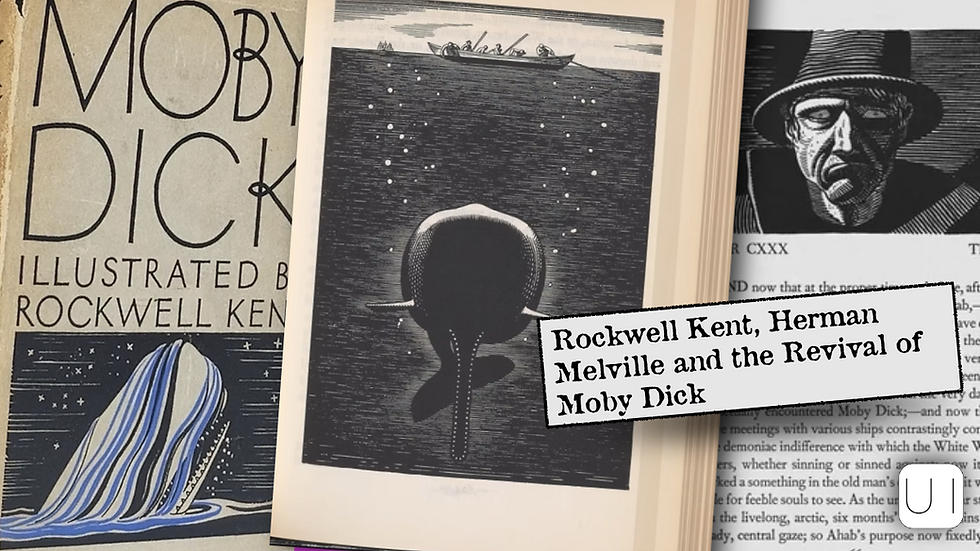
Melville turned the whale into Moby Dick and the shipwreck into the novel's final chapter, but he left out the cannibalism, the lottery and the slow deaths in the boats. Moby Dick came out in 1851 and flopped. It took Rockwell Kent's illustrations and a 1930 reissue to turn it into the classic we know now.
In 1852, a year after the book came out, Melville finally visited Nantucket and met Pollard. The two only exchanged a few words, and Melville was careful not to drag up the past. Afterwards he wrote that “To the islanders he was a nobody”, but to Melville he was the most impressive man he'd ever met.

The Cabin Boy's Lost Notebook
For well over a century Chase's account was pretty much the only version of events. Then a second one turned up in an attic. In 1876, an elderly Thomas Nickerson wrote down his memories for a writer named Leon Lewis, who never did anything with them. The manuscript ended up in a trunk belonging to Darius Ogden of Penn Yan in upstate New York. Then everyone forgot about it.
In 1960 an Ogden descendant, Ann Finch, found it. She assumed it was fiction and kept it in her study in Hamden, Connecticut, for 20 years. Only on a trip to Nantucket in 1980 did she realise the story was real. She handed it to local whaling historian Edouard Stackpole. Once he'd confirmed it was genuine, the Nantucket Historical Association published it in 1984. Nickerson's version filled in things Chase had skipped, including Chappel's fire on Floreana.
Nickerson is often described as the last survivor of the Essex, but that's not quite right. Seth Weeks, one of the three men who stayed behind on Henderson Island, outlived him and died in 1887. Nickerson's notebook went on to shape Nathaniel Philbrick's 2000 book In the Heart of the Sea, which won the National Book Award and became Ron Howard's 2015 film, with Chris Hemsworth as Owen Chase.
Suggested Reading
Want the full story? These are the books to grab.
In the Heart of the Sea: The Tragedy of the Whaleship Essex by Nathaniel Philbrick. The definitive modern account, drawing on Nickerson's rediscovered notebook. Gripping from the first page.
The Loss of the Ship Essex, Sunk by a Whale by Thomas Nickerson and Owen Chase. The survivors' own words, with Chase's 1821 narrative and the cabin boy's account in one Penguin Classics edition.
Moby Dick by Herman Melville. See what Melville did with the story once he'd got hold of it.
As an Amazon Associate, Utterly Interesting earns from qualifying purchases.
You Might Also Like
Sources
The True-Life Horror That Inspired Moby-Dick, Smithsonian Magazine
This Real-Life Whaling Disaster Inspired Moby-Dick, National Geographic
Essex: American Whaling Ship, Encyclopaedia Britannica
Moby-Dick and the Galápagos Tortoises, Scientific American
Shipwrecks and Survivors, Massachusetts Historical Society
The Sinking of the Essex, Carleton College
The Henderson Island Skeletons, Pitcairn Islands Study Center
Marine Archaeologists Find Shipwreck Linked to Moby Dick, Smithsonian Magazine
Rare 1823 Wreck Found: Captain Linked to Moby-Dick and Cannibalism, National Geographic
A Whale of a Story, Notre Dame Magazine
Voice from the Sea, PBS Voyage of the Odyssey
The Essex Disaster, American Heritage
The Loss of the Ship Essex, Sunk by a Whale (Thomas Nickerson, 1984 edition), Internet Archive