Werner Herzog's Wild Youth, Before He Made a Single Film
Updated: 4 days ago

Werner Herzog has spent six decades making films about people who chase impossible goals in places that don't want them there: a man dragging a steamship over a mountain, conquistadors floating to their deaths on a raft in the Amazon, scientists holed up at the bottom of the world. Long before any of that, he was living the same story himself. Between finishing school and shooting his first real film, Herzog followed a girlfriend to a slum in Manchester, tried to walk into the chaos of the newly independent Congo and nearly died doing it, worked rodeos and smuggled electronics on the Mexican border under a fake name and dreamed up a plan to help found an independent Mayan state in the Guatemalan jungle. Almost everything we know about those years comes from one source, Herzog himself, in interviews and in his own memoir, and he's always been upfront that he cares more about what he calls "ecstatic truth" than about getting every date and detail exactly right. Even the year he supposedly showed up in Pittsburgh keeps shifting depending on who's telling it. What follows sticks as close as possible to what can actually be checked, while being honest about where the record gets blurry.
A Girlfriend, a Manchester Slum and a Crash Course in English
Herzog hadn't technically finished school yet when he first left Germany, chasing a girlfriend across the North Sea to Manchester. He didn't settle into anything resembling student housing. He bought into a run down house in the city's slums shared with seven other tenants, four from Bengal and three from Nigeria, and picked up work at the docks to get by. At some point during the stay he signed up for formal English classes, and hated them. He found the lessons pointless, dry drills that had nothing to do with the English he was actually hearing every day from his housemates and coworkers, and he eventually stopped showing up entirely. What stuck was the version of English he picked up on the street and on the job, not in a classroom, and it's more or less the same accent he still speaks with today, one that's become almost as recognizable as his voice itself.

Chasing the Congo, and Nearly Dying Along the Way
The year he sat his final school exams, 1961, nineteen year old Herzog set off on the kind of trip that would end up defining the rest of his life: pointless by any practical measure, and driven purely by an idea he couldn't shake. The Congo had won independence from Belgium the previous summer, and the transition collapsed almost immediately into the chaos of what's now called the Congo Crisis, a civil war whose roots trace straight back to decades of forced labor and mass killing under Belgian colonial rule, most infamously under Belgium's King Leopold II, who'd treated the entire territory as his personal property for over twenty years. Herzog wanted to see that chaos for himself.
He drove a truck to Athens, made his way through Crete and on to Alexandria, and kept heading south with the vague aim of crossing into the Congo itself. He never got there. Somewhere near the border with what's now South Sudan, he came down badly ill, and accounts of exactly what hit him don't agree, which is itself very on brand for a Herzog story. His own official biography blames bilharzia, a parasitic infection picked up from contaminated water. In one retelling he describes finding a nest of rats inside his own sweater and being bitten on the arm and the cheek, a scar he says he still carries. Elsewhere the illness gets described simply as dysentery. Whatever it actually was, he was sick enough to abandon the trip and turn back north, eventually helped along by engineers working on the Aswan Dam in Egypt. It's hard not to notice, given how much of his later filmmaking obsesses over dams, canals and men trying to bend entire landscapes to their will, that the trip that nearly killed him ended with a rescue by dam builders. Looking back on it decades later, he said flatly that he thanked God on his knees that he never actually made it into the Congo.
A Not Very Serious Student at Munich University
Back in Germany, Herzog enrolled at Munich's Ludwig Maximilian University to study history and literature, though he's never pretended to have taken it seriously. "I certainly cannot claim to have been a very serious student," he said later, and the record backs him up. He was already far more interested in making films than attending lectures, and he'd effectively obtained his first real camera by walking out of the Munich Film School with one that didn't belong to him, later insisting he doesn't consider it theft so much as claiming something he had a natural right to. He funded his earliest short films working night shifts at a steel factory, all while technically enrolled in an entirely different subject at university. By his own account he hadn't seen a single film before the age of eleven and didn't make his first phone call until he was seventeen, which makes the speed of what came next even stranger. He shot his first short film in 1962, and by 1964, in his early twenties, he'd already won the prestigious Carl Mayer Prize for an early screenplay, beating out roughly 480 other entrants.
A Pittsburgh Scholarship, Depending on Who You Ask
The Carl Mayer win opened the door to a scholarship in the United States, and this is where Herzog's own account of his life starts to genuinely contradict itself. In his book length conversation with Paul Cronin, published in 2002, Herzog says he accepted a scholarship to study at the University of Pittsburgh and handed it back after just three days, unimpressed and unwilling to stay somewhere he considered overly fancy. Other, better documented accounts describe a longer and stranger story. According to Duquesne University's own enrollment records and a personal essay Herzog wrote for The New Yorker in 2023, he actually arrived in Pittsburgh in September 1965 at 23 years old, not the 20 that gets repeated in a lot of quick biographical summaries, and he stuck around for months, not days.
He found Duquesne itself unimpressive too, calling the university intellectually barren and disappointed to discover it had only a television studio rather than real film equipment. He slept on a professor's sofa at first, then in the university library, until a woman named Evelyn Franklin picked him up hitchhiking one rainy day and invited him to stay in the attic room of her house in the Fox Chapel suburb. He ended up more or less adopted into her family, a household that included seven children, an elderly grandmother and a dog named Benjamin Franklin. "I loved the Franklins," he wrote decades later. "With them, I got to know some of the best and deepest things about America." When he returned to the neighborhood years afterward, while filming Jack Reacher in 2012, he found the old house overgrown and learned that Evelyn had died and that her son Billy, who Herzog said had been like a brother to him, had died two years after that.
The Pittsburgh stay ended the way a lot of Herzog stories end, badly and then interestingly. He took work for a producer at the local public television station WQED, on a documentary about plasma rocket research, without a valid work permit. Once that was discovered, he faced the real possibility of deportation and fled the country entirely, driving a rusted out Volkswagen through the winter, with a broken leg in a cast, all the way down toward the Mexican border, packing wads of newspaper around his own foot along the way to keep from losing toes to frostbite.

Rodeos, Gunrunning and a New Name in Mexico
Herzog crossed into Mexico through what he later called a weak spot on the border between the twin cities of Reynosa and McAllen, and spent the following months living about as far from a film student's life as it's possible to get. He worked the charreada, Mexico's traditional rodeo, performing under the assumed name El Alamein, and got hurt constantly. By his own account he was injured almost every week, and quit for good after catching his leg between an animal and the arena wall badly enough to end his rodeo career on the spot. He supported himself for a while smuggling televisions across the border and buying up firearms for wealthy local ranch owners, earning enough of a reputation doing it that people started calling him a gun runner. He eventually moved on to San Miguel de Allende, a Spanish colonial hill town already popular with American and European expatriates, using it as a base while he worked out what came next.
An Independent Mayan State That Never Happened
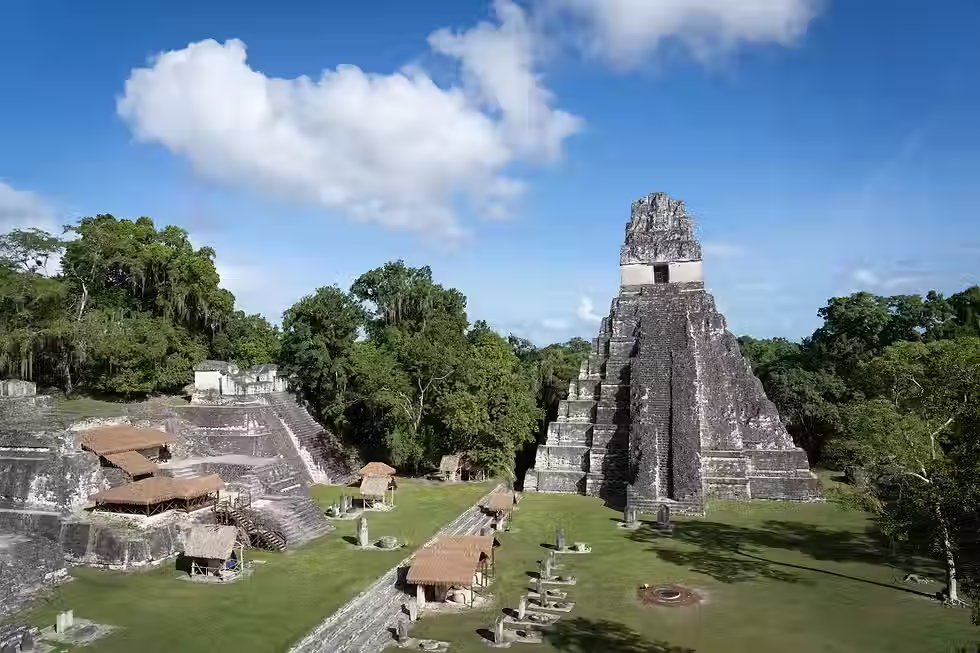
What came next was Guatemala, and one of the stranger ambitions Herzog has ever admitted to chasing. In his 2023 memoir, he describes being "obsessed with the vague idea that I would help form an independent Mayan state" in the Petén region of northern Guatemala, a stretch of dense rainforest scattered with the ruins of ancient Maya cities like Tikal and Uaxactun. It's the same restless instinct behind a very different European drifter's story, the Swedish sailor Carl Emil Pettersson, who washed up on a Pacific island decades earlier and genuinely married into local royalty, ending up king of it. Herzog's version of that fantasy never got off the ground. By his own account in the memoir, Guatemala simply refused to give him a visa. Other retellings of the same stretch of his life describe him actually making it into the country before illness stopped him, contracting hepatitis and having to abandon the plan and drive all the way back to Pittsburgh, where he still had a support network, to get treated. Either way, the Mayan state idea died before it ever really began, and Herzog headed home to Germany not long after.
Back in Germany, Finally Behind a Camera for Good
Herzog spent a final few months traveling around Europe before settling back in Munich to begin serious pre-production on what would become his first feature, Signs of Life. Shot on the Greek island of Kos and centered on a wounded German soldier slowly losing his mind while guarding an ammunition depot during World War II, the film premiered at the Berlin Film Festival in June 1968, where it won the Silver Bear Extraordinary Jury Prize. He was 25 years old, and the wandering, half improvised chaos of the previous several years was effectively over. What replaced it was a career built almost entirely on recreating that same chaos on purpose, sending Klaus Kinski up an Amazonian river, hauling a real steamship over a real mountain for Fitzcarraldo and walking cast and crew into genuinely dangerous places again and again, because Herzog had already spent his early twenties proving to himself that he could survive it.
Quick Answers
Did Werner Herzog really smuggle goods across the border in Mexico? By his own account, yes. After fleeing visa trouble in Pittsburgh in the mid 1960s, Herzog says he smuggled televisions across the border and bought firearms for wealthy ranchers, earning a local reputation as a gun runner before eventually settling for a while in San Miguel de Allende.
How old was Werner Herzog when he tried to reach the Congo? He was nineteen. Right after finishing his final school exams in 1961, he set out to reach the newly independent Congo but fell seriously ill near the border with what's now South Sudan and had to turn back before ever crossing in.