


Werner Herzog and Klaus Kinski: The Friendship Where Both Men Planned a Murder

Somewhere in the Peruvian jungle in 1981, a local chief walked up to Werner Herzog and made him a polite offer. Would the director like his leading man killed? Herzog thought about it. Then he said no, because he still had scenes to shoot. That's about as close to a compliment as Klaus Kinski ever got from him.
The two Germans made five feature films together between 1972 and 1987, and two of them, Aguirre and Fitzcarraldo, still turn up on lists of the greatest films ever made. They also threatened each other with guns, screamed at each other in front of hundreds of extras and, by Herzog's own admission, each plotted to kill the other. Here's how it started, how bad it got and why the story looks a lot darker now than it did when Herzog first told it.
Quick Answers
How many films did they make together? Five features between 1972 and 1987, plus a documentary Herzog made about him after his death.
Did Herzog really direct Kinski at gunpoint? No. He threatened to shoot him if he walked off Aguirre, but says he wasn't holding a gun at the time.
Did someone really offer to kill Kinski? Yes, by Herzog’s account. Indigenous extras on Fitzcarraldo made the offer and he turned it down.
Did Herzog plan to kill him? He says he once set out to firebomb Kinski's house and was stopped by the actor's Alsatian.
When did they fall out for good? On Cobra Verde in Ghana. They never worked together again and Kinski died in 1991.
The lodger who destroyed the bathroom
Herzog didn't meet Kinski on a film set. He met him at home. When Herzog was 13, his mother moved the family into a cramped pension in the Schwabing district of Munich, where she, Werner and his brothers shared a single room. A back room in the same flat went to a penniless young stage actor who'd talked the soft-hearted landlady, Clara, into putting him up for nothing. (Herzog's own teenage years got even stranger after that, and we've covered his wild youth before he made a single film separately.)
Kinski was born Nikolaus Nakszynski in 1926 in Zoppot, now Sopot in Poland. He'd been drafted at 16 and captured by the British on his second day of combat, and he first acted in shows put on by fellow prisoners of war. By the mid-1950s he had a reputation on the German stage and no money at all.

He was a nightmare of a housemate. Herzog's 2023 memoir describes him refusing cutlery and eating with his hands, and announcing to the landlady that “Eating's a bestial act”. When he found out she cooked with margarine instead of butter, he smashed the plates and threw an iron casserole dish through a closed window. He knocked a door off its hinges because his shirt collars hadn't been ironed to his liking, and he shut himself in a cupboard for hours at a time to do voice exercises.
Then came the bathroom. Kinski locked himself in for two days, screaming, and broke the bath and toilet into pieces so small that, in Herzog’s telling, you could have sifted them through a tennis racket. That got him thrown out. The 13-year-old watching all this wasn't frightened. He was taking notes. In the memoir Herzog says of the man he'd later hire five times: “No one tamed him as well as I did.”
The Herzog and Kinski films in order
Five features in 15 years, and something went wrong on nearly all of them.
Aguirre, the Wrath of God (1972). Kinski concussed a fellow actor with a sword, fired a rifle into a tent full of extras and tried to walk out.
Nosferatu the Vampyre (1979). The calm one, at least by their standards.
Woyzeck (1979). Started days after Nosferatu wrapped, with the same exhausted crew. Co-star Eva Mattes won a prize at Cannes.
Fitzcarraldo (1982). Kinski came in as a late replacement and the extras offered to have him killed.
Cobra Verde (1987). The cameraman walked off, Kinski went for Herzog with a rock and the two stopped speaking.
Did Herzog really pull a gun on Kinski?
About 15 years later Herzog sent Kinski the script for Aguirre, the Wrath of God, about a Spanish conquistador who loses his mind hunting for El Dorado. Kinski rang him at three in the morning and screamed down the phone for a long time. That was a yes.

By then Kinski was a familiar face from dozens of cheap European thrillers and spaghetti westerns, including For a Few Dollars More for Sergio Leone, whose later epic we've written about in the making of Once Upon a Time in the West. He'd also just come off a disastrous stage tour in which he played Jesus as a raving outlaw and ended up bellowing at hecklers.
The shoot was tiny and desperate. The whole budget was about $370,000, a third of which went straight to Kinski, and the film was shot on a single camera Herzog had helped himself to from the Munich Film School. The shoot lasted six weeks, a good chunk of it spent living on rafts on Amazon tributaries.
Kinski hit another actor over the head with a sword hard enough to concuss him through his helmet. One night, annoyed by extras playing cards and drinking in a nearby tent, he fired three rounds from a Winchester rifle through the wall. Dozens of men were inside. Nobody died, but one extra lost the tip of a finger. Herzog confiscated the rifle and says he still owns it. It's worth knowing that almost all of this comes from Herzog himself, who's never been shy about improving a story.
The famous confrontation came near the end. Kinski packed his bags and announced he was leaving. Herzog told him that if he did, he'd put eight bullets in him and keep the ninth for himself. The legend says Herzog directed the rest of the film with a gun pointed at his star, which he's always denied. He says he wasn't even holding a weapon. Kinski's version, naturally, was that he was the one with the gun. Either way, Herzog told NPR that Kinski was as good as gold for the last 11 days.
Fitzcarraldo: “Shall we kill him for you?”
The pair made Nosferatu the Vampyre and Woyzeck back to back in 1979, with the second starting just days after the first wrapped and using the same worn-out crew. Compared with what came next, those were holidays.
Fitzcarraldo is about a rubber-boom dreamer who drags a steamship over a hill to build an opera house in the jungle. The real rubber boom was far uglier than the film lets on, as the story of Armando Normand and the Putumayo atrocities makes clear. Herzog, being Herzog, insisted on hauling a real ship of more than 300 tonnes up a real muddy slope with no models and no camera tricks.
Kinski wasn't even meant to be in it. Herzog had ruled him out, sure he'd go to pieces in the Amazon. Jason Robards had the lead and Mick Jagger played his sidekick. Then, with roughly 40 per cent of the film in the can, Robards caught amoebic dysentery and his doctors wouldn't let him go back. Jagger had to leave for a Rolling Stones tour, and Herzog wrote his part out of the script instead of recasting it. Everything already shot was useless. Herzog rang Kinski.
It was a wretched shoot before he arrived. There'd been plane crashes that left people critically injured, a raid on the camp in which a man took an arrow through the throat and a logger who cut off his own foot with a chainsaw after a snakebite. Kinski added screaming. He raged at the food, the mud and the production manager, and Les Blank's documentary Burden of Dreams caught some of it on camera.
The Indigenous extras, who settled arguments without raising their voices, were appalled by him. Eventually one of their leaders offered to deal with the problem for good. Herzog's line about it, as Roger Ebert recorded, was: “I needed Kinski for a few more shots, so I turned them down.” Asked years later whether the offer was serious, he said: “They would have done it in less than 60 seconds.”
There's a nastier detail that Herzog kept out of the jolly anecdotes for decades. His shooting journal, published as Conquest of the Useless, records the film's producer Walter Saxer describing Kinski dragging his wife through hotel corridors at night, and Saxer cleaning the blood off the walls in the morning. The same journal has Herzog admitting he hadn't dared write any of it down at the time.
Cobra Verde and the end of the road
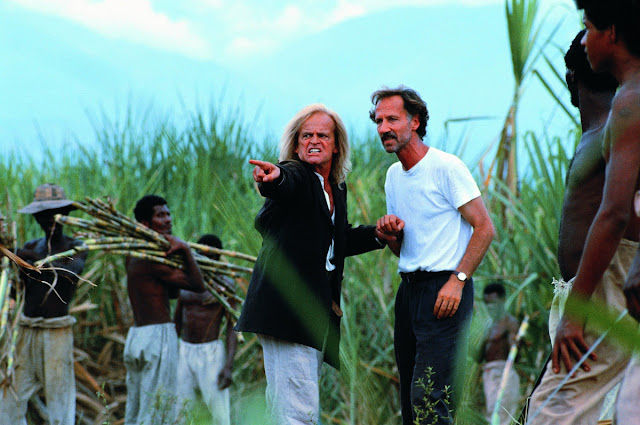
Their last film, Cobra Verde, was shot in Ghana with Kinski as a Brazilian bandit turned slave trader. The novelist Bruce Chatwin, who wrote the book it's based on, visited the set and watched Kinski lecture the crew on how every shot should be framed. Herzog's cameraman Thomas Mauch, who'd survived both Aguirre and Fitzcarraldo, walked off the film and had to be replaced.
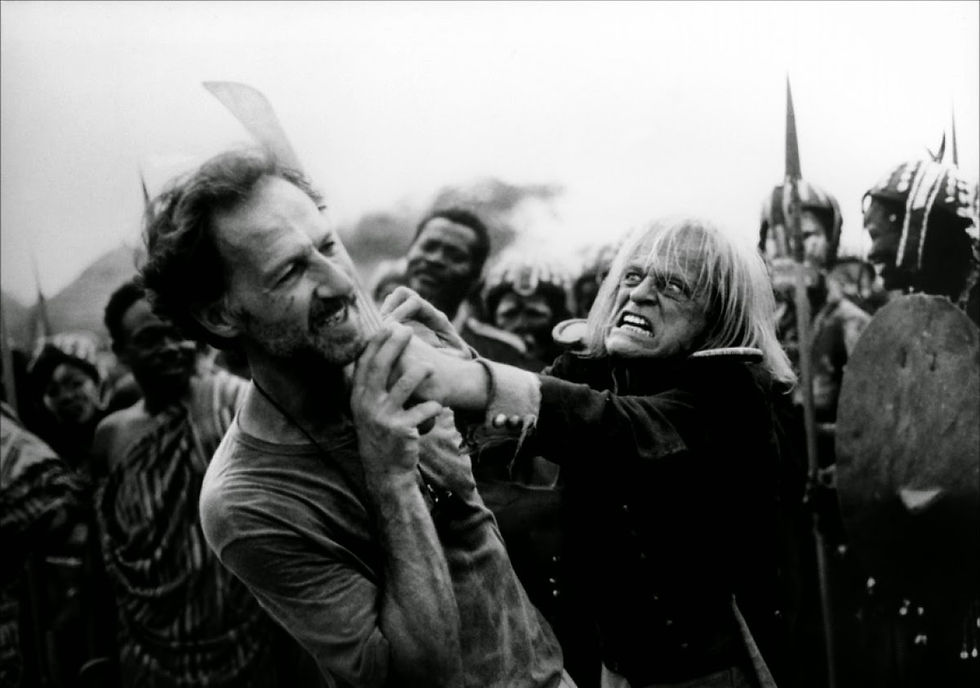
At one point, Herzog says, Kinski came at him with a rock. By the time filming ended the two weren't speaking, and Herzog swore he'd never hire him again. He didn't. Looking back, he said that they “had mutual respect for each other, even as we both planned each other's murder”.
Did Herzog really try to kill Kinski?
Herzog insists his own murder plan was real. In his documentary My Best Fiend he says he once set out for Kinski's house intending to firebomb it, and was put off only by the actor's very alert Alsatian. He tells the story laughing, which doesn't make it any less odd.
Kinski's revenge was literary. His memoir, published in English in 1988 as All I Need Is Love and again in 1996 as Kinski Uncut, devotes pages to abusing Herzog as a liar, a coward and a bore. Herzog's response was to claim co-authorship. He says he helped Kinski come up with fouler insults, because Kinski reckoned a book without filth wouldn't sell. As the A.V. Club points out, it's hard to know how much of that to believe. Kinski could be more generous when he felt like it. In a 1985 Playboy profile he rated Herzog “a less big asshole than the others”.
Kinski died on 23 November 1991 at his home in Lagunitas, north of San Francisco. He was 65. A friend found the body after he failed to turn up to meet his son.
My Best Fiend: Herzog gets the last word
Eight years after Kinski died, Herzog made a documentary about him. My Best Fiend (Mein liebster Feind in German) premiered at Cannes in 1999 and runs about an hour and a half. Herzog goes back to the Munich flat and shows the current owners where the bathroom used to be, returns to the Peruvian locations and talks to co-stars Claudia Cardinale and Eva Mattes, both of whom remember Kinski as gentle and kind to them.
It's where most of the famous stories come from, and that's the catch. Kinski wasn't around to give his side, so the film is Herzog's version from start to finish. It also couldn't include what his daughter would say 14 years later. It ends on footage of Kinski in the jungle, smiling, with a butterfly that won't leave him alone.

What we know now
For a long time that was the story: two impossible men, a lot of shouting and some great films. It doesn't hold up so neatly any more.
In January 2013 Kinski's eldest daughter Pola published a memoir, Kindermund, saying her father had sexually abused her from the age of five until she was 19. She told Stern magazine: “Whether one believes me or not, this is what happened to me.” She said she'd gone public because she was sick of watching him be worshipped. Her half-sister Nastassja called her a hero and said their father had tried to get too close to her as well.
Herzog has said he has no doubt Pola is telling the truth. He's also asked, without really answering, whether that means the films should be withdrawn, and pointed out that nobody takes Caravaggio's paintings off the wall because he killed a man. The London Review of Books wasn't convinced by that, noting that his memoir treats Kinski's violence mostly as a test of Herzog's own toughness.
It changes how the old stories land. The lodger smashing up a bathroom, the star shooting into a tent, the chief's offer: Herzog has always told them as comedy. The people who actually had to live with Kinski weren't laughing.
You Might Also Like
Sources
Nick Thorpe, "Herzog's Unfilmable Nightmare", Sunday Herald Magazine (2007)
The Bedlam Files, "The Strange Case of the Dueling Klaus Kinski Memoirs"
The A.V. Club, "Werner Herzog remembers his favorite leading man" (2020)
David Trotter, "Go for it, losers", London Review of Books (2023)
Mark O'Connell, "Shooting Werner Herzog", New York Review of Books (2023)
Associated Press obituary of Klaus Kinski, Seattle Times (26 November 1991)
The Local Germany, Nastassja Kinski on her sister's memoir (2013)


