

Victor Hugo's Wild Life: Scandals, Affairs & Secrets

Victor Hugo wrote Les Misérables and The Hunchback of Notre-Dame, two of the biggest tearjerkers in French literature. But his own life could have filled a few scandalous novels of its own, and honestly, it almost makes his fiction look tame by comparison. Between affairs, arrests, a secret diary written in a code his own family couldn't crack, and a funeral that reportedly shut down every brothel in Paris for the day, Hugo lived like a man determined to out drama his own books. Here's the rundown of the scandals, secrets and flat out bizarre stories from the life of France's most celebrated writer.
The Wife Who Strayed First
Hugo married his childhood sweetheart Adèle Foucher in 1822, and for a while the marriage looked like the start of a great romance. That changed after the birth of their fourth child, when Adèle reportedly stopped sleeping with her husband altogether. Around 1830 she grew close to Charles Augustin Sainte-Beuve, a literary critic and one of Hugo's own best friends, who by then was spending so much time at the Hugo house that the whole arrangement started to look obvious to everyone except, apparently, Hugo himself.
When he finally caught on, Hugo didn't take it well. He wrote Sainte-Beuve a raw, wounded letter and confronted him in person, begging him to stay away from Adèle. Sainte-Beuve agreed to Hugo's face and then kept seeing her in secret anyway. Hugo eventually gave his wife an ultimatum, stay married or leave with his friend, and Adèle chose to stay. The marriage survived on paper for the rest of her life, but by most accounts it turned into a quiet arrangement rather than an actual romance. A few years later, Hugo met an actress named Juliette Drouet, and that's when his own love life stopped being the wronged party's story and became the scandal instead.

Caught in Flagrante: The Adultery Arrest
In 1845, Hugo was carrying on a passionate affair with Léonie d'Aunet, a married travel writer and one of the first Frenchwomen to explore the Arctic Circle. Her husband, the painter Auguste Biard, got suspicious, hired a police officer, and raided the Paris hotel room on the Passage Saint-Roch where the two were meeting. They caught Hugo and Léonie in flagrante delicto, no ambiguity about what was happening.
Here's where it gets ugly. Hugo was a member of the Chamber of Peers at the time, a high ranking political position that came with legal immunity, and he simply invoked it and walked away from the whole mess. Léonie wasn't so lucky. She was hauled off to Saint-Lazare, a prison that at the time doubled as a holding facility for prostitutes and so-called "fallen women," and put through a formal adultery trial. She lost custody of her own children to her husband and then spent close to six months locked away in a convent. King Louis Philippe I personally smoothed things over for everyone involved, reportedly buying the husband's silence with a lucrative commission to paint murals at Versailles. The whole affair says everything about how consequences worked, or didn't, for powerful men in nineteenth century France.
The Devoted Mistress Hugo Could Never Quite Deserve
Even while his marriage limped along, Hugo kept up a relationship with the actress Juliette Drouet that lasted an incredible 50 years. But "relationship" undersells how controlling it actually was. Hugo made Juliette give up her acting career entirely, moved her into a flat near his own home, and reportedly restricted when and how she could leave the house without him. The two of them wrote to each other constantly, and by the time it was all over their correspondence added up to something like 22,000 letters, with Juliette writing at least one nearly every single day of their half century together.

Despite the control, and despite Hugo's constant cheating on her (see literally every other section of this article), Juliette stayed devoted to him for the rest of her life. She copied out his manuscripts by hand, and during Napoleon III's coup in 1851, she was the one who arranged the false papers that let Hugo escape France safely rather than face arrest. When Juliette died decades later, Hugo reportedly wanted to attend her funeral. His own family talked him out of it, worried about the scandal it would cause if the wronged wife's husband showed up to grieve his mistress in public.
A Family Habit: Sharing Mistresses
Hugo's appetite for romantic pursuit didn't stop at other men's wives, and it apparently didn't stop at family lines either. In 1847 he pursued the actress Alice Ozy with love poetry and plenty of persistence. The catch: Ozy had spent that same year as the mistress of Hugo's own son, Charles, before leaving him for his father.
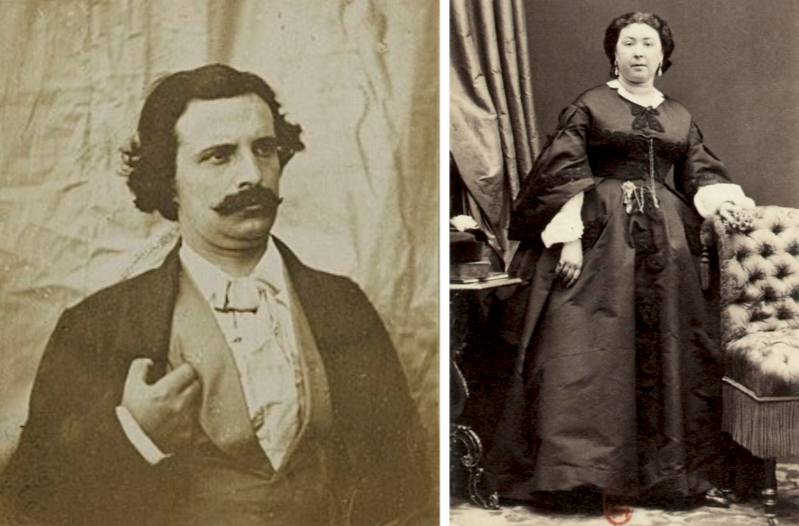
Ozy wasn't just anyone either. Born Julie Justine Pilloy, she'd worked her way up from a factory job to become one of the most sought after courtesans in Paris, running a salon where writers, painters and poets gathered, and counting the poet Théophile Gautier and the painter Théodore Chassériau among her other lovers around that same period. She was hardly the only woman of the era who turned scandal into a kind of long term fame, a pattern that shows up again and again in stories like the strange, scandal soaked life of Marguerite Alibert, Princess Fahmy, another woman whose private life became public property. Awkward family dinners at the Hugo house, presumably, were guaranteed for a while after that.
The Secret Sex Diaries and Their Bizarre Code
Hugo kept detailed diaries of his sexual encounters, and to keep his family from finding out, he wrote them in a cipher of his own invention. It mixed Latin abbreviations, like osc for kisses, Spanish phrases like misma or mismas cosas, meaning the same or same things, and homophones that swapped one French word for a similar sounding one. Seins, meaning breasts, became saint. Poêle, meaning stove, stood in for poils, meaning pubic hair.
He also used analogy as camouflage. He referred to a woman's breasts as her suisses, or Swiss, a nod to Switzerland's reputation for dairy farming. After encounters with a woman named Laetitia, he'd write joie, meaning happiness, and if he added the note t.n., short for toute nue, it meant she'd been completely naked.
It's an oddly elaborate system for a man who was, by most accounts, one of the most famous writers alive at the time. But it worked exactly as intended. Historians only pieced together the full picture long after his death, going line by line through a code that hid in plain sight for well over a century.
Old Age, Undiminished Appetite
Most people slow down eventually. Hugo, apparently, did not. His diaries show that in the final four months of his life, at 83 years old, he recorded 83 separate sexual encounters. Whatever his secret to longevity was, it clearly wasn't rest.

When Hugo Died, Paris's Brothels Closed for the Day
Hugo died of pneumonia in 1885 at age 83, and Paris responded with a state funeral that drew roughly two million mourners as his coffin traveled from the Arc de Triomphe to the Panthéon, one of the largest send offs the city has ever seen. According to popular accounts, Parisian brothels closed for the day so the women who worked there could attend, some reportedly draping themselves in black fabric as a mark of mourning. Hugo had been both a loyal, high paying customer and a writer who treated sex workers with real humanity in his fiction, most famously through the character of Fantine in Les Misérables.
Whether every brothel literally shut its doors is hard to verify centuries later, but the story has stuck around because it captures something true about how Paris saw him, equal parts scandal and hero. If you want another wild slice of the same old Paris underworld Hugo moved through, the story of Amélie Élie and the Casque d'Or gangs of the city's back alleys is a good place to keep going.

Bonus Weirdness: Séances, Zoo Meat, and a Flying Bat
The scandals weren't only romantic. After his daughter Léopoldine drowned, Hugo spent years in exile on the Channel Islands. He'd been kicked out of France for opposing Napoleon III, then kicked out of Jersey too, for publicly defending fellow exiles who'd insulted Queen Victoria. While there, he got deep into séances, holding table turning sessions that supposedly let him chat with Shakespeare, Galileo, Hannibal and Rousseau, among others. Shakespeare's ghost was apparently a flatterer, reportedly telling Hugo he'd always found French a nicer sounding language than English, and that he rated Hugo's own writing above his own.
Hugo also claimed to have communicated with the spirit of Napoleon III during these sessions, despite Napoleon III still being very much alive at the time back in France. It's a strange footnote next to another one of French history's odder afterlife stories, the bizarre, decades long journey of Napoleon Bonaparte's body part relic, which suggests Hugo wasn't the only Frenchman whose legacy took an unexpected physical turn.
During the 1870 Siege of Paris, when food ran short, Hugo turned to the Paris Zoo for dinner, writing in his journal about the parade of animals that ended up on his plate, stag one day, bear the next, antelope after that, along with more ordinary wartime staples like horse and rat. And according to a persistent, if unverified, story, he once mailed his wife Adèle an envelope with a live bat inside, which flew out and hit her in the face when she opened it.
Say what you want about the man's judgment, but Victor Hugo never lived a boring day in his life.


