


Amélie Élie: The Woman Who Started a Gang War in Belle Époque Paris
Updated: Oct 6

In the spring of 1902, the newspapers of Paris couldn't get enough of a young woman named Amélie Élie. They called her Casque d'Or, the Golden Helmet, a reference to her distinctive mass of blonde hair piled high in the style of the day. She was 23 years old, working as a gigolette in the dance halls and streets of the 11th arrondissement, and she had just become the most talked-about woman in the city, not because of anything she had done herself, but because two of the most dangerous men in the Parisian underworld were trying to kill each other over her.

The trial that followed turned Élie into a genuine celebrity at a time when celebrity, in its modern sense, was still a relatively new phenomenon. The mass-circulation newspapers of the Belle Époque had created an audience hungry for exactly this kind of story: glamour, violence, passion, and the exotic world of the Apaches, Paris's notorious street gangs. Élie gave them all of it.
The Apaches of Paris
To understand Élie's story, you need to know something about the world she moved through. The Apaches were a subculture of working-class Parisian street gangs that dominated the city's underworld from roughly the 1890s through to the First World War. The name was coined around 1902 by a journalist named Victor Moris, after a police inspector described a particularly bloody crime scene to him using the phrase 'c'est un véritable truc d'Apaches,' a real Apache thing, drawing a comparison to the ferocity attributed to Native American Apache warriors. The gangs liked the name and adopted it.
The Apaches dressed with deliberate flair: flared trousers, striped Breton jerseys, red flannel sashes, and casquette caps worn at an angle. They spoke an obscure slang called jare, carried knives and a distinctive multi-purpose weapon known as the Apache revolver, and abhorred what they called honest labour. They operated in the working-class outer districts of Paris, particularly Belleville and Ménilmontant, running protection rackets, mugging the bourgeoisie, and gathering in the city's guinguettes, the popular open-air dance halls where the apache dance, a highly theatrical combination of close steps and violent-looking throws, became their signature.
The Apaches operated by a strict code of silence. Gang members who were arrested were expected to give nothing to the police, not names, not locations, not information about crimes. The code held, mostly, until Amélie Élie came along.
From Orléans to the Streets of Paris
Élie was born at 3am on 14 March 1878 in Orléans, the daughter of a tinsmith named Gustave Élie and his wife Marie-Louise. The family moved to the 11th arrondissement of Paris when she was young, settling into the densely populated working-class neighbourhood where she would spend most of her life. Living conditions in the 11th were hard. The area was home to artisans and industrial workers, and the combination of overcrowding and poverty produced the kind of street culture in which the Apaches thrived.
At 13, Élie ran away with a boy two years older than her. Her parents collected her back. She ran away again. After several repetitions of this, her parents gave up, and Élie found herself on her own in Paris. She was a teenager with no income and no family support. Through a woman named Hélène de Courtille, an established prostitute with wealthy clients who acted as mentor, close friend, and possibly lover, Élie was introduced to the trade. Courtille became possessive. Élie moved on. She found a pimp named Bouchon, who provided protection but was violently jealous and beat her when she failed to meet her daily earnings quota. She eventually escaped from him too.
Manda, Leca, and the Feud
After leaving Bouchon, Élie met Joseph Pleigneur, known as Manda, a 22-year-old gang leader and one of the more prominent Apache figures in eastern Paris. Manda was drawn to her immediately and made his intentions clear by stabbing Bouchon, which in the context of the Apache world was both a statement of intent and a warning to anyone else who might have designs on Élie. Their relationship was unstable from the start. Manda was frequently absent, saw other women, and couldn't keep up financially with the lifestyle Élie expected. She eventually left him. Partly in an effort to win her back, Manda became the leader of a gang called Les Orteaux.

On the streets, Élie met Dominique François Eugène Leca, a member of a rival gang. She and Leca became involved. This was the spark. Manda's jealousy turned violent immediately. In 1902, Manda and several Orteaux members attacked Leca in a cab, stabbing him multiple times. Leca survived and was hospitalised. In keeping with the Apache code, he told the police nothing about who had attacked him or why. Once he was discharged, Manda's men came for him again and were finally apprehended by police.
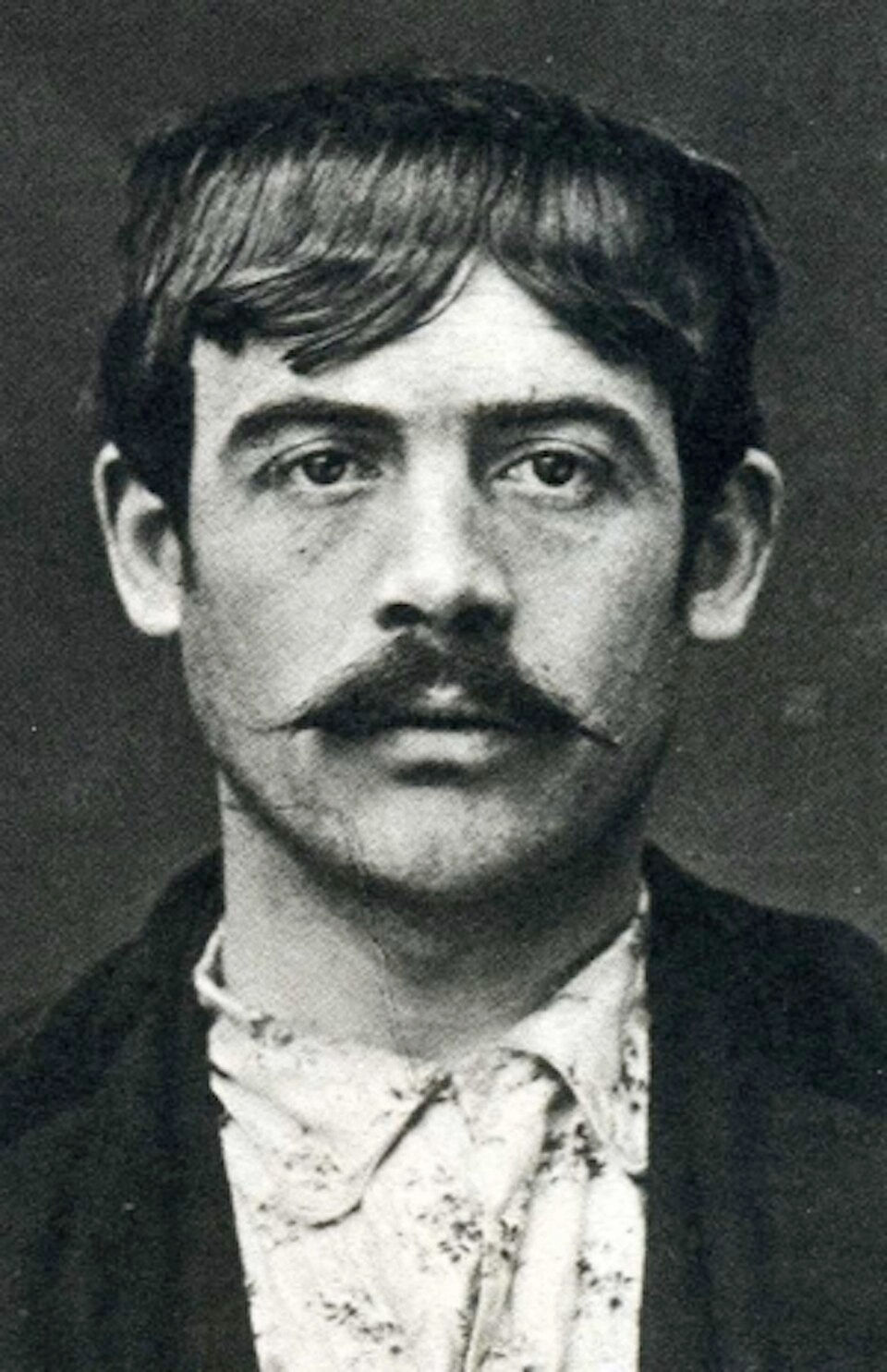
The press had been following the story from the beginning, and by the time the case came to trial in May 1902, Paris was transfixed. Crowds gathered outside the courtroom trying to get in. Newspapers including Le Petit Journal ran detailed daily coverage, complete with descriptions of the men's appearance, their tattoos, their Apache affiliations, and the woman at the centre of it all. Élie herself was described in terms that mixed fascination with barely concealed moral condemnation: beautiful, manipulative, the kind of woman men couldn't resist and couldn't control.
The Trial and the Code That Broke
When Élie testified, she broke with the Apache code of silence. She revealed names, details, and information about the gang's operations that the underworld had expected to stay buried. For many in the Apache world, this was an unforgivable betrayal. For the newspapers and the public following the case, it made her simultaneously more sympathetic and more sensational: a woman who had navigated a brutal world on her own terms and was now, under oath, saying what she knew.
The verdicts were severe. Manda claimed crimes of passion and was sentenced to a lifetime of forced labour in the penal colonies. Leca was sentenced to eight years in a penal colony. Both men were effectively removed from Parisian life permanently.
Élie emerged from the trial famous. Portrait painters approached her. Theatre producers wanted her in their shows. She wrote an account of her experiences for Fin de Siècle, a journal of the period, which was later published in its entirety by a historian. The fame was intense but brief. Celebrity in 1902 had a short half-life, and Élie had no particular means of sustaining it. She made some money from the attention and then, gradually, the spotlight moved elsewhere.

After the Fame
The later years of Élie's life were quiet by comparison. On 17 January 1917, nearly fifteen years after the trial that had made her name, she married André Alexandre Nardin, a shoemaker twenty years her junior. Nardin was 23. Élie was nearly 40. He had four children from a previous relationship, and Élie helped raise them. The couple lived modestly in Paris on Nardin's small income.
She died on 6 April 1933, aged 55, from an unstated illness. She'd never left Paris. The city that had made her infamous had also simply absorbed her back into its working-class fabric, as if the trial, the newspapers, and the two men sent to the colonies on her account had been someone else's story entirely.
Casque d'Or: The Film
Nineteen years after her death, Élie's story was turned into a film. Casque d'Or, directed by Jacques Becker and released in 1952, stars Simone Signoret as Marie, the character based on Élie, and Serge Reggiani as Manda. The film compresses and fictionalises the story considerably: the character of Leca is recast as the leader of the gang rather than a rival, the romance between Marie and Manda is given greater weight and tragedy than the historical record supports, and many of the period's grittier details are smoothed over in favour of a more cinematic love story.
None of which diminished the film's reputation. Casque d'Or is now regarded as one of the finest French films of the postwar era, a masterpiece of atmosphere and restraint. Signoret won a BAFTA for her performance. The film failed at the box office on its original release, was pulled after two weeks, and was then rediscovered by critics who recognised it as something exceptional. It's been on the Criterion Collection and cited regularly in surveys of the greatest films ever made.

Amélie Élie died in obscurity, a widow in a quiet Paris flat, with nothing to suggest that the story of her youth would eventually become a celebrated piece of French cinema. She'd been a teenage runaway, a gigolette, a woman who survived several violent and controlling men, and then a briefly famous face in the newspapers. The hair that gave her the nickname had gone white long before the end. The city had moved on. She'd just lived in it.
Sources
1. Wikipedia: Amélie Élie – https://en.wikipedia.org/wiki/Am%C3%A9lie_%C3%89lie
2. Wikipedia: Apaches (subculture) – https://en.wikipedia.org/wiki/Apaches_(subculture)
3. RetroNews / BnF: Casque d'Or, légendaire fille de joie des Apaches – https://www.retronews.fr/justice/long-format/2018/05/15/casque-dor-legendaire-fille-de-joie-des-apaches
4. Gallica / BnF: Casque d'Or et les Apaches – https://gallica.bnf.fr/accueil/fr/html/casque-dor-et-les-apaches
5. Gang de Paris: L'Histoire de Casque d'Or – https://gangdeparis.com/blogs/articles/lhistoire-de-casque-dor-partie-2
6. Lucy Sante, The Other Paris (Farrar, Straus & Giroux, 2015)
7. Jérôme Beauchez, 'The Iconic Apache: Early 1900s Paris and the Making of a Criminal Bogeyman', The British Journal of Criminology, 2024
8. Criterion Collection: Philip Kemp, 'Casque d'or: Tenderness and Violence' – https://www.criterion.com/current/posts/679-casque-d-or-tenderness-and-violence
9. Bonjour Paris: The Dandy Criminals who Terrorized Paris – https://bonjourparis.com/history/the-dandy-criminals-who-terrorized-paris/


