


The Capture and Execution of Ned Kelly: From Glenrowan to the Gallows

Ned Kelly's last stand should've been a massacre. He'd planned to wreck a train full of police, then pick off the survivors. Instead, a schoolteacher with a candle and a red scarf ruined everything, and within five months Australia's most wanted man was dangling from a rope in Melbourne.
This is the story of how it all went wrong for the Kelly Gang, from a sleepless night in a country pub to a 25-minute jury, a petition with tens of thousands of names and a headless skeleton that didn't get a proper burial until 2013.
Quick Answers
When was Ned Kelly captured? On the morning of 28 June 1880, at the end of the siege of Glenrowan in north-east Victoria.
How was he caught? Police shot at his unprotected legs until he fell. His armour stopped every bullet that hit it.
What was he convicted of? The murder of Constable Thomas Lonigan at Stringybark Creek in October 1878.
When was Ned Kelly hanged? At 10am on 11 November 1880, inside Old Melbourne Gaol. He was 25.
Where's he buried now? Greta Cemetery in Victoria, next to his mother. His skull has never been found.

The Plan That Went Off the Rails
By the middle of 1880 the Kelly Gang had been outlaws for almost two years. Ned, his younger brother Dan and their mates Joe Byrne and Steve Hart had killed three policemen at Stringybark Creek, robbed banks at Euroa and Jerilderie and made the Victorian police look useless at every turn.
The endgame they cooked up was brutal. On 26 June Byrne and Dan Kelly murdered Aaron Sherritt, a former friend turned police informer, near Beechworth. The idea was that news of the killing would bring a special police train racing up the line. The gang would be waiting at Glenrowan, where they'd had the rails torn up, ready to send it into a gully. The Indigenous trackers on board were their main targets, since they were the people most likely to hunt the gang down in the bush.
The trouble was the train didn't come. Not for hours and hours. While the gang waited, they rounded up more than 60 locals and crammed them into Ann Jones's Glenrowan Inn. There was drinking, there was dancing and by the second night the four outlaws were running on empty.
The Schoolteacher Who Stopped the Train
One of the hostages was Thomas Curnow, the 25-year-old head teacher at the local state school. Curnow played the loyal sympathiser, chatted with the gang and kept asking to take his sick wife home. Late on 27 June, a knackered Ned Kelly finally agreed.
Curnow got his family home, then grabbed a candle and his sister's red scarf and ran to the line. When the pilot engine came through in the early hours, he stood on the tracks holding the scarf in front of the flame as a makeshift danger signal. The train stopped. He later said he'd only done it "to save the lives of the people on the train", but he knew exactly what it'd cost him in a district full of Kelly sympathisers. He spent the rest of his life away from Glenrowan and died in Ballarat in 1922.
Back at the inn, it dawned on the gang that they'd been rumbled. Police poured off the train and surrounded the building, and the shooting started almost straight away. Superintendent Francis Hare took a bullet to the wrist in the opening exchange and had to hand over command.
Iron Men and Bullets
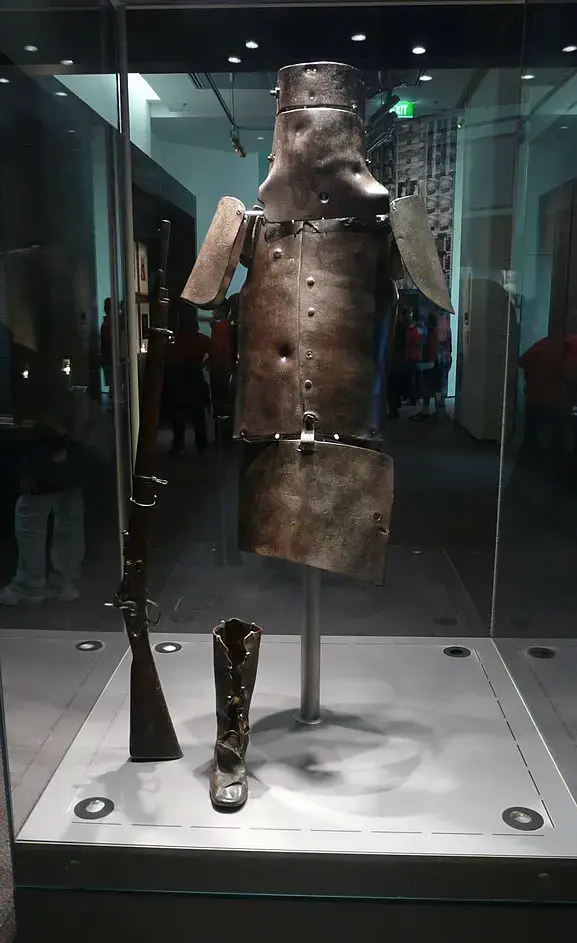
This is the bit everyone knows. The gang had spent months putting together suits of armour hammered out of plough mouldboards, some bought, some donated by friendly farmers and a few simply nicked. Ned's own suit weighed about 44kg, and bullets bounced straight off it.
What the armour didn't do was help them move. Byrne apparently saw the problem coming, and one constable later swore he heard him grumble to Ned, "I always said this bloody armour would bring us to grief". A few hours into the siege Byrne was standing at the bar when a bullet caught him in the groin, one of the few places the iron didn't cover. He bled to death on the floor.
The hostages had it worst. They were stuck between four armed outlaws and a ring of police firing blindly into a weatherboard pub. Several were hit, and 13-year-old Johnny Jones, the innkeeper's son, died of his wounds.
Ned's Last Stand
Ned had slipped out of the inn during the night, wounded in the arm and foot. He could've kept going. Instead, at first light, he came back.
Out of the morning mist walked a tall figure in a long coat with a bucket-shaped iron helmet where its head should be. Police fired and the rounds simply clanged off. To the men in the trees it must have looked like something out of a nightmare as Ned plodded towards the inn, firing his revolver as he went.
Sergeant Arthur Steele worked out what everyone else had missed. He aimed low, at the only bits of Ned that weren't covered. Shotgun blasts tore into Kelly's legs and he went down, crying out "I am done, I am done" as Steele and several others piled on top of him. The Argus counted six wounds in his foot, legs, hand, arm and groin. Not one bullet had got through the armour.
He was carried to the stationmaster's office, where Dr Nicholson from Benalla dressed his wounds. Plenty of people thought he wouldn't live long enough to hang.
Fire at the Glenrowan Inn
Dan Kelly and Steve Hart were still inside with the remaining hostages. After about 12 hours of stalemate, Superintendent John Sadleir decided to burn them out. Police gave a final warning, and roughly 25 people stumbled out with their hands in the air.

At around 2:50pm, Senior Constable Charles Johnston crept up and set the building alight with burning straw. Nobody came out. Father Matthew Gibney, a Catholic priest who'd come up from Melbourne, ran into the blazing inn to give the last rites and found Dan Kelly and Steve Hart already dead, lying side by side. Whether they'd been shot, died by their own hands or simply choked on the smoke has been argued about ever since.
By the end of the day three of the gang were dead and the fourth was in custody. The Kelly outbreak was over.
Two Days in Court
Ned was patched up and taken to Melbourne, where his mother Ellen was already locked up in the same gaol. She was serving three years over the 1878 Fitzpatrick incident, the scuffle with a police constable at the Kelly home that had kicked the whole saga off in the first place.
His defence got off to a rocky start. The experienced barrister Hickman Molesworth held the murder brief until 15 October, less than two weeks before the trial, then dropped out. The job landed on a junior barrister, Henry Bindon, who had almost no time to prepare.

The trial opened on 28 October 1880 at the Central Criminal Court on Russell Street. Kelly was charged with murdering Constable Thomas Lonigan at Stringybark Creek. His lawyers told him not to go into the witness box, and he grumbled afterwards that he could've cleared his name if they'd let him question the witnesses himself. The jury took 25 minutes to find him guilty.
There's no official transcript, so everything we know comes from the reporters in the room. What they recorded was one of the strangest sentencing hearings in Australian legal history, with Kelly arguing back and forth with the judge, Sir Redmond Barry, as if the two of them were having a row in a pub.
"I Will See You There Where I Go"
Barry was the same judge who'd sentenced Ellen Kelly two years earlier, and there's a long-running story that he told her he'd have given Ned 15 years if he'd been in the dock too. If true, it'd be a glaring reason for Barry to step aside. An article in the State Library's La Trobe Journal argued the story isn't soundly based, and nobody at the time applied to have Barry removed.
Either way, the two men clearly couldn't stand each other. When Barry finished passing the death sentence with the customary request for the Lord to have mercy on Kelly's soul, Ned shot back that he'd go a little further and said "I will see you there where I go".
It's hard to read that line now without a shiver, because Barry died on 23 November 1880, twelve days after Kelly was hanged. Doctors put it down to congestion of the lungs and an infected carbuncle on his neck. Barry was 67 and had been unwell, so the "Kelly curse" is almost certainly a coincidence. It's a cracking coincidence though.
The Fight to Save Ned Kelly
The verdict didn't end things. If anything, it lit a fire. On 4 November the Executive Council met and set the execution date, and Kelly's supporters went into overdrive. The Gaunson brothers David and William ran the campaign, with Kelly's sister Kate right alongside them.
A meeting at the Hippodrome in Melbourne drew around 6,000 people. A petition asking the Governor for a reprieve gathered 32,424 signatures in a matter of days, and William Gaunson later claimed the real total had passed 40,000. Crowds gathered on the Treasury steps and outside government offices on Spring Street.
The establishment wasn't having any of it. Victoria's newspapers lined up to condemn the reprieve movement as an embarrassment to the colony. The Argus sneered in an editorial that Jack Sheppard and Dick Turpin were still heroes to the rougher end of the theatre crowd, and Kelly's fans were no better. Chief Secretary Graham Berry wouldn't budge. The date stood.
The Last Days in the Condemned Cell
Ned spent his final days writing to the authorities and receiving family. Ellen was allowed out of her own cell to see her son one last time, and the line that's come down from that visit is pure Kelly. She's said to have told him "mind you die like a Kelly".
The day before the execution, Ned asked to have his photograph taken so it could be handed round to his friends. That picture, of a gaunt and heavily bearded young man in chains, is the one most people picture when they think of him.
11 November 1880: The Hanging
At 10am on Thursday 11 November, Kelly was led out of a holding cell next to the gallows inside Old Melbourne Gaol. His arms were pinned with a heavy leather strap and a white hood sat folded back on his forehead. About 20 magistrates, doctors and reporters watched.
The hangman wasn't a professional at all. He was Elijah Upjohn, an elderly, grey-haired prisoner who was doing time for larceny. Upjohn put the noose round Kelly's neck, pulled the hood down over his face and the trapdoor dropped.

Then there are the famous last words. Everyone knows them as "Such is life", and they've ended up on T-shirts, tattoos and pub signs all over Australia. The trouble is that most of the people actually standing on the gaol floor didn't hear that at all. Their reports had him saying something closer to "Ah well, I suppose it has come to this". A 2016 paper by historian S. E. Dawson went further and argued "such is life" was very likely made up by a journalist. Such is life, eh?
Death Masks and Phrenology
Ned's body wasn't left in peace even for an hour. Officials shaved off his hair and beard and took a plaster cast of his head and face, which was standard practice for executed criminals at the time. Victorians were obsessed with phrenology, the junk science that claimed you could read a person's character from the bumps on their skull.
The very next day a copy of the mask went on display at Maximilian Kreitmayer's waxworks on Bourke Street, complete with explanations of how the shape of Kelly's head supposedly proved he was born bad. As a condemned man his body was handed over for dissection before what was left of it went into an unmarked grave inside the gaol walls.

Ned Kelly's Very Long Journey to the Grave
That should've been the end, but Ned Kelly turned out to be far harder to bury than he was to hang.
When Old Melbourne Gaol closed in 1929, workmen dug up the prisoners' graves to move the remains to Pentridge Prison. Onlookers helped themselves to bones as souvenirs, including a skull everyone assumed was Ned's. Another skull ended up on display at the old gaol until somebody stole it from its glass cabinet in 1978.
That stolen skull resurfaced in 2009, and it kicked off a proper forensic hunt. Archaeologists had already found a mass grave on the Pentridge site, and scientists at the Victorian Institute of Forensic Medicine spent around 20 months working through the jumbled skeletons. On 1 September 2011 they announced they'd found Ned, identified using DNA from his great-great nephew. The skull, embarrassingly, wasn't his after all. Only a fragment of his own skull was with the skeleton.
There was one more twist. The developer turning Pentridge into housing laid claim to the remains and hoped to keep them on site, until the Victorian Government issued a fresh exhumation licence in August 2012 that sent them back to the family.
On 20 January 2013, more than 132 years after he was hanged, Ned Kelly was finally buried in consecrated ground at Greta Cemetery, next to his mother Ellen. The family had the grave sealed in concrete, which tells you plenty about how much they trusted souvenir hunters. His skull is still out there somewhere. If you think that sounds familiar, the American outlaw Big Nose George Parrott had an even grislier afterlife.
The Armour Ended Up in the Judge's Room
Here's a final bit of irony. After Glenrowan, police officers carried off chunks of the gang's armour as souvenirs, and for decades nobody was quite sure which suit was which. It wasn't until 2001 that research by Allison Holland showed the set at the State Library of Victoria, long labelled as Steve Hart's, was actually Ned's.
Both shoulder plates have since been reunited with it, and today Ned Kelly's armour stands in the Redmond Barry Reading Room. That's the room named after the judge who sentenced him to death. Barry founded the library, so it makes sense, but you can't help thinking Ned would've enjoyed having the last word.
If you're after more stories of the rope, have a look at Minnie Dean, the only woman ever hanged in New Zealand, who went to the gallows just 15 years after Kelly.
Suggested Reading
Want to dig deeper into the Kelly story? These are worth a look.
Ned Kelly: A Short Life by Ian Jones. Still the go-to biography. Jones spent decades on the Kelly story and it shows.
Ned Kelly by Peter FitzSimons. A big, pacy telling of the whole saga, with Glenrowan and the trial in full colour.
True History of the Kelly Gang by Peter Carey. The Booker-winning novel written in Ned's own voice, inspired by the Jerilderie Letter.
As an Amazon Associate, Utterly Interesting earns from qualifying purchases.
You Might Also Like
Sources
The Last Stand of the Kelly Gang: Sites in Glenrowan, Victorian Collections
Thomas Curnow, KellyGang
Ned Kelly's armour, State Library Victoria
Ned Kelly armour, National Film and Sound Archive of Australia
The Argus, 8 July 1880: capture of Ned Kelly, KellyGang (transcription)
Sir Redmond Barry and the Kelly trials, La Trobe Journal, State Library Victoria
Ned Kelly: trial and execution, State Library Victoria
The Sentence on Ned Kelly, Nelson Evening Mail, 10 November 1880 (Papers Past)
Irish bushrangers and beyond, National Museum of Australia
Latest Australian News, Manawatu Times, 17 November 1880 (Papers Past)
Ned Kelly's End, KellyGang
The Argus, 8 November 1880: editorial, KellyGang (transcription)
Who Was Ned Kelly?, History Hit
The Execution (1880), The Express & Telegraph, Adelaide, 11 November 1880 (via Australian Culture)
Kelly, Edward (Ned) (1855–1880), Australian Dictionary of Biography
Ned Kelly information sheet, State Library Victoria
Ned Kelly's remains handed back to family, Otago Daily Times
Outlaw Ned Kelly's remains finally identified in Australia, IrishCentral
Remains of outlaw Ned Kelly identified, The Irish Times
Ned Kelly's remains to go to family, not developers, The History Blog
After DNA testing confirmed the bones, Australian outlaw Ned Kelly buried in cement, Artdaily / Agence France-Presse


